

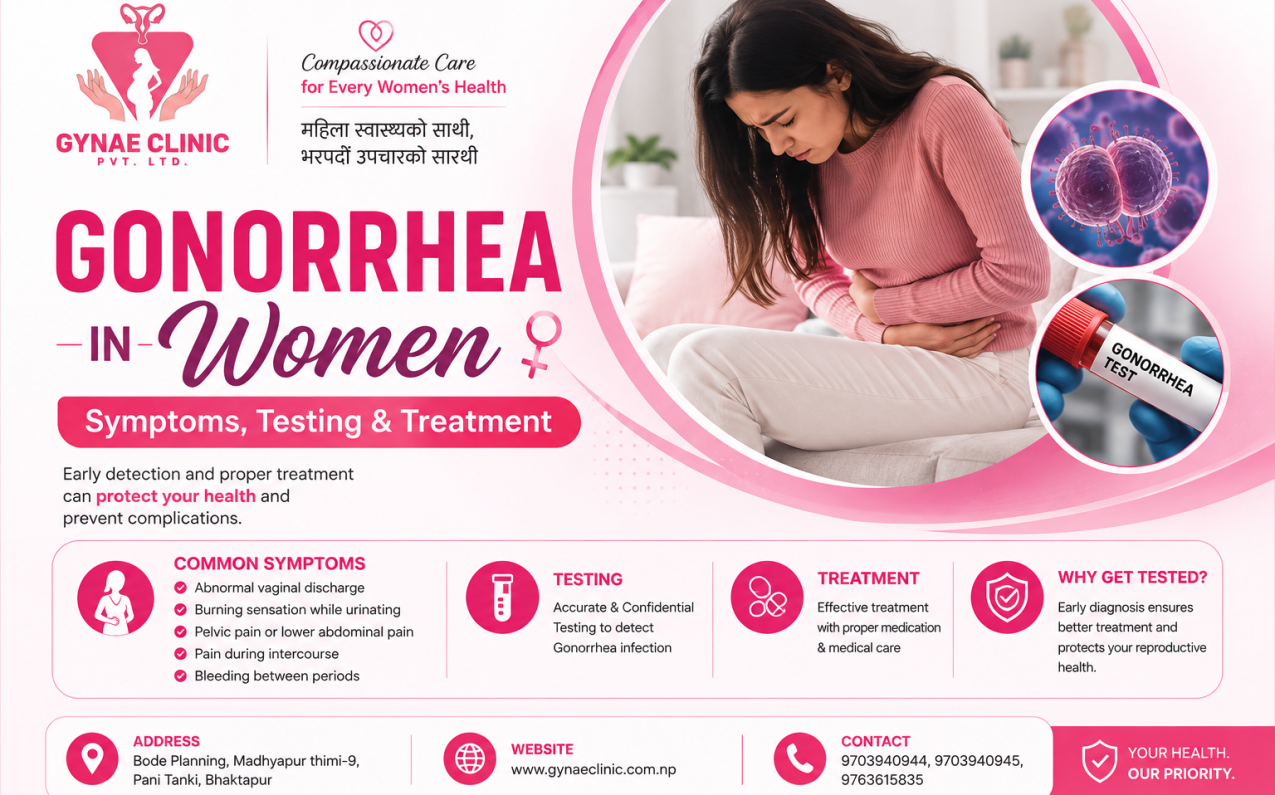
Gonorrhea in women can be difficult to recognize because many women have no obvious symptoms. When symptoms do occur, they may look like a urinary or vaginal problem—such as burning while urinating, unusual vaginal discharge, bleeding between periods or after sex, or pelvic discomfort. Without appropriate diagnosis and treatment, gonorrhea can cause pelvic inflammatory disease (PID), infertility, and ectopic pregnancy.
At Gynae Clinic Pvt. Ltd., Bode Planning, Madhyapur Thimi-9, Bhaktapur, women can receive confidential gynecological and STI evaluation, including appropriate gonorrhea testing and treatment guidance with a Gynecologist and Venerologist.
What Is Gonorrhea in Women?
Gonorrhea is a sexually transmitted infection caused by the bacterium Neisseria gonorrhoeae.
It can be transmitted through:
- Vaginal sex
- Oral sex
- Anal sex
The infection can affect the cervix, urethra, rectum, and throat. Throat and rectal infections can be completely asymptomatic.
Gonorrhea is curable with appropriate antibiotics, but increasing antimicrobial resistance makes correct diagnosis and medically guided treatment especially important.
Gonorrhea Symptoms in Women
One of the most important facts about gonorrhea is that many women do not notice symptoms.
When symptoms occur, they may include:
1. Abnormal Vaginal Discharge
You may notice:
- More discharge than usual
- A change in the appearance of discharge
- Unusual vaginal secretions
However, vaginal discharge is not specific to gonorrhea. It can also occur with chlamydia, bacterial vaginosis, trichomoniasis, yeast infection, and other conditions.
2. Burning While Urinating
Gonorrhea can cause pain or burning during urination.
Because a UTI can cause similar symptoms, women sometimes assume the problem is a urinary infection when an STI may actually be involved.
3. Bleeding Between Periods
Gonorrhea can cause inflammation of the cervix and may result in unexpected bleeding between menstrual periods.
4. Bleeding After Sex
Cervical inflammation can sometimes cause bleeding during or after intercourse.
Repeated bleeding after sex should always be evaluated rather than automatically attributed to an STI.
5. Pelvic or Lower Abdominal Pain
Pelvic or lower abdominal discomfort can occur, particularly when gonorrhea contributes to pelvic inflammatory disease (PID).
6. Pain During Sex
Pain during intercourse may occur with cervical or pelvic inflammation.
Persistent or newly developed pain during sex deserves professional evaluation.
Can a Woman Have Gonorrhea Without Symptoms?
Yes.
Many women with gonorrhea have no noticeable symptoms or may have symptoms so mild that they are overlooked.
This means:
No symptoms does not necessarily mean no infection.
A person can potentially transmit gonorrhea without knowing that they have it.
Testing can therefore be important after a relevant sexual exposure or when a healthcare professional considers STI testing appropriate.
How Is Gonorrhea Transmitted?
Gonorrhea is primarily transmitted through sexual contact with an infected person.
Transmission can occur through:
- Vaginal intercourse
- Anal intercourse
- Oral sex
A person does not need to have obvious symptoms to transmit the infection.
Who Should Consider Gonorrhea Testing?
Talk to a healthcare professional about testing if you have:
- A new sexual partner
- Unprotected sex
- A partner diagnosed with gonorrhea
- A partner diagnosed with another STI
- A possible STI exposure
- Unusual vaginal discharge
- Burning urination
- Pelvic pain
- Pain during sex
- Bleeding between periods
- Bleeding after sex
- Rectal symptoms after anal exposure
- Throat symptoms following oral sexual exposure
Testing decisions should be individualized according to symptoms, sexual history, pregnancy status, and the anatomical sites potentially exposed.
Gonorrhea Testing in Women
Testing is the best way to determine whether gonorrhea is present.
WHO identifies molecular tests as the gold-standard diagnostic approach for N. gonorrhoeae. Depending on the clinical situation, samples can be collected from the genital tract and, when indicated, the throat or rectum.
Possible specimens include:
- Vaginal swab
- Cervical sample
- Urine
- Rectal swab
- Throat swab
For women, swab-based testing may be appropriate depending on the site of infection and clinical circumstances.
Important:
If you have had oral or anal sexual exposure, tell your doctor.
A genital test alone may not identify an infection located in the throat or rectum.
Gonorrhea PCR / Molecular Test
A molecular test can detect genetic material from Neisseria gonorrhoeae.
This can be particularly useful because gonorrhea may cause few or no symptoms.
At Gynae Clinic Pvt. Ltd., patients can discuss appropriate STI testing with a Gynecologist and Venerologist, based on their symptoms and exposure history.
Gonorrhea vs UTI in Women
Gonorrhea and urinary tract infections can produce similar symptoms.
| Symptom | Gonorrhea | UTI |
|---|---|---|
| Burning urination | Possible | Common |
| Urinary frequency | Possible | Common |
| Vaginal discharge | Possible | Usually not typical |
| Pelvic discomfort | Possible | Possible |
| STI | Yes | No |
| Requires STI assessment | When suspected | Usually no |
If burning urination occurs after a possible sexual exposure, don’t automatically assume it is a UTI.
Appropriate testing can help identify the cause.
Gonorrhea vs Chlamydia
Gonorrhea and chlamydia are different bacterial STIs, but their symptoms can overlap.
Both may cause:
- Abnormal discharge
- Burning urination
- Pelvic pain
- Pain during sex
- Abnormal bleeding
- No symptoms at all
Because the infections can occur together, a clinician may recommend testing for both gonorrhea and chlamydia when appropriate.
Can Gonorrhea Cause Pelvic Inflammatory Disease?
Yes.
Untreated gonorrhea can spread upward from the cervix and contribute to pelvic inflammatory disease (PID).
PID can involve the:
- Uterus
- Fallopian tubes
- Ovaries
- Surrounding pelvic tissues
Possible symptoms include:
- Lower abdominal pain
- Pelvic pain
- Pain during intercourse
- Abnormal discharge
- Abnormal bleeding
- Fever
PID requires prompt medical attention because reproductive-tract damage can occur.
Can Gonorrhea Cause Infertility?
Yes.
One of the major concerns with untreated gonorrhea in women is reproductive-tract damage.
Gonorrhea can contribute to PID, which may damage the fallopian tubes.
Potential complications include:
- Infertility
- Ectopic pregnancy
- Chronic pelvic pain
- Tubal damage
WHO specifically identifies PID, ectopic pregnancy, and infertility among complications of untreated gonorrhea in women.
Early diagnosis matters.
Can Gonorrhea Cause Infertility Without Severe Symptoms?
Unfortunately, yes.
A woman may have an infection without significant symptoms and still develop complications.
This is one reason STI testing can be important when there has been a relevant exposure.
Can Gonorrhea Cause Vaginal Odor?
Gonorrhea is not diagnosed by vaginal odor.
A strong or fishy vaginal odor is more commonly associated with conditions such as bacterial vaginosis, although other infections can alter discharge and odor.
If odor occurs together with:
- Abnormal discharge
- Pelvic pain
- Burning urination
- Bleeding
- Pain during sex
- Possible STI exposure
a professional evaluation is appropriate.
Can Gonorrhea Cause Bleeding After Sex?
Yes.
Gonorrhea can cause cervical inflammation, which may contribute to bleeding during or after sexual intercourse.
However, postcoital bleeding has several possible causes, including cervical conditions, infections, hormonal causes, and other gynecological problems.
Repeated bleeding after sex should be assessed by a gynecologist.
Can Gonorrhea Affect the Throat?
Yes.
Gonorrhea can infect the throat following oral sexual exposure.
Throat gonorrhea is often asymptomatic.
When symptoms occur, they may resemble a sore throat.
If oral exposure is relevant, tell your doctor so the appropriate testing site can be considered.
Can Gonorrhea Affect the Rectum?
Yes.
Rectal gonorrhea may cause:
- Rectal discharge
- Itching
- Soreness
- Bleeding
- Painful bowel movements
Some rectal infections may have no symptoms.
Gonorrhea During Pregnancy
Gonorrhea during pregnancy requires medical evaluation.
An infected mother can transmit gonorrhea to her baby during childbirth, potentially causing serious eye infection in the newborn.
If you are pregnant and concerned about:
- A possible STI exposure
- Abnormal vaginal discharge
- Burning urination
- Pelvic pain
- A partner with gonorrhea
speak with your gynecologist promptly.
Do not self-medicate with antibiotics during pregnancy.
Gonorrhea Treatment in Women
Gonorrhea is curable with appropriate antibiotic treatment.
However, treatment should be prescribed by a qualified clinician because antimicrobial resistance in gonorrhea is a major global concern. WHO reports increasing resistance to multiple antibiotic classes.
Current WHO guidance identifies ceftriaxone as the preferred treatment in many settings, while the exact regimen should be determined by the treating clinician according to current guidelines, infection site, pregnancy status, allergies, local resistance patterns, and other clinical factors.
Do not self-treat gonorrhea.
Avoid:
- Leftover antibiotics
- Antibiotics prescribed for someone else
- Incomplete courses
- Random combinations of antibiotics
Incorrect treatment can fail to clear infection and may contribute to antimicrobial resistance.
What Happens After a Positive Gonorrhea Test?
If your test is positive, your doctor will discuss:
- The test result.
- Appropriate antibiotic treatment.
- Whether chlamydia or other STI testing is needed.
- Whether your sexual partner(s) should be evaluated.
- When sexual activity can safely resume.
- Whether follow-up or a test of cure is needed in your particular situation.
WHO recommends partner notification and management as an important part of STI control.
Can Gonorrhea Come Back After Treatment?
Yes.
Treatment can cure the current infection, but it does not provide immunity against future gonorrhea.
Reinfection can occur through:
- An untreated partner
- A new infected partner
- A new sexual exposure
Partner evaluation and treatment are therefore important when indicated.
Gonorrhea and Other STI Testing
If gonorrhea is suspected or confirmed, your doctor may recommend evaluation for other STIs depending on your symptoms and exposure.
This may include:
- Chlamydia
- Syphilis
- HIV
- Trichomoniasis
- Other infections when clinically appropriate
WHO notes that gonorrhea testing is often coupled with testing for other STIs.
When Should a Woman See a Gynecologist?
Seek professional evaluation if you experience:
- Abnormal vaginal discharge
- Burning while urinating
- Pelvic or lower abdominal pain
- Pain during sex
- Bleeding after sex
- Bleeding between periods
- Rectal symptoms
- Possible STI exposure
- A partner diagnosed with gonorrhea
- Recurrent vaginal or urinary symptoms
Seek urgent medical care
Get prompt medical attention for severe pelvic pain, fever, fainting, heavy bleeding, severe weakness, or symptoms during a possible pregnancy.
Gonorrhea in Women: Why Early Testing Matters
Gonorrhea can be silent, but the absence of symptoms does not guarantee that the infection is absent.
A simple symptom such as burning urination may represent a UTI, chlamydia, gonorrhea, or another condition.
Likewise, abnormal discharge may have many different causes.
The better approach is:
Possible exposure → Clinical evaluation → Appropriate STI testing → Correct diagnosis → Appropriate treatment
Confidential Gonorrhea & Women’s STI Care in Bhaktapur
At Gynae Clinic Pvt. Ltd., we provide confidential evaluation for women concerned about gonorrhea, chlamydia, vaginal discharge, pelvic pain, burning urination, abnormal bleeding, and other STI-related symptoms.
Our clinic provides access to a Gynecologist and Venerologist for professional sexual-health and gynecological evaluation.
Gynae Clinic Pvt. Ltd.
📍 Bode Planning, Madhyapur Thimi-9, Bhaktapur, Nepal
📞 9703940944
📞 9703940945
📞 9763615835
Our STI & Gynecological Care Includes:
- Gonorrhea testing
- Chlamydia PCR testing
- STI testing and consultation
- Venerology consultation
- Gynecology consultation
- Pelvic pain evaluation
- Abnormal vaginal discharge evaluation
- Burning urination evaluation
- Abnormal bleeding evaluation
- Pain during intercourse evaluation
- Sexual-health consultation
- Women’s reproductive-health care
Concerned About Gonorrhea?
Don’t rely on symptoms alone. Get appropriate testing and professional medical advice.
Gynae Clinic Pvt. Ltd. — Confidential STI & Women’s Healthcare in Madhyapur Thimi, Bhaktapur.
Frequently Asked Questions
What are the symptoms of gonorrhea in women?
Many women have no symptoms. When symptoms occur, they can include vaginal discharge, burning urination, bleeding between periods or after sex, and pelvic symptoms.
Can gonorrhea be completely cured?
Yes. Gonorrhea is curable with appropriate antibiotics, although antibiotic resistance makes professional diagnosis and treatment important.
Can gonorrhea cause infertility in women?
Yes. Untreated gonorrhea can cause PID and reproductive-tract damage, increasing the risk of infertility and ectopic pregnancy.
Can I have gonorrhea without symptoms?
Yes. Many women with gonorrhea have no noticeable symptoms.
Can gonorrhea look like a UTI?
Yes. Burning during urination can occur with both gonorrhea and a UTI. Testing may be needed when an STI is possible.
Can gonorrhea and chlamydia occur together?
Yes. Because symptoms overlap and co-infection can occur, clinicians may recommend testing for both.
Does gonorrhea affect pregnancy?
Gonorrhea can be transmitted from an infected mother to her baby during childbirth and can cause neonatal eye infection. Pregnant women with possible exposure should seek medical evaluation.
Should my sexual partner be tested?
If gonorrhea is diagnosed, current and recent sexual partners may need evaluation and treatment to reduce transmission and reinfection.
Author; Gynae Clinic Pvt. Ltd.
Medical note: This article is for education and does not replace an individual medical examination. Gonorrhea treatment should follow current professional guidance because antimicrobial resistance is an important concern.