

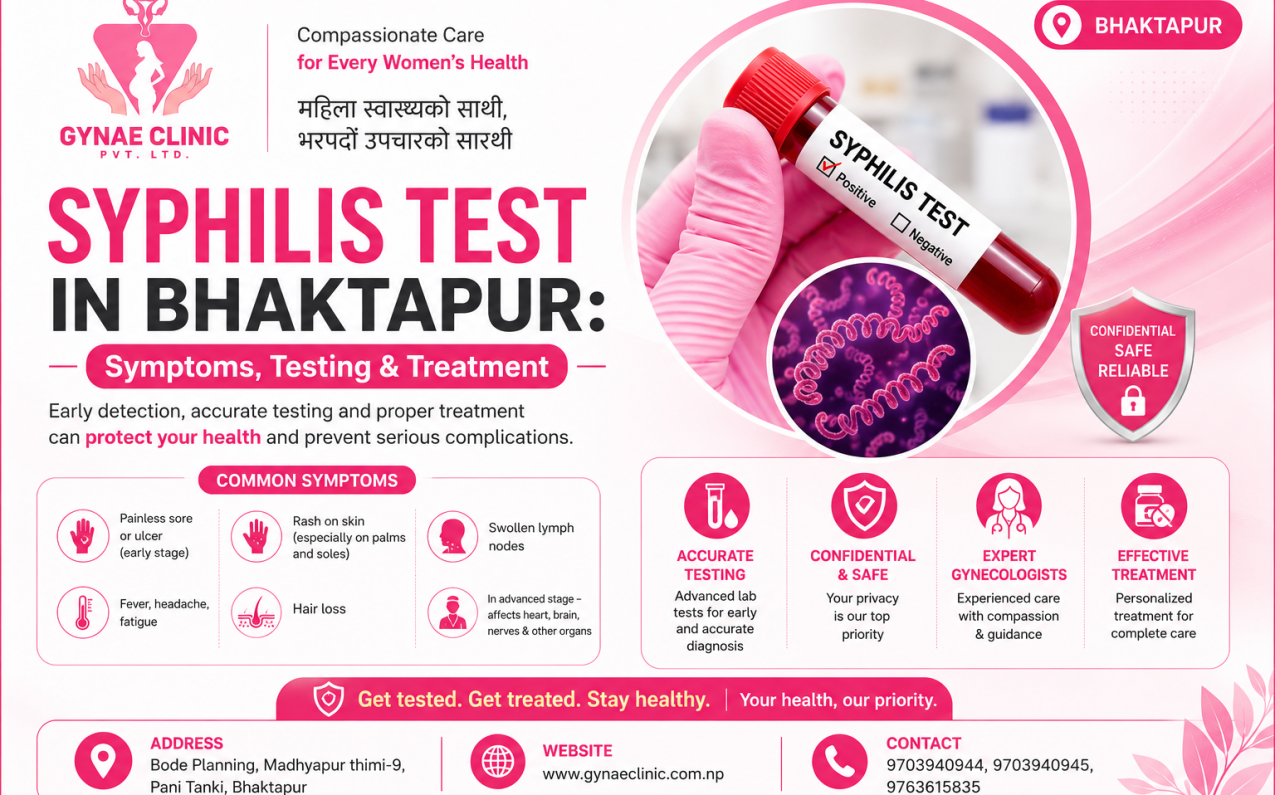
Looking for a syphilis test in Bhaktapur? Syphilis is a sexually transmitted infection (STI) caused by the bacterium Treponema pallidum. It can progress through different stages, and symptoms may disappear even though the infection remains in the body. This makes appropriate testing especially important after a possible exposure or when symptoms suggest syphilis.
At Gynae Clinic Pvt. Ltd., Bode Planning, Madhyapur Thimi-9, Bhaktapur, patients can receive confidential STI evaluation with Gynecologist and Venerologist consultation.
What Is Syphilis?
Syphilis is a bacterial STI caused by Treponema pallidum. It is primarily transmitted through direct contact with an infectious syphilis lesion during sexual contact.
Syphilis can affect the:
- Genitals
- Vagina
- Cervix
- Anus
- Rectum
- Mouth
- Throat
- Skin
- Nervous system
- Cardiovascular system
One of the major challenges is that syphilis can be present without obvious symptoms. Untreated infection can remain latent for years and may eventually cause serious complications.
Syphilis Symptoms in Women
Syphilis develops in stages. The symptoms can vary considerably from one person to another.
1. Primary Syphilis: A Painless Sore
The first noticeable sign may be a painless sore called a chancre.
It can develop at the location where the bacteria entered the body, including:
- Vulva
- Vagina
- Cervix
- Anus
- Rectum
- Mouth
- Throat
The sore may be easy to miss, particularly when it occurs inside the vagina or on the cervix.
Importantly, the sore can heal on its own even without treatment. Healing does not mean the infection has disappeared.
2. Secondary Syphilis: Rash and Other Symptoms
If primary syphilis is not treated, the infection can progress to secondary syphilis.
Possible symptoms include:
- Skin rash
- Rash involving the palms of the hands
- Rash involving the soles of the feet
- Swollen lymph nodes
- Fever
- Fatigue
- Headache
- Sore throat
- Muscle aches
- Hair loss in some cases
- Moist or raised lesions around the genital or anal area
The rash can be mild and may resemble other skin conditions.
A common misconception
Syphilis rash does not always itch.
A rash involving the palms and soles is particularly important to discuss with a healthcare professional when an STI is possible.
3. Latent Syphilis: No Symptoms
After the early stages, syphilis can enter a latent stage.
During latent syphilis:
There may be no visible symptoms at all.
A person can feel completely healthy while infection remains present.
This is one reason laboratory testing is so important.
4. Late Syphilis
Without treatment, syphilis can eventually cause serious complications affecting multiple organs.
Possible complications include:
- Neurological disease
- Cardiovascular disease
- Problems affecting the eyes
- Other long-term organ damage
These complications can occur years or even decades after the initial infection.
Can You Have Syphilis Without Symptoms?
Yes.
Syphilis can be completely asymptomatic, particularly during the latent stage.
Therefore:
No sore + no rash + no symptoms does not necessarily mean no syphilis.
If you have had a possible exposure, appropriate testing can be much more reliable than waiting for symptoms.
Who Should Consider a Syphilis Test?
Consider discussing syphilis testing with a qualified healthcare professional if you have:
- Had unprotected sexual contact
- A new sexual partner
- Multiple sexual partners
- A partner diagnosed with syphilis
- A partner diagnosed with another STI
- A possible STI exposure
- An unexplained genital sore
- A painless genital ulcer
- An unexplained rash
- A rash on the palms or soles
- Unexplained swollen lymph nodes
- Unexplained genital or anal lesions
- Symptoms suggestive of another STI
Testing recommendations depend on your individual circumstances and risk factors.
Syphilis Test in Bhaktapur
Syphilis is diagnosed primarily through laboratory testing combined with medical history and examination.
WHO describes both treponemal and non-treponemal serological tests as important tools in syphilis diagnosis.
Common blood tests include:
RPR
Rapid Plasma Reagin (RPR) is a non-treponemal test.
It can be useful for:
- Supporting diagnosis
- Assessing disease activity
- Monitoring response to treatment
VDRL
Venereal Disease Research Laboratory (VDRL) is another non-treponemal test used in syphilis evaluation.
TPHA / TPPA
These are treponemal tests that detect antibodies specifically associated with Treponema pallidum.
Other Treponemal Tests
Depending on the laboratory and clinical situation, other treponemal antibody tests or rapid tests may be used.
Why One Syphilis Test May Not Be Enough
Syphilis testing can be more complicated than simply asking whether a single test is positive or negative.
WHO recommends using appropriate combinations of treponemal and non-treponemal tests depending on the clinical and testing setting.
A positive test can also require interpretation in the context of:
- Previous syphilis treatment
- Current symptoms
- Timing of exposure
- Previous test results
- Stage of infection
Your doctor should interpret the result rather than relying on the laboratory number alone.
Can a Syphilis Test Be Negative After Recent Exposure?
Yes.
Testing too early after infection can produce a negative result because the body’s antibodies may not yet be detectable.
WHO notes that serological tests can be negative during the very early stage of primary syphilis.
If exposure was recent but suspicion remains high, your doctor may recommend repeat testing at an appropriate interval.
Can Syphilis Be Diagnosed From a Genital Sore?
Sometimes.
Direct detection methods can be used in certain settings to identify T. pallidum from a lesion, but blood-based serological testing is commonly used for syphilis diagnosis.
A genital ulcer should never be assumed to be syphilis based only on appearance.
Other causes include:
- Genital herpes
- Chancroid
- Trauma
- Other infections
- Non-infectious skin conditions
Professional evaluation is important.
Syphilis vs Herpes: What’s the Difference?
Both can cause genital sores, but their typical presentations differ.
| Feature | Syphilis | Genital Herpes |
|---|---|---|
| Typical first lesion | Often a painless chancre | Often painful blisters/ulcers |
| Pain | Chancre usually painless | Often painful |
| Cause | Bacterium | Virus |
| Blood testing | Commonly used | May be used in certain situations |
| Curable | Yes | No cure, but manageable |
| Treatment | Antibiotics | Antiviral medicines |
Appearance alone is not enough to reliably diagnose either infection.
Syphilis and Pregnancy
Syphilis testing is particularly important during pregnancy.
Untreated maternal syphilis can be transmitted to the developing baby and cause congenital syphilis, which can lead to severe pregnancy and newborn complications.
WHO emphasizes identifying and treating syphilis during pregnancy to prevent adverse pregnancy outcomes and congenital infection.
If you are pregnant and:
- Had a possible STI exposure
- Have a partner with syphilis
- Have an unexplained genital sore
- Have an unexplained rash
- Have not previously been tested
speak with your gynecologist promptly.
Is Syphilis Curable?
Yes. Syphilis is treatable and curable.
WHO recommends benzathine penicillin G as the primary treatment, with the number of doses depending on the stage and clinical circumstances.
Treatment should be determined by a qualified clinician.
Do not self-treat syphilis.
The correct treatment depends on:
- Stage of infection
- Pregnancy status
- Previous treatment
- Allergy history
- Neurological or eye symptoms
- Clinical findings
- Current medical guidelines
Syphilis Treatment in Women
For early syphilis, benzathine penicillin G injection is the standard recommended treatment in many clinical settings. Later stages may require a different dosing schedule.
Importantly, pregnancy requires special management. WHO identifies benzathine penicillin as the treatment of choice for pregnant women with syphilis because it is the treatment that prevents transmission to the fetus.
Your doctor should determine the appropriate regimen rather than using antibiotics without medical supervision.
What Happens After Syphilis Treatment?
Treatment does not simply end with the injection.
Your clinician may recommend follow-up based on:
- Stage of syphilis
- Initial RPR/VDRL level
- Treatment received
- Pregnancy status
- Symptoms
- Risk of reinfection
Non-treponemal test levels such as RPR may be useful for monitoring treatment response.
Can Syphilis Come Back After Treatment?
A person who has been successfully treated can become infected again after a new exposure.
Treatment does not provide lifelong immunity.
Therefore, preventing new exposure and ensuring appropriate partner evaluation are important.
Should Your Partner Be Tested?
Yes, when appropriate.
Sexual partners of someone diagnosed with syphilis may need evaluation, testing, and sometimes treatment depending on the timing and nature of the exposure.
Partner services are an important component of syphilis control. WHO’s updated 2024 recommendations include guidance on syphilis testing and partner services.
Can Syphilis Occur Together With Other STIs?
Yes.
A person can have more than one STI at the same time.
Depending on your history and symptoms, your doctor may recommend testing for:
- HIV
- Chlamydia
- Gonorrhea
- Hepatitis B
- Other STIs
Because STI symptoms can overlap—or be completely absent—testing should be individualized.
Syphilis and HIV
Syphilis and HIV can occur together.
If you are diagnosed with syphilis or have had a significant STI exposure, your healthcare professional may recommend HIV testing and other STI screening depending on your circumstances.
When Should You See a Venerologist or Gynecologist?
Seek professional evaluation if you have:
- A painless genital sore
- Genital or anal ulcer
- Unexplained rash
- Rash on palms or soles
- Swollen lymph nodes
- A partner diagnosed with syphilis
- A possible STI exposure
- Positive syphilis test
- Previous untreated STI
- Concerns about STI exposure during pregnancy
A Venerologist can provide specialized STI evaluation, while a Gynecologist can assess female reproductive and genital health.
Why Choose Professional Syphilis Testing?
Syphilis can be challenging because:
Symptoms can disappear.
Symptoms can resemble other diseases.
The infection can become latent.
A single test may not tell the entire story.
Professional evaluation allows your doctor to combine:
Medical history + examination + appropriate laboratory testing + follow-up
to reach the most appropriate diagnosis and treatment plan.
Syphilis Test in Bhaktapur at Gynae Clinic
At Gynae Clinic Pvt. Ltd., patients can discuss sensitive sexual-health concerns in a confidential clinical environment.
Our team provides access to:
- Syphilis testing
- STI screening
- Chlamydia PCR testing
- Gonorrhea testing
- Venerology consultation
- Gynecology consultation
- Sexual-health evaluation
- Genital sore evaluation
- Genital rash evaluation
- Abnormal vaginal discharge evaluation
- Pelvic pain evaluation
- STI treatment guidance
Gynae Clinic Pvt. Ltd. is located at Bode Planning, Madhyapur Thimi-9, Bhaktapur.
Contact Gynae Clinic
📍 Bode Planning, Madhyapur Thimi-9, Bhaktapur, Nepal
📞 9703940944
📞 9703940945
📞 9763615835
Gynecologist & Venerologist Care
If you are concerned about syphilis, don’t wait for symptoms to disappear or rely on appearance alone.
Get appropriate testing and professional medical advice.
Gynae Clinic Pvt. Ltd. — Confidential STI & Women’s Healthcare in Madhyapur Thimi, Bhaktapur.
Frequently Asked Questions About Syphilis Testing
What is the most common syphilis test?
Blood-based serological testing is commonly used. Testing may include a treponemal test and a non-treponemal test such as RPR or VDRL, depending on the diagnostic strategy.
Can syphilis be completely cured?
Yes. Syphilis is treatable and curable with appropriate antibiotic therapy.
Can syphilis disappear without treatment?
The symptoms of some stages can disappear without treatment, but the infection can remain in the body and progress to later stages.
Is a syphilis sore painful?
The classic chancre of primary syphilis is usually painless, although presentation can vary.
Can women have syphilis without symptoms?
Yes. Syphilis can enter a latent stage with no clinical signs.
Can syphilis affect pregnancy?
Yes. Untreated syphilis can be transmitted from mother to baby and cause congenital syphilis. Testing and appropriate treatment during pregnancy are therefore extremely important.
Can syphilis be treated during pregnancy?
Yes. Benzathine penicillin is the recommended treatment for pregnant women with syphilis, because it is effective at preventing congenital syphilis.
Can syphilis return after treatment?
A new infection can occur after successful treatment following another exposure. Treatment does not provide immunity.
Medical disclaimer: This article is for educational purposes and should not replace an individual medical examination, laboratory interpretation, or treatment plan. Syphilis testing and treatment should be determined by a qualified healthcare professional, particularly during pregnancy. WHO’s current recommendations include updated guidance on syphilis testing, treatment, pregnancy, and partner services.
Author; Gynae Clinic Pvt. Ltd.