


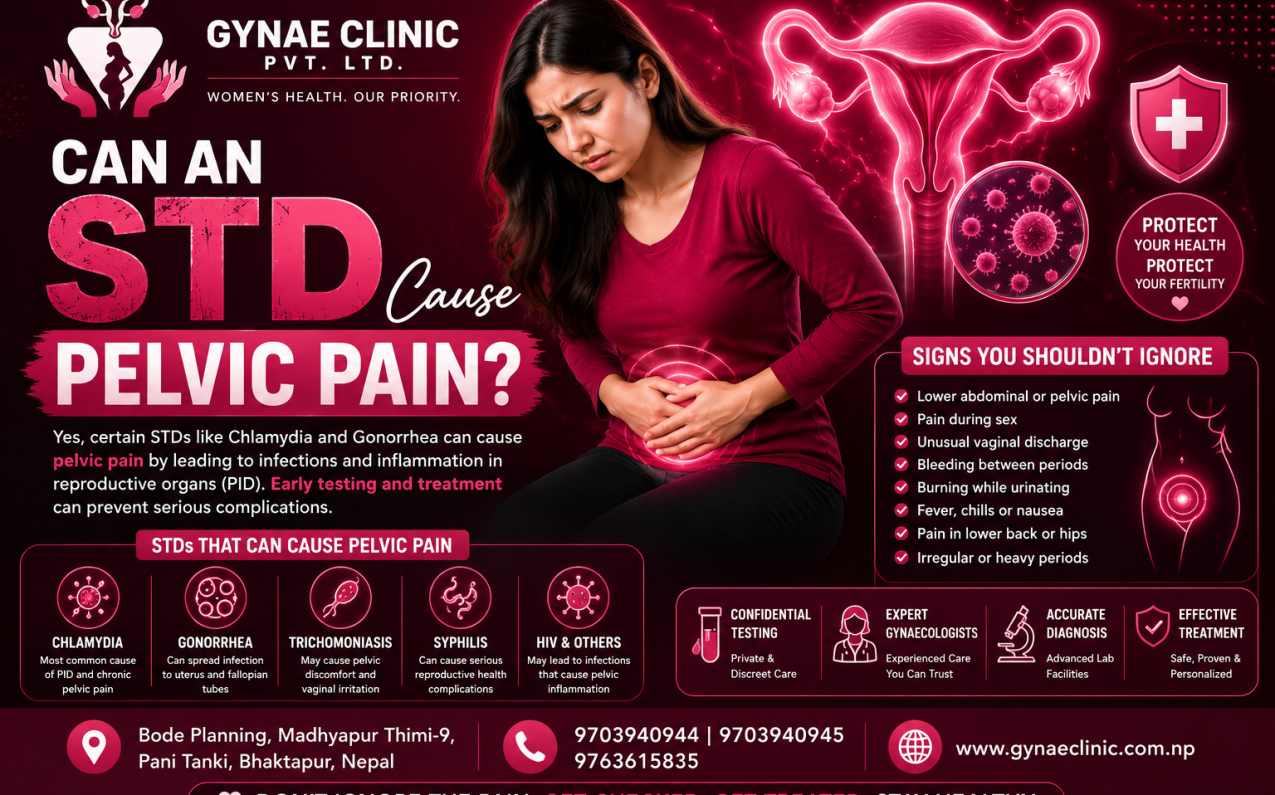
Yes, an STD (sexually transmitted disease), also called an STI (sexually transmitted infection), can cause pelvic pain in women. Pelvic or lower abdominal pain may occur when an STI causes inflammation of the cervix or spreads to the upper reproductive tract.
Chlamydia and gonorrhea are particularly important because untreated infections can lead to pelvic inflammatory disease (PID), which may cause pelvic pain and potentially affect fertility.
However, pelvic pain does not automatically mean you have an STD. Ovarian cysts, endometriosis, fibroids, urinary infections, pregnancy-related conditions and other gynecological problems can also cause pelvic pain.
If you have pelvic pain after a possible sexual exposure—especially together with unusual vaginal discharge, burning while urinating, pain during sex, abnormal bleeding or fever—professional evaluation and appropriate STI testing are important.
Can an STD Cause Pelvic Pain?
Yes. Certain STIs can cause pelvic or lower abdominal pain.
An STI may initially infect the cervix and cause cervicitis. If the infection is not diagnosed and treated, it can sometimes spread upward into the uterus, fallopian tubes and surrounding pelvic structures.
This can result in pelvic inflammatory disease (PID).
Pelvic pain associated with an STI may be:
- Mild or severe
- Dull or cramping
- Constant or intermittent
- Felt in the lower abdomen
- Felt on one or both sides
- Worse during sexual intercourse
- Associated with abnormal vaginal discharge
- Associated with abnormal vaginal bleeding
Because many conditions can cause similar symptoms, pelvic pain alone cannot diagnose an STI.
Which STDs Can Cause Pelvic Pain?
Several sexually transmitted infections may be associated with pelvic pain.
1. Chlamydia
Chlamydia is one of the most important STIs to consider when a woman develops pelvic pain.
Many women with chlamydia have no obvious symptoms. When symptoms occur, they may include:
- Pelvic or lower abdominal pain
- Abnormal vaginal discharge
- Burning while urinating
- Pain during sex
- Bleeding between periods
- Bleeding after sex
Untreated chlamydia can spread into the upper reproductive tract and cause PID.
Early diagnosis and appropriate treatment are important because complications can sometimes develop even when symptoms are mild.
2. Gonorrhea
Gonorrhea can also cause pelvic pain in women.
Possible symptoms include:
- Lower abdominal pain
- Pelvic discomfort
- Abnormal vaginal discharge
- Burning while urinating
- Pain during sex
- Bleeding between periods
- Bleeding after sex
Gonorrhea may also cause few or no noticeable symptoms.
When untreated, gonorrhea can spread to the upper reproductive tract and contribute to PID.
3. Trichomoniasis
Trichomoniasis is another sexually transmitted infection that can cause genital and vaginal symptoms.
Possible symptoms include:
- Vaginal discharge
- Unpleasant vaginal odor
- Genital irritation
- Itching
- Burning while urinating
- Pain or discomfort during sex
- Lower abdominal or pelvic discomfort in some cases
Not every woman with trichomoniasis develops pelvic pain.
What Is Pelvic Inflammatory Disease (PID)?
Pelvic inflammatory disease is an infection and inflammation of the female upper reproductive organs.
It can involve the:
- Uterus
- Fallopian tubes
- Ovaries
- Surrounding pelvic tissues
PID can develop when certain untreated infections spread upward from the cervix.
Chlamydia and gonorrhea are important causes of PID, although other bacteria can also be involved.
Symptoms of PID can include:
- Lower abdominal pain
- Pelvic pain
- Pain during sex
- Abnormal vaginal discharge
- Abnormal vaginal bleeding
- Burning while urinating
- Fever
- Pain or tenderness during a gynecological examination
PID requires medical assessment and appropriate treatment.
Can Pelvic Pain Be the Only Symptom of an STD?
Yes, it is possible, but pelvic pain alone does not prove that you have an STI.
Some women with STIs experience very few symptoms.
You may have pelvic discomfort without obvious:
- Vaginal discharge
- Genital sores
- Itching
- Burning
- Abnormal bleeding
Other women may have several symptoms at the same time.
Because STIs can be silent, testing may be appropriate after a possible sexual exposure even when symptoms are limited.
Can You Have an STD Without Pelvic Pain?
Yes.
Most STIs do not necessarily cause pelvic pain.
Depending on the infection, a woman may have:
- No symptoms
- Vaginal discharge
- Burning while urinating
- Bleeding after sex
- Bleeding between periods
- Genital sores
- Genital bumps
- Itching
- Other symptoms
Therefore, the absence of pelvic pain does not rule out an STI.
STD Pelvic Pain vs Other Causes of Pelvic Pain
Pelvic pain has many possible causes.
Possible infectious causes
- Chlamydia
- Gonorrhea
- Trichomoniasis
- Pelvic inflammatory disease
- Other pelvic infections
Possible gynecological causes
- Ovarian cysts
- Endometriosis
- Uterine fibroids
- Adenomyosis
- Ovulation-related pain
- Menstrual cramps
- Other reproductive conditions
Other possible causes
- Urinary tract infection
- Kidney or urinary conditions
- Gastrointestinal conditions
- Pregnancy-related conditions
This is why self-diagnosing pelvic pain as an STD can be misleading.
How Can You Tell If Pelvic Pain Is From an STD?
There is no reliable way to determine the cause based on pain alone.
A healthcare professional may consider:
- Your symptoms
- Sexual history
- Recent sexual exposure
- Menstrual history
- Pregnancy possibility
- Physical examination
- STI testing
- Urine testing
- Vaginal or cervical testing
- Blood tests when appropriate
- Ultrasound or other investigations when clinically indicated
The goal is to identify the underlying cause rather than simply treat the symptom.
Pelvic Pain After Sex: Could It Be an STD?
It could be, but there are many possible causes.
Pelvic pain during or after sex can occur with:
- Chlamydia
- Gonorrhea
- PID
- Vaginal infections
- Endometriosis
- Ovarian cysts
- Cervical conditions
- Vaginal dryness
- Pelvic floor problems
- Other gynecological conditions
If pain during or after sex is new, persistent or associated with abnormal discharge or bleeding, a gynecological evaluation is recommended.
Can an STD Cause Lower Abdominal Pain?
Yes.
Lower abdominal pain can occur when an STI causes cervical inflammation or PID.
You may experience:
- Central lower abdominal pain
- Pain on the right or left side
- Pain on both sides
- Cramping
- Pressure or heaviness
- Pain during sex
However, lower abdominal pain can also occur with ovarian, uterine, urinary, gastrointestinal and pregnancy-related conditions.
Can Chlamydia Cause Pelvic Pain?
Yes.
Chlamydia can cause pelvic or lower abdominal pain, particularly when infection spreads to the upper reproductive tract.
One major concern is that untreated chlamydia can contribute to PID.
PID may cause:
- Pelvic pain
- Pain during sex
- Abnormal bleeding
- Abnormal discharge
- Fever
Long-term complications may include fallopian tube damage, infertility and increased risk of ectopic pregnancy.
Can Gonorrhea Cause Pelvic Pain?
Yes.
Gonorrhea can cause pelvic pain when it affects the reproductive tract and can contribute to PID if untreated.
Possible associated symptoms include:
- Abnormal discharge
- Burning urination
- Pelvic pain
- Pain during sex
- Abnormal bleeding
Some women have few or no symptoms, making appropriate testing important when exposure is possible.
Can an STD Cause Pelvic Pain and Vaginal Discharge?
Yes. This combination should not be ignored.
Pelvic pain together with abnormal vaginal discharge can occur with:
- Chlamydia
- Gonorrhea
- Trichomoniasis
- PID
- Other vaginal or cervical infections
Pay particular attention if the discharge is:
- Yellow
- Green
- Gray
- Foul-smelling
- Unusually heavy
- Different from your normal discharge
These symptoms do not prove an STI, but they are reasons to seek professional evaluation.
Can an STD Cause Pelvic Pain and Irregular Periods?
Yes, certain STIs can be associated with abnormal bleeding.
For example, cervical inflammation caused by chlamydia or gonorrhea can result in:
- Bleeding between periods
- Spotting
- Bleeding after sex
Pelvic pain plus abnormal bleeding may also occur with PID.
However, irregular periods have many other causes, including:
- PCOS
- Hormonal imbalance
- Thyroid problems
- Stress
- Pregnancy
- Fibroids
- Perimenopause
A proper evaluation is needed to determine the cause.
Can an STD Cause Pelvic Pain Without Discharge?
Yes.
Some STIs cause no obvious vaginal discharge.
A woman may experience only:
- Pelvic pain
- Pain during sex
- Burning urination
- Abnormal bleeding
or may have no symptoms at all.
Therefore, absence of discharge does not rule out an STI.
When Should You Get an STD Test for Pelvic Pain?
Consider discussing STI testing with a healthcare professional if pelvic pain occurs with:
- Recent unprotected sex
- A new sexual partner
- A partner diagnosed with an STI
- Unknown partner STI status
- Abnormal vaginal discharge
- Burning while urinating
- Pain during sex
- Bleeding after sex
- Bleeding between periods
- Genital sores or bumps
- A previous STI
- A possible sexual exposure
You do not need to wait until symptoms become severe before seeking advice.
What STD Tests May Be Needed?
The appropriate tests depend on your symptoms and exposure.
Depending on the clinical situation, testing may include:
Chlamydia testing
Urine or genital samples may be used depending on the test and clinical circumstances.
Gonorrhea testing
Urine or genital samples may be used.
Trichomoniasis testing
Vaginal samples or other appropriate tests may be recommended.
Syphilis testing
Blood testing is commonly used.
HIV testing
Appropriate approved HIV tests may be used.
Hepatitis B testing
Blood tests can assess infection and immunity.
Not every woman with pelvic pain needs every STI test. A healthcare professional can determine which tests are appropriate.
How Soon After Sex Can an STD Cause Pelvic Pain?
There is no single timeline for every STI.
Some infections can produce symptoms relatively quickly, while others can remain unnoticed for weeks, months or longer.
Also, symptoms cannot reliably determine when an infection was acquired.
If you are worried about a recent sexual exposure, tell your healthcare provider:
- When the exposure occurred
- What type of sexual contact occurred
- Whether protection was used
- Whether your partner has an STI
- What symptoms you have
You may need testing immediately, testing after an appropriate interval, or repeat testing depending on the suspected infection.
Can an STD Cause Infertility Through Pelvic Pain?
The pain itself does not cause infertility.
The concern is the underlying infection and inflammation.
Untreated chlamydia or gonorrhea can sometimes cause PID, which may damage the fallopian tubes.
This can increase the risk of:
- Infertility
- Ectopic pregnancy
- Chronic pelvic pain
This is why pelvic pain associated with a possible STI deserves attention rather than being ignored.
Can STD Treatment Stop Pelvic Pain?
If an STI is the cause of pelvic pain, appropriate treatment can treat the infection and may improve symptoms.
However, treatment depends on the specific infection and whether complications such as PID have developed.
Do not self-treat pelvic pain with leftover antibiotics.
Taking the wrong medicine can delay correct diagnosis and treatment.
If you are prescribed treatment:
- Take it exactly as directed.
- Complete the recommended course.
- Follow instructions regarding sexual activity.
- Ask whether your partner needs testing or treatment.
- Attend follow-up appointments when recommended.
How Can Women Reduce Their Risk of STDs?
Practical steps include:
Use condoms correctly
Consistent and correct condom use reduces the risk of many STIs, although it does not eliminate all transmission.
Get tested when appropriate
Testing is particularly important after a possible exposure or when symptoms develop.
Know your partner’s STI status
Open communication about testing and sexual health can reduce risk.
Avoid sexual contact during unexplained symptoms
If you develop genital symptoms, seek medical advice rather than assuming they will resolve.
Complete treatment
If an STI is diagnosed, follow your healthcare professional’s treatment and partner-management advice.
When Is Pelvic Pain an Emergency?
Severe or sudden pelvic pain should not be ignored.
Seek urgent medical assessment if pelvic pain is:
- Severe or rapidly worsening
- Associated with heavy vaginal bleeding
- Associated with fainting or severe dizziness
- Associated with high fever
- Associated with repeated vomiting
- Associated with significant weakness
- Occurring during a possible or confirmed pregnancy
Severe pelvic pain can have causes other than an STI, including conditions that require urgent treatment.
STD Testing and Pelvic Pain Evaluation in Bhaktapur
If you are searching for STD testing in Bhaktapur, STI testing in Bhaktapur, gynecological consultation in Bhaktapur, or a women’s clinic in Bhaktapur, professional evaluation can help identify the actual cause of pelvic pain.
At Gynae Clinic Pvt. Ltd., women can discuss concerns related to:
- Pelvic pain
- Lower abdominal pain
- STDs and STIs
- Chlamydia
- Gonorrhea
- Trichomoniasis
- Abnormal vaginal discharge
- Bleeding after sex
- Irregular periods
- PCOS
- Fertility concerns
- Pregnancy-related women’s health
Gynae Clinic Pvt. Ltd.
Address:
Bode Planning, Madhyapur Thimi-9, Pani Tanki, Bhaktapur, Nepal
Website:
www.gynaeclinic.com.np
Contact:
9703940944 | 9703940945 | 9763615835
If you have pelvic pain and are concerned about an STI, confidential professional consultation can help determine whether STI testing or other gynecological investigations are appropriate.
Frequently Asked Questions
Can an STD cause pelvic pain?
Yes. STIs such as chlamydia and gonorrhea can cause pelvic pain, particularly when they lead to pelvic inflammatory disease.
Which STD causes pelvic pain?
Chlamydia and gonorrhea are important STIs associated with pelvic pain. Trichomoniasis and other infections may also cause pelvic or genital discomfort.
Can chlamydia cause lower abdominal pain?
Yes. Chlamydia can cause lower abdominal or pelvic pain, especially if infection spreads to the upper reproductive tract.
Can gonorrhea cause pelvic pain?
Yes. Gonorrhea can cause pelvic pain and may contribute to PID when untreated.
Can you have an STD with pelvic pain but no discharge?
Yes. Some STIs can cause pelvic pain without noticeable vaginal discharge.
Can pelvic pain be the only symptom of an STD?
It can be, although pelvic pain has many possible causes. Testing and medical evaluation are needed to determine whether an STI is responsible.
Can an STD cause pelvic pain during sex?
Yes. Cervical inflammation and PID can cause pain during sexual intercourse.
Can an STD cause pelvic pain and irregular periods?
Some STIs can cause abnormal bleeding, particularly when cervical inflammation or PID is present. However, hormonal conditions and other gynecological problems can also cause irregular periods.
Can an STD cause permanent pelvic pain?
Untreated pelvic infections can sometimes result in chronic pelvic pain. Early diagnosis and appropriate treatment can help reduce the risk of complications.
Can an STD cause infertility?
Some untreated STIs, particularly chlamydia and gonorrhea, can cause PID and reproductive tract damage that may affect fertility.
Should I get tested for an STD if I have pelvic pain?
If pelvic pain occurs after a possible sexual exposure or alongside abnormal discharge, bleeding, burning urination or pain during sex, discussing STI testing with a healthcare professional is appropriate.
Final Takeaway
Can an STD cause pelvic pain? Yes.
Chlamydia and gonorrhea are particularly important because untreated infections can spread to the upper reproductive tract and cause pelvic inflammatory disease (PID). PID can cause pelvic pain and may lead to serious reproductive complications, including infertility, ectopic pregnancy and chronic pelvic pain.
But pelvic pain is not automatically an STD. Ovarian cysts, endometriosis, fibroids, urinary infections, hormonal conditions and pregnancy-related problems can produce similar symptoms.
If you have pelvic pain after a possible STI exposure, especially with abnormal discharge, burning urination, pain during sex, abnormal bleeding or fever, do not self-diagnose. Seek professional evaluation and ask whether STI testing is appropriate.
Gynae Clinic Pvt. Ltd.
Bode Planning, Madhyapur Thimi-9, Pani Tanki, Bhaktapur, Nepal
9703940944 | 9703940945 | 9763615835
www.gynaeclinic.com.np
Medical Disclaimer
This blog is for general health information only and does not replace professional medical advice, diagnosis or treatment. If you have pelvic pain, STI concerns, severe symptoms or possible pregnancy, consult a qualified healthcare professional.


