
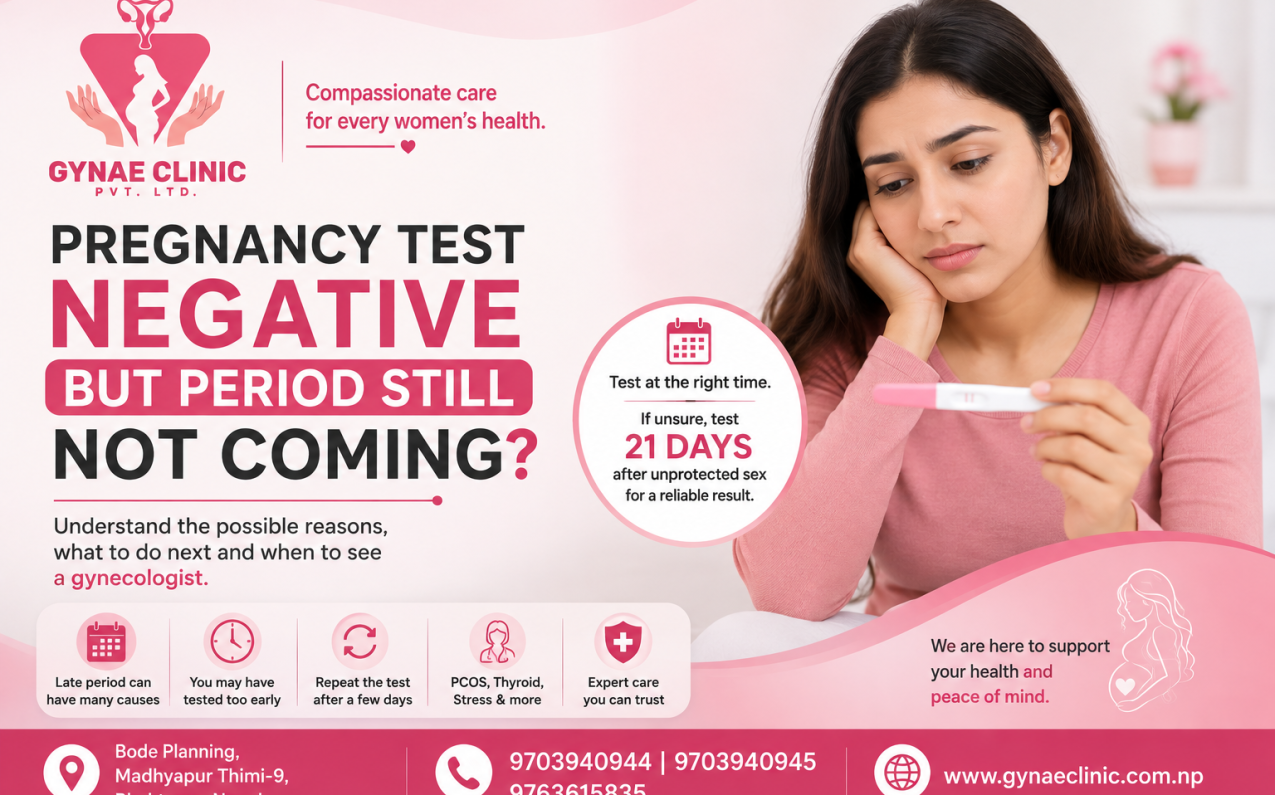
A late period with a negative pregnancy test can be confusing—especially if you were expecting your period and are worried about pregnancy.
A negative pregnancy test does not always completely rule out pregnancy, particularly if the test was taken too early. However, a delayed period can also happen for many reasons unrelated to pregnancy, including stress, PCOS, hormonal changes, thyroid problems, changes in weight, illness, excessive exercise and other health conditions.
If your pregnancy test is negative but your period is late, the next step depends on when you tested, your usual menstrual cycle and whether you have other symptoms.
For women looking for pregnancy testing and gynecological consultation near Bhaktapur, Madhyapur Thimi, Koteshwor, Jadibuti, Kausaltar or Lokanthali, Gynae Clinic Pvt. Ltd. provides women’s reproductive healthcare from Bode Planning, Madhyapur Thimi-9, Pani Tanki, Bhaktapur, Nepal.
Pregnancy Test Negative but Period Is Late: Does It Mean You Are Not Pregnant?
Not necessarily.
A home pregnancy test detects human chorionic gonadotropin (hCG) in urine. hCG increases after implantation, so testing too early may produce a negative result even if pregnancy has occurred.
A negative result can therefore mean:
- You are not pregnant.
- You tested too early.
- Your ovulation occurred later than usual.
- Your urine was too diluted.
- The test was not performed correctly.
- The pregnancy is at a very early stage.
If your period remains absent, repeating the pregnancy test after a short interval can be appropriate.
When Should You Take a Pregnancy Test?
The timing of the test matters.
If you test before your expected period or very soon after your missed period, pregnancy may not yet produce enough hCG to be detected by some home tests.
For the best chance of detecting an early pregnancy:
- Follow the test manufacturer’s instructions carefully.
- Check the expiry date.
- Avoid drinking excessive amounts of fluid immediately before testing.
- Consider testing with first-morning urine, particularly when testing early.
- If the result is negative but your period still does not arrive, repeat the test after a few days.
If repeated tests remain negative and your period continues to be delayed, consider speaking with a gynecologist.
Why Is My Period Late If the Pregnancy Test Is Negative?
There are many possible reasons.
1. You Tested Too Early
This is one of the most common explanations when pregnancy is possible.
If ovulation occurred later than usual, your period may also be later than expected. In that situation, a pregnancy test taken according to the calendar date of your expected period may be too early.
A repeat test may become positive later if pregnancy has occurred.
2. Late Ovulation
Your period generally occurs after ovulation.
If ovulation happens later than usual, your next period can also arrive later.
Late ovulation can occur because of:
- Stress
- Illness
- Changes in sleep
- Significant weight changes
- Travel
- Hormonal changes
- PCOS
- Other health conditions
Therefore, a late period does not automatically mean pregnancy.
3. Stress
Significant physical or emotional stress can affect the hormonal signals involved in ovulation.
This can result in:
- Late ovulation
- A delayed period
- A shorter or longer cycle
- Occasionally a missed period
If you have been experiencing considerable stress recently, it may be one possible reason for the delay.
However, pregnancy should still be considered if you have had unprotected sex.
4. PCOS
Polycystic ovary syndrome (PCOS) is a common cause of irregular periods.
Women with PCOS may experience:
- Irregular periods
- Long menstrual cycles
- Missed periods
- Acne
- Increased facial or body hair
- Hair thinning
- Difficulty becoming pregnant
If your periods are frequently late rather than just once, PCOS or another hormonal condition may need to be considered.
You can read our detailed PCOS Symptoms, Causes & Diagnosis in Bhaktapur for more information.
5. Hormonal Changes
Changes in reproductive hormones can affect your menstrual cycle.
Hormonal causes may include:
- PCOS
- Thyroid disorders
- Elevated prolactin
- Changes related to weight
- Perimenopause
- Other endocrine conditions
If late or missed periods happen repeatedly, a gynecological evaluation can help determine whether further testing is appropriate.
6. Changes in Weight
Both significant weight loss and significant weight gain can affect menstrual cycles.
Very restrictive dieting, inadequate nutrition or rapid changes in body weight may interfere with normal ovulation.
A balanced diet and sustainable lifestyle are generally preferable to extreme weight-loss approaches.
7. Excessive Exercise
Very intense exercise combined with inadequate calorie intake can sometimes affect ovulation and menstruation.
This may be more likely in women who suddenly increase their training or have very low energy availability.
8. Illness or Other Health Problems
Being unwell can temporarily affect your menstrual cycle.
Other medical conditions can also contribute to irregular periods.
If your menstrual pattern changes repeatedly, it is worth discussing the change with a healthcare professional rather than assuming that pregnancy is the only possible cause.
9. Perimenopause
Women approaching menopause can experience changes in menstrual regularity.
Periods may become:
- Longer apart
- Shorter apart
- Heavier
- Lighter
- Less predictable
If you are in the age range when perimenopause may be beginning, hormonal changes may contribute to a late period.
10. Certain Medications
Some medications can affect menstrual cycles.
If your periods changed after starting a medication, discuss it with your doctor rather than stopping prescribed medicine on your own.
Can You Still Be Pregnant After a Negative Test?
Yes, particularly if the test was taken early.
A negative urine pregnancy test is more reassuring when it is performed at an appropriate time and repeated if necessary.
If you had unprotected sex and your period is late, consider:
Negative test + no period → repeat the test after a few days if pregnancy remains possible.
If repeated tests remain negative and your period does not return, a gynecological consultation may be appropriate.
What If the Pregnancy Test Is Negative but You Have Pregnancy Symptoms?
Some women experience symptoms such as:
- Breast tenderness
- Nausea
- Fatigue
- Mild abdominal cramping
- Increased urination
- Bloating
These symptoms can occur during early pregnancy, but they can also occur before a period or because of hormonal changes.
Symptoms alone cannot confirm pregnancy.
Pregnancy testing and, when clinically appropriate, further evaluation are more reliable.
For information about early pregnancy symptoms, read our Early Pregnancy Symptoms and First Signs of Pregnancy in Bhaktapur.
What Should You Do If Your Pregnancy Test Is Negative and Your Period Is Late?
A practical approach is:
Step 1: Consider when you tested
If you tested very early, the result may not yet be conclusive.
Step 2: Repeat the test
If your period still has not started, repeat the pregnancy test after a few days according to the test instructions.
Step 3: Consider other causes
If pregnancy tests remain negative, consider whether you have:
- Stress
- Irregular cycles
- PCOS
- Recent illness
- Major weight changes
- Excessive exercise
- Thyroid or other hormonal concerns
Step 4: See a gynecologist if the delay persists
If your period continues to be absent or your cycles are repeatedly irregular, a gynecologist can help identify the possible cause.
When Should You See a Gynecologist for a Late Period?
Consider medical consultation if:
- Your period is repeatedly late.
- You frequently miss periods.
- Your cycles have suddenly become irregular.
- You repeatedly have negative pregnancy tests but no period.
- You have significant pelvic pain.
- You have unusual vaginal bleeding.
- You have symptoms of PCOS.
- You are trying to conceive.
- You have a history of thyroid or hormonal problems.
- You are concerned about fertility.
A single late period is not necessarily a sign of a serious problem, but repeated menstrual changes deserve attention.
For more information, read our Irregular Periods Treatment in Bhaktapur: Causes, PCOS & Hormonal Problems.
When Is a Late Period an Emergency?
Seek urgent medical care if you could be pregnant and develop symptoms such as:
- Severe or worsening abdominal or pelvic pain
- Severe one-sided pelvic pain
- Fainting or feeling very weak
- Significant dizziness
- Heavy vaginal bleeding
- Shoulder-tip pain associated with abdominal pain or bleeding
A negative early pregnancy test does not completely exclude a very early pregnancy or an ectopic pregnancy.
Do not wait for another home pregnancy test if you have severe or concerning symptoms.
Can a Blood Pregnancy Test Help?
A healthcare professional may recommend a blood hCG test when clinically appropriate.
Blood testing can detect lower levels of hCG than some urine tests and may be useful in certain situations.
However, not every woman with a late period needs a blood pregnancy test. The appropriate evaluation depends on the timing of the missed period, symptoms, pregnancy possibility and medical history.
Can Ultrasound Detect an Early Pregnancy?
Ultrasound is an important tool in pregnancy evaluation, but it may not show a very early pregnancy.
If an ultrasound is performed too early, the pregnancy may simply be too small to visualize.
Depending on the situation, your healthcare professional may recommend:
- Repeat pregnancy testing
- Blood hCG testing
- Ultrasound
- Follow-up evaluation
The timing should be individualized.
Late Period and PCOS: Is There a Connection?
Yes.
PCOS can cause irregular or absent ovulation, which may result in late or missed periods.
If your periods are repeatedly delayed and you also have acne, excess facial hair, hair thinning or fertility concerns, PCOS may be one possible explanation.
However, PCOS should not be diagnosed solely because your period is late.
A proper clinical evaluation is important.
Late Period and Fertility
If your periods are regularly late or unpredictable, ovulation may also be irregular.
This can make it harder to identify the fertile window and may sometimes affect conception.
If you are trying to become pregnant, a fertility consultation may evaluate:
- Menstrual cycles
- Ovulation
- Ovarian function
- Hormonal factors
- Uterine health
- Other reproductive factors
You can read our Fertility Tests for Women: Complete Female Fertility Testing Guide if you are concerned about conception.
Pregnancy Testing Near Bhaktapur
Women looking for pregnancy testing near Bhaktapur or Madhyapur Thimi can consider Gynae Clinic Pvt. Ltd. for gynecological and reproductive health consultation.
The clinic is located at:
Bode Planning, Madhyapur Thimi-9, Pani Tanki, Bhaktapur, Nepal
Women from nearby areas including:
- Madhyapur Thimi
- Bode
- Kausaltar
- Lokanthali
- Jadibuti
- Koteshwor
- Balkumari
- Gatthaghar
- Radhe Radhe
- Sallaghari
- Sanothimi
- Bhaktapur
- Suryabinayak
- Jagati
can contact the clinic for women’s health and pregnancy-related consultation.
Pregnancy Checkup Near Koteshwor and Bhaktapur
If you live around Koteshwor, Jadibuti, Kausaltar or Lokanthali, Madhyapur Thimi can be a nearby option for pregnancy-related gynecological care.
Gynae Clinic Pvt. Ltd. is not located in Koteshwor; its physical location is Bode Planning, Madhyapur Thimi-9, Pani Tanki, Bhaktapur.
This distinction is important when searching online for a pregnancy test or gynecologist near Koteshwor and Bhaktapur.
For information about the first pregnancy visit, see our First Pregnancy Checkup: When Should You See a Gynecologist?.
What If Your Period Is More Than a Week Late?
If your period is more than a week late and your pregnancy test is negative:
- Consider whether you tested too early.
- Repeat the pregnancy test if pregnancy is still possible.
- Track your menstrual symptoms and cycle.
- Consider other causes of delayed menstruation.
- Consult a gynecologist if the period remains absent or the pattern keeps happening.
The exact timing matters because menstrual cycles and ovulation can vary.
What If Your Period Is Two Weeks Late but Pregnancy Tests Are Negative?
A period that is two weeks late deserves more attention, particularly if this is unusual for you.
If repeated pregnancy tests remain negative, pregnancy becomes less likely, but the reason for the delayed period may still need evaluation.
Possible causes include:
- Late ovulation
- PCOS
- Thyroid problems
- Stress
- Weight changes
- Other hormonal conditions
- Medication effects
- Other medical conditions
A gynecologist can determine whether examination or laboratory testing is appropriate.
What If Your Period Is a Month Late?
If you have missed an entire menstrual period and pregnancy tests remain negative, consider scheduling a gynecological consultation.
A doctor may review:
- Your usual cycle
- Pregnancy possibility
- Recent stress or illness
- Weight changes
- Medications
- PCOS symptoms
- Thyroid symptoms
- Other medical history
Additional testing may be recommended based on your individual situation.
How to Prevent Confusion About Your Menstrual Cycle
Tracking your cycle can be very helpful.
Record:
- First day of each period
- Number of days of bleeding
- Cycle length
- Unusual bleeding
- Pain
- Pregnancy test dates
- Other significant symptoms
A menstrual tracking app or simple calendar can help you identify whether your periods are actually irregular or whether there is occasional variation.
Frequently Asked Questions
Can I be pregnant if my pregnancy test is negative but my period is late?
Yes, especially if you tested too early. Repeat testing may be appropriate if your period remains absent.
How many days late should I wait before taking a pregnancy test?
Home pregnancy tests can often be used around the expected period, but accuracy depends on the timing of ovulation and implantation. Follow the instructions for the specific test and repeat the test if necessary.
Why is my period late but the pregnancy test is negative?
Possible causes include early testing, late ovulation, stress, PCOS, hormonal changes, thyroid problems, weight changes, excessive exercise, illness and some medications.
Should I repeat my pregnancy test?
If pregnancy is possible and the first test was negative but your period has not arrived, repeating the test after a few days can be reasonable.
Can PCOS cause a late period?
Yes. PCOS can cause irregular or absent ovulation, which can lead to delayed or missed periods.
Can stress delay my period?
Yes. Significant stress can affect hormonal regulation and ovulation, potentially delaying menstruation.
When should I see a doctor for a late period?
Consider seeing a gynecologist when the period remains absent, late periods happen repeatedly, pregnancy tests remain negative despite prolonged absence of menstruation, or you have pain, abnormal bleeding or other concerning symptoms.
Can a late period mean infertility?
No. A late period by itself does not mean infertility. However, repeated irregular periods can sometimes indicate irregular ovulation, which may affect fertility.
Pregnancy Test Negative but Period Late: Key Takeaway
A negative pregnancy test with a late period does not always have one single explanation.
If you tested early, pregnancy may not yet be detectable. If repeat testing remains negative, other causes such as late ovulation, PCOS, stress, hormonal changes, thyroid problems, weight changes or other health conditions may need to be considered.
If your period remains absent or your cycles are repeatedly irregular, consult a gynecologist rather than repeatedly guessing the cause.
For women in Bhaktapur, Madhyapur Thimi, Kausaltar, Lokanthali, Jadibuti, Koteshwor and nearby areas, Gynae Clinic Pvt. Ltd. provides gynecological and reproductive healthcare from Bode Planning, Madhyapur Thimi-9, Pani Tanki, Bhaktapur, Nepal.
Gynae Clinic Pvt. Ltd.
Address: Bode Planning, Madhyapur Thimi-9, Pani Tanki, Bhaktapur, Nepal
Contact: 9703940944, 9703940945, 9763615835
Website: www.gynaeclinic.com.np
Compassionate care for every women’s health.
Medical Disclaimer
This article is for general educational purposes and does not replace an individual medical consultation. Pregnancy testing, diagnosis and treatment should be based on individual symptoms, medical history and appropriate clinical evaluation. Seek urgent medical care for severe pain, heavy bleeding, fainting or other concerning symptoms. Complex cases may need specialized referral.
Author
Gynae Clinic Pvt. Ltd.
Bode Planning, Madhyapur Thimi-9, Pani Tanki, Bhaktapur, Nepal