
Trying to conceive can be exciting, but when pregnancy does not happen as quickly as expected, one of the most common questions is: “How long should we keep trying before seeing a fertility specialist?”
The answer depends mainly on age, menstrual-cycle regularity, medical history and any known fertility concerns.
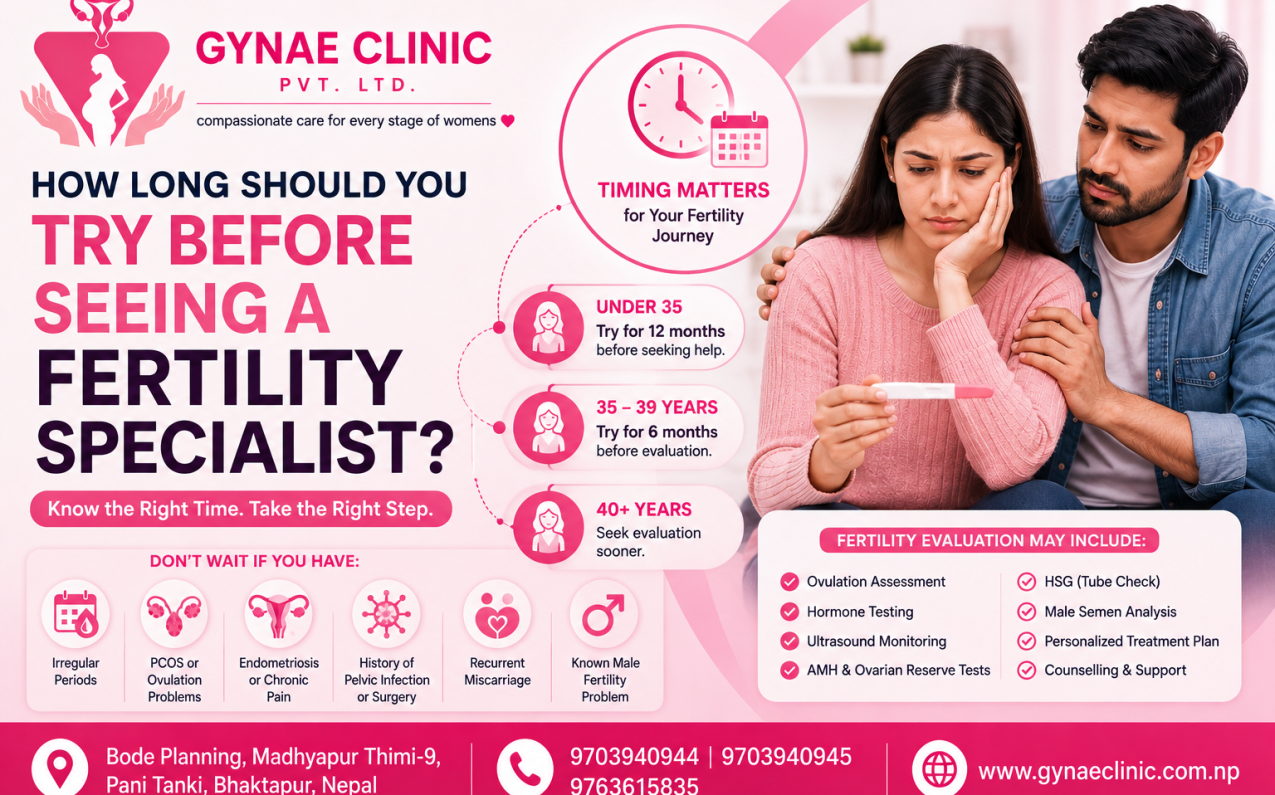
For couples without known fertility problems, professional guidance generally recommends fertility evaluation after 12 months of regular, unprotected intercourse if the woman is under 35, and after 6 months if she is 35 or older. Women over 40 may benefit from more immediate evaluation.
However, you do not always need to wait 6 or 12 months. Certain symptoms or medical conditions can justify an earlier fertility assessment.
When Should You See a Fertility Specialist?
If you are under 35
If you are younger than 35 and have regular unprotected intercourse without becoming pregnant, fertility evaluation is generally recommended after:
12 months of trying.
This does not mean you should wait exactly 12 months if you already have a known fertility concern.
If you are 35 or older
If you are 35 or older, consider fertility evaluation after:
6 months of trying without pregnancy.
Female fertility generally declines with age, making timely evaluation more important.
If you are over 40
If you are over 40, it may be appropriate to seek fertility advice without waiting several months.
ASRM notes that more immediate evaluation and treatment may be warranted in women over 40.
An earlier consultation does not mean you will need fertility treatment. It simply gives you an opportunity to understand your reproductive health and discuss appropriate options.
You May Need Fertility Evaluation Earlier If You Have These Problems
The 6- or 12-month guideline is intended for people without an obvious fertility problem.
You may benefit from an earlier evaluation if you have:
- Irregular periods
- Very long or very short menstrual cycles
- Absent periods
- Suspected problems with ovulation
- PCOS
- Endometriosis
- Previous pelvic infection
- Previous ectopic pregnancy
- Previous reproductive or pelvic surgery
- Known uterine or fallopian-tube problems
- Recurrent pregnancy loss
- Known ovarian problems
- A history that may affect ovarian reserve
- A partner with a known fertility problem
- Sexual or ejaculation difficulties
ASRM recommends initiating evaluation without delay when there is a known condition associated with infertility.
Why Shouldn’t You Always Wait?
Waiting can be reasonable when you are younger than 35, have regular cycles and have no known fertility concerns.
But waiting may not be appropriate when there are already signs that something could be affecting fertility.
For example, if your periods occur only every 2–3 months, waiting another year may not be helpful because irregular periods can indicate irregular or absent ovulation.
Similarly, someone with known endometriosis, previous pelvic infection or a history of ectopic pregnancy may benefit from earlier evaluation.
The right timing is individualized.
What Happens at a Fertility Consultation?
Seeing a fertility specialist or gynecologist does not automatically mean you need IVF or another advanced fertility treatment.
The first step is usually understanding why pregnancy may not be happening.
Your doctor may ask about:
- Your age
- Menstrual-cycle pattern
- How long you have been trying
- Frequency and timing of intercourse
- Previous pregnancies
- Previous miscarriages
- Previous ectopic pregnancy
- Previous pelvic infections
- Previous surgeries
- PCOS or endometriosis
- Medications and medical conditions
- Your partner’s fertility history
A systematic evaluation helps identify the most relevant factors rather than ordering every possible test unnecessarily.
What Fertility Tests Might Be Recommended?
There is no single test that can tell you whether you are fertile or infertile.
Depending on your circumstances, your doctor may consider:
1. Ovulation Assessment
Your menstrual history can provide important information about whether ovulation is likely occurring regularly.
Additional testing may sometimes include ovulation predictor kits, hormone testing or ultrasound monitoring.
2. Hormone Testing
Selected hormone tests may be recommended based on your symptoms and menstrual pattern.
These may help investigate particular hormonal or ovulatory concerns.
3. Pelvic Ultrasound
Ultrasound can help assess:
- Uterus
- Ovaries
- Endometrium
- Ovarian follicles
- Certain structural abnormalities
4. Ovarian Reserve Assessment
Tests such as AMH and antral follicle count may be considered in appropriate circumstances.
However, AMH should not be treated as a simple test that tells you whether you can become pregnant naturally. Ovarian-reserve testing is an adjunct to fertility evaluation rather than a standalone prediction of fertility.
5. Fallopian-Tube Assessment
If appropriate, a test such as HSG (hysterosalpingography) may be used to assess whether the fallopian tubes are open.
6. Semen Analysis
Fertility evaluation should not focus only on the woman.
Male factors can contribute to difficulty conceiving, so semen analysis is commonly included when a couple is being evaluated.
Is Infertility Only a Woman’s Problem?
No.
Difficulty conceiving can involve:
- Female factors
- Male factors
- Both partners
- Or sometimes no identifiable cause
This is why evaluating both partners when appropriate can prevent unnecessary delays.
A semen analysis is often a relatively straightforward initial investigation for male fertility.
What If My Periods Are Regular?
Regular periods are encouraging because they often suggest that ovulation is occurring, but they do not guarantee that every fertility factor is normal.
Even with regular periods, difficulties can sometimes involve:
- Fallopian tubes
- Endometriosis
- Uterine conditions
- Ovarian factors
- Age-related fertility changes
- Male-factor infertility
Therefore, if you have been trying for the recommended period without pregnancy, evaluation can still be worthwhile.
What If I Have PCOS?
PCOS can affect ovulation and make conception more difficult for some women.
If you have PCOS and are trying to become pregnant, you may not need to wait 12 months before discussing fertility.
An individualized evaluation can help determine:
- Whether you are ovulating
- How regularly you are ovulating
- Whether other fertility factors need assessment
- What pregnancy-planning approach may be appropriate
Many women with PCOS do become pregnant with appropriate care.
You can also read our detailed guide on PCOS Symptoms, Causes & Diagnosis in Bhaktapur.
What If I Have Had a Miscarriage Before?
A previous miscarriage does not necessarily mean that you will have difficulty becoming pregnant again.
However, if you have experienced recurrent pregnancy loss, discussing your reproductive history with a gynecologist is important.
Your evaluation may be different from a routine infertility assessment because your previous pregnancy history provides additional information that may need to be considered. ASRM specifically notes that fertility evaluation may be appropriate in patients presenting with recurrent pregnancy loss.
Should You See a Gynecologist or a Fertility Specialist?
For many women, a gynecologist with experience in reproductive and fertility care can be an appropriate first step.
An initial consultation can help determine:
- Whether you need fertility testing
- Which tests are appropriate
- Whether ovulation needs assessment
- Whether your partner should have testing
- Whether additional specialist care may be appropriate
You do not necessarily need to go directly to an advanced fertility center simply because pregnancy has not happened yet.
What Can You Do While Trying to Conceive?
While trying naturally, focus on the basics:
Track your menstrual cycle
Knowing when your periods begin and understanding your cycle pattern can help identify your fertile period.
Understand ovulation
Ovulation is the key event around which the fertile window occurs.
Have intercourse regularly
For couples trying naturally, intercourse every 1–2 days during the fertile window can help maximize the chance of conception.
Look after your general health
Avoid smoking and recreational drugs, maintain a healthy lifestyle and discuss medications or medical conditions with your healthcare professional when planning pregnancy.
Don’t rely on one fertility symptom
Apps, cervical mucus, ovulation predictor kits and cycle calculations can provide useful information, but they are not equally reliable for everyone.
When Should You Stop Waiting and Get Checked?
A simple guide is:
| Age / Situation | When to Consider Evaluation |
|---|---|
| Under 35 | After 12 months of trying |
| 35–39 | After 6 months of trying |
| 40+ | Consider evaluation sooner |
| Irregular/absent periods | Earlier evaluation |
| Known PCOS/endometriosis | Earlier evaluation may be appropriate |
| Previous pelvic infection or surgery | Consider earlier evaluation |
| Recurrent pregnancy loss | Discuss evaluation rather than simply waiting |
| Known male fertility problem | Evaluate earlier |
| Previous ectopic pregnancy | Earlier assessment may be appropriate |
These are general guidelines; your personal circumstances can change the appropriate timing.
Fertility Evaluation in Bhaktapur
If you have been trying to conceive and are unsure whether it is time to seek help, you do not have to wait until you feel completely overwhelmed.
Gynae Clinic Pvt. Ltd. provides gynecological and fertility-related consultation for women with concerns about conception, ovulation, PCOS, irregular periods and reproductive health.
The clinic’s fertility evaluation information covers assessment of ovulation, ovarian reserve, hormones, uterus, ovaries, fallopian tubes and other factors, with testing selected according to the individual’s age, history and symptoms.
You can read the clinic’s Female Fertility Testing in Bhaktapur guide for more information.
You can also learn about Infertility Treatment in Bhaktapur and the best time to get pregnant, ovulation and the fertile window.
Visit Gynae Clinic Pvt. Ltd.
Address: Bode Planning, Madhyapur Thimi-9, Pani Tanki, Bhaktapur, Nepal
Contact: 9703940944, 9703940945, 9763615835
Website: www.gynaeclinic.com.np
Compassionate care for every stage of womens
Frequently Asked Questions
How long should I try naturally before seeing a fertility specialist?
If you are under 35 with no known fertility concerns, evaluation is generally recommended after 12 months of regular unprotected intercourse without pregnancy. If you are 35 or older, consider evaluation after 6 months.
Should I wait 12 months if I have irregular periods?
No. Irregular or absent periods can indicate an ovulation problem, so earlier evaluation may be appropriate.
Should women over 40 wait six months?
Not necessarily. More immediate fertility evaluation may be appropriate after age 40.
Does seeing a fertility specialist mean I need IVF?
No. A fertility consultation is primarily about understanding what may be affecting conception. Treatment depends on the underlying cause.
Should my husband also be tested?
Yes. Male factors can contribute to infertility, and semen analysis is commonly included in fertility evaluation.
What if all fertility tests are normal?
Sometimes no specific cause is identified despite appropriate evaluation. This is often called unexplained infertility. Your doctor can discuss the next appropriate steps based on age, duration of trying and individual circumstances.
Medical Disclaimer
This article is for general educational purposes and does not replace individualized medical consultation, diagnosis or treatment. Fertility evaluation and treatment should be tailored to age, medical history, reproductive history and individual circumstances. Certain complex conditions may benefit from advanced specialist care.
Author: Gynae Clinic Pvt. Ltd.
Address: Bode Planning, Madhyapur Thimi-9, Pani Tanki, Bhaktapur, Nepal