

If you have irregular periods, acne, unwanted facial hair, weight changes, difficulty becoming pregnant, or other symptoms of hormonal imbalance, you may wonder whether you have polycystic ovary syndrome (PCOS).
One of the most common questions is: “Which test confirms PCOS?”
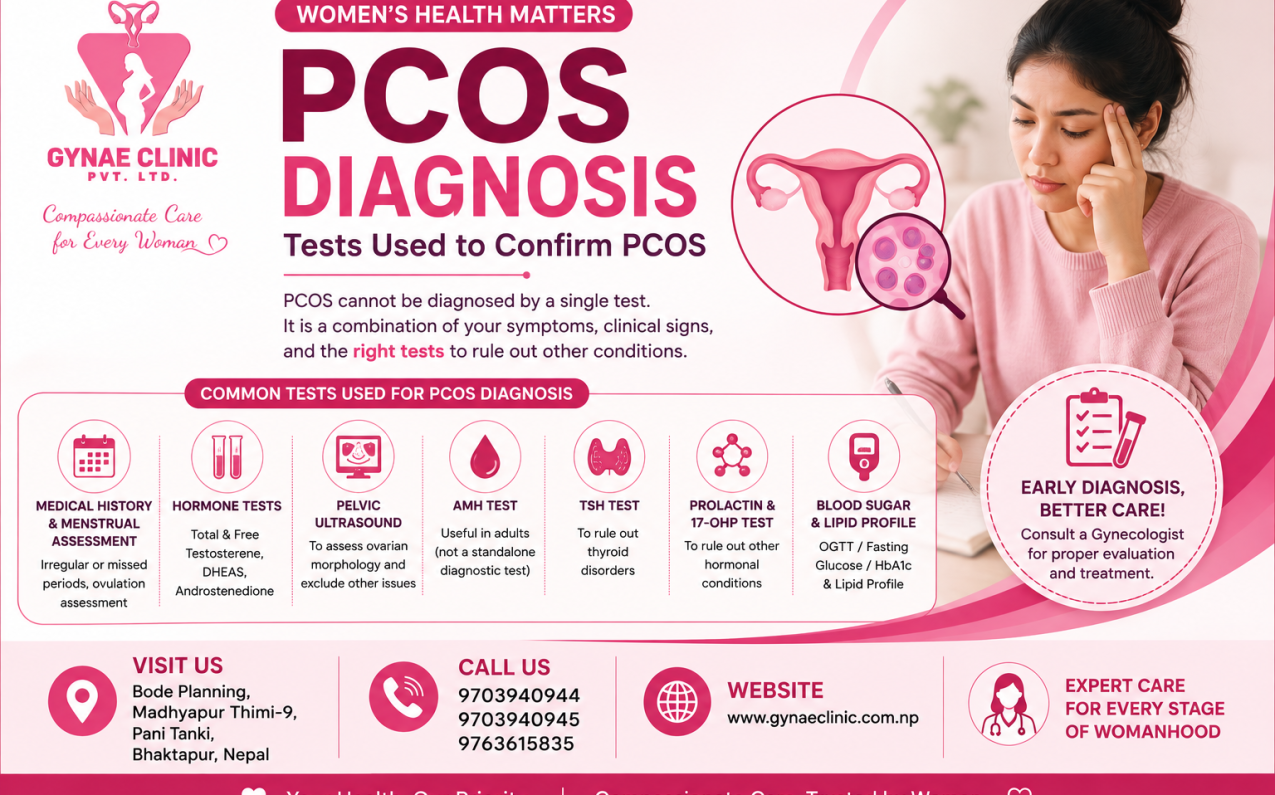
The answer is important: there is no single blood test, ultrasound scan, or symptom that confirms PCOS by itself. PCOS is diagnosed using a combination of menstrual and ovulation history, signs or blood-test evidence of higher androgen levels, and assessment of the ovaries when appropriate, while other conditions that can cause similar symptoms are excluded. Current international guidance supports this overall diagnostic approach.
If you are looking for PCOS diagnosis in Bhaktapur, understanding which tests may actually be useful can help you prepare for a more focused gynecological evaluation.
What Is PCOS?
Polycystic ovary syndrome (PCOS) is a common hormonal and metabolic condition that can affect menstrual cycles, ovulation, androgen levels, fertility and long-term metabolic health.
PCOS may present differently from one woman to another.
Some women primarily experience:
- Irregular or missed periods
- Difficulty becoming pregnant
- Excess facial or body hair
- Acne
- Hair thinning
- Evidence of higher androgen levels
Others may have metabolic concerns such as insulin resistance or increased risk of abnormal blood glucose.
Importantly, having irregular periods does not automatically mean you have PCOS, and seeing polycystic-appearing ovaries on an ultrasound does not by itself establish the diagnosis.
Is There One Test for PCOS?
No.
PCOS is a clinical diagnosis supported by appropriate investigations.
In adults, the diagnostic framework generally considers three major features:
- Ovulatory dysfunction — irregular or absent ovulation, often reflected by irregular menstrual cycles
- Hyperandrogenism — clinical signs or biochemical evidence of increased androgen levels
- Polycystic ovarian morphology on ultrasound or, in appropriate adults, an elevated AMH level
After other causes have been excluded, the diagnosis can generally be made when the appropriate combination of these features is present.
This is why a proper PCOS evaluation involves more than simply ordering an “PCOS blood test.”
1. Menstrual History and Ovulation Assessment
The first part of PCOS diagnosis is often your menstrual history.
Your gynecologist may ask:
- When did your periods start?
- How often do your periods occur?
- How many days does bleeding usually last?
- Have your cycles become irregular recently?
- Do you sometimes go several months without a period?
- Have you had prolonged gaps between periods?
- Are you trying to become pregnant?
- Have you noticed changes in your cycle over time?
Irregular cycles can suggest ovulatory dysfunction, one of the major features considered when diagnosing PCOS.
Importantly, regular-looking cycles do not always guarantee regular ovulation. If confirmation of ovulation is needed, a clinician may use additional assessment such as a serum progesterone measurement at an appropriate time in the cycle.
2. Blood Tests for Androgens
Another important part of PCOS evaluation is checking for hyperandrogenism, meaning higher-than-expected levels or effects of male-type hormones called androgens.
The main blood tests may include:
Total Testosterone
Total testosterone can help identify biochemical hyperandrogenism.
Free Testosterone
Free testosterone can be particularly useful when evaluating biochemical hyperandrogenism. Current guidance recommends assessment using total and free testosterone, with a calculated free androgen index also being an option depending on laboratory methods.
DHEAS
Dehydroepiandrosterone sulfate (DHEAS) may sometimes be checked when testosterone is not elevated but androgen excess is still suspected.
Androstenedione
Androstenedione can also be considered in selected patients, although it is generally less specific than testosterone testing.
Your doctor will decide which androgen tests are appropriate based on your symptoms and examination.
3. Clinical Signs of High Androgens
PCOS diagnosis does not depend only on blood tests.
A doctor may look for clinical signs of androgen excess, including:
- Excess facial hair
- Increased body hair
- Acne
- Scalp hair thinning
- Male-pattern hair loss
This is known as clinical hyperandrogenism.
Some women have obvious symptoms even when their blood-test results are not dramatically abnormal, while others may have biochemical hyperandrogenism without prominent physical symptoms.
4. Pelvic Ultrasound for PCOS
A pelvic ultrasound may be used to assess the ovaries and uterus.
The ultrasound can evaluate:
- Ovarian morphology
- Follicle number
- Ovarian volume
- Uterine structure
- Endometrial thickness
- Other pelvic abnormalities
In adults, polycystic ovarian morphology can be one of the features used in the diagnostic process.
Does an ultrasound alone diagnose PCOS?
No.
This is one of the most important points for patients to understand.
An ultrasound showing multiple small follicles does not automatically mean you have PCOS. Diagnosis must be considered together with menstrual/ovulatory history, androgen findings and exclusion of other causes.
5. AMH Test and PCOS Diagnosis
Anti-Müllerian hormone (AMH) is produced by ovarian follicles and is often associated with the number of small growing follicles in the ovaries.
AMH has an important role in modern PCOS assessment.
Current international guidance allows AMH to be used as an alternative to ultrasound for defining polycystic ovarian morphology in adults, when used appropriately within the diagnostic algorithm.
However:
AMH is not a standalone “PCOS test.”
An elevated AMH level alone should not be used to diagnose PCOS.
For example, if a woman already has irregular menstrual cycles and clear evidence of hyperandrogenism, an AMH test may not be necessary to establish the diagnosis.
This is particularly important because AMH levels can vary between individuals and laboratories.
6. Thyroid Test — TSH
Thyroid problems can cause menstrual irregularities that may look similar to PCOS.
For this reason, thyroid-stimulating hormone (TSH) testing may be used to exclude thyroid disease when evaluating menstrual irregularities.
This helps your doctor distinguish PCOS from thyroid-related menstrual problems. Current international guidance specifically recommends exclusion of thyroid disease as part of the diagnostic assessment.
7. Prolactin Test
High prolactin levels can interfere with normal reproductive hormone function and may cause:
- Irregular periods
- Missed periods
- Difficulty becoming pregnant
- Breast milk or nipple discharge unrelated to breastfeeding
A prolactin blood test may therefore be appropriate when symptoms or clinical findings suggest hyperprolactinemia.
International PCOS guidance recommends considering exclusion of hyperprolactinemia during PCOS diagnosis.
8. 17-Hydroxyprogesterone
Some hormonal disorders can mimic PCOS.
One example is non-classic congenital adrenal hyperplasia (NCCAH).
A 17-hydroxyprogesterone test may be used when clinically appropriate to help exclude this condition.
This is another reason why simply labeling every irregular menstrual cycle as PCOS can be inaccurate. Appropriate testing should be guided by the patient’s symptoms and medical history.
9. Pregnancy Test
If you have missed periods, a pregnancy test may be one of the first tests considered.
This is particularly important when menstrual bleeding has stopped or become significantly delayed.
Pregnancy can sometimes be overlooked when a woman already has a history of irregular periods.
A negative pregnancy test does not automatically establish PCOS.
10. Blood Sugar Testing in PCOS
PCOS is not only a reproductive or menstrual condition.
Women with PCOS have an increased risk of impaired glucose tolerance and type 2 diabetes, regardless of body weight. Therefore, glycaemic status should be assessed when PCOS is diagnosed.
Depending on the situation, assessment may include:
Oral Glucose Tolerance Test (OGTT)
The 75-g oral glucose tolerance test is considered the most accurate test for assessing glycaemic status in PCOS.
Fasting Blood Glucose
Fasting glucose may be used when an OGTT cannot be performed.
HbA1c
HbA1c may also be considered, although the guideline notes that it is less accurate than an OGTT for assessing glycaemic status in PCOS.
The most appropriate test depends on your individual risk factors and clinical situation.
11. Cholesterol and Lipid Profile
PCOS can also be associated with cardiometabolic risk.
A lipid profile may include:
- Total cholesterol
- LDL cholesterol
- HDL cholesterol
- Triglycerides
International guidance recommends a lipid profile at the time of PCOS diagnosis, with later testing based on individual risk factors and results.
This means PCOS evaluation should look beyond periods and fertility alone.
12. Blood Pressure and Overall Health Assessment
A PCOS consultation may also include:
- Blood pressure measurement
- Weight assessment
- Height and BMI assessment
- Waist measurement when appropriate
- Medical and family history
- Lifestyle assessment
- Mental health screening when clinically appropriate
These assessments help identify broader health risks associated with PCOS.
Which Tests Are Usually Most Important?
There is no universal list of tests that every woman with suspected PCOS needs.
Depending on symptoms, age and clinical findings, an evaluation may include:
| Assessment/Test | Why It May Be Used |
|---|---|
| Menstrual history | Assess ovulatory dysfunction |
| Pregnancy test | Exclude pregnancy |
| Total testosterone | Assess biochemical androgen excess |
| Free testosterone | Assess biochemical androgen excess |
| DHEAS | Consider additional androgen assessment |
| Androstenedione | Consider in selected cases |
| Pelvic ultrasound | Assess ovarian morphology and other pelvic structures |
| AMH | Alternative to ultrasound for ovarian morphology in appropriate adults |
| TSH | Exclude thyroid disease |
| Prolactin | Exclude hyperprolactinemia |
| 17-hydroxyprogesterone | Exclude non-classic congenital adrenal hyperplasia when indicated |
| OGTT | Assess glucose tolerance |
| Fasting glucose/HbA1c | Alternative glycaemic assessment when appropriate |
| Lipid profile | Assess cardiovascular risk factors |
Not every patient needs every test.
The right PCOS test panel should be individualized rather than ordered automatically.
Can PCOS Be Diagnosed Without an Ultrasound?
Yes, in appropriate adults.
Ultrasound is not always necessary to diagnose PCOS.
When a woman has the appropriate combination of ovulatory dysfunction and hyperandrogenism, an ultrasound or AMH measurement may not be required to establish the diagnosis after other causes have been excluded.
This is why PCOS should not be reduced to an ultrasound report.
Can PCOS Be Diagnosed With an Ultrasound Alone?
No.
An ultrasound may show multiple follicles or polycystic ovarian morphology, but this finding alone does not necessarily mean the woman has PCOS.
The diagnosis must be interpreted in the context of menstrual patterns, androgen features and other possible conditions.
Is AMH Enough to Diagnose PCOS?
No.
AMH can be useful in adults as part of the diagnostic algorithm, but it should not be treated as a standalone PCOS test.
A woman with an elevated AMH level does not automatically have PCOS.
PCOS Diagnosis in Teenagers and Adolescents
Diagnosing PCOS in adolescents can be more complicated because normal puberty can temporarily cause features that resemble PCOS.
The current international guidance is more cautious about using ovarian ultrasound and AMH in adolescents because of overlap with normal reproductive development.
Therefore, teenagers with irregular periods, acne or excess hair should be assessed using age-appropriate diagnostic criteria rather than applying adult criteria without modification.
What Happens During a PCOS Consultation?
A gynecological PCOS evaluation may follow this general process:
Step 1: Discuss your symptoms
Your doctor will ask about your periods, acne, hair growth, weight changes, fertility and other concerns.
Step 2: Review your medical history
This may include previous diagnoses, medications, contraception, family history and lifestyle factors.
Step 3: Physical assessment
Depending on your symptoms, your doctor may assess signs of androgen excess and metabolic risk factors.
Step 4: Select appropriate tests
Not every woman needs the same laboratory tests or ultrasound.
Step 5: Exclude other causes
Conditions such as thyroid disease, hyperprolactinemia and other hormonal disorders may need to be ruled out.
Step 6: Establish the diagnosis
Your doctor combines the clinical findings and test results rather than relying on one test.
Why Correct PCOS Diagnosis Matters
Getting the diagnosis right matters because several conditions can cause:
- Irregular periods
- Acne
- Hair growth
- Difficulty becoming pregnant
- Weight changes
- Hormonal symptoms
If the underlying cause is not PCOS, simply treating the symptoms as PCOS may delay appropriate care.
A correct diagnosis also allows your healthcare provider to assess metabolic health, fertility concerns and other aspects of PCOS that may need attention.
When Should You Get Tested for PCOS?
Consider a gynecological evaluation if you have:
- Repeatedly irregular periods
- Very long menstrual cycles
- Frequent missed periods
- Excess facial or body hair
- Persistent acne with menstrual irregularity
- Scalp hair thinning
- Difficulty becoming pregnant
- Unexplained hormonal symptoms
- Weight or metabolic concerns associated with irregular periods
You do not need to have every symptom to be evaluated for PCOS.
PCOS Diagnosis in Bhaktapur, Madhyapur Thimi & Nearby Areas
If you are searching for PCOS diagnosis in Bhaktapur, PCOS tests in Madhyapur Thimi, or a gynecologist for PCOS near Bhaktapur, professional evaluation can help determine which tests are actually appropriate for you.
Gynae Clinic Pvt. Ltd. is located at:
Bode Planning, Madhyapur Thimi-9, Pani Tanki, Bhaktapur, Nepal
The clinic serves women from nearby areas including:
- Bode
- Madhyapur Thimi
- Thimi
- Lokanthali
- Gatthaghar
- Kaushaltar
- Kausaltar
- Jadibuti
- Suryabinayak
- Sallaghari
- Other surrounding areas of Bhaktapur and Kathmandu Valley
If you have irregular periods, symptoms of androgen excess or fertility concerns, a gynecological consultation can help determine whether PCOS is actually the cause and which investigations are appropriate.
Frequently Asked Questions About PCOS Diagnosis
What is the main test for PCOS?
There is no single main test. PCOS diagnosis involves menstrual/ovulatory history, assessment of androgen excess, and ovarian assessment by ultrasound or AMH when appropriate, while excluding other causes.
Can a blood test confirm PCOS?
Blood tests can provide important evidence, particularly by assessing androgen levels, but no single blood test confirms PCOS on its own.
Is ultrasound necessary for PCOS diagnosis?
Not always. In appropriate adults with irregular ovulation and hyperandrogenism, ultrasound may not be necessary after other causes have been excluded.
Is AMH a PCOS test?
AMH can be used in adults as an alternative to ultrasound for defining polycystic ovarian morphology within the diagnostic algorithm, but it is not a standalone test for PCOS.
Which hormone tests are used for PCOS?
Depending on the patient, testing may include total and free testosterone and, when indicated, DHEAS or androstenedione. Other tests such as TSH, prolactin and 17-hydroxyprogesterone may be used to exclude conditions that can mimic PCOS.
Does PCOS always cause irregular periods?
No. Ovulatory dysfunction is common, but some women may have apparently regular cycles and still have irregular ovulation. Additional assessment may be needed when clinically indicated.
Can you have PCOS with normal ultrasound?
Yes. PCOS does not require polycystic ovarian morphology in every patient. The diagnosis can be established through the appropriate combination of other diagnostic features after excluding alternative causes.
Should I get an AMH test if I suspect PCOS?
Not necessarily. AMH may be useful in selected adults, but it is not required for every woman with suspected PCOS. Your gynecologist can determine whether it adds useful information.
Final Takeaway
PCOS cannot be diagnosed by one test.
A proper evaluation combines your menstrual and ovulation history, physical symptoms, androgen testing and, when appropriate, pelvic ultrasound or AMH. Additional tests such as TSH, prolactin, 17-hydroxyprogesterone, glucose testing and lipid profile may be used to exclude other conditions and assess the broader health effects associated with PCOS.
If you have irregular periods, excess hair growth, acne, difficulty becoming pregnant or other symptoms that make you concerned about PCOS, do not rely on a single hormone test or ultrasound report. A personalized gynecological evaluation is the better way to determine the cause.
PCOS Diagnosis in Bhaktapur
Gynae Clinic Pvt. Ltd.
Address: Bode Planning, Madhyapur Thimi-9, Pani Tanki, Bhaktapur, Nepal
Phone: 9703940944, 9703940945, 9763615835
Website: www.gynaeclinic.com.np
Author: Gynae Clinic Pvt. Ltd. Medical Content Team
Medical Disclaimer
This article is intended for general educational purposes and does not replace an individual medical consultation, examination, diagnosis or treatment. The appropriate tests for suspected PCOS vary from woman to woman, and abnormal periods or hormone levels can have causes other than PCOS. Complex cases may require specialized care