

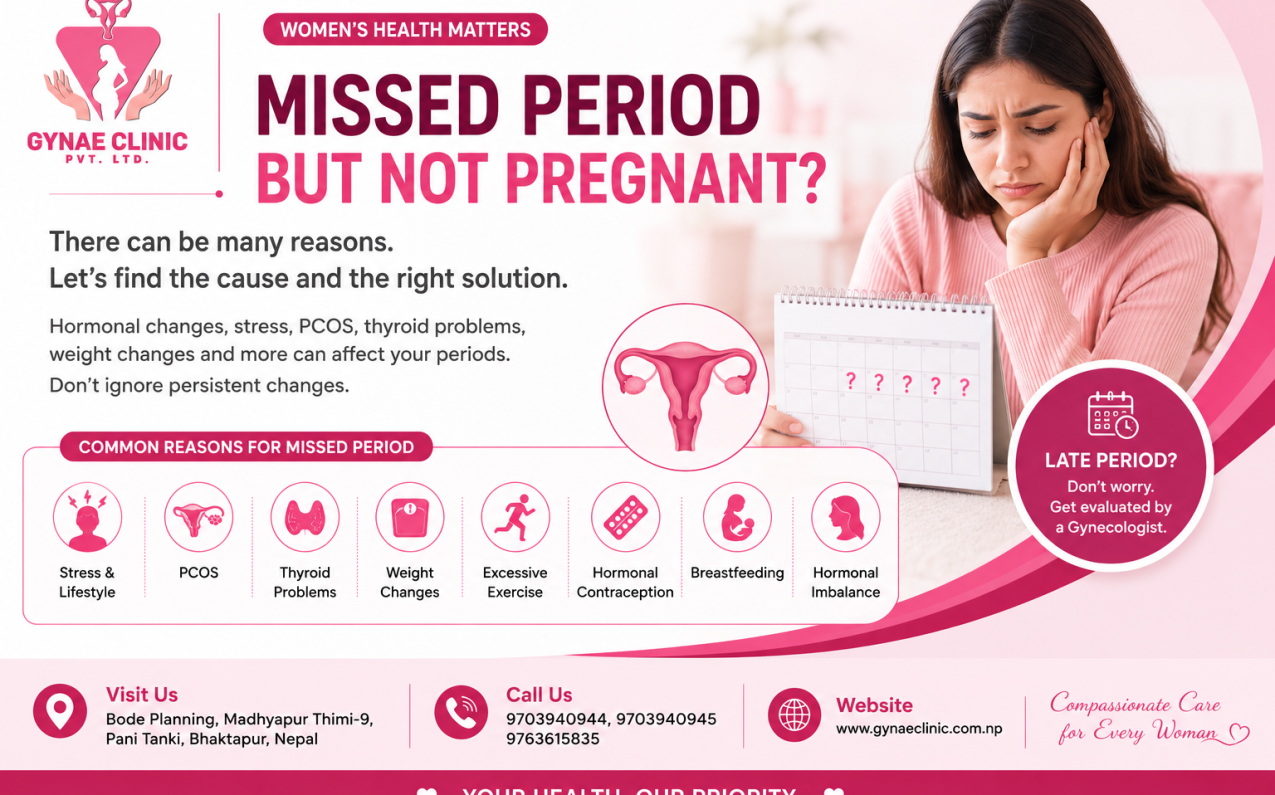
A missed period can be worrying, especially when a pregnancy test is negative. However, pregnancy is not the only reason a period can be late or absent. Stress, PCOS, hormonal changes, weight changes, excessive exercise, thyroid problems, breastfeeding, certain medicines and hormonal contraception can all affect the menstrual cycle.
If your period is late and pregnancy has been ruled out, the next step is to understand why your menstrual cycle has changed rather than taking medicines on your own to bring the period.
What Does a Missed Period Mean?
A missed period means menstrual bleeding has not occurred when you expected it based on your usual cycle.
Occasionally having a late period does not necessarily mean there is a serious problem. Menstrual cycles can naturally vary, and factors such as stress, illness, changes in weight, exercise and hormonal fluctuations can temporarily affect ovulation and menstruation.
When periods repeatedly become irregular or stop for several months, however, medical evaluation is important.
First: Make Sure You Are Not Pregnant
Even if you think pregnancy is unlikely, pregnancy should usually be considered first when a sexually active woman misses a period.
A home pregnancy test is generally most reliable from the first day of a missed period. If you do not know when your period was due, testing at least 21 days after the last unprotected sex can be useful.
What if the pregnancy test is negative?
A negative test does not always completely rule out very early pregnancy. Testing too early can produce a false-negative result. If your period still does not come and pregnancy remains possible, repeating the test after several days or discussing a blood pregnancy test with a healthcare professional may be appropriate.
If repeated pregnancy tests are negative and your periods remain absent, another cause should be investigated.
Why Is My Period Late If I’m Not Pregnant?
There are several possible reasons.
1. Stress
Stress can affect the part of the brain that regulates reproductive hormones. Significant emotional stress, sleep disruption or major changes in daily life can interfere with ovulation and cause a period to become late or temporarily stop.
You may notice this after:
- Work or academic pressure
- Emotional distress
- Major life changes
- Poor sleep
- Prolonged anxiety
- Significant changes in your daily routine
2. PCOS
Polycystic ovary syndrome (PCOS) is an important cause of irregular or missed periods.
PCOS can interfere with regular ovulation, resulting in periods that are:
- Late
- Infrequent
- Irregular
- Occasionally absent for several months
Other symptoms may include acne, increased facial or body hair, weight changes or difficulty becoming pregnant.
If missed periods occur repeatedly together with these symptoms, a gynecological evaluation for PCOS may be appropriate.
3. Hormonal Imbalance
Menstruation depends on coordinated communication between the brain, pituitary gland and ovaries.
Changes in hormones can interfere with ovulation and cause missed or irregular periods.
Depending on your symptoms, a doctor may consider checking hormones such as:
- Thyroid-stimulating hormone (TSH)
- Prolactin
- Follicle-stimulating hormone (FSH)
- Other reproductive hormones when clinically appropriate
The exact tests depend on your age, symptoms, menstrual history and medical history.
4. Thyroid Problems
Both an underactive thyroid and an overactive thyroid can affect menstrual cycles.
You may have additional symptoms such as:
- Unusual tiredness
- Weight changes
- Changes in skin or hair
- Feeling unusually cold or hot
- Changes in heart rate
- Mood changes
If missed periods occur together with these symptoms, thyroid testing may be considered.
5. Sudden Weight Loss or Weight Gain
Major changes in body weight can affect hormonal function and ovulation.
Periods may become irregular after:
- Significant dieting
- Rapid weight loss
- Very low body weight
- Rapid weight gain
- Major changes in eating patterns
Maintaining balanced nutrition and a healthy lifestyle can support normal menstrual function.
6. Excessive Exercise
Very intense exercise, particularly when combined with inadequate calorie intake or low body weight, can interfere with ovulation.
This can happen in women involved in intensive athletic training or strenuous exercise programs.
7. Breastfeeding
Breastfeeding can naturally suppress ovulation and cause periods to become irregular or absent for a period of time.
However, pregnancy can still occur during breastfeeding, so pregnancy should not automatically be ruled out simply because periods have not returned.
8. Hormonal Contraception
Some hormonal contraceptive methods can make periods lighter, irregular or absent.
These can include certain:
- Birth control pills
- Hormonal injections
- Hormonal implants
- Hormonal intrauterine systems
After stopping some hormonal contraceptives, it can also take some time for regular ovulation and menstruation to return.
9. Perimenopause
As menopause approaches, menstrual cycles can become increasingly irregular.
Perimenopause commonly occurs in the years before menopause and may be associated with:
- Irregular periods
- Hot flashes
- Night sweats
- Sleep problems
- Mood changes
- Vaginal dryness
Age and individual circumstances matter when assessing these changes.
10. Certain Medicines
Some medicines can affect menstrual cycles.
If your periods changed after starting a new medicine, tell your doctor about all medicines and supplements you take rather than stopping prescribed treatment yourself.
Missed Period and Negative Pregnancy Test: What Should You Do?
If your period is late and your pregnancy test is negative, consider these steps:
Step 1: Check when you tested
If you tested very early, pregnancy may not yet have been detectable.
Step 2: Repeat the pregnancy test if necessary
If your period still has not started and pregnancy remains possible, repeat testing after several days or discuss a blood pregnancy test with a healthcare professional.
Step 3: Track your menstrual cycle
Record:
- First day of your last period
- Typical cycle length
- Number of days your period lasts
- Any spotting
- Weight changes
- Stress
- Medications
- New symptoms
This information can help your gynecologist identify patterns.
Step 4: Look for other symptoms
Tell your doctor if you also have:
- Acne
- Excess facial hair
- Weight changes
- Hair loss
- Breast discharge
- Pelvic pain
- Headaches
- Vision changes
- Excessive tiredness
These symptoms can provide important clues about the underlying cause.
What Tests May Be Needed for a Missed Period?
There is no single test that is appropriate for every woman.
Depending on your history and examination, a gynecologist may recommend:
Pregnancy test
This is commonly the first step when pregnancy is possible.
Thyroid testing
A thyroid function test may help identify thyroid-related menstrual problems.
Hormonal blood tests
Depending on symptoms, tests such as FSH, prolactin and other reproductive hormones may be considered.
Pelvic ultrasound
An ultrasound may be recommended when the doctor needs to evaluate the uterus, ovaries or other pelvic structures.
Additional investigations
Further tests may be needed when symptoms suggest a particular hormonal, ovarian, pituitary or structural cause.
The right tests depend on the individual patient. Not every woman with one late period needs extensive testing.
Can PCOS Cause a Missed Period Even When You’re Not Pregnant?
Yes.
PCOS can cause irregular ovulation, which can result in long gaps between periods.
A woman with PCOS may notice:
- Periods occurring only every several weeks or months
- Acne
- Increased facial hair
- Weight changes
- Difficulty getting pregnant
- Oily skin
- Irregular menstrual cycles
However, not every woman with irregular periods has PCOS. Other causes, including thyroid problems, stress, weight changes and other hormonal conditions, can produce similar symptoms.
A proper evaluation is therefore more useful than assuming every missed period is caused by PCOS.
Is It Normal to Miss One Period?
Sometimes, yes.
A single late or missed period can happen because of temporary changes in stress, sleep, weight, exercise, illness or hormones.
However, repeated missed periods should not simply be ignored.
If you have missed three periods in a row, medical evaluation is recommended.
When Should You See a Gynecologist?
Consider seeing a gynecologist if:
- You repeatedly miss your periods
- Your periods suddenly become irregular
- You have missed three periods in a row
- Pregnancy tests are negative but periods remain absent
- You have significant weight changes
- You have excessive facial or body hair
- You have persistent acne with irregular periods
- You have nipple discharge unrelated to breastfeeding
- You have pelvic pain
- You are having difficulty becoming pregnant
- You have symptoms suggesting a thyroid or hormonal problem
Early evaluation can help identify the cause and prevent prolonged menstrual problems.
When Is a Missed Period an Emergency?
A missed period itself is usually not an emergency.
However, seek urgent medical care if pregnancy is possible and you develop symptoms such as severe or worsening abdominal/pelvic pain, fainting, marked dizziness or heavy bleeding.
These symptoms require prompt assessment because some pregnancy-related conditions can be serious.
Treatment for Missed Periods Depends on the Cause
There is no single medicine that is appropriate for every missed period.
Treatment may involve addressing the underlying cause, such as:
- Managing PCOS
- Treating thyroid problems
- Addressing nutritional or weight-related factors
- Managing excessive exercise
- Addressing significant stress
- Reviewing medications or contraception
- Treating other hormonal conditions
In some situations, hormonal treatment may be recommended by a doctor. Treatment should be based on the underlying diagnosis rather than simply trying to force menstrual bleeding.
Avoid taking medicines to “bring your period” without medical advice
Taking hormonal tablets or other medicines without knowing the cause can mask the underlying problem and may not be appropriate for you.
Missed Periods and Fertility
Irregular or absent periods can sometimes indicate that ovulation is not occurring regularly.
If ovulation is irregular, becoming pregnant can be more difficult. Conditions such as PCOS and some hormonal disorders can affect both menstrual cycles and fertility.
If you are trying to conceive and your periods are consistently irregular, a gynecological or fertility evaluation can help identify whether you are ovulating regularly and whether additional testing is needed.
Missed Period but Not Pregnant in Bhaktapur
Women searching for missed period treatment in Bhaktapur, late period treatment in Madhyapur Thimi, or a gynecologist for irregular periods near Bhaktapur can seek professional evaluation rather than relying on self-treatment.
Gynae Clinic Pvt. Ltd. is located in Bode Planning, Madhyapur Thimi-9, Pani Tanki, Bhaktapur, Nepal, and serves women from nearby areas including Bode, Thimi, Lokanthali, Gatthaghar, Kaushaltar, Kausaltar, Jadibuti, Suryabinayak, Sallaghari and surrounding areas of Bhaktapur and Kathmandu Valley.
If your period is repeatedly late, a gynecological assessment can help determine whether the cause is PCOS, hormonal imbalance, thyroid dysfunction, stress, weight changes or another condition.
Frequently Asked Questions
Can I miss my period and still not be pregnant?
Yes. Pregnancy is only one possible cause of a missed period. Stress, PCOS, thyroid problems, weight changes, excessive exercise, breastfeeding, hormonal contraception and other factors can also affect menstruation.
Why is my period 10 days late but the pregnancy test is negative?
Testing too early can produce a false-negative result, particularly if ovulation occurred later than usual. If pregnancy remains possible, repeat the test after several days and seek medical advice if your period remains absent.
How long can stress delay a period?
There is no fixed number of days because the effect of stress varies between women. Significant stress can interfere with ovulation and temporarily delay or stop menstruation.
Can PCOS cause periods to stop completely?
PCOS can cause very infrequent or absent periods because ovulation may not occur regularly. However, other conditions can also cause absent periods, so proper evaluation is important.
Can thyroid problems cause missed periods?
Yes. Both an underactive and overactive thyroid can contribute to menstrual irregularities.
Should I take medicine if my period is late?
Do not take hormonal medicine simply to induce a period without identifying the cause. The appropriate treatment depends on why your period is late.
When should I worry about a missed period?
One occasional late period may not indicate a serious problem, but repeated missed periods, three consecutive missed periods, or associated symptoms such as pelvic pain, abnormal discharge, nipple discharge, excessive hair growth or major weight changes should be medically evaluated.
Conclusion
A missed period does not always mean pregnancy. If your pregnancy test is negative, the delay may be related to stress, PCOS, hormonal changes, thyroid problems, weight changes, excessive exercise, breastfeeding, contraception or other medical causes.
The most important step is to find the reason instead of repeatedly taking medication to bring on your period. If missed or irregular periods continue, a gynecologist can assess your symptoms, determine which tests are appropriate and recommend treatment based on the underlying cause.
If you are looking for missed period treatment, irregular period treatment or a gynecologist in Bhaktapur, Gynae Clinic Pvt. Ltd. provides women’s healthcare and gynecological consultation in Madhyapur Thimi.
Gynae Clinic Pvt. Ltd.
Address: Bode Planning, Madhyapur Thimi-9, Pani Tanki, Bhaktapur, Nepal
Phone: 9703940944, 9703940945, 9763615835
Website: www.gynaeclinic.com.np
Author: Gynae Clinic Pvt. Ltd. Medical Content Team
Medical Disclaimer
This article is for general educational purposes and does not replace an individual medical consultation, examination, diagnosis or treatment. A missed or irregular period can have several causes, and pregnancy should be appropriately ruled out when relevant. If symptoms are persistent, severe, recurrent or associated with significant pain or abnormal bleeding, seek professional medical evaluation. Complex cases may require specialized care at an appropriate higher-level facility.