


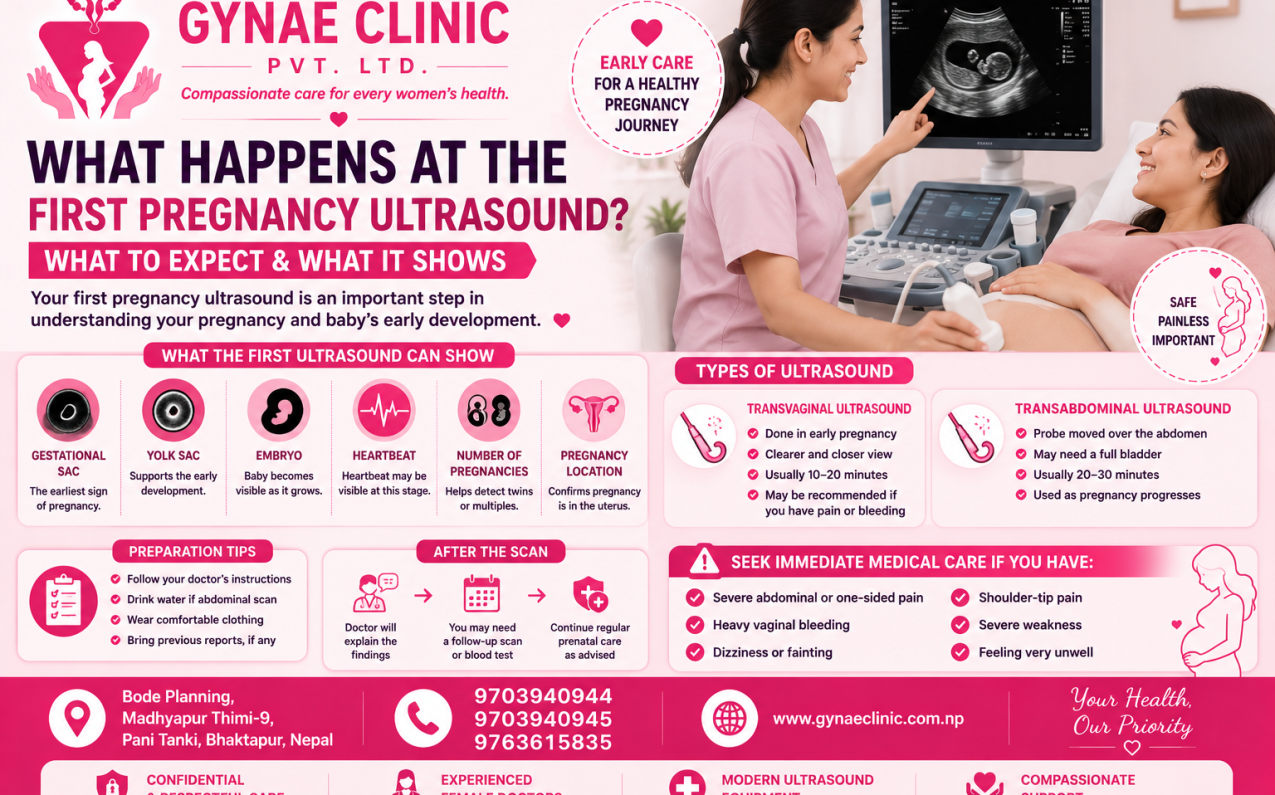
Finding out that you are pregnant can bring excitement, happiness and plenty of questions. One of the first questions many women ask is:
“What happens at the first pregnancy ultrasound?”
An early pregnancy ultrasound helps healthcare professionals assess the pregnancy, depending on how far along you are and why the scan is being performed. It may help confirm the pregnancy location, assess early development, estimate gestational age and identify whether there is more than one pregnancy. In some situations, it is also used to investigate pain or bleeding.
The exact timing and type of the first pregnancy ultrasound can vary. A very early scan and a later first-trimester dating scan are not necessarily the same examination.
What Is the First Pregnancy Ultrasound?
A pregnancy ultrasound uses sound waves to create images of the uterus and developing pregnancy. Unlike X-rays, ultrasound does not use ionizing radiation. Routine ultrasound is considered safe when performed appropriately by trained professionals.
Depending on the stage of pregnancy and the reason for the scan, your healthcare professional may perform:
- Transabdominal ultrasound – the probe moves over your abdomen.
- Transvaginal ultrasound – a covered, lubricated probe is gently inserted into the vagina to obtain a closer view of the uterus and early pregnancy.
A transvaginal scan can provide clearer images in very early pregnancy and may be particularly useful when the pregnancy is only a few weeks along or when there is pain or bleeding.
When Is the First Pregnancy Ultrasound Done?
There is no single week that is correct for every woman.
The timing depends on:
- Your last menstrual period
- Whether your menstrual cycles are regular
- Whether you have already had a positive pregnancy test
- Previous pregnancy history
- Abdominal or pelvic pain
- Vaginal bleeding
- Risk of ectopic pregnancy
- The purpose of the scan
- Your healthcare provider’s assessment
A very early pregnancy scan may be performed around the first few weeks after a positive pregnancy test, particularly when there are symptoms or a clinical reason for early assessment.
A dating scan is generally performed later in the first trimester. For example, NHS guidance describes a routine dating scan around 11–14 weeks, while earlier ultrasound may be used when clinically indicated.
So, when someone says “first pregnancy ultrasound,” it is important to clarify which type of scan they mean.
What Happens Before the Ultrasound?
Before the scan, your healthcare professional may ask about:
- The first day of your last menstrual period
- Your usual menstrual cycle
- The date of your positive pregnancy test
- Pregnancy symptoms
- Previous pregnancies
- Previous miscarriage
- Previous ectopic pregnancy
- Vaginal bleeding
- Abdominal or pelvic pain
- Medications
- Relevant medical history
If you are having pain or bleeding, these details are particularly important because they can help determine whether an early pregnancy ultrasound is needed and what type of scan may be appropriate.
You may also be asked to provide a urine sample or have a pregnancy blood test depending on your circumstances.
Do You Need a Full Bladder?
It depends on the type and timing of the ultrasound.
For a transabdominal ultrasound, a fuller bladder may sometimes help improve visualization.
For an early transvaginal ultrasound, you may instead be asked to empty your bladder before the scan.
Your clinic or sonographer will tell you what preparation is needed for your particular examination.
What Happens During a Transabdominal Pregnancy Ultrasound?
If an abdominal scan is appropriate, you will usually lie on your back and expose your abdomen.
The sonographer or healthcare professional will:
- Apply ultrasound gel to your abdomen.
- Move the ultrasound probe across your abdomen.
- View the pregnancy on the ultrasound screen.
- Take measurements and images as needed.
- Assess the uterus and developing pregnancy.
Some pressure may be applied to your abdomen to obtain clearer images. Routine ultrasound scans are generally painless, although you may experience some pressure or discomfort.
What Happens During a Transvaginal Ultrasound?
A transvaginal ultrasound is commonly used during very early pregnancy because it can provide a closer and clearer view.
During the procedure:
- You will usually be asked to empty your bladder.
- You will lie in a private examination area.
- The ultrasound probe is covered and lubricated.
- The probe is gently inserted into the vagina.
- Images of the uterus and pelvic structures are obtained.
- The pregnancy is assessed according to its stage of development.
The procedure is generally brief. Cambridge University Hospitals describes an early-pregnancy transvaginal scan as taking approximately 10–20 minutes.
A transvaginal ultrasound does not increase the risk of miscarriage.
What Can the First Early Pregnancy Ultrasound Show?
Depending on how early the scan is performed, the ultrasound may show different structures.
Possible findings include:
Gestational sac
This is one of the earliest structures visible inside the uterus.
Yolk sac
The yolk sac can become visible as the pregnancy develops.
Embryo or fetal pole
The embryo becomes visible as the pregnancy progresses.
Cardiac activity
Cardiac activity can become visible during early pregnancy, depending on gestational age and the quality and type of ultrasound examination.
Pregnancy location
One important purpose of an early ultrasound is determining whether the pregnancy is located inside the uterus.
Number of pregnancies
The scan may identify a multiple pregnancy, such as twins.
What If the Baby Is Too Small to See?
This is one of the most important things to understand about an early ultrasound.
Not seeing an embryo on a very early scan does not automatically mean miscarriage.
If the pregnancy is earlier than expected, the gestational sac may be visible before the yolk sac or embryo can be clearly seen.
This can happen when:
- Ovulation occurred later than expected.
- Your menstrual cycles are irregular.
- Your last menstrual period is uncertain.
- The pregnancy is simply very early.
Your doctor may recommend a repeat ultrasound after an appropriate interval rather than making a premature diagnosis.
This is particularly important because an early ultrasound provides only a snapshot of pregnancy development at that particular moment.
What If the Ultrasound Shows an Empty Gestational Sac?
An empty gestational sac can have more than one explanation.
It may mean:
- The pregnancy is still too early.
- Pregnancy dates are inaccurate.
- The pregnancy has uncertain viability.
- An anembryonic pregnancy may be developing.
A diagnosis of miscarriage should not be made solely because one very early scan does not show an embryo. Ultrasound measurements and appropriate follow-up are important.
If you want to understand this in more detail, read our related article:
Empty Gestational Sac: Causes, Diagnosis and Next Steps
Can the First Ultrasound Confirm the Pregnancy Is in the Uterus?
Yes, an early ultrasound can often help determine the location of the pregnancy.
This is particularly important when there is:
- Abdominal pain
- One-sided pelvic pain
- Vaginal bleeding
- Previous ectopic pregnancy
- Pregnancy with an uncertain location
A transvaginal ultrasound is generally more accurate than an abdominal ultrasound for identifying the location of a very early pregnancy.
What If the Pregnancy Cannot Be Seen?
Sometimes a woman has a positive pregnancy test but the pregnancy cannot yet be clearly identified on ultrasound.
This does not automatically mean ectopic pregnancy.
Possible explanations include:
- Pregnancy is too early.
- The pregnancy has already ended.
- The pregnancy is located outside the uterus.
Depending on the situation, your doctor may recommend:
- Repeat ultrasound
- Quantitative Beta-hCG testing
- Repeat Beta-hCG testing
- Clinical examination
- Monitoring of symptoms
Early ectopic pregnancy can sometimes be difficult to identify on the first scan, which is why follow-up can be important.
What Does the Doctor Measure During the First Ultrasound?
Depending on gestational age and the type of scan, measurements may include:
- Gestational sac size
- Embryo size
- Crown-rump length
- Pregnancy location
- Number of embryos
- Cardiac activity when visible
- Uterine findings
- Ovarian or adnexal findings when clinically relevant
Crown-rump length is commonly used to assess early fetal size and help establish gestational age.
Can the First Ultrasound Tell How Many Weeks Pregnant You Are?
An ultrasound can help estimate gestational age.
However, the accuracy of pregnancy dating depends on the stage of pregnancy and the measurements available.
A later first-trimester dating scan can provide an important estimate of gestational age and expected due date.
If your ultrasound date and menstrual dates differ, your healthcare professional will interpret the results based on the complete clinical picture.
Can the First Ultrasound Show the Baby’s Heartbeat?
If the pregnancy is sufficiently advanced, cardiac activity may be visible on ultrasound.
But if the pregnancy is very early, not seeing cardiac activity does not automatically mean that something is wrong.
The timing of development matters.
If the pregnancy is too early for a definitive assessment, your doctor may recommend another ultrasound rather than reaching a premature conclusion.
What If You Have No Pregnancy Symptoms?
Some women have:
- Nausea
- Breast tenderness
- Fatigue
- Increased urination
while others have very few symptoms.
The absence of pregnancy symptoms does not by itself indicate that the pregnancy is unhealthy.
Similarly, pregnancy symptoms alone cannot confirm that everything is progressing normally.
Ultrasound and appropriate medical assessment provide more useful information.
You can also read:
Early Pregnancy Symptoms: First Signs of Pregnancy in Bhaktapur
What If You Have Brown Discharge Before the Ultrasound?
Light brown discharge can represent old blood and can occur for different reasons.
However, bleeding during pregnancy should be considered together with symptoms and pregnancy stage.
If brown discharge occurs with:
- Increasing bleeding
- Abdominal pain
- One-sided pain
- Dizziness
- Fainting
- Shoulder-tip pain
seek medical assessment promptly.
For more information:
Brown Discharge During Early Pregnancy: Causes and When to Worry
What If You Have Pregnancy Cramps?
Mild cramping can occur during early pregnancy and does not automatically indicate a problem.
However, severe, persistent or one-sided pain requires medical assessment.
If cramps are accompanied by bleeding, dizziness or fainting, urgent evaluation may be necessary.
Read our related guide:
Pregnancy Cramps Without Bleeding: Is It Normal?
What Happens After the Ultrasound?
After the scan, your healthcare professional will discuss the findings and recommend the next step.
Depending on the results, you may be advised to:
Continue routine pregnancy care
If the pregnancy is developing appropriately.
Schedule another ultrasound
If the pregnancy is too early or the findings are uncertain.
Have Beta-hCG testing
If additional information about early pregnancy development is clinically useful.
Attend an early pregnancy assessment
If there is bleeding, pain or concern about miscarriage or ectopic pregnancy.
Continue antenatal care
As the pregnancy progresses.
The next scan depends on your pregnancy stage and individual medical needs.
Is the First Pregnancy Ultrasound Painful?
Most women do not find ultrasound painful.
An abdominal scan may cause mild pressure from the probe.
A transvaginal scan may feel unusual or mildly uncomfortable, but it should not usually be painful.
If you experience significant discomfort, tell the healthcare professional performing the examination.
How Long Does a Pregnancy Ultrasound Take?
The duration depends on the type of scan and how much information needs to be obtained.
A standard ultrasound may take around 20–30 minutes, although some scans are shorter or longer.
An early transvaginal scan may take approximately 10–20 minutes.
If the images are difficult to obtain or additional assessment is required, the examination may take longer.
Is Ultrasound Safe During Pregnancy?
Ultrasound uses sound waves rather than ionizing radiation.
Diagnostic ultrasound has been used extensively during pregnancy, and current guidance describes it as having no known harmful effects when appropriately performed.
Your healthcare professional will recommend scans according to your clinical needs.
First Pregnancy Ultrasound: What Should You Bring?
It can be useful to bring:
- Your pregnancy test result, if available
- Previous ultrasound reports
- Previous medical records relevant to pregnancy
- Your last menstrual period information
- A list of medications and supplements
- Information about previous pregnancies
- Details of any bleeding or pain
- Questions you want to ask your doctor
If you are anxious, bringing a trusted support person may also be helpful where clinic policy permits.
Questions to Ask at Your First Pregnancy Ultrasound
You can ask your healthcare professional:
- How far along does the pregnancy appear to be?
- Is the pregnancy located inside the uterus?
- Is the gestational sac developing normally?
- Is a yolk sac visible?
- Is the embryo visible?
- Is cardiac activity visible?
- Does the pregnancy size match the estimated dates?
- Is another ultrasound needed?
- Do I need Beta-hCG testing?
- When should my next pregnancy checkup be?
Understanding the scan can make the early pregnancy journey less stressful.
First Pregnancy Ultrasound Near Bhaktapur, Madhyapur Thimi, Koteshwor & Jadibuti
If you are searching for first pregnancy ultrasound in Bhaktapur, early pregnancy ultrasound near Madhyapur Thimi, or pregnancy checkup near Koteshwor and Jadibuti, Gynae Clinic Pvt. Ltd. provides pregnancy-related consultation and ultrasound guidance.
Gynae Clinic Pvt. Ltd.
Address:
Bode Planning, Madhyapur Thimi-9, Pani Tanki, Bhaktapur, Nepal
Contact:
9703940944 | 9703940945 | 9763615835
Website:
www.gynaeclinic.com.np
Gynae Clinic is conveniently located for women from Bode, Madhyapur Thimi, Kausaltar, Lokanthali, Jadibuti, Koteshwor, Balkumari, Gatthaghar, Radhe Radhe, Sallaghari, Sanothimi, Suryabinayak, Jagati, Banepa and Dhulikhel, as well as nearby areas of Kathmandu Valley.
The clinic provides pregnancy-related consultation, pregnancy monitoring, ultrasound guidance and women’s healthcare.
Frequently Asked Questions About the First Pregnancy Ultrasound
When should I have my first pregnancy ultrasound?
The timing depends on the purpose of the scan and how far along you are. An early scan may be performed when pregnancy location or development needs assessment, while a routine dating scan is commonly performed later in the first trimester.
Is the first pregnancy ultrasound abdominal or vaginal?
It can be either. A transvaginal ultrasound may be preferred in very early pregnancy because it can provide clearer images.
Does a transvaginal ultrasound cause miscarriage?
No. A properly performed transvaginal ultrasound does not increase the risk of miscarriage.
Can the first ultrasound detect an ectopic pregnancy?
An early ultrasound can help determine pregnancy location and may detect an ectopic pregnancy, although very early pregnancies can sometimes be difficult to locate and require follow-up.
What if nothing is visible on the first ultrasound?
The pregnancy may simply be too early to see clearly. Depending on the situation, your doctor may recommend repeat ultrasound and/or Beta-hCG testing.
Can I see the baby’s heartbeat at the first ultrasound?
If the pregnancy is sufficiently advanced, cardiac activity may be visible. If the scan is performed very early, it may not yet be visible.
How long does an early pregnancy ultrasound take?
A transvaginal early pregnancy scan may take approximately 10–20 minutes, although the duration varies.
Should I be worried if my ultrasound shows an empty sac?
Not necessarily. An empty sac can occur when the pregnancy is too early to see an embryo. If the findings are uncertain, a repeat ultrasound may be needed before determining viability.
Can I have an ultrasound if I have early pregnancy bleeding?
Yes. Ultrasound is commonly used when women have bleeding or pain during early pregnancy to help assess the pregnancy.
What symptoms require urgent medical attention?
Seek urgent medical care for severe abdominal or one-sided pain, heavy bleeding, shoulder-tip pain, dizziness, fainting or severe weakness during early pregnancy. These can be warning signs of an ectopic pregnancy or another serious complication.
Final Takeaway
The first pregnancy ultrasound is an important step in early pregnancy care, but what can be seen depends heavily on how early the scan is performed.
The scan may help assess:
Pregnancy location → gestational age → gestational sac → yolk sac → embryo → cardiac activity → number of pregnancies → uterus and surrounding structures.
A very early scan may not show everything yet. An empty sac or an absent heartbeat on an early scan does not automatically mean miscarriage when the pregnancy is too early or the findings are inconclusive.
When necessary, repeat ultrasound and/or Beta-hCG testing can help clarify the situation.
If you have severe pain, one-sided pain, heavy bleeding, dizziness, fainting or shoulder-tip pain, seek urgent medical attention rather than waiting for a routine appointment.
Gynae Clinic Pvt. Ltd.
Bode Planning, Madhyapur Thimi-9, Pani Tanki, Bhaktapur, Nepal
9703940944 | 9703940945 | 9763615835
www.gynaeclinic.com.np
Compassionate care for every women’s health.
Medical Disclaimer
This article is for general educational purposes and does not replace an individual medical consultation. The timing and findings of a pregnancy ultrasound vary according to gestational age and individual circumstances. Seek prompt medical care for severe pain, heavy bleeding, dizziness, fainting or other concerning symptoms. Complex cases may need specialized referral.
Author: Gynae Clinic Pvt. Ltd.


