

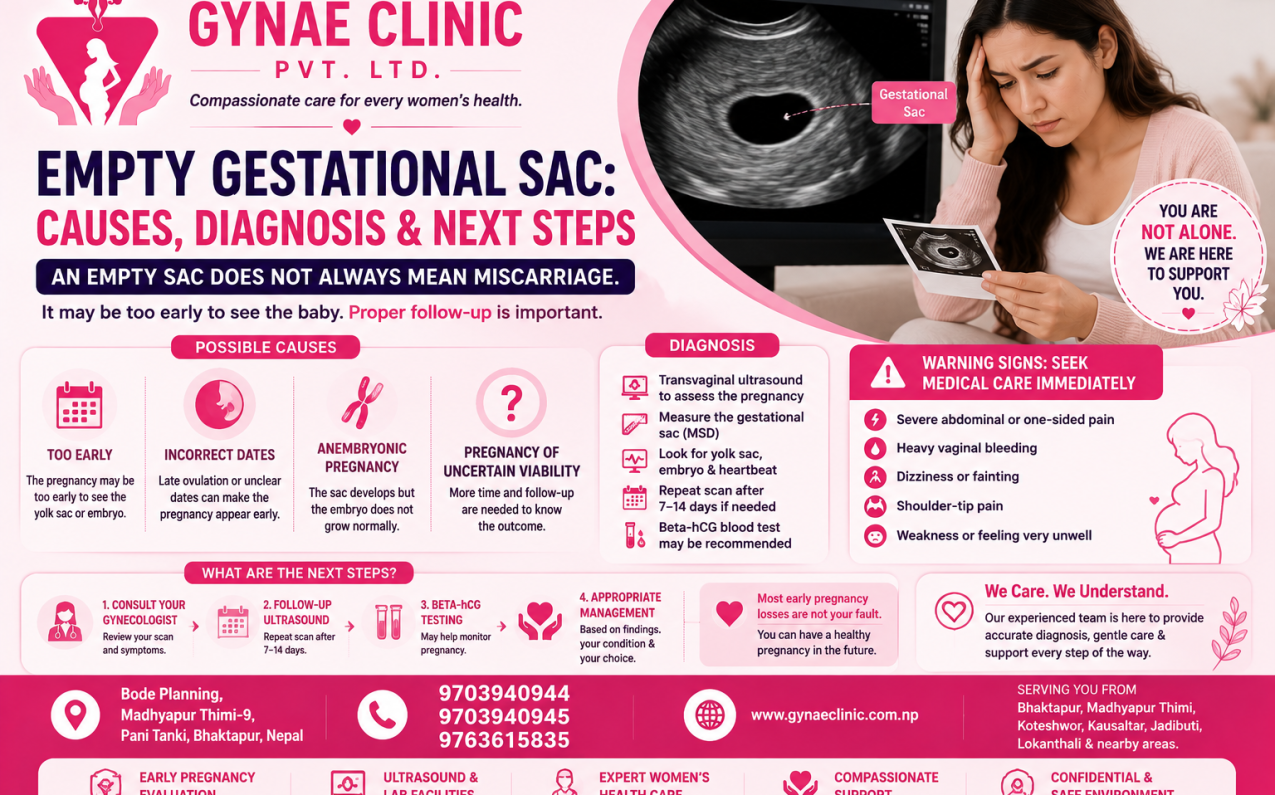
Seeing an empty gestational sac on an early pregnancy ultrasound can be confusing and emotionally difficult. An empty sac does not always mean that the pregnancy has ended. Sometimes the pregnancy is simply too early to see an embryo or yolk sac, particularly when ovulation occurred later than expected or the pregnancy dates are uncertain.
In other situations, an empty gestational sac may indicate an anembryonic pregnancy, sometimes called an empty sac pregnancy or blighted ovum, where the pregnancy sac develops but the embryo does not develop normally.
The most important point is:
One early ultrasound showing an empty sac should not automatically be interpreted as a miscarriage.
The size of the gestational sac, whether a yolk sac is present, the timing of the scan, symptoms, pregnancy dates and follow-up ultrasound all matter.
What Is an Empty Gestational Sac?
A gestational sac is the early fluid-filled structure that develops inside the uterus during pregnancy.
On an early ultrasound, healthcare professionals may eventually expect to see:
- Gestational sac
- Yolk sac
- Embryo/fetal pole
- Cardiac activity
These structures do not necessarily become visible at exactly the same time in every pregnancy.
Therefore, if an ultrasound shows a gestational sac but no visible embryo, it may simply be too early to determine whether the pregnancy is developing normally. This is often described as an intrauterine pregnancy of uncertain viability.
Does an Empty Gestational Sac Mean Miscarriage?
Not necessarily.
This is one of the most important things to understand.
An empty gestational sac can mean:
The pregnancy is simply too early
The pregnancy may be younger than expected because:
- Ovulation occurred later.
- Implantation occurred later.
- Menstrual dates are uncertain.
- Periods are irregular.
- The pregnancy was conceived later than estimated.
In this situation, a repeat ultrasound may later show a yolk sac and embryo.
The pregnancy may have stopped developing
An empty sac can also occur with an anembryonic pregnancy, in which a gestational sac develops but an embryo does not develop normally.
The diagnosis should be made using established ultrasound criteria rather than based only on the phrase “empty sac.”
What Is an Anembryonic Pregnancy?
An anembryonic pregnancy is an early pregnancy loss in which a gestational sac develops but an embryo does not develop or is no longer visible.
You may hear terms such as:
- Empty gestational sac
- Empty sac pregnancy
- Anembryonic pregnancy
- Blighted ovum
- Early pregnancy loss
Although these terms are sometimes used interchangeably, the important issue is whether ultrasound findings meet the criteria for a non-viable pregnancy.
An anembryonic pregnancy may cause bleeding and cramping, but some women have no symptoms at all and only discover the problem during an ultrasound.
Why Can an Empty Gestational Sac Happen?
There are several possibilities.
1. The Pregnancy Is Too Early
This is one of the most common reasons for an uncertain early ultrasound.
A pregnancy may be developing normally but be too small for the embryo to be seen.
This is particularly possible when:
- Your cycle is irregular.
- You are unsure of your last menstrual period.
- You ovulated later than usual.
- Your dates were calculated only from the last menstrual period.
A repeat scan after an appropriate interval can provide much more information.
2. Anembryonic Pregnancy
An anembryonic pregnancy occurs when the gestational sac develops but the embryo does not develop normally.
This is a type of early pregnancy loss.
Importantly, it is not caused by something you did.
Early pregnancy losses are usually related to problems with the development of the pregnancy, often involving chromosomal abnormalities.
3. Incorrect Pregnancy Dating
Pregnancy is traditionally dated from the first day of the last menstrual period, but ovulation does not necessarily occur on exactly the same day in every cycle.
For example, if you ovulated later than expected, a pregnancy described as “7 weeks” based on your period might actually be considerably younger.
This is why an apparently empty sac can sometimes become a normally developing pregnancy on a repeat ultrasound.
4. Pregnancy of Uncertain Viability
Sometimes the ultrasound simply does not provide enough information to determine whether the pregnancy will continue normally.
This is called an intrauterine pregnancy of uncertain viability.
A repeat ultrasound is commonly used to determine whether the pregnancy has developed appropriately.
When Can an Empty Sac Be Diagnosed as a Miscarriage?
This is where careful ultrasound assessment becomes extremely important.
For a transvaginal ultrasound, commonly used diagnostic criteria include:
Mean sac diameter of 25 mm or more with no embryo
An empty gestational sac with a mean sac diameter (MSD) of at least 25 mm and no embryo is considered diagnostic of pregnancy failure in commonly used early-pregnancy ultrasound guidelines.
However, because an incorrect diagnosis can have serious consequences, clinical services may use repeat scanning or confirmation by another experienced sonographer when appropriate.
Timing between scans also matters
If an earlier scan showed a gestational sac but no yolk sac or embryo, a repeat scan after an appropriate interval may be required before confirming pregnancy failure.
Some guidelines use:
- At least 14 days after a scan showing a gestational sac without a yolk sac or embryo
- At least 11 days after a scan showing a gestational sac with a yolk sac but no embryo
before diagnosing pregnancy failure based on absent expected development.
The exact approach depends on the ultrasound findings, equipment, clinical situation and local protocol.
Why Should You Not Rush to Diagnose a Miscarriage?
Because pregnancy dates are not always accurate.
If a woman believes she is 7 weeks pregnant but actually conceived later, an ultrasound may appear “behind” without anything being wrong.
A premature diagnosis could incorrectly label a potentially viable pregnancy as a miscarriage.
That is why repeat ultrasound is often the safest approach when the initial findings are uncertain.
What Is the Next Step After an Empty Gestational Sac?
The next step depends on the ultrasound findings.
Step 1: Review the Ultrasound Report
Important information includes:
- Mean sac diameter
- Whether a yolk sac is visible
- Whether an embryo is visible
- Embryo crown-rump length if visible
- Whether cardiac activity is present
- Whether the pregnancy is clearly inside the uterus
- Whether there are ovarian or adnexal abnormalities
- Whether there is pelvic free fluid
Do not focus only on the phrase “empty gestational sac.”
The measurements and complete ultrasound findings matter.
Step 2: Determine Whether the Pregnancy Is Definitely Inside the Uterus
If a true intrauterine gestational sac has been identified, this is different from a situation where a pregnancy test is positive but no pregnancy is seen anywhere on ultrasound.
The latter may be called a pregnancy of unknown location (PUL) and can have several explanations, including very early pregnancy, miscarriage or ectopic pregnancy.
This distinction is extremely important.
Step 3: Repeat the Ultrasound When Appropriate
If the first scan is inconclusive, a repeat ultrasound is often recommended.
Depending on the findings, this may be performed approximately 7–14 days later.
The purpose is to determine whether there has been expected development.
A repeat scan may show:
- A yolk sac
- An embryo
- Cardiac activity
- Appropriate growth
If these structures develop, the pregnancy may be viable.
If expected development does not occur and diagnostic criteria are met, an early pregnancy loss may be confirmed.
Step 4: Beta-hCG Testing May Be Considered
Your healthcare professional may recommend a quantitative β-hCG blood test.
Sometimes repeat β-hCG measurements are used to help assess an early pregnancy, particularly when the ultrasound findings are unclear.
However, β-hCG alone cannot always determine whether an empty gestational sac represents a viable pregnancy or miscarriage.
Ultrasound findings and clinical symptoms remain important.
RCOG notes that blood tests checking pregnancy hormone levels may be used during assessment of early pregnancy loss.
Can Pregnancy Symptoms Continue With an Empty Gestational Sac?
Yes.
You may still experience:
- Breast tenderness
- Nausea
- Fatigue
- Increased urination
- Pregnancy-related discharge
This does not necessarily tell you whether the pregnancy is developing normally.
Similarly, having no pregnancy symptoms does not automatically mean that the pregnancy has ended.
Ultrasound and appropriate clinical assessment are more reliable than symptoms alone.
Can an Empty Gestational Sac Cause Bleeding?
Yes.
Anembryonic pregnancy or early miscarriage can cause:
- Brown discharge
- Pink spotting
- Red bleeding
- Abdominal cramps
- Passage of tissue
However, some women may have no bleeding or pain at all and only discover the pregnancy loss on ultrasound.
Empty Gestational Sac With No Bleeding
If you have an empty gestational sac but no bleeding or pain, do not assume that the pregnancy has ended.
The pregnancy may simply be too early to see the embryo.
Your doctor may recommend a repeat ultrasound after an appropriate interval.
This waiting period can be emotionally difficult, but allowing enough time for development can prevent an incorrect diagnosis.
Empty Gestational Sac With Brown Discharge
Brown discharge usually represents older blood.
It can occur during early pregnancy for several reasons.
If you have:
Empty gestational sac + brown discharge + abdominal pain
you should contact your healthcare provider for appropriate assessment.
For more information, read our related article:
Brown Discharge During Early Pregnancy: Causes and When to Worry
Empty Gestational Sac With One-Sided Pain
This situation requires particular attention.
If you have a positive pregnancy test and an ultrasound that does not clearly establish a normal intrauterine pregnancy, one-sided pain should not be ignored.
Ectopic pregnancy must be considered when pregnancy location or viability is uncertain.
Warning signs include:
- One-sided abdominal pain
- Increasing pain
- Vaginal bleeding
- Shoulder-tip pain
- Dizziness
- Fainting
Seek urgent medical care if severe symptoms develop.
For more information, read:
One-Sided Pain in Early Pregnancy: Causes and Warning Signs
Does an Empty Gestational Sac Mean You Cannot Have a Baby?
No.
Having one anembryonic pregnancy or early miscarriage does not mean that you cannot have a healthy pregnancy in the future.
Most early pregnancy losses are isolated events, and many women go on to have successful pregnancies.
If an early pregnancy loss is confirmed, your gynecologist can discuss appropriate follow-up and future pregnancy planning.
What Happens If the Empty Sac Is Confirmed as a Miscarriage?
If repeat assessment confirms an early pregnancy loss, there are generally several management approaches.
Depending on your symptoms, gestational age and medical circumstances, these may include:
1. Expectant management
Waiting for the body to pass the pregnancy tissue naturally.
2. Medical management
Medication may be used to help the uterus pass the pregnancy tissue.
3. Surgical management
A procedure may be recommended in certain circumstances.
The appropriate option depends on the individual’s clinical situation and should be discussed with a qualified healthcare professional. RCOG describes expectant, medical and surgical options for confirmed early miscarriage.
Is an Empty Gestational Sac Your Fault?
No.
An early pregnancy loss is not caused by ordinary activities such as:
- Walking
- Working
- Normal exercise
- Having sex in an otherwise uncomplicated pregnancy
- Feeling stressed
- Travelling
- Sleeping in a particular position
If an anembryonic pregnancy is confirmed, it is important not to blame yourself.
Can You Prevent an Anembryonic Pregnancy?
There is usually no reliable way to prevent an individual anembryonic pregnancy.
Early pregnancy losses are often related to problems in the development of the pregnancy that are outside a woman’s control.
Healthy pre-pregnancy and pregnancy care can support overall reproductive health, but it cannot guarantee that an early pregnancy will continue normally.
What Should You Do While Waiting for the Repeat Scan?
The waiting period can be difficult.
While waiting:
- Follow your healthcare provider’s instructions.
- Monitor bleeding and pain.
- Attend the scheduled repeat ultrasound.
- Take prescribed medicines as directed.
- Avoid self-starting medicines or treatments.
- Seek urgent care if severe symptoms develop.
Most importantly, do not assume the outcome from the first scan unless your doctor has confirmed that the ultrasound meets diagnostic criteria.
When Is an Empty Gestational Sac an Emergency?
An empty gestational sac itself is not usually an emergency.
However, symptoms accompanying an early pregnancy can be an emergency.
Seek urgent medical attention if you develop:
Severe abdominal or pelvic pain
Especially sudden or strongly one-sided pain.
Heavy vaginal bleeding
Heavy bleeding that rapidly soaks a pad requires urgent evaluation.
Shoulder-tip pain
This can be associated with internal bleeding in an ectopic pregnancy.
Dizziness or fainting
These can be warning signs of significant internal bleeding.
Severe weakness or feeling very unwell
Do not wait for symptoms to become worse.
NHS guidance advises urgent/emergency assessment for pregnancy-related bleeding accompanied by severe abdominal pain, shoulder pain, dizziness, fainting or heavy bleeding.
Empty Gestational Sac vs Pregnancy of Unknown Location
These are not the same thing.
Empty gestational sac
A sac has been identified within the uterus, but an embryo or yolk sac may not yet be visible.
This may represent:
- Very early intrauterine pregnancy
- Pregnancy of uncertain viability
- Anembryonic pregnancy
Pregnancy of unknown location
A pregnancy test is positive but ultrasound does not clearly identify a pregnancy inside or outside the uterus.
Possible explanations include:
- Very early pregnancy
- Miscarriage
- Ectopic pregnancy
This situation requires appropriate follow-up.
Why Transvaginal Ultrasound May Be Recommended
A transvaginal ultrasound provides a more detailed view of an early pregnancy than an abdominal ultrasound.
It can help assess:
- Gestational sac
- Yolk sac
- Embryo
- Cardiac activity
- Uterus
- Ovaries
- Adnexal structures
RCOG notes that transvaginal scanning may be recommended because it provides a clearer image in early pregnancy.
Can an Empty Sac Become a Normal Pregnancy?
Yes, if the scan was performed too early.
An initially empty sac may later develop visible pregnancy structures on repeat ultrasound.
This is why an inconclusive early scan should not automatically be called a miscarriage.
However, if ultrasound criteria for pregnancy failure are met, or expected development fails to occur on appropriate follow-up, an early pregnancy loss may be diagnosed.
A Simple Example
Imagine a woman believes she is 6 weeks pregnant.
Her ultrasound shows:
Gestational sac → no yolk sac → no embryo
This does not automatically mean miscarriage.
If the sac is small and the pregnancy may be younger than expected, the doctor may recommend waiting and repeating the scan.
If the repeat scan shows normal development, the pregnancy may continue.
If the sac reaches diagnostic criteria for pregnancy failure and no embryo develops, an anembryonic pregnancy may be confirmed.
Empty Gestational Sac: What Should You Ask Your Doctor?
If your ultrasound shows an empty gestational sac, ask:
- What is the mean sac diameter?
- Is a yolk sac visible?
- Is the pregnancy definitely inside the uterus?
- Is this an intrauterine pregnancy of uncertain viability?
- When should I repeat the ultrasound?
- Do I need a quantitative Beta-hCG test?
- Are there any signs suggesting ectopic pregnancy?
- What symptoms should make me seek urgent care?
Having these answers can make the next steps much clearer.
Empty Gestational Sac in Bhaktapur, Madhyapur Thimi, Koteshwor & Nearby Areas
If you are searching for early pregnancy ultrasound and gynecological consultation in Bhaktapur, pregnancy care near Madhyapur Thimi, or a gynecologist near Koteshwor, Jadibuti, Kausaltar or Lokanthali, Gynae Clinic Pvt. Ltd. provides women’s health and pregnancy-related consultation.
Gynae Clinic Pvt. Ltd.
Address:
Bode Planning, Madhyapur Thimi-9, Pani Tanki, Bhaktapur, Nepal
Contact:
9703940944
9703940945
9763615835
Website:
www.gynaeclinic.com.np
The clinic is accessible for women from nearby areas including Bode, Madhyapur Thimi, Kausaltar, Lokanthali, Jadibuti, Koteshwor, Balkumari, Gatthaghar, Radhe Radhe, Sallaghari, Sanothimi, Suryabinayak, Jagati, Banepa and Dhulikhel.
For related information, you can read:
Pregnancy Cramps Without Bleeding: Is It Normal?
and
Brown Discharge During Early Pregnancy: Causes and When to Worry
These internal resources help explain common early-pregnancy symptoms that can occur alongside an uncertain ultrasound finding.
Frequently Asked Questions
What does an empty gestational sac mean?
It means an ultrasound has identified a gestational sac but has not yet shown an embryo. It can be because the pregnancy is very early or because the pregnancy has stopped developing.
Does an empty sac always mean miscarriage?
No. If the pregnancy is very early, a repeat ultrasound may later show normal development. Pregnancy failure should be diagnosed using appropriate ultrasound criteria and follow-up when necessary.
What is an anembryonic pregnancy?
An anembryonic pregnancy is an early pregnancy loss in which a gestational sac develops but an embryo does not develop normally.
What is the gestational sac size for an empty sac miscarriage diagnosis?
A mean sac diameter of 25 mm or more with no embryo on transvaginal ultrasound is a commonly used diagnostic criterion for pregnancy failure. Appropriate clinical confirmation and local protocols should be followed.
How long should I wait before repeating an ultrasound?
Depending on the initial findings, repeat ultrasound is commonly performed after 7–14 days. When a gestational sac is seen without a yolk sac or embryo, some diagnostic protocols require at least 14 days before confirming pregnancy failure based on absent development.
Can an empty gestational sac be caused by incorrect dates?
Yes. Late ovulation or uncertain menstrual dates can make a pregnancy appear earlier than expected.
Can Beta-hCG confirm whether an empty sac is a miscarriage?
Beta-hCG can provide useful information, but it should not be interpreted alone. Ultrasound findings, timing and clinical symptoms are important.
Can I still have pregnancy symptoms with an empty gestational sac?
Yes. Pregnancy hormones can remain elevated, so nausea, breast tenderness or fatigue can continue even when a pregnancy is not developing normally.
What if I have severe pain with an empty gestational sac?
Seek urgent medical assessment, particularly if the pain is one-sided or accompanied by bleeding, dizziness, fainting or shoulder-tip pain because ectopic pregnancy needs to be considered.
Final Takeaway
An empty gestational sac does not automatically mean that you have had a miscarriage.
The pregnancy may simply be too early to see the embryo, particularly when dates are uncertain.
However, an empty sac can also indicate an anembryonic pregnancy, an early pregnancy loss in which the embryo does not develop normally.
The safest approach is to consider:
Ultrasound measurements → pregnancy dates → yolk sac/embryo findings → symptoms → Beta-hCG when appropriate → repeat ultrasound when necessary.
Do not make a final diagnosis based only on one early scan unless the ultrasound findings clearly meet established diagnostic criteria.
If you experience severe abdominal pain, one-sided pain, heavy bleeding, shoulder-tip pain, dizziness or fainting, seek urgent medical attention because ectopic pregnancy or another serious complication needs to be excluded.
Gynae Clinic Pvt. Ltd.
Bode Planning, Madhyapur Thimi-9, Pani Tanki, Bhaktapur, Nepal
9703940944 | 9703940945 | 9763615835
www.gynaeclinic.com.np
Compassionate care for every women’s health.
Medical Disclaimer
This article is for general educational purposes and does not replace an individual medical consultation. An empty gestational sac requires interpretation of ultrasound findings, pregnancy dates and clinical symptoms. Do not assume miscarriage from an early scan without appropriate medical assessment and follow-up. Complex cases may need specialized referral.
Author
Gynae Clinic Pvt. Ltd. – Women’s Health & Gynecology Team