

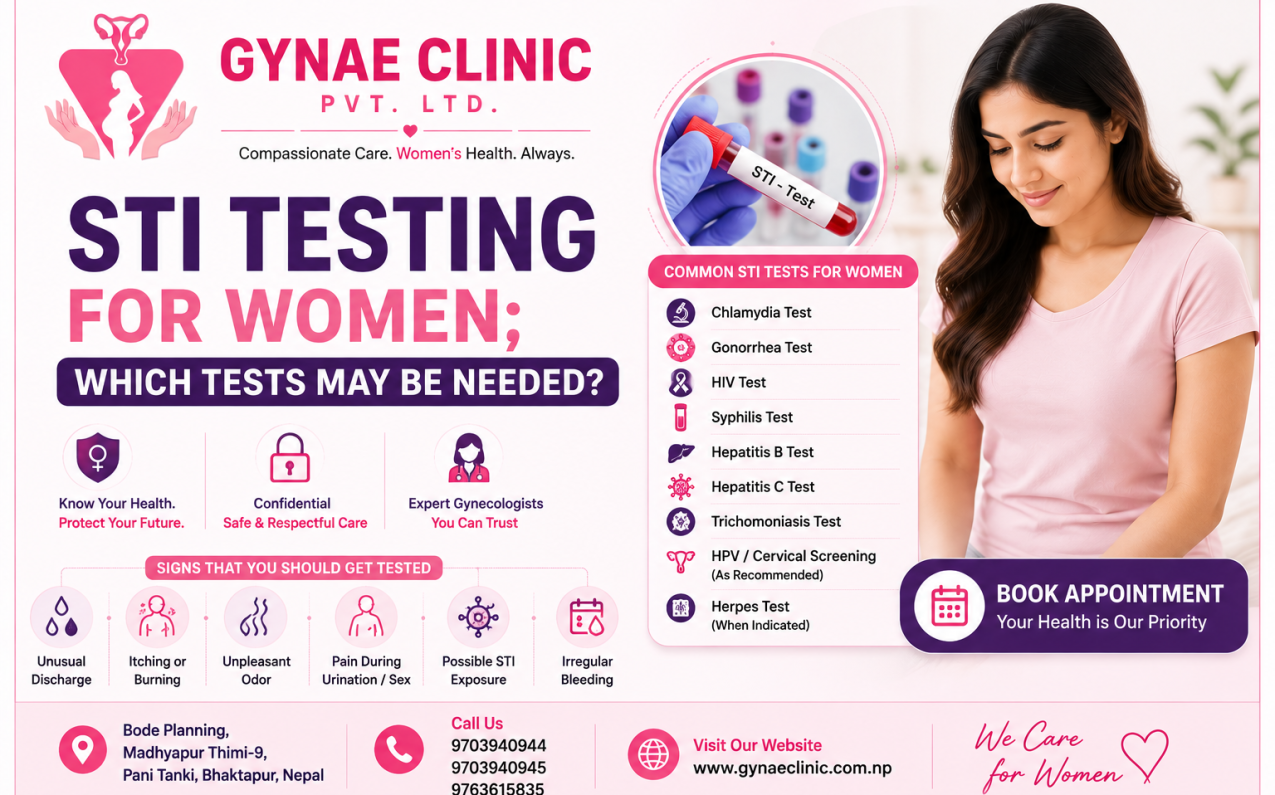
Sexually transmitted infections (STIs) can affect women of any age, and many STIs may cause few or no symptoms. This means you cannot always tell whether you have an STI simply by how you feel.
Depending on your age, symptoms, sexual history, pregnancy status, possible exposure and risk factors, a gynecologist may recommend different STI tests. There is no single test that detects every STI.
If you are searching for STI testing in Bhaktapur, confidential STI testing in Madhyapur Thimi, or a gynecologist for sexual-health concerns, Gynae Clinic Pvt. Ltd. provides confidential women’s health consultation and STI testing guidance in Bode Planning, Madhyapur Thimi-9, Bhaktapur.
What Is STI Testing?
STI testing involves laboratory tests used to detect infections that can be transmitted through sexual contact.
Depending on the suspected infection, testing may involve:
- Blood tests
- Urine tests
- Vaginal swabs
- Cervical samples
- Throat swabs
- Rectal swabs when relevant to sexual exposure
- Other laboratory tests
The correct test depends on where the possible infection occurred, your symptoms, the type and timing of exposure, and your medical history.
Which STI Tests May Women Need?
There is no universal STI test package that is appropriate for every woman.
A healthcare professional may consider some or all of the following.
1. Chlamydia Test
Chlamydia is one of the most important STIs to consider in sexually active women.
It can cause:
- Abnormal vaginal discharge
- Burning during urination
- Pelvic or lower abdominal pain
- Pain during sex
- Bleeding between periods
- Bleeding after sex
However, chlamydia frequently causes no noticeable symptoms.
Testing is commonly performed using a urine sample or vaginal/cervical sample, depending on the testing method and clinical situation.
CDC recommendations include routine screening for sexually active women younger than 25 and screening women aged 25 or older when they have increased risk factors.
2. Gonorrhea Test
Gonorrhea can affect the cervix, urethra, rectum and throat.
Possible symptoms include:
- Abnormal discharge
- Burning during urination
- Pelvic pain
- Bleeding between periods
- Bleeding after sex
- Rectal symptoms
Many women may have no symptoms.
Testing may involve urine or genital samples. If there has been oral or anal sexual exposure, testing at the relevant site may also be considered.
3. HIV Test
HIV testing is an important part of sexual health screening.
HIV may not cause obvious symptoms for years, so symptoms cannot reliably determine whether someone has HIV.
Testing is usually performed using blood or an approved rapid testing method, depending on the setting and test available.
CDC guidance recommends HIV screening for people aged 13–64 and specifically recommends HIV testing for people being evaluated or treated for STIs.
If you are concerned about a previous sexual exposure, speak with a healthcare professional about the appropriate timing and type of HIV test.
4. Syphilis Test
Syphilis is usually diagnosed with blood testing.
It can produce different symptoms at different stages, and some people may not recognize the symptoms.
Possible signs can include:
- Painless genital sores
- Rash
- Swollen lymph nodes
- Unusual skin changes
- Later neurological or other systemic symptoms
Testing may be particularly important when there is increased risk, a sexual partner has syphilis, symptoms suggest syphilis, or another STI has been diagnosed.
Pregnant women should be screened for syphilis early in pregnancy, with repeat testing in certain higher-risk situations.
5. Trichomoniasis Test
Trichomoniasis is a sexually transmitted infection caused by a parasite.
It can cause:
- Vaginal discharge
- Unpleasant odor
- Vaginal itching
- Burning
- Irritation
- Pain during urination
- Discomfort during sex
Some women have no symptoms.
Testing may involve a vaginal sample and laboratory methods such as microscopy or molecular testing, depending on the clinical situation and available diagnostic methods.
Testing may be considered particularly when symptoms suggest trichomoniasis or when a woman has increased risk.
6. Hepatitis B Testing
Hepatitis B can be sexually transmitted as well as transmitted through other routes.
Testing may be appropriate depending on:
- Sexual exposure
- Vaccination status
- Partner’s hepatitis B status
- Previous STI
- Other risk factors
- Pregnancy
Hepatitis B testing can involve different blood markers that help determine whether a person has current infection, previous exposure or immunity.
Pregnant women should be screened for hepatitis B during each pregnancy, according to CDC guidance.
7. Hepatitis C Test
Hepatitis C is primarily transmitted through blood exposure, but sexual transmission can occur in certain circumstances.
A hepatitis C blood test may be recommended depending on age, medical history and risk factors.
Current CDC screening guidance recommends hepatitis C screening for adults aged 18 years and older, with specific considerations based on local prevalence and clinical circumstances.
8. HPV Testing
HPV is different from many other STI tests because HPV testing is primarily used as part of cervical cancer screening rather than as a general STI test.
Certain high-risk HPV types can cause cervical cell changes that may eventually lead to cervical cancer.
Depending on age and screening guidelines, cervical cancer screening may involve:
- HPV testing
- Pap/cytology testing
- HPV and Pap testing together
HPV testing is not the same as a general test for all sexually transmitted infections.
For women concerned about HPV:
HPV Infection in Women: Symptoms, Genital Warts & Cervical Health
https://gynaeclinic.com.np/hpv-infection-in-women-symptoms-genital-warts-cervical-health/
And for women wondering about screening:
HPV Test in Bhaktapur: Who Needs HPV Screening?
https://gynaeclinic.com.np/hpv-test-in-bhaktapur-who-needs-hpv-screening/
9. Genital Herpes Testing
Genital herpes is caused by herpes simplex virus (HSV).
If you have active genital sores or blisters, a healthcare professional may recommend testing a sample from a lesion when appropriate.
Possible symptoms include:
- Painful blisters
- Genital sores
- Burning
- Tingling
- Pain during urination
- Recurrent outbreaks
Routine blood testing for herpes in people who have no symptoms is not recommended for everyone. Testing decisions should be individualized.
For more information:
Genital Herpes in Women: Symptoms, Treatment & Prevention
https://gynaeclinic.com.np/genital-herpes-in-women-symptoms-treatment-prevention/
Do I Need Every STI Test?
No.
This is one of the most important things to understand.
A woman with vaginal discharge does not automatically need every available STI test.
The appropriate testing may depend on:
- Your age
- Symptoms
- Sexual history
- Number of partners
- New sexual partner
- Condom use
- Type of sexual contact
- Partner’s STI status
- Previous STI
- Pregnancy
- Medical history
- Local prevalence and risk factors
A healthcare professional can determine which tests are appropriate for you.
STI Testing Based on Symptoms
Your symptoms can help determine which tests may be useful.
If you have unusual vaginal discharge
Evaluation may include testing for:
- Chlamydia
- Gonorrhea
- Trichomoniasis
- Other vaginal infections such as bacterial vaginosis or candidiasis
Not every abnormal discharge is an STI.
Vaginal Discharge: Is It an STD or Something Else?
https://gynaeclinic.com.np/vaginal-discharge-is-it-an-std-or-something-else-causes-sti-testing-treatment-in-bhaktapur/
If you have genital sores or blisters
Your doctor may consider:
- Herpes evaluation/testing
- Syphilis testing
- Other tests depending on the appearance and history
Do not assume that every genital sore is herpes.
If you have burning while urinating
Depending on your symptoms, evaluation may include:
- Chlamydia testing
- Gonorrhea testing
- Other STI testing
- Urine testing for urinary infection
The cause needs to be determined rather than assuming that every burning sensation is an STI.
If you have pelvic pain
Pelvic pain with abnormal discharge or bleeding may require evaluation for:
- Chlamydia
- Gonorrhea
- Other infections
- Pelvic inflammatory disease
- Non-infectious gynecological conditions
Persistent or significant pelvic pain should not be ignored.
Which STI Tests Use Blood?
Blood testing can be used for infections such as:
HIV
Blood or approved rapid testing methods may be used.
Syphilis
Blood tests are commonly used.
Hepatitis B
Blood testing can identify different markers of hepatitis B infection or immunity.
Hepatitis C
Blood testing is used to screen for hepatitis C infection.
Herpes
Type-specific blood testing may sometimes be considered, but routine screening of asymptomatic people is not recommended for everyone.
Which STI Tests Use Urine?
Urine-based testing can be used for certain infections, particularly:
- Chlamydia
- Gonorrhea
The appropriate specimen depends on the test and the patient’s exposure.
If exposure involved the throat or rectum, urine testing alone may not identify an infection at those sites. CDC guidance notes that throat and rectal testing can be considered according to reported sexual practices and exposure.
Which STI Tests Use Vaginal or Cervical Swabs?
Vaginal or cervical samples may be used to evaluate infections such as:
- Chlamydia
- Gonorrhea
- Trichomoniasis
- Certain vaginal infections
The exact sample and test depend on the suspected infection and laboratory method.
Do I Need a Throat or Rectal STI Test?
Sometimes.
If you have had oral or anal sexual exposure, infection may occur at the throat or rectum even when genital testing is negative.
Depending on the reported exposure and clinical assessment, a healthcare professional may recommend testing from the relevant site.
This is an important reason to give your healthcare professional accurate information about the type of sexual contact you have had.
STI Testing During Pregnancy
STI testing becomes particularly important during pregnancy because certain infections can affect both the mother and baby.
Pregnant women should receive appropriate screening during prenatal care.
CDC guidance recommends screening during pregnancy for:
- Syphilis
- HIV
- Hepatitis B
- Hepatitis C
Chlamydia and gonorrhea testing may also be recommended based on age and risk factors, with repeat testing in certain situations.
If you are pregnant and think you may have been exposed to an STI, contact your pregnancy care provider rather than waiting for symptoms to develop.
When Should Women Get STI Testing?
Consider STI testing or a gynecological consultation if:
- You have a new sexual partner
- You had unprotected sex
- A condom broke
- Your partner has an STI
- You have unusual vaginal discharge
- You have genital sores or blisters
- You have burning while urinating
- You have pelvic pain
- You have bleeding after sex
- You have bleeding between periods
- You have persistent vaginal irritation
- You have a previous STI
- You are pregnant and may have been exposed
- You simply want confidential sexual-health screening
Importantly, STIs can exist without symptoms, so testing may be appropriate even when you feel completely healthy.
Can You Have an STI Without Symptoms?
Yes.
This is one of the biggest reasons STI screening is important.
Chlamydia, gonorrhea, HIV and other infections can sometimes cause no obvious symptoms.
A woman may therefore feel completely normal while still having an infection.
Testing is the only reliable way to determine whether a specific STI is present.
How Soon After Sex Should You Get Tested?
There is no single testing time that applies to every STI.
Different infections become detectable at different times, and the type of test also matters.
If you recently had a possible exposure, tell the healthcare professional:
- The date of exposure
- Type of sexual contact
- Whether a condom was used
- Whether the partner is known to have an STI
- Whether you have symptoms
They can advise you about which tests to perform now and whether repeat testing is needed later.
What Happens During an STI Consultation?
A confidential consultation may include questions about:
- Your symptoms
- When symptoms started
- Previous STI history
- Recent sexual exposure
- New or multiple partners
- Condom use
- Pregnancy status
- Previous testing
- Medications
- Other medical conditions
Depending on your situation, the healthcare professional may recommend:
Blood tests + urine testing + vaginal/cervical swabs + other site-specific testing when appropriate.
Not every woman needs every test.
Should You Test for STI If You Have No Symptoms?
Sometimes, yes.
Testing may be appropriate even without symptoms when:
- You have a new partner
- You have had unprotected sex
- Your partner has an STI
- You have risk factors for an STI
- You are pregnant
- You are being evaluated for another STI
- You want routine sexual-health screening
Screening recommendations vary according to age, risk and individual circumstances.
STI Testing vs Vaginal Infection Testing
These are not always the same thing.
A woman with vaginal itching or discharge may have:
- Yeast infection
- Bacterial vaginosis
- Trichomoniasis
- Chlamydia
- Gonorrhea
- Cervical infection
- Irritation or another non-infectious condition
Therefore, a vaginal infection test is not necessarily an STI test, and an STI test does not automatically diagnose every cause of vaginal discharge.
If your main symptom is discharge, itching, burning or odor, a gynecological evaluation can help determine which tests are actually needed.
Why You Should Not Order Random STI Tests
It may seem convenient to request a large “full STI panel,” but more tests are not always better.
The usefulness of a test depends on:
- Your actual risk
- The infection being investigated
- Timing of exposure
- The site of exposure
- Your symptoms
- The accuracy and limitations of the test
For example, HPV testing is primarily used for cervical cancer screening, while routine herpes blood testing is not recommended for everyone without symptoms.
A targeted testing plan is often more useful than testing for everything without considering your individual circumstances.
STI Testing in Bhaktapur
If you are looking for STI testing in Bhaktapur, STD testing in Madhyapur Thimi, confidential sexual-health consultation near Bode, or a gynecologist for vaginal discharge, genital sores or possible STI exposure, Gynae Clinic Pvt. Ltd. provides confidential gynecological consultation and guidance about appropriate testing.
Gynae Clinic Pvt. Ltd.
Address:
Bode Planning, Madhyapur Thimi-9, Pani Tanki, Bhaktapur, Nepal
Contact:
9703940944 | 9703940945 | 9763615835
Website:
www.gynaeclinic.com.np
The clinic is conveniently located for women from Bode, Madhyapur Thimi, Thimi, Sanothimi, Gatthaghar, Kaushaltar, Lokanthali, Balkumari, Radhe Radhe, Sallaghari, Suryabinayak, Jagati, Jadibuti, Koteshwor, Pepsicola, Tinkune, Baneshwor and surrounding areas.
For additional information:
STD Clinic in Bhaktapur: Confidential STI Testing, Treatment & Sexual Health Care
https://gynaeclinic.com.np/std-clinic-in-bhaktapur-confidential-sti-testing-treatment-venereology-care/
Frequently Asked Questions
What STI tests should women get?
There is no single STI test package for every woman. Depending on your situation, testing may include chlamydia, gonorrhea, HIV, syphilis, hepatitis B, hepatitis C or trichomoniasis. Other tests may be considered when clinically appropriate.
What is the most common STI test for women?
Chlamydia and gonorrhea testing is particularly important for sexually active younger women and women with increased risk. HIV and other STI testing may also be appropriate depending on individual circumstances.
Is an STI blood test enough?
No. Some infections are better detected using urine or genital swabs, while others require blood testing. The correct test depends on the suspected infection.
Can a urine test detect all STIs?
No. Urine testing cannot detect every STI. Some infections require blood testing or samples from the vagina, cervix, throat, rectum or a genital lesion.
Do I need an HPV test for STI screening?
HPV testing is primarily part of cervical cancer screening rather than a general STI screening test.
Do I need a herpes test if I have no symptoms?
Not necessarily. Routine herpes blood screening is not recommended for everyone without symptoms. Testing decisions should be individualized.
Can I have an STI even if I feel completely healthy?
Yes. Several STIs can be asymptomatic, which is why screening can be important for people with relevant risk factors.
Should pregnant women get STI testing?
Yes. Pregnancy includes specific STI screening recommendations, including testing for syphilis, HIV, hepatitis B and hepatitis C, with additional testing depending on risk and clinical circumstances.
Where can I get confidential STI testing in Bhaktapur?
Gynae Clinic Pvt. Ltd. is located at Bode Planning, Madhyapur Thimi-9, Pani Tanki, Bhaktapur, Nepal, and provides confidential gynecological consultation and STI testing guidance.
Final Takeaway
There is no single STI test that detects every sexually transmitted infection.
Depending on your symptoms, sexual exposure, age, pregnancy status and risk factors, you may need:
Chlamydia testing • Gonorrhea testing • HIV testing • Syphilis testing • Trichomoniasis testing • Hepatitis B testing • Hepatitis C testing • HPV/cervical screening when appropriate • Herpes evaluation when clinically indicated
Testing may involve blood, urine, vaginal/cervical swabs or samples from other sites of exposure.
Most importantly, do not assume that symptoms—or the absence of symptoms—can tell you whether you have an STI. The right testing strategy depends on your individual situation.
If you are concerned about a recent sexual exposure, unusual discharge, genital sores, burning urination, pelvic pain or a partner’s STI diagnosis, confidential medical evaluation can help determine which tests you actually need and when they should be performed.
Gynae Clinic Pvt. Ltd.
Bode Planning, Madhyapur Thimi-9, Pani Tanki, Bhaktapur, Nepal
9703940944 | 9703940945 | 9763615835
www.gynaeclinic.com.np
Author
Author: Gynae Clinic Pvt. Ltd. Medical Content Team
Gynae Clinic Pvt. Ltd. provides women’s health and gynecological consultation, including sexual-health concerns and STI testing guidance, in Bode Planning, Madhyapur Thimi-9, Bhaktapur, Nepal.
Medical Disclaimer
This article is for general health information only and does not replace professional medical advice, diagnosis or treatment. STI testing should be selected according to individual symptoms, exposure and medical history.