

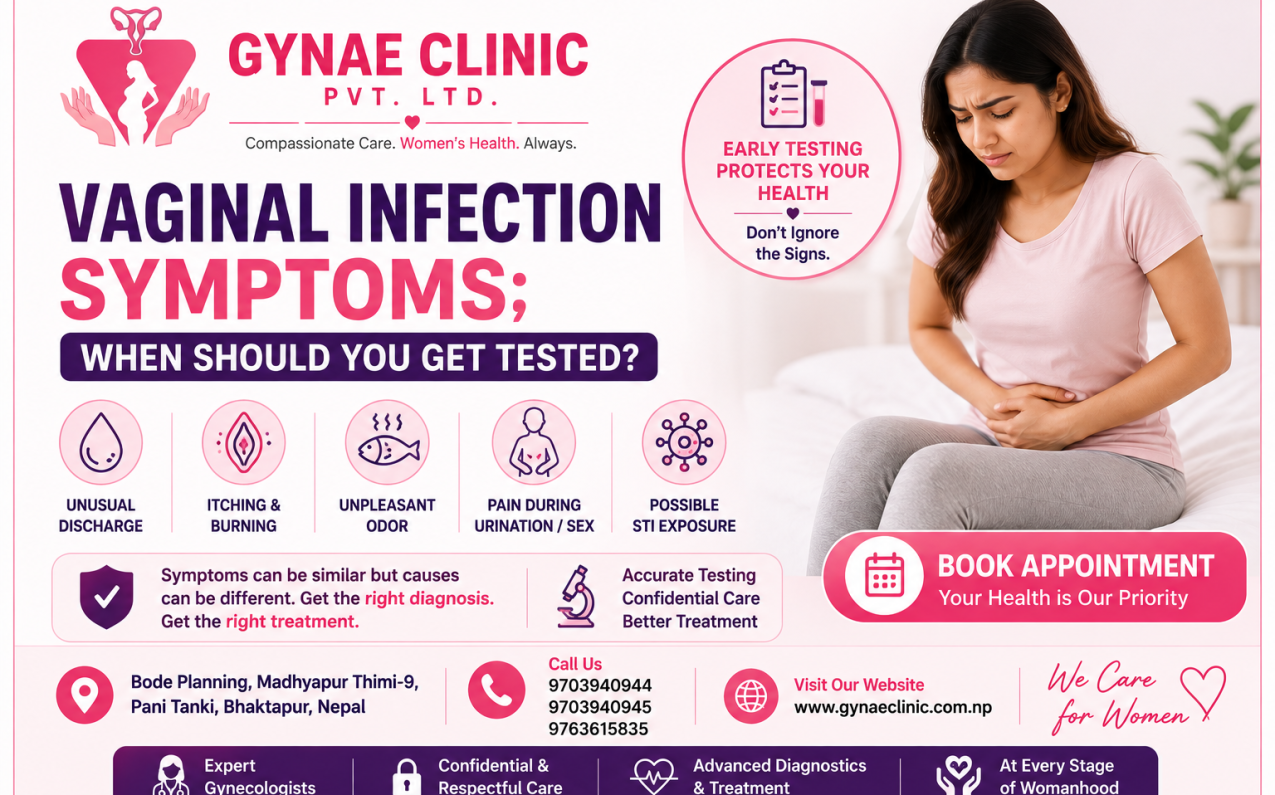
Vaginal infection symptoms can be uncomfortable, confusing and sometimes difficult to identify. Vaginal itching, burning, unusual discharge, unpleasant odor or pain can be caused by several different conditions—including bacterial vaginosis, yeast infection, trichomoniasis, sexually transmitted infections (STIs), or non-infectious irritation.
One important point is that symptoms alone do not always tell you which infection you have. A thick white discharge may suggest a yeast infection, while a fishy odor may suggest bacterial vaginosis, but several conditions can produce similar symptoms.
So, when should you get tested for a vaginal infection?
If your symptoms are new, persistent, recurrent, unusual, severe, or associated with sexual exposure, testing or a gynecological evaluation may be appropriate.
For women searching for vaginal infection testing in Bhaktapur, vaginal infection treatment in Madhyapur Thimi, or a gynecologist near Bode, Gynae Clinic Pvt. Ltd. provides confidential women’s health and gynecological consultation.
What Is a Vaginal Infection?
A vaginal infection occurs when an infectious organism affects the vagina or surrounding genital area.
Common causes include:
- Bacterial vaginosis (BV)
- Vaginal yeast infection
- Trichomoniasis
- Certain sexually transmitted infections
- Other bacterial or parasitic infections
However, not every vaginal symptom is caused by an infection. Irritation from soaps, intimate washes, scented products, hormonal changes and certain skin conditions can also cause itching, burning or discomfort.
This is why finding the cause is more important than simply treating the symptom.
Common Symptoms of Vaginal Infection
Vaginal infections can produce different combinations of symptoms.
1. Unusual vaginal discharge
Your discharge may become:
- Yellow
- Green
- Grayish
- Thick and clumpy
- unusually watery
- heavier than usual
- associated with an unpleasant odor
A change in discharge does not automatically mean an STI. Bacterial vaginosis, yeast infection and other conditions can also cause abnormal discharge.
2. Vaginal itching
Itching is one of the most common reasons women seek care for vaginal symptoms.
It may occur with:
- Yeast infection
- Irritation
- Certain vaginal infections
- Some STIs
- Vulvar skin conditions
Severe or persistent itching should be evaluated rather than repeatedly treated with an antifungal medicine without confirming the cause.
Vaginal Itching in Women: Causes, Symptoms, Testing & Treatment in Bhaktapur
3. Vaginal burning
Burning may occur inside the vagina or around the vulva.
You may notice burning:
- Throughout the day
- When urinating
- During sexual intercourse
- After using a new soap or intimate product
Because burning can have several causes, persistent symptoms may require examination or testing.
4. Unpleasant vaginal odor
A strong, fishy or foul vaginal odor can be a sign of an abnormal vaginal condition.
Bacterial vaginosis is commonly associated with a fishy odor, but other infections can also cause changes in vaginal smell.
If the odor is new or persistent, consider a gynecological evaluation.
Vaginal Discharge Treatment in Bhaktapur: Causes, Symptoms, Tests & Treatment
5. Pain during urination
Burning or pain when urinating can occur with some vaginal infections, urinary infections or sexually transmitted infections.
If painful urination continues, especially when accompanied by discharge, genital irritation or pelvic pain, medical evaluation is recommended.
6. Pain during sexual intercourse
Pain or burning during sex may occur because of vaginal inflammation, infection, dryness or other gynecological conditions.
It should not simply be considered normal if it is persistent or new.
7. Pelvic or lower abdominal pain
Pelvic pain deserves particular attention.
When vaginal symptoms occur together with:
- Lower abdominal pain
- Fever
- Pain during sex
- Abnormal bleeding
- Unusual discharge
you should seek medical evaluation promptly.
8. Genital sores, blisters or unusual bumps
Sores, blisters, ulcers or new genital bumps can be associated with certain infections, including sexually transmitted infections.
These symptoms should be examined rather than treated based only on appearance.
When Should You Get Tested for a Vaginal Infection?
There is no single testing rule for every woman.
However, testing or professional evaluation is especially appropriate when symptoms are unusual, persistent, recurrent or associated with possible sexual exposure.
Here are important situations when you should consider getting tested.
1. Your vaginal discharge suddenly changes
If your normal discharge changes significantly in:
- Color
- Smell
- Amount
- Texture
- Consistency
it is worth discussing with a gynecologist.
Particularly concerning changes include green, gray, yellow, foul-smelling, unusually heavy or persistent discharge.
White Vaginal Discharge: Causes, Symptoms, Diagnosis & Treatment in Bhaktapur
2. You have persistent vaginal itching or burning
If itching or burning lasts several days, repeatedly returns, or does not improve with appropriate treatment, do not keep assuming it is a yeast infection.
Persistent symptoms can have several causes.
A gynecologist may determine whether you need:
- Vaginal examination
- Vaginal swab
- Microscopy
- Culture
- STI testing
- Urine testing
- Other investigations
The appropriate test depends on your symptoms.
3. Your symptoms keep coming back
Recurrent vaginal symptoms should not be ignored.
If you repeatedly experience:
- Itching
- Burning
- Abnormal discharge
- Vaginal odor
- Irritation
the diagnosis may need to be reconsidered.
For example, repeated suspected yeast infections may actually involve another type of vaginal infection, a different Candida species, irritation, or another condition.
Recurrent Vaginal Yeast Infection: Why Does It Keep Coming Back?
4. Treatment did not work
If you used medication for a suspected vaginal infection and:
- Symptoms did not improve
- Symptoms became worse
- Symptoms returned shortly afterward
- The same problem keeps returning
you may need further evaluation.
Do not repeatedly switch between antibiotics and antifungal medicines without knowing the cause.
Using the wrong treatment can delay the correct diagnosis.
5. You have symptoms after unprotected sex
Consider STI testing if you develop vaginal or genital symptoms after:
- Unprotected vaginal sex
- A new sexual partner
- A broken condom
- Sexual contact with a partner whose STI status is unknown
- A partner diagnosed with an STI
Remember that some STIs can cause few or no symptoms.
Therefore, the absence of symptoms does not always mean that testing is unnecessary after a significant exposure.
How Do I Know If I Have an STD? Symptoms, Testing & When to Get Checked
6. Your partner has been diagnosed with an STI
If a sexual partner tells you that they have an STI, contact a healthcare professional even if you feel completely well.
Depending on the infection and timing of exposure, the appropriate tests may be different.
Early evaluation can help determine what testing is appropriate and whether treatment or follow-up is necessary.
7. You have genital sores or blisters
Genital sores, blisters or ulcers should be medically assessed.
Possible causes include certain STIs, skin conditions and other problems.
Do not attempt to diagnose genital sores based on photographs or internet searches alone.
8. You have abnormal bleeding
Seek medical evaluation if you experience:
- Bleeding after sex
- Bleeding between periods
- Unexpected vaginal bleeding
- Bleeding associated with unusual discharge
The cause may not be an infection, but persistent or unexplained bleeding should be evaluated.
9. You are pregnant
Pregnancy can naturally change vaginal discharge, but new abnormal discharge, strong odor, itching, burning, bleeding or watery leakage during pregnancy should be discussed with your pregnancy care provider.
Do not repeatedly self-treat vaginal symptoms during pregnancy without medical advice.
10. You have pelvic pain or fever
Vaginal symptoms accompanied by pelvic pain, lower abdominal pain or fever deserve prompt medical attention.
These symptoms can sometimes indicate an infection that requires more than simple vaginal treatment.
11. You have a recurrent vaginal infection
If you have repeated episodes of vaginal infection, your doctor may need to determine:
- Whether the original diagnosis was correct
- Which organism is responsible
- Whether more than one infection is present
- Whether an underlying condition is contributing
- Whether additional testing is needed
This is especially important when treatment repeatedly fails.
Which Vaginal Infections May Require Testing?
Different vaginal conditions may require different approaches.
Bacterial Vaginosis
BV occurs when the normal bacterial balance in the vagina changes.
Typical symptoms may include:
- Thin discharge
- White or gray discharge
- Fishy odor
- Mild irritation
Testing or clinical assessment may help distinguish BV from other causes.
Vaginal Yeast Infection
A yeast infection is commonly associated with:
- Intense itching
- Burning
- Redness
- Vulvar irritation
- Thick white discharge
However, these symptoms are not exclusive to yeast infection.
If symptoms are recurrent or treatment fails, further evaluation may be necessary.
Vaginal Yeast Infection Treatment in Bhaktapur: Symptoms, Causes, Treatment and Prevention
Trichomoniasis
Trichomoniasis is a sexually transmitted infection that can cause:
- Unusual discharge
- Vaginal irritation
- Burning
- Unpleasant odor
- Pain during urination
- Discomfort during sex
Some people have few or no symptoms.
Testing is important when trichomoniasis is suspected.
Chlamydia and Gonorrhea
These infections can sometimes cause:
- Abnormal discharge
- Burning during urination
- Pelvic pain
- Bleeding after sex
- Bleeding between periods
However, many infections can be asymptomatic.
This is why appropriate STI testing may be important after a possible exposure even when symptoms are absent.
What Tests May Be Used for Vaginal Infection?
The test you need depends on your symptoms and medical history.
Vaginal examination
A gynecologist may examine the vulva and vagina for:
- Redness
- Swelling
- Irritation
- Sores
- Abnormal discharge
- Other visible changes
Vaginal swab
A vaginal sample can sometimes be tested for specific infections.
This may help determine whether symptoms are related to yeast, bacterial changes or other organisms.
Microscopy
A sample may be examined under a microscope to look for features associated with certain vaginal infections.
Vaginal culture
Culture may be considered in selected cases, particularly when symptoms are recurrent or treatment has not worked.
STI testing
Depending on the exposure and symptoms, testing may be considered for infections such as:
- Chlamydia
- Gonorrhea
- Trichomoniasis
- HIV
- Syphilis
- Hepatitis B
Not every woman needs every test. Testing should be selected according to individual risk, symptoms and clinical assessment.
Can You Diagnose a Vaginal Infection by Discharge Color?
No.
Discharge color can provide clues, but it cannot reliably identify the cause.
For example:
- White discharge can be normal or associated with yeast infection.
- Grayish discharge may occur with bacterial vaginosis.
- Yellow or green discharge can occur with several infections.
- Watery discharge can have multiple causes.
This is why repeatedly treating yourself based only on discharge color is not recommended.
Can a Vaginal Infection Exist Without Symptoms?
Yes.
Some vaginal and sexually transmitted infections may cause mild symptoms or no noticeable symptoms.
This is particularly important for STI screening.
You may need testing even when you feel completely normal if you have had a significant sexual exposure or if a partner has been diagnosed with an STI.
What Happens During a Vaginal Infection Consultation?
A gynecological consultation usually begins with a discussion of your symptoms and medical history.
Your healthcare professional may ask:
- When did symptoms begin?
- Has this happened before?
- Has the discharge changed?
- Is there an unusual smell?
- Is there itching or burning?
- Do you have pelvic pain?
- Is there pain during sex?
- Have you taken antibiotics or antifungal medicines?
- Are you pregnant?
- Have you had recent sexual exposure?
- Has a partner been diagnosed with an STI?
Depending on your symptoms, an examination or testing may then be recommended.
Should You Take Medicine Before Testing?
Not always.
If symptoms are mild and the diagnosis is clear, a healthcare professional may sometimes diagnose and treat based on the clinical picture.
But if symptoms are:
- Recurrent
- Severe
- Persistent
- Unusual
- Not responding to treatment
- Associated with possible STI exposure
testing can be particularly useful.
Avoid taking random antibiotics or antifungal medicines simply because the symptoms “feel like” a previous infection.
What Should You Do Before a Vaginal Infection Test?
Unless your healthcare professional gives you different instructions:
- Tell the doctor about any medicines you have recently taken.
- Mention previous vaginal infections.
- Tell them if you are pregnant.
- Mention any recent antibiotic or antifungal treatment.
- Be honest about possible sexual exposure.
- Do not hide symptoms because of embarrassment.
Vaginal and sexual-health concerns are common medical problems and deserve confidential, respectful care.
Can Vaginal Infection Be Prevented?
Not every vaginal infection can be prevented, but some habits can reduce irritation and certain risks.
Avoid vaginal douching
The vagina naturally maintains its own environment. Routine internal cleansing is unnecessary.
Avoid strongly scented intimate products
Perfumed washes, sprays and deodorants can irritate sensitive genital skin.
Practice safer sex
Condom use can reduce the risk of many STIs.
Get tested after significant sexual exposure
Testing can provide clarity when there is a possible STI risk.
Avoid repeated self-medication
If symptoms keep returning, find out why instead of repeatedly using the same medicine.
Seek medical attention for persistent symptoms
Early evaluation can prevent prolonged discomfort and help identify the appropriate treatment.
Vaginal Infection Testing in Bhaktapur
If you are searching for vaginal infection symptoms and testing in Bhaktapur, vaginal infection treatment in Madhyapur Thimi, STI testing near Bode, or a gynecologist for vaginal discharge near Gatthaghar, Gynae Clinic Pvt. Ltd. provides confidential women’s health and gynecological consultation.
Gynae Clinic Pvt. Ltd.
Address:
Bode Planning, Madhyapur Thimi-9, Pani Tanki, Bhaktapur, Nepal
Contact:
9703940944 | 9703940945 | 9763615835
Website:
www.gynaeclinic.com.np
The clinic is conveniently located for women from Bode, Madhyapur Thimi, Thimi, Sanothimi, Gatthaghar, Kausaltar, Lokanthali, Balkumari, Nagadesh, Manohara, Sallaghari, Radhe Radhe, Suryabinayak, Jadibuti, Koteshwor, Pepsicola and surrounding areas.
For additional information about abnormal vaginal discharge and possible causes:
Vaginal Discharge: Is It an STD or Something Else?
Frequently Asked Questions
When should I get tested for a vaginal infection?
Consider testing or gynecological evaluation when you have persistent or recurrent discharge, unusual odor, itching, burning, painful urination, pelvic pain, abnormal bleeding, genital sores, or possible STI exposure.
Does vaginal itching always mean a yeast infection?
No. Itching can occur with yeast infection, irritation, some STIs, skin conditions and other vaginal problems.
Does unusual vaginal discharge mean I have an STI?
Not necessarily. Vaginal discharge can be caused by normal hormonal changes, BV, yeast infection, trichomoniasis, cervical infections and other conditions.
Can I have an STI without symptoms?
Yes. Some STIs can cause few or no symptoms. Testing may therefore be appropriate after a significant sexual exposure.
Should I get tested if my partner has an STI?
Yes. Contact a healthcare professional promptly so the appropriate testing and follow-up can be discussed.
Can I treat vaginal infection at home?
It is better not to repeatedly self-treat unexplained symptoms. Different infections require different treatments, and incorrect treatment can delay diagnosis.
What if my symptoms return after treatment?
If symptoms return repeatedly or soon after treatment, consult a gynecologist. Further examination or testing may be needed to confirm the cause.
Is vaginal discharge during pregnancy always an infection?
No. Pregnancy can naturally increase vaginal discharge. However, unusual odor, itching, burning, bleeding, pelvic pain or watery leakage should be assessed.
Can vaginal infection cause pelvic pain?
Some infections can cause pelvic or lower abdominal pain. Pelvic pain with fever, abnormal discharge or bleeding should receive prompt medical attention.
Where can I get vaginal infection testing in Bhaktapur?
Women can contact Gynae Clinic Pvt. Ltd., Bode Planning, Madhyapur Thimi-9, Pani Tanki, Bhaktapur, for gynecological consultation and appropriate evaluation.
Final Takeaway
Do not wait until vaginal infection symptoms become severe before seeking medical advice.
You should consider getting tested or evaluated when you have persistent or recurrent vaginal discharge, unusual odor, itching, burning, painful urination, pelvic pain, pain during sex, genital sores, abnormal bleeding or possible STI exposure.
Remember:
Symptoms can provide clues—but testing and proper clinical evaluation can provide answers.
Do not assume every case of discharge is a yeast infection, BV or an STI, and avoid repeatedly taking antibiotics or antifungal medicines without knowing the cause.
For confidential gynecological and vaginal infection care in Bhaktapur and Madhyapur Thimi, contact:
Gynae Clinic Pvt. Ltd.
Bode Planning, Madhyapur Thimi-9, Pani Tanki, Bhaktapur, Nepal
9703940944 | 9703940945 | 9763615835
www.gynaeclinic.com.np
Author
Author: Gynae Clinic Pvt. Ltd. Medical Content Team
Gynae Clinic Pvt. Ltd. provides women’s health and gynecological consultation in Bode Planning, Madhyapur Thimi-9, Pani Tanki, Bhaktapur, Nepal.
Medical Disclaimer
This article is for general health information only and does not replace professional medical advice, diagnosis or treatment. Persistent, severe or recurrent symptoms should be evaluated by a qualified healthcare professional.