
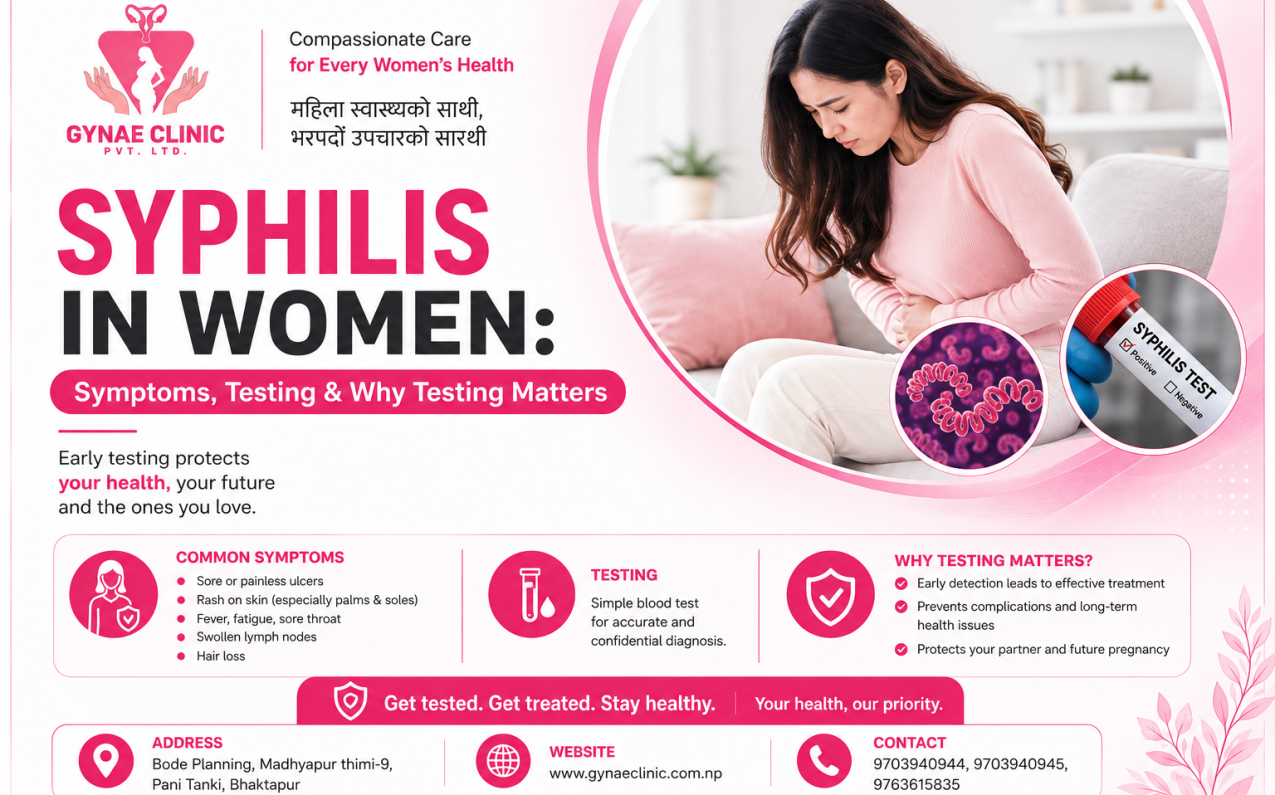
Syphilis is a bacterial sexually transmitted infection (STI) that can affect women at different stages of life, including during pregnancy. One of the most important things to understand about syphilis is that many people may have no noticeable symptoms or may not recognize the symptoms when they occur.
Because early symptoms can disappear without treatment, some women may mistakenly believe that the infection has gone away. However, untreated syphilis can remain in the body and may eventually cause serious health complications.
If you are searching for syphilis symptoms in women, syphilis testing in Bhaktapur, STD testing for women, or information about syphilis treatment, this guide explains the symptoms, testing process and treatment principles.
Women with concerns about possible STI exposure can seek confidential gynecology and sexual health consultation at Gynae Clinic Pvt. Ltd. in Bhaktapur.
What Is Syphilis?
Syphilis is an STI caused by the bacterium Treponema pallidum.
It can spread through direct contact with an infectious syphilis sore or lesion during:
- Vaginal sex
- Oral sex
- Anal sex
Syphilis can also pass from a pregnant woman to her baby during pregnancy.
Syphilis is preventable and curable, but early diagnosis and appropriate treatment are important because untreated infection can progress through different stages and eventually affect multiple parts of the body.
Syphilis Symptoms in Women
Syphilis symptoms can vary depending on the stage of infection.
Some women may have noticeable symptoms, while others may have symptoms that are mild or located in areas that are difficult to see.
The infection is commonly divided into:
- Primary syphilis
- Secondary syphilis
- Latent syphilis
- Tertiary syphilis
1. Primary Syphilis: The First Stage
The first noticeable sign of syphilis may be a sore called a chancre.
The sore is often:
- Round
- Firm
- Usually painless
- Located on the genitals, vagina, cervix, anus or another area exposed during sexual contact
Because the sore may be painless and can occur inside the vagina or on the cervix, some women may not notice it.
The sore may heal even without treatment.
However:
When the sore disappears, the syphilis infection may still remain in the body.
This is one reason why women should not rely only on visible symptoms to determine whether an STI is present.
2. Secondary Syphilis: Rash and Other Symptoms
If syphilis is not treated, the infection may progress to the secondary stage.
Possible symptoms include:
- Skin rash
- Rash on the palms of the hands
- Rash on the soles of the feet
- Sores or lesions in warm and moist areas
- Fever
- Swollen lymph nodes
- Fatigue
- Sore throat
- Headache
- Muscle aches
- Patchy hair loss in some cases
The rash associated with secondary syphilis may not be itchy and can sometimes be mild enough to go unnoticed.
Symptoms may later disappear even without treatment.
However, the disappearance of symptoms does not necessarily mean that the infection has been cured.
Featured Image
Place the featured image directly below the title.
A premium women’s healthcare consultation image showing a woman speaking privately with a compassionate female healthcare professional about STI testing and sexual health. Use a clean, elegant pink, blush and white medical setting that communicates privacy, trust and professional care.
3. Latent Syphilis: When There Are No Symptoms
After the earlier stages, syphilis may enter a latent stage.
During this stage:
- There may be no visible symptoms
- The woman may feel completely healthy
- Blood tests may still detect evidence of syphilis infection
This is why STI testing can be important for women with possible exposure or relevant risk factors.
Feeling healthy does not always mean that an STI is absent.
4. Tertiary Syphilis: Late Complications
Without appropriate treatment, syphilis can remain in the body for years.
In some people, late-stage syphilis may eventually affect:
- The brain
- Nerves
- Eyes
- Heart
- Blood vessels
- Bones and joints
Serious complications can occur.
This is why early testing and appropriate treatment are important.
Not every untreated infection progresses to late-stage complications, but delaying diagnosis can increase health risks.
Can Women Have Syphilis Without Symptoms?
Yes.
Many people with syphilis may not notice symptoms.
A woman may:
- Have no obvious symptoms
- Have a painless sore that goes unnoticed
- Develop a mild rash
- Experience symptoms that disappear without treatment
Because symptoms can be absent or temporary, laboratory testing is important when there is concern about possible exposure.
How Do Women Get Syphilis?
Syphilis can be transmitted through direct contact with an infectious lesion during sexual contact.
Transmission may occur through:
- Vaginal sex
- Oral sex
- Anal sex
A person can have syphilis without realizing they are infected.
For this reason, a partner’s lack of symptoms does not guarantee that an STI is absent.
Condoms can reduce the risk of syphilis transmission, although a syphilis lesion located outside the area covered by a condom may still allow transmission through direct contact.
When Should Women Get Tested for Syphilis?
Women should consider discussing syphilis testing when they:
- Have had unprotected sexual contact
- Have a new sexual partner
- Have multiple sexual partners
- Learn that a sexual partner has an STI
- Have genital sores or unexplained lesions
- Develop an unexplained rash
- Have a rash affecting the palms or soles
- Have been diagnosed with another STI
- Have concerns about a previous sexual exposure
- Are pregnant
- Have other individual risk factors
Women can also explore more women’s health information through the Gynae Clinic Pvt. Ltd. official website.
How Is Syphilis Tested in Women?
Syphilis cannot be reliably diagnosed based only on symptoms.
Testing commonly involves blood tests.
Different types of syphilis blood tests may be used to:
- Detect evidence of syphilis infection
- Help confirm a positive screening result
- Assist with clinical assessment
- Monitor response to treatment when appropriate
Healthcare professionals may use a combination of tests because one test result alone may not always provide the complete clinical picture.
Testing and interpretation should consider:
- Symptoms
- Possible exposure
- Previous syphilis history
- Previous treatment
- Pregnancy status
- Other laboratory results
Rapid syphilis tests may also be available in some settings and can provide results quickly.
Image 2
Recommended placement: After the syphilis testing section.
A clean medical editorial illustration showing a blood sample, laboratory testing and a subtle women’s reproductive health symbol. Use premium pink, rose and white colors with a modern, professional laboratory style.
Can a Pap Smear Detect Syphilis?
No.
A Pap smear is used for cervical screening and is not a routine test for diagnosing syphilis.
Syphilis generally requires specific laboratory testing.
Women should not assume that a previous Pap smear or routine gynecological examination automatically included STI testing.
If you are concerned about possible STI exposure, discuss which specific tests may be appropriate.
Syphilis and Pregnancy
Syphilis during pregnancy is particularly important because the infection can pass from mother to baby.
Untreated or inadequately treated syphilis during pregnancy can lead to serious complications, including:
- Stillbirth
- Newborn death
- Premature birth
- Low birth weight
- Congenital syphilis
Pregnant women should receive syphilis screening as part of appropriate prenatal care.
Early identification and correct treatment are important for protecting both maternal and newborn health.
Syphilis Treatment
Syphilis is a curable bacterial infection.
The appropriate treatment depends on factors such as:
- The stage of syphilis
- Pregnancy status
- Previous treatment history
- Individual medical circumstances
Penicillin-based treatment is the standard treatment recommended in major clinical guidance, and correct treatment during pregnancy is especially important for preventing congenital syphilis.
The treatment plan should be determined by a qualified healthcare professional.
Do Not Self-Treat Syphilis
Do not:
- Take leftover antibiotics
- Use antibiotics prescribed for another person
- Buy antibiotics without proper medical guidance
- Stop treatment early
- Assume that symptoms disappearing means the infection is cured
Incorrect treatment can leave the infection untreated or inadequately treated.
Proper diagnosis is important before deciding on treatment.
Why Partner Testing and Treatment Matter
Sexual partners may also need evaluation and appropriate testing.
If one partner receives treatment while another infected partner remains untreated, reinfection can occur.
Partner management may include:
- Informing potentially exposed partners
- Appropriate STI testing
- Medical evaluation
- Treatment when indicated
Treating and evaluating partners is an important part of preventing continued transmission and reinfection.
Can Syphilis Come Back After Treatment?
Successful treatment can cure the current syphilis infection.
However, treatment does not provide permanent protection against future exposure.
A person can become infected again after another exposure.
Follow-up testing may be recommended after treatment depending on the stage of infection and individual circumstances.
Syphilis and Other STIs
A woman diagnosed with syphilis may also need assessment for other sexually transmitted infections.
Depending on individual circumstances, testing may include infections such as:
- HIV
- Chlamydia
- Gonorrhea
- Hepatitis B
- Hepatitis C
The appropriate testing plan depends on symptoms, sexual history and individual risk factors.
How Can Women Reduce the Risk of Syphilis?
Risk reduction may include:
- Consistent and correct condom use
- Appropriate STI screening
- Testing after relevant sexual exposure
- Open communication with sexual partners
- Seeking medical advice when unusual sores or rashes appear
- Completing prescribed treatment
- Ensuring appropriate partner evaluation
Because syphilis may cause no noticeable symptoms, testing can be an important part of sexual and reproductive healthcare.
Image 3
Recommended placement: Before the FAQ section.
A premium and confidential women’s sexual health consultation showing a woman receiving compassionate medical guidance from a female healthcare professional. The design should communicate privacy, STI testing, trust and professional women’s healthcare using elegant pink and white tones.
Frequently Asked Questions About Syphilis in Women
Can women have syphilis without symptoms?
Yes. Many people with syphilis may have no noticeable symptoms or may not recognize the symptoms they experience.
What is the first symptom of syphilis in women?
One possible early sign is a usually painless sore called a chancre. However, the sore may be inside the vagina or on the cervix and may not be noticed.
Can syphilis cause a rash?
Yes. Secondary syphilis can cause a rash that may affect different areas of the body, including the palms of the hands and soles of the feet.
Is syphilis curable?
Yes. Syphilis is a bacterial infection that can be cured with appropriate treatment.
Can syphilis affect pregnancy?
Yes. Untreated or inadequately treated syphilis during pregnancy can cause serious complications and can be passed to the baby.
Can a woman get syphilis again after treatment?
Yes. Successful treatment does not provide permanent protection. Reinfection can occur after future exposure.
Can I know I have syphilis by looking at my symptoms?
No. Symptoms can be absent, mild or similar to other conditions. Appropriate laboratory testing is needed for diagnosis.
Syphilis Testing and Women’s Sexual Health Consultation in Bhaktapur
If you are searching for:
- Syphilis testing in Bhaktapur
- Syphilis symptoms in women
- STD testing for women
- STI testing in Madhyapur Thimi
- Confidential sexual health consultation
- Blood test for syphilis
- Female gynecologist for STI concerns
- STI testing near Bode
- Women’s health consultation near Pani Tanki
- Gynecology care near Gatthaghar
- Women’s healthcare near Lokanthali
- Sexual health consultation near Jadibuti
- STI consultation near Koteshwor
you can seek professional consultation at Gynae Clinic Pvt. Ltd.
Gynae Clinic Pvt. Ltd.
Address:
Bode Planning, Madhyapur Thimi-9, Pani Tanki, Bhaktapur, Nepal
Contact:
9703940944, 9703940945, 9763615835
Website:
www.gynaeclinic.com.np
Final Thoughts
Syphilis in women can be difficult to recognize because symptoms may be painless, mild or completely absent.
An early syphilis sore may disappear without treatment, and later symptoms may also resolve temporarily. This does not necessarily mean that the infection has been cured.
Appropriate testing is the most reliable way to diagnose syphilis.
The good news is that syphilis is a curable bacterial infection. Early diagnosis, correct treatment and appropriate partner management can help prevent ongoing transmission and serious complications.
If you have concerns about possible STI exposure, genital sores, an unexplained rash or sexual health, professional consultation can help determine which tests may be appropriate.
Medical Disclaimer
This article is for general health education and does not replace an individual medical consultation, diagnosis or treatment plan. Symptoms of syphilis can be absent or overlap with other medical conditions, so appropriate laboratory testing is important for accurate diagnosis. Certain complex conditions may benefit from advanced specialist care.
Author: Gynae Clinic Pvt. Ltd. Medical Content Team