
Vaginal dryness is common, but many women feel embarrassed to talk about it.
If you experience dryness, burning, irritation, soreness, or discomfort during or after sex, you are not alone. Vaginal dryness can happen at different stages of life and for many different reasons. It is not something you should feel ashamed about—and persistent symptoms deserve proper attention.
Sometimes the cause is temporary, such as inadequate lubrication or irritation. In other situations, hormonal changes, certain medicines, breastfeeding, menopause, vaginal infections, or other health factors may contribute.
The good news is that vaginal dryness can often be evaluated and managed once the underlying cause is understood.
What Is Vaginal Dryness?
Vaginal dryness occurs when the vagina does not have enough natural moisture and lubrication.
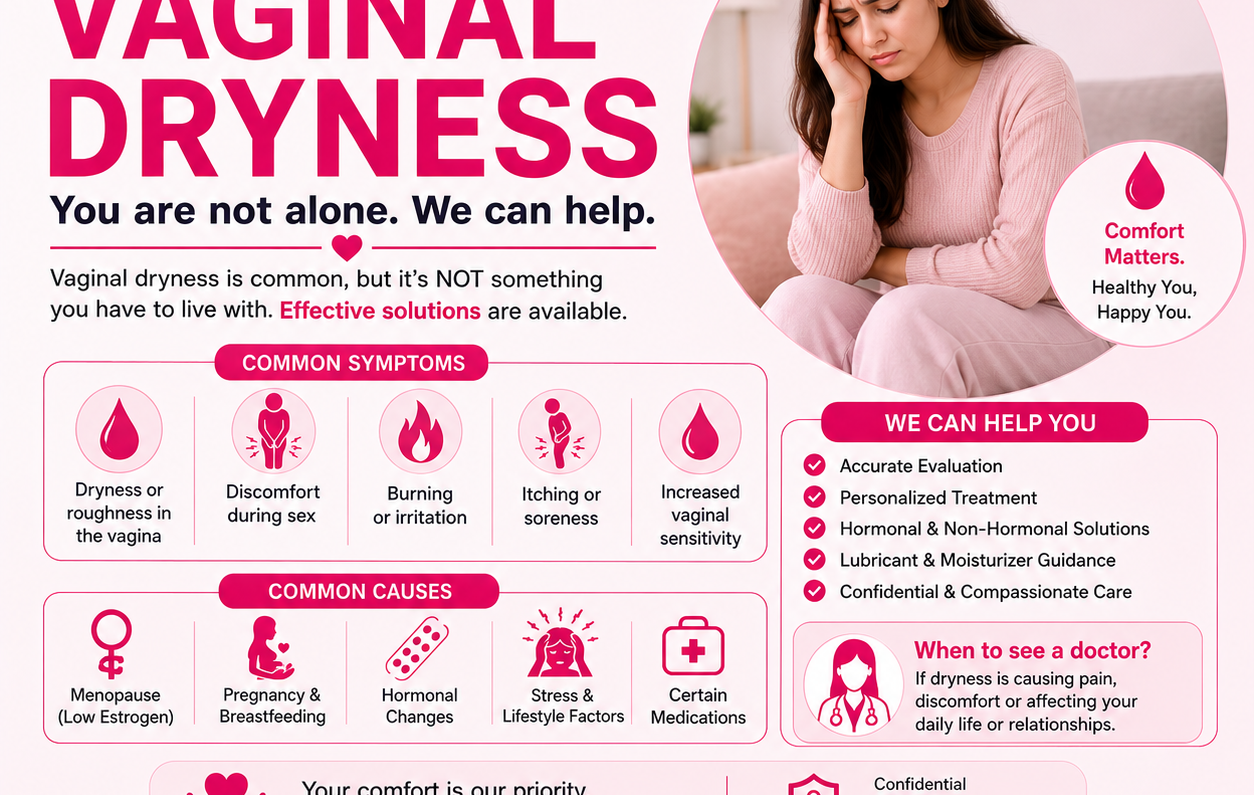
You may notice:
- Dryness or tightness
- Burning or irritation
- Itching
- Soreness
- Pain during sexual intercourse
- Discomfort after sex
- Small amounts of bleeding after intercourse
- Increased sensitivity around the vaginal opening
- Urinary discomfort in some cases
The symptoms can be mild or significant and may occur occasionally or repeatedly.
Vaginal Dryness Is More Common Than You Think
Many women assume vaginal dryness only happens after menopause.
That is not true.
Although reduced estrogen around menopause is an important cause, younger women can also experience vaginal dryness. It may occur during breastfeeding, after childbirth, because of hormonal changes, with some medicines, or when sexual arousal and natural lubrication are insufficient.
That is why the right question is not simply, “Why am I dry?”
It is:
“What is causing my vaginal dryness?”
Understanding the cause helps determine the most appropriate solution.
Common Causes of Vaginal Dryness
1. Hormonal Changes
Estrogen helps maintain healthy vaginal tissues and natural lubrication.
When estrogen levels decrease, vaginal tissues may become thinner, drier and more sensitive.
This can happen during:
- Perimenopause
- Menopause
- Breastfeeding
- The postpartum period
- Certain hormonal treatments
- Some medical conditions affecting hormones
Women experiencing menopause may also notice other symptoms such as hot flashes, changes in periods and sleep disturbances.
If vaginal dryness develops together with other hormonal symptoms, a gynecological consultation can help determine whether hormonal changes may be contributing.
2. Breastfeeding and After Childbirth
Some women experience vaginal dryness after giving birth, particularly while breastfeeding.
Hormonal changes during breastfeeding can temporarily reduce estrogen activity, which may affect vaginal lubrication.
This can make intercourse uncomfortable even when there was no previous history of dryness.
If sex has become painful after childbirth, you do not have to simply tolerate it. Talk with a healthcare professional about the symptoms and possible causes.
3. Not Enough Sexual Arousal
Natural lubrication normally increases with sexual arousal.
If intercourse begins before adequate arousal, there may be more friction and discomfort.
Stress, anxiety, relationship difficulties, fatigue or simply not having enough time for arousal can contribute.
This does not mean that the problem is “all in your head.” Sexual comfort involves physical, hormonal and emotional factors, and more than one factor may be involved.
4. Certain Medicines
Some medicines can contribute to vaginal dryness.
For example, dryness may sometimes occur with certain medications that affect hormonal or mucosal function.
If you noticed dryness after starting a new medication, tell your doctor. Do not stop prescribed medicine on your own.
Your healthcare professional can determine whether the medicine could be contributing and whether an alternative approach is appropriate.
5. Stress and Emotional Factors
Stress can affect sexual response and arousal.
When you are tired, anxious or under significant stress, your body may respond differently during intimacy, potentially reducing natural lubrication.
Persistent sexual discomfort can then create another problem: fear of pain can make intimacy stressful, which may make relaxation and arousal more difficult.
Addressing both physical and emotional factors can sometimes be important.
Can Vaginal Dryness Cause Pain During Sex?
Yes.
When there is inadequate lubrication, friction can increase during penetration.
This may cause:
- Burning
- Stinging
- Soreness
- Pain during penetration
- Pain afterward
- Irritation around the vaginal opening
If pain happens repeatedly, it should not simply be considered “normal.”
For more information about recurring discomfort after intercourse, read our guide on [post-sex discomfort and when it should be evaluated].
Vaginal Dryness and Burning: Could It Be an Infection?
Sometimes.
Dryness and burning can occur with irritation or vaginal conditions, but similar symptoms can also occur with infections.
Depending on the cause, you may also have:
- Unusual discharge
- Unpleasant odor
- Itching
- Redness
- Swelling
- Pain during urination
- Pain during sex
Because different conditions can produce similar symptoms, it is not always possible to determine the cause simply from symptoms.
If dryness is accompanied by unusual discharge, odor, itching or persistent burning, a gynecological assessment may be appropriate.
You can also learn more about [vaginal infection symptoms and when testing may be needed].
Can Vaginal Dryness Be Related to an STI?
Vaginal dryness itself does not automatically mean you have an STI.
However, sexual-health symptoms can sometimes overlap with infections, and many sexually transmitted infections may cause few or no symptoms.
If you have concerns about a recent sexual exposure, a new partner, unprotected sex, or symptoms such as unusual discharge, pelvic pain, sores or abnormal bleeding, discuss appropriate STI testing with a healthcare professional.
Gynae Clinic provides information about [STI testing for women and which tests may be needed].
Vaginal Dryness During Menopause
Vaginal dryness is particularly common around and after menopause because declining estrogen can affect vaginal tissues.
Some women experience:
- Dryness
- Burning
- Itching
- Pain during sex
- Reduced lubrication
- Urinary symptoms
- Increased vaginal sensitivity
These symptoms can be part of genitourinary syndrome of menopause (GSM).
Importantly, women do not have to simply accept severe vaginal discomfort as an unavoidable part of aging.
A gynecologist can discuss suitable management options based on your age, symptoms, medical history and individual circumstances.
When Should You See a Gynecologist for Vaginal Dryness?
Consider making an appointment if:
- Vaginal dryness keeps returning
- Sex has become painful
- Burning or irritation persists
- You have vaginal itching
- You notice unusual discharge
- There is a new vaginal odor
- You experience bleeding after sex
- You have urinary discomfort
- Symptoms began around menopause
- Symptoms started after childbirth or while breastfeeding
- You are concerned about an STI
- Home measures have not improved the problem
- Vaginal dryness is affecting your relationship or quality of life
You can also read our complete guide on [when you should visit a gynecologist].
What Will a Gynecologist Check?
Your consultation may begin with a discussion about your symptoms and medical history.
Your gynecologist may ask:
- When did the dryness begin?
- Is it constant or occasional?
- Does it happen mainly during sex?
- Do you have burning or itching?
- Is there unusual discharge?
- Are your periods regular?
- Are you pregnant, postpartum or breastfeeding?
- Are you approaching or going through menopause?
- Are you taking any medicines?
- Have you noticed urinary symptoms?
- Could there be an STI concern?
Depending on your symptoms, an examination or appropriate testing may be recommended.
The goal is to identify the underlying cause, rather than simply masking the symptom.
What Can You Do About Vaginal Dryness?
The right approach depends on the cause.
Some women may benefit from practical measures that reduce friction and improve comfort. Others may need treatment for an infection, management of hormonal changes, or evaluation of another gynecological condition.
A healthcare professional can help determine which approach is appropriate for you.
Avoid self-diagnosing based only on symptoms.
For example, assuming that every case of burning is a yeast infection and repeatedly using treatment without evaluation may delay identification of another cause.
Do Not Ignore Pain During Sex
One of the biggest reasons women continue to experience vaginal dryness is that they simply become accustomed to discomfort.
You may think:
“It will go away.”
Or:
“This happens to everyone.”
Or:
“Maybe I am just getting older.”
But persistent discomfort deserves attention.
Your comfort matters. Your sexual health matters. Your overall women’s health matters.
Vaginal Dryness: You Are Not Alone
If you are experiencing vaginal dryness, please remember:
You are not alone.
It is a common women’s health concern, and there may be a clear reason behind your symptoms.
Whether the cause is hormonal changes, breastfeeding, menopause, medication, inadequate lubrication, irritation, infection or another condition, the first step is understanding what is happening.
You do not need to feel embarrassed about discussing vaginal dryness with a gynecologist.
At Gynae Clinic Pvt. Ltd., women can discuss gynecological and sexual-health concerns in a private, respectful and compassionate healthcare environment.
Looking for a Gynecologist in Bhaktapur?
If vaginal dryness, painful intercourse, burning, irritation or other intimate health concerns are affecting your daily life or relationship, consider getting a professional gynecological evaluation.
Gynae Clinic Pvt. Ltd.
Bode Planning, Madhyapur Thimi-9, Pani Tanki, Bhaktapur, Nepal
Appointments:
📞 9703940944
📞 9703940945
📞 9763615835
Email: gynaeclinic1@gmail.com
Compassionate care for every women’s health.
Frequently Asked Questions
Is vaginal dryness normal?
Vaginal dryness is common, but persistent or bothersome dryness should not simply be ignored. It can have several causes, many of which can be evaluated and managed.
Why am I dry during sex?
Possible reasons include inadequate arousal or lubrication, hormonal changes, breastfeeding, menopause, medications, irritation and certain vaginal conditions.
Can young women have vaginal dryness?
Yes. Vaginal dryness is not limited to menopause. Younger women can experience it for several different reasons, including hormonal changes, breastfeeding, medications and sexual or physical factors.
Does vaginal dryness mean menopause?
Not necessarily. Menopause is one common cause, but vaginal dryness can occur at many ages.
Can vaginal dryness cause pain after sex?
Yes. Reduced lubrication can increase friction and cause soreness, burning or irritation during or after intercourse.
Should I worry if I bleed after sex?
Bleeding after sex can have several causes. If it happens repeatedly or is unexplained, it should be discussed with a gynecologist.
Can vaginal dryness be treated?
Management depends on the cause. A gynecologist can evaluate your symptoms and recommend an appropriate approach based on your individual circumstances.
When should I see a gynecologist?
See a gynecologist if dryness is persistent, recurrent, painful, associated with abnormal discharge, itching, bleeding, urinary symptoms or other concerning symptoms, or if it is affecting your quality of life.
Medical Disclaimer
This article is intended for general educational purposes and does not replace an individual medical consultation or diagnosis. Vaginal dryness can have different causes, and appropriate examination or testing may sometimes be necessary. Do not start or stop prescription medication based solely on information in this article. Certain complex conditions may benefit from advanced specialist care.
Author: Gynae Clinic Pvt. Ltd. — Women’s Health & Gynecology Care, Bhaktapur, Nepal