
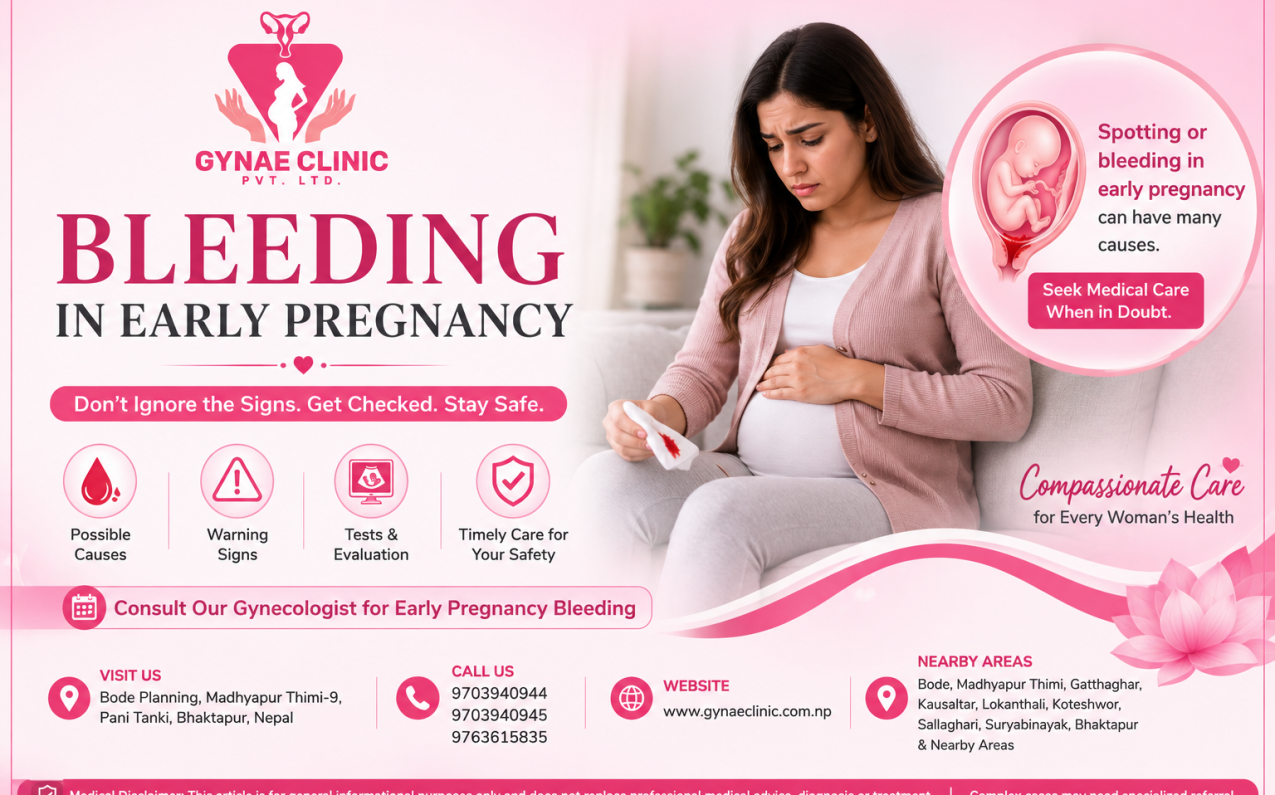
Bleeding in early pregnancy can be frightening, but it does not always mean that something is wrong. Light spotting can occur in the first trimester, and many women who experience early pregnancy bleeding continue to have a healthy pregnancy. However, bleeding can also be a sign of miscarriage or ectopic pregnancy, so it should never simply be ignored.
If you are experiencing bleeding during early pregnancy in Bhaktapur, Madhyapur Thimi, Bode, Thimi, Lokanthali or nearby areas, timely medical assessment can help determine what is happening and whether further monitoring or treatment is needed.
What Is Bleeding in Early Pregnancy?
Early pregnancy bleeding refers to spotting or vaginal bleeding during the first trimester, generally the first 12–13 weeks of pregnancy.
It may appear as:
- Pink spotting
- Brown discharge
- Light red bleeding
- Bleeding similar to a period
- Heavy red bleeding
- Bleeding with small or larger clots
The amount and appearance of blood can vary considerably.
Importantly, the amount of bleeding alone cannot determine whether a pregnancy is healthy or not. Evaluation may be needed to understand the cause.
Is Bleeding in Early Pregnancy Normal?
Bleeding during early pregnancy is relatively common and does not always indicate miscarriage.
Some women experience light spotting and continue to have a normal pregnancy. However, bleeding can sometimes indicate a problem requiring medical attention, including miscarriage or ectopic pregnancy.
Therefore:
Light bleeding does not automatically mean miscarriage.
But:
Any unexplained bleeding during pregnancy deserves appropriate medical advice.
Common Causes of Bleeding in Early Pregnancy
There are several possible causes.
1. Implantation-Related Bleeding
Very early in pregnancy, some women experience light spotting around the time the pregnancy implants into the uterine lining.
It may appear as:
- Light pink spotting
- Brown spotting
- Small amounts of blood
However, not every episode of early pregnancy bleeding should automatically be called implantation bleeding. The timing, amount of bleeding and other symptoms need to be considered.
2. Changes in the Cervix
Pregnancy increases blood flow to the cervix.
As a result, the cervix can become more sensitive and may bleed more easily, including after sexual intercourse or a pelvic examination.
This can cause spotting without necessarily meaning that the pregnancy is failing.
3. Subchorionic Bleeding or Hematoma
Sometimes blood collects between the pregnancy-related tissues and the uterine wall.
This may appear on an ultrasound and can cause vaginal bleeding during early pregnancy.
The significance depends on factors such as the amount and location of the bleeding and the stage of pregnancy.
Your doctor may recommend monitoring with follow-up assessment or ultrasound.
4. Miscarriage
One of the major concerns with early pregnancy bleeding is miscarriage.
Miscarriage means that a pregnancy has ended.
Possible symptoms include:
- Vaginal bleeding
- Increasing abdominal cramps
- Lower abdominal pain
- Passing blood clots
- Passing tissue or fluid from the vagina
However, bleeding does not automatically mean that a miscarriage has occurred. Some women experience bleeding but continue to have a viable pregnancy.
An ultrasound and, when appropriate, blood tests can help determine what is happening.
5. Ectopic Pregnancy
An ectopic pregnancy occurs when a pregnancy develops outside the main cavity of the uterus, most commonly in a fallopian tube.
It is less common than miscarriage but can become a serious medical emergency if the pregnancy causes internal bleeding.
Possible symptoms include:
- Vaginal bleeding
- Lower abdominal or pelvic pain
- Pain mainly on one side
- Shoulder-tip pain
- Dizziness
- Weakness
- Fainting
An ectopic pregnancy can sometimes have few symptoms initially, so early assessment is important when pregnancy and unusual bleeding or pain occur together.
6. Infection
Some infections involving the vagina, cervix or urinary tract can cause bleeding during pregnancy.
Bleeding may occur together with:
- Abnormal vaginal discharge
- Unpleasant vaginal odor
- Burning while urinating
- Pelvic discomfort
- Fever
- Pain during intercourse
Your doctor may recommend examination or appropriate testing when infection is suspected.
7. Cervical Polyps or Other Cervical Conditions
A cervical polyp or another condition affecting the cervix can sometimes cause bleeding, particularly after intercourse.
A clinical examination may help identify whether the cervix could be contributing to the bleeding.
What Does the Color of Blood Mean?
Women often worry about whether the blood is pink, brown or red.
Brown blood
Brown discharge often represents older blood.
Pink blood
Pink spotting may occur when a small amount of blood mixes with vaginal discharge.
Bright red blood
Bright red blood usually represents more recent bleeding.
Heavy red bleeding with clots
Heavy bleeding, particularly when accompanied by pain or other concerning symptoms, requires prompt medical assessment.
The color alone cannot tell whether a pregnancy is healthy. The amount of bleeding, symptoms, pregnancy age and examination findings are more important.
Bleeding Without Pain vs Bleeding With Pain
Bleeding without pain
Light spotting without significant pain may have several causes and does not automatically mean miscarriage.
Nevertheless, inform your healthcare professional about bleeding during pregnancy.
Bleeding with abdominal pain
Bleeding together with abdominal or pelvic pain deserves greater attention.
This is particularly important when pain is:
- Severe
- Increasing
- Mainly on one side
- Associated with dizziness or weakness
Such symptoms can occur with miscarriage or ectopic pregnancy and require prompt evaluation.
When Is Bleeding in Early Pregnancy an Emergency?
Seek urgent medical care immediately if you have pregnancy-related bleeding together with:
- Severe abdominal or pelvic pain
- Severe one-sided pain
- Shoulder-tip pain
- Fainting or loss of consciousness
- Severe dizziness or weakness
- Heavy bleeding that rapidly soaks a pad
- Significant worsening of symptoms
These can be warning signs of serious complications, including ectopic pregnancy or significant blood loss.
Do not wait for the bleeding to stop if these symptoms are present.
How Is Bleeding in Early Pregnancy Evaluated?
Your doctor may ask about:
- The first day of your last menstrual period
- How many weeks pregnant you may be
- When the bleeding started
- The amount of bleeding
- The color of the blood
- Whether you have passed clots or tissue
- Abdominal or pelvic pain
- Previous pregnancies
- Previous miscarriage or ectopic pregnancy
- Previous gynecological problems
- Any medications you are taking
Depending on your situation, evaluation may include:
Pregnancy testing
A pregnancy test may help confirm pregnancy when the pregnancy status is uncertain.
Blood tests
A blood test such as quantitative beta-hCG may be used in appropriate situations.
Sometimes repeat measurements are needed to understand how the pregnancy is progressing.
Ultrasound
An early pregnancy ultrasound can help assess:
- Location of the pregnancy
- Pregnancy development
- Gestational sac
- Embryonic structures when visible
- Fetal cardiac activity when appropriate for gestational age
- Possible bleeding around the pregnancy
Depending on how early the pregnancy is, one ultrasound may not provide all the answers, and repeat assessment may sometimes be necessary.
Can Ultrasound Confirm a Miscarriage?
Ultrasound can provide important information about the pregnancy, but the timing of the scan matters.
Very early in pregnancy, it may simply be too soon to see all expected structures.
In some situations, doctors may recommend:
- Repeat ultrasound
- Repeat beta-hCG testing
- Clinical follow-up
This prevents a pregnancy from being incorrectly diagnosed as non-viable simply because the scan was performed too early.
What Should You Do If You Start Bleeding?
If you notice bleeding during early pregnancy:
1. Stay calm
Bleeding does not automatically mean that you have miscarried.
2. Note the amount and appearance
Keep track of:
- Color
- Amount
- Clots
- Tissue
- How frequently you need to change a pad
3. Contact a healthcare professional
Tell them that you are pregnant and experiencing bleeding.
4. Seek urgent care if symptoms become severe
Do not delay assessment if you develop severe pain, heavy bleeding, fainting, dizziness or shoulder-tip pain.
Should You Use a Tampon During Pregnancy Bleeding?
If you are experiencing bleeding during pregnancy, using a sanitary pad rather than a tampon can make it easier to monitor how much you are bleeding.
Record approximately how often you need to change the pad and whether the bleeding is becoming heavier.
Does Bleeding Always Mean Miscarriage?
No.
This is an important point for every pregnant woman to understand.
Many women experience spotting or bleeding during early pregnancy and continue to have a healthy pregnancy. However, because miscarriage and ectopic pregnancy are also possible causes, the symptoms should be assessed appropriately.
You cannot determine the health of the pregnancy based on bleeding alone.
Can Stress Cause Bleeding in Early Pregnancy?
Stress itself should not be assumed to be the explanation for pregnancy bleeding.
If you are pregnant and experiencing vaginal bleeding, it is better to have the symptom assessed rather than assuming that stress is the cause.
Can Sex Cause Bleeding During Early Pregnancy?
Because the cervix can become more sensitive and have increased blood flow during pregnancy, spotting after intercourse can occur.
However, bleeding after sex during pregnancy should still be discussed with your healthcare professional, particularly if it is recurrent, heavy or associated with pain.
Bleeding in Early Pregnancy and Ectopic Pregnancy
One of the most important reasons for assessing early pregnancy bleeding is to make sure the pregnancy is located inside the uterus.
An ectopic pregnancy can initially present with relatively mild symptoms and can sometimes be difficult to identify at the earliest stage.
Warning symptoms include:
- One-sided lower abdominal pain
- Vaginal bleeding
- Shoulder-tip pain
- Dizziness
- Fainting
- Increasing weakness
If these symptoms occur, urgent medical assessment is important.
Bleeding in Early Pregnancy and Miscarriage
A miscarriage may cause:
- Increasing bleeding
- Abdominal cramps
- Lower back discomfort
- Passing clots
- Passing pregnancy tissue
However, symptoms vary.
Some women with bleeding have a pregnancy that continues normally, while some miscarriages may initially have few symptoms.
Therefore, medical assessment is more reliable than trying to diagnose a miscarriage based on symptoms alone.
Is There Treatment for Bleeding in Early Pregnancy?
Treatment depends entirely on the cause.
There is no single treatment for all pregnancy bleeding.
Depending on the diagnosis, management may involve:
- Observation and follow-up
- Repeat ultrasound
- Blood tests
- Treatment of an infection
- Medication in selected situations
- Management of miscarriage
- Treatment of ectopic pregnancy
If the pregnancy is healthy and no serious cause is identified, sometimes no specific treatment is required, but appropriate monitoring may still be recommended.
When Should You See a Gynecologist?
You should contact a gynecologist or pregnancy-care provider if you experience:
- Any unexplained bleeding during pregnancy
- Repeated spotting
- Bleeding after intercourse
- Bleeding with abdominal cramps
- Increasing bleeding
- Passage of clots or tissue
- Abnormal vaginal discharge
- Pelvic pain
Seek urgent medical care for severe pain, heavy bleeding, fainting, severe dizziness or shoulder-tip pain.
Bleeding in Early Pregnancy in Bhaktapur
If you are looking for bleeding in early pregnancy care in Bhaktapur, Gynae Clinic Pvt. Ltd. provides gynecological and pregnancy-related consultations in Bode Planning, Madhyapur Thimi-9, Pani Tanki, Bhaktapur, Nepal.
The clinic is conveniently located for women from nearby areas including:
- Bode
- Madhyapur Thimi
- Thimi
- Lokanthali
- Gatthaghar
- Kaushaltar
- Kausaltar
- Jadibuti
- Suryabinayak
- Sallaghari
- Other surrounding areas of Bhaktapur and Kathmandu Valley
If you are experiencing bleeding during early pregnancy, bring your pregnancy test report, previous ultrasound reports and other relevant medical reports if available.
Gynae Clinic Pvt. Ltd.
Address: Bode Planning, Madhyapur Thimi-9, Pani Tanki, Bhaktapur, Nepal
Phone: 9703940944, 9703940945, 9763615835
Website: www.gynaeclinic.com.np
Compassionate care for every woman.
Frequently Asked Questions
Is light bleeding in early pregnancy normal?
Light bleeding can occur during early pregnancy and does not always indicate a problem. However, pregnancy bleeding should still be discussed with a healthcare professional because miscarriage and ectopic pregnancy are possible causes.
Does spotting mean miscarriage?
No. Spotting does not automatically mean miscarriage. Many pregnancies continue normally after early bleeding, but evaluation may be necessary to determine the cause.
Is brown bleeding during early pregnancy dangerous?
Brown blood often represents older blood, but the color alone cannot determine whether the pregnancy is safe. If bleeding continues, increases or occurs with pain, seek medical advice.
When should I worry about bleeding during pregnancy?
Seek urgent medical care if bleeding is heavy or occurs with severe abdominal pain, one-sided pain, shoulder-tip pain, fainting or severe dizziness.
Can ectopic pregnancy cause bleeding?
Yes. Ectopic pregnancy can cause vaginal bleeding, often together with pelvic or abdominal pain. It can become dangerous if internal bleeding occurs.
Can bleeding happen after sex during early pregnancy?
Yes. Increased blood flow and sensitivity of the cervix can cause spotting after intercourse. However, recurrent, heavy or painful bleeding should be evaluated.
What tests are done for bleeding in early pregnancy?
Depending on the situation, evaluation can include pregnancy-related blood tests such as beta-hCG, ultrasound, urine testing and clinical examination.
Can an early ultrasound show everything?
Not always. If the pregnancy is very early, some structures may not yet be visible. A repeat ultrasound or blood testing may sometimes be needed.
Final Takeaway
Bleeding in early pregnancy does not always mean miscarriage, but it should never be ignored.
Light spotting can occur for several reasons, including changes in the cervix and other early pregnancy changes. However, bleeding can also be associated with miscarriage or ectopic pregnancy, particularly when accompanied by abdominal pain or other warning symptoms.
The safest approach is to have the bleeding assessed according to your pregnancy age, symptoms, bleeding pattern and examination findings.
If you experience heavy bleeding, severe abdominal pain, one-sided pain, shoulder-tip pain, fainting or severe dizziness, seek urgent medical care immediately.
Medical Disclaimer
This article is for general educational purposes only and does not replace an individual medical consultation, examination, diagnosis or treatment. Bleeding during pregnancy can have several causes, and the appropriate evaluation depends on the stage of pregnancy and individual symptoms. If you experience significant bleeding, severe pain, dizziness, fainting or other concerning symptoms, seek prompt medical care. Complex cases may require specialized care at an appropriate facility.
Author: Gynae Clinic Pvt. Ltd. Medical Content Team