


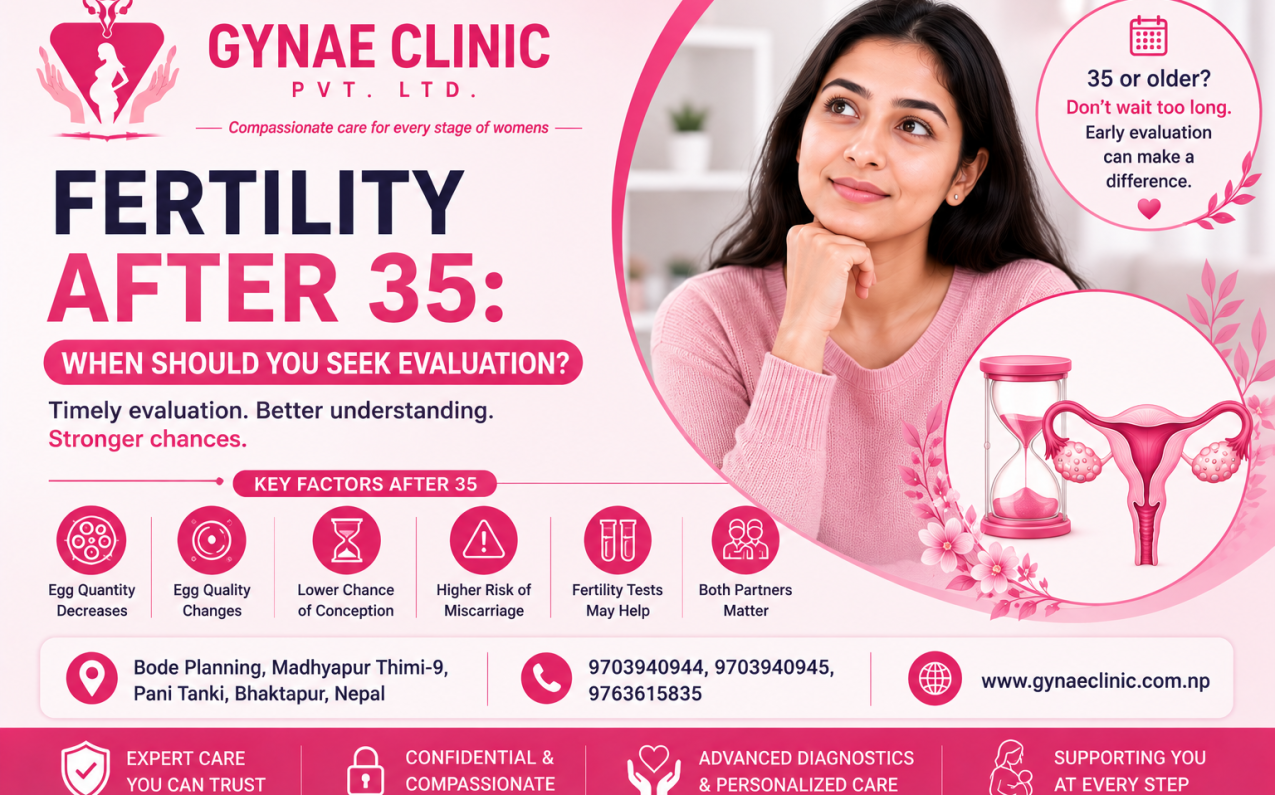
Planning a pregnancy after 35 is absolutely possible, and many women have healthy pregnancies in their late 30s and beyond. However, female fertility gradually declines with age, and the decline becomes more important during the mid-to-late 30s.
This does not mean that turning 35 suddenly causes infertility. Instead, age affects factors such as egg quantity, egg quality and the likelihood of conception, while pregnancy-related risks also become more relevant.
For this reason, women aged 35 and older are generally advised not to wait as long for fertility evaluation if pregnancy is not occurring.
If you are looking for fertility evaluation in Bhaktapur, this guide explains when to seek help, which tests may be considered and what women should know about fertility after 35.
Is It Harder to Get Pregnant After 35?
Fertility generally declines with age, particularly because both the number and quality of eggs decrease over time.
A woman may still have:
- Regular periods
- Regular ovulation
- No obvious health problems
- A healthy lifestyle
and still experience age-related changes in fertility.
This is because having regular periods does not necessarily mean that egg quality or ovarian reserve is unchanged.
Age is therefore an important part of fertility assessment, but it is not the only factor.
Other factors include:
- Ovulation
- Ovarian reserve
- Fallopian tubes
- Uterus
- Endometriosis
- PCOS
- Sperm health
- General health
Gynae Clinic’s fertility guidance notes that female fertility changes with age and that the decline becomes more significant during the mid-to-late 30s.
When Should You Seek Fertility Evaluation After 35?
If you are 35 or older
If you are 35 or older and have been trying to conceive for 6 months without pregnancy, it is generally appropriate to seek a fertility evaluation.
You do not necessarily need to wait 12 months.
This six-month timeframe is particularly important because fertility can change with age, and delaying evaluation may reduce the time available to identify and manage potentially treatable causes.
Gynae Clinic’s fertility information similarly recommends considering evaluation after approximately six months of trying for women aged 35 or older.
Should You Seek Help Before Six Months?
Sometimes, yes.
You may benefit from an earlier consultation if you already have a known or suspected fertility concern.
Consider speaking with a gynecologist sooner if you have:
- Irregular or absent periods
- Suspected ovulation problems
- PCOS
- Endometriosis
- Severe period pain
- Previous pelvic infection
- Previous ectopic pregnancy
- Previous pelvic or reproductive surgery
- Repeated pregnancy loss
- Known ovarian problems
- Known fallopian-tube problems
- Previous fertility treatment
- A concern about declining fertility because of age
Earlier assessment can be especially useful when there is already a reason to suspect that conception may be more difficult.
What If You Are 35 and Just Starting to Try?
You do not automatically need fertility treatment simply because you are 35 or older.
If you have just started trying and have no known fertility concerns, you may begin with healthy pregnancy planning and appropriate preconception care.
However, it is reasonable to discuss your reproductive health with a gynecologist, particularly if pregnancy is important to you and you are concerned about your reproductive timeline.
A preconception consultation can review:
- Menstrual cycles
- Ovulation
- Medical history
- Previous pregnancies
- Medications
- Existing health conditions
- Pregnancy plans
- Lifestyle factors
Gynae Clinic’s pregnancy-planning guidance recommends discussing reproductive health and pregnancy preparation with a gynecologist when appropriate.
Why Does Fertility Decline With Age?
1. Egg Quantity Decreases
Women are born with a finite number of eggs.
The number of remaining eggs gradually decreases throughout life.
By the mid-to-late 30s, ovarian reserve may become increasingly important when planning pregnancy.
2. Egg Quality Changes
Egg quality also changes with age.
This is particularly important because pregnancy depends not only on having an egg available but also on the reproductive potential of that egg.
A woman can therefore have:
Regular periods + regular ovulation + difficulty conceiving.
This does not necessarily mean something is “wrong” with her menstrual cycle.
3. Miscarriage Risk Increases With Age
Age is associated with an increasing risk of miscarriage, largely because chromosomal abnormalities in eggs become more common with advancing maternal age.
This does not mean miscarriage is inevitable after 35.
Many women over 35 have healthy pregnancies.
What Fertility Tests May Be Recommended After 35?
There is no single fertility test that can determine whether you can become pregnant.
A proper fertility evaluation is individualized.
Your gynecologist may consider:
Menstrual and Ovulation Assessment
Your cycle history can provide important information about whether ovulation is likely occurring regularly.
However, regular periods alone do not prove that every cycle is ovulatory.
AMH Test
AMH (Anti-Müllerian Hormone) is commonly used as one marker of ovarian reserve.
However:
AMH is not a simple fertility score.
A high AMH does not guarantee pregnancy.
A low AMH does not automatically mean pregnancy is impossible.
AMH should be interpreted alongside your:
- Age
- Menstrual history
- Ultrasound findings
- Medical history
- Fertility history
Gynae Clinic’s female fertility testing guide specifically explains that AMH provides information about ovarian reserve but cannot independently predict natural pregnancy.
For more information, read [AMH Test: What Does Your AMH Level Mean for Fertility?] AMH Test: What Does Your AMH Level Mean for Fertility?
Pelvic Ultrasound
A pelvic ultrasound may be used to evaluate:
- Uterus
- Ovaries
- Endometrium
- Fibroids
- Ovarian cysts
- Follicles
- Certain PCOS-related findings
Ultrasound may also be used for follicular monitoring when ovulation assessment is needed.
Hormonal Tests
Depending on your symptoms and medical history, your doctor may consider selected hormone tests.
These can include:
- FSH
- LH
- Estradiol
- AMH
- Thyroid testing
- Prolactin
Not every woman needs all of these tests.
The appropriate investigation depends on the individual clinical situation.
Fallopian-Tube Testing
Even if you ovulate regularly, pregnancy may be difficult if the fallopian tubes are blocked or damaged.
An HSG (hysterosalpingography) is one investigation that may be used to assess whether the fallopian tubes are open.
The need for tubal testing depends on your history and fertility evaluation.
Don’t Forget Male Fertility
Fertility evaluation should not focus only on the woman.
Difficulty conceiving can involve:
- Female factors
- Male factors
- Both partners
- Or sometimes no single identifiable cause
A semen analysis may therefore be an important part of the fertility evaluation.
Evaluating both partners can help avoid unnecessary delays.
What If Your Periods Are Regular After 35?
Regular periods are reassuring, but they do not guarantee normal fertility.
A woman with regular cycles can still have:
- Reduced ovarian reserve
- Age-related egg-quality changes
- Endometriosis
- Blocked fallopian tubes
- Uterine abnormalities
- Male-factor fertility problems
This is why fertility evaluation should look beyond menstrual regularity.
For women aged 35 and older who are not conceiving after six months of trying, evaluation is generally appropriate even when periods are regular.
Fertility After 35 and Endometriosis
Endometriosis can affect fertility and may occur even when periods are regular.
Possible symptoms include:
- Severe menstrual pain
- Pelvic pain
- Pain during intercourse
- Pain associated with bowel movements during menstruation
- Difficulty becoming pregnant
If you have significant pelvic pain and are planning pregnancy after 35, discussing your symptoms earlier can be particularly important.
Fertility After 35 and PCOS
PCOS can cause irregular ovulation and may make conception more difficult.
Women with PCOS can still become pregnant.
If you have PCOS and are over 35, fertility evaluation may consider:
- Ovulation
- Menstrual pattern
- Hormonal factors
- Ovarian reserve when appropriate
- Ultrasound findings
- Other fertility factors
PCOS should not be diagnosed solely from an AMH result or ultrasound appearance.
How Can You Improve Your Chances of Pregnancy After 35?
Age-related fertility changes cannot be completely prevented, but healthy pregnancy planning can support your overall reproductive health.
Track your menstrual cycle
Knowing your cycle can help you understand your fertile period.
Understand ovulation
Pregnancy is most likely when intercourse occurs during the fertile window around ovulation.
Maintain a healthy weight
Both significant underweight and obesity can affect reproductive health.
Eat a balanced diet
Choose a varied diet containing vegetables, fruits, whole grains, protein and healthy fats.
Exercise appropriately
Regular moderate physical activity supports general health.
Avoid smoking
Smoking can negatively affect reproductive health.
Get preconception advice
A pre-pregnancy consultation can help review medications, medical conditions and pregnancy-planning needs.
How Long Should You Try After 35?
The commonly used timeframe is:
Under 35: seek evaluation after 12 months of trying without pregnancy.
35 or older: seek evaluation after 6 months of trying without pregnancy.
Known fertility concern: consider evaluation earlier.
Over 40: an earlier fertility consultation is generally appropriate because age is an increasingly important factor in reproductive potential. Gynae Clinic’s fertility testing guidance specifically recommends earlier consultation for women over 40.
What If You Are 38 or 39?
If you are 38 or 39 and planning pregnancy, it may be reasonable to discuss your fertility sooner rather than waiting unnecessarily.
This does not mean you need to panic.
It means time becomes a more important part of fertility planning.
A consultation can help you understand:
- Your menstrual and ovulation pattern
- Ovarian reserve
- Uterine health
- Possible tubal factors
- Medical history
- Your pregnancy goals
The results can help determine whether you should continue trying naturally or whether further evaluation is appropriate.
What If You Are 40 or Older?
Women over 40 may benefit from an earlier fertility consultation, rather than waiting six months or a year.
Age has a stronger influence on fertility at this stage, so timely evaluation can help identify potential issues and discuss available options.
This does not mean natural pregnancy is impossible.
It means that early, individualized assessment becomes more valuable.
Fertility Evaluation After 35 in Bhaktapur
If you are searching for fertility evaluation after 35 in Bhaktapur, female fertility testing in Madhyapur Thimi, or fertility consultation near Bode, Sallaghari, Radhe Radhe, Gatthaghar, Kausaltar, Lokanthali, Sanothimi, Jadibuti or Koteshwor, Gynae Clinic Pvt. Ltd. provides gynecological consultation and fertility evaluation guidance.
The clinic’s fertility evaluation considers age, menstrual history, ovulation, ovarian reserve, ultrasound findings, pregnancy history and other relevant reproductive factors.
For a detailed guide to testing, read [Fertility Tests for Women: Female Fertility Testing in Bhaktapur] Fertility Tests for Women in Bhaktapur
For broader fertility information, read [Infertility Treatment in Bhaktapur: Causes, Fertility Tests, Treatment & When to See a Doctor] Infertility Treatment in Bhaktapur
For pregnancy planning and understanding the fertile window, read [Best Time to Get Pregnant: Ovulation, Fertile Window and Pregnancy Planning] Best Time to Get Pregnant
Gynae Clinic Pvt. Ltd.
Address: Bode Planning, Madhyapur Thimi-9, Pani Tanki, Bhaktapur, Nepal
Contact: 9703940944, 9703940945, 9763615835
Website: www.gynaeclinic.com.np
Compassionate care for every stage of womens
Serving women from Bhaktapur, Madhyapur Thimi, Bode, Sallaghari, Radhe Radhe, Gatthaghar, Kausaltar, Lokanthali, Sanothimi, Jadibuti, Koteshwor, Baneshwor, Suryabinayak, Jagati, Banepa and Dhulikhel.
Frequently Asked Questions
Is 35 too late to get pregnant?
No. Many women become pregnant naturally after 35. However, fertility generally declines with age, particularly during the mid-to-late 30s, so pregnancy planning and timely evaluation become increasingly important.
When should I see a fertility doctor after 35?
If you are 35 or older and have been trying to conceive for six months without pregnancy, fertility evaluation is generally recommended. Earlier evaluation may be appropriate if you have known fertility concerns.
Should I get fertility testing before trying after 35?
Not every woman needs fertility testing before trying. However, preconception consultation can be useful if you have PCOS, endometriosis, irregular periods, previous ectopic pregnancy, recurrent miscarriage, previous reproductive surgery or other fertility concerns.
Can I get pregnant naturally at 38?
Yes. Natural pregnancy is possible at 38, although fertility is generally lower than at younger ages. Individual fertility varies considerably.
Is AMH important after 35?
AMH can provide information about ovarian reserve, but it cannot independently predict whether you will become pregnant naturally.
Do regular periods mean my fertility is normal after 35?
Not necessarily. Regular periods are reassuring but do not rule out age-related egg-quality changes, reduced ovarian reserve, blocked fallopian tubes, endometriosis or male-factor fertility problems.
Should my husband get tested too?
Yes. Male factors can contribute to difficulty conceiving, so fertility evaluation should consider both partners when appropriate.
What if I am over 40 and want to become pregnant?
An earlier fertility consultation is generally appropriate rather than waiting several months before seeking advice.
Medical Disclaimer
This article is for general educational purposes and does not replace individualized medical consultation, diagnosis or treatment. Fertility varies from woman to woman, and the appropriate timing and type of evaluation depend on age, medical history, reproductive history and individual circumstances. Certain complex conditions may benefit from advanced specialist care.
Author: Gynae Clinic Pvt. Ltd.
Address: Bode Planning, Madhyapur Thimi-9, Pani Tanki, Bhaktapur, Nepal


