


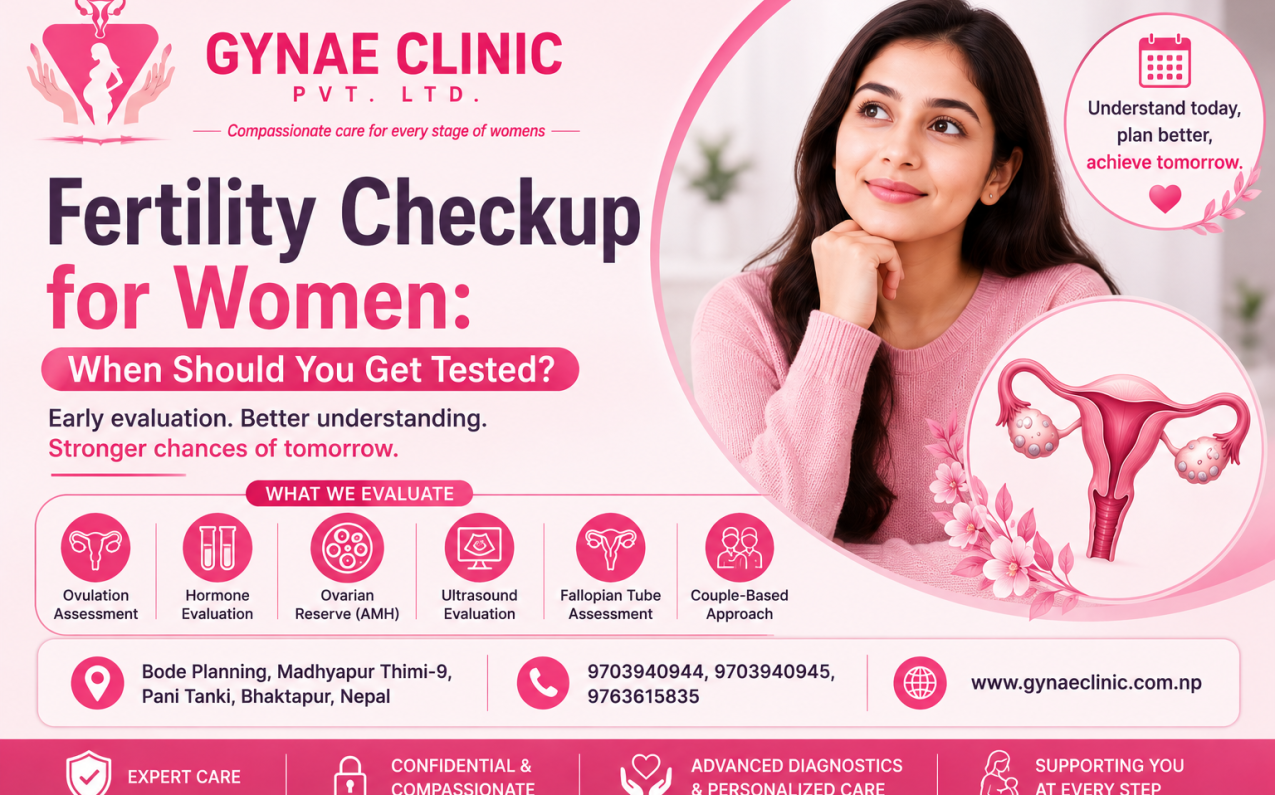
Trying to conceive can be an exciting journey, but it can also raise questions when pregnancy does not happen as quickly as expected. One of the most common questions women ask is:
“When should I get a fertility checkup?”
The answer depends on your age, menstrual cycle, medical history, previous pregnancies, reproductive health and how long you have been trying to conceive.
A fertility checkup is not simply one blood test. A proper evaluation may look at ovulation, ovarian reserve, hormones, the uterus, fallopian tubes and other factors that can influence pregnancy. Not every woman needs every test.
If you are looking for a female fertility checkup in Bhaktapur, understanding when testing is appropriate can help you avoid unnecessary delays while also avoiding tests that may not be needed.
What Is a Fertility Checkup for Women?
A female fertility checkup is an evaluation designed to identify factors that may affect your ability to become pregnant.
Depending on your individual situation, your gynecologist may assess:
- Menstrual-cycle pattern
- Ovulation
- Ovarian reserve
- Hormonal health
- Uterus
- Ovaries
- Fallopian tubes
- Previous pelvic infections
- Endometriosis
- Previous pregnancy or miscarriage
- Other reproductive health concerns
There is no single fertility test that can tell you whether you will definitely become pregnant. Fertility is influenced by several factors, and test results need to be interpreted together.
When Should a Woman Get a Fertility Checkup?
The timing depends primarily on your age and individual circumstances.
If you are under 35
If you have regular unprotected intercourse and have been trying to conceive for 12 months without pregnancy, fertility evaluation is generally appropriate.
If you are 35 or older
If you are 35 or older and have been trying for 6 months without pregnancy, it is generally advisable to seek fertility evaluation rather than waiting another year.
If you are 40 or older
A fertility discussion may be appropriate earlier, because female fertility changes with age and egg quality and quantity become increasingly important factors.
You may need testing sooner at any age
You do not necessarily need to wait 6 or 12 months if you already have a known fertility concern. Earlier evaluation may be appropriate if you have:
- Very irregular or absent periods
- Suspected ovulation problems
- PCOS
- Endometriosis
- Previous pelvic infection
- Previous ectopic pregnancy
- Repeated pregnancy loss
- Previous reproductive or pelvic surgery
- Known ovarian or tubal problems
- Concerns about declining fertility with age
Do You Need a Fertility Checkup If Your Periods Are Regular?
Not necessarily—but regular periods do not guarantee that every fertility factor is normal.
Regular menstrual cycles often suggest that ovulation is occurring, but fertility also depends on the:
Egg + sperm + fallopian tubes + uterus + implantation process
For example, a woman can have regular periods and still have:
- Blocked fallopian tubes
- Endometriosis
- Reduced ovarian reserve
- Age-related egg-quality changes
- Uterine fibroids or polyps
- Male-factor fertility problems
If you have regular periods but pregnancy has not occurred after the appropriate time, a complete fertility evaluation may still be worthwhile.
What Fertility Tests Are Usually Done for Women?
The tests are selected according to your individual circumstances rather than automatically ordering every possible test.
1. Menstrual and Medical History
Your doctor may first ask about:
- Cycle length
- Period regularity
- Last menstrual period
- Previous pregnancies
- Previous miscarriages
- Previous ectopic pregnancy
- Previous surgeries
- Pelvic pain
- Previous infections
- PCOS or endometriosis
- Medications
- How long you have been trying to conceive
This information helps determine which tests are actually useful.
2. Ovulation Assessment
Ovulation is essential for natural conception.
If your periods are irregular, very long or absent, your doctor may investigate whether you are ovulating regularly.
Depending on your situation, evaluation can involve:
- Menstrual-cycle assessment
- Hormonal testing
- Ovulation-related testing
- Ultrasound
- Follicular monitoring
Ultrasound monitoring can sometimes be used to follow follicular development and assess ovulation.
3. AMH Test
AMH (Anti-Müllerian Hormone) is commonly discussed when women are considering fertility testing.
AMH can provide information about ovarian reserve, but it should not be interpreted as a simple yes-or-no fertility test.
A high or low AMH level alone cannot tell you whether you will become pregnant naturally.
Your doctor may interpret AMH together with:
- Age
- Menstrual history
- Ultrasound findings
- Medical history
- Other fertility investigations
For more information, read [AMH Test: What Does Your AMH Level Mean for Fertility?] AMH Test: What Does Your AMH Level Mean for Fertility?
4. Hormone Tests
Hormonal testing may be recommended when your symptoms or medical history suggest a hormonal cause of fertility problems.
Depending on your situation, your doctor may consider tests related to:
- Thyroid function
- Prolactin
- Ovulation
- Reproductive hormones
- Ovarian function
You do not necessarily need every hormone test. The appropriate investigations depend on your symptoms, age and reproductive history.
5. Pelvic Ultrasound
A pelvic ultrasound can provide useful information about the reproductive organs.
It may assess:
- Uterus
- Ovaries
- Endometrial lining
- Ovarian follicles
- Fibroids
- Ovarian cysts
- Certain PCOS-related findings
- Other pelvic abnormalities
Ultrasound can also be used for fertility monitoring when appropriate.
6. Fallopian Tube Testing
The fallopian tubes are important because they provide the pathway where sperm and egg can meet.
If a tube is blocked or damaged, natural conception may be affected even if:
- Your periods are regular
- You are ovulating
- Your hormone tests are normal
When clinically appropriate, an HSG (hysterosalpingography) may be used to assess whether the fallopian tubes are open.
A tubal test does not by itself guarantee pregnancy; it answers a specific question about the reproductive tract.
7. Should Your Partner Also Be Tested?
Yes.
Fertility difficulties can involve the woman, the man, both partners, or sometimes no single identifiable cause.
For this reason, evaluating only the woman may delay finding an important male fertility factor.
A semen analysis is a common part of male fertility evaluation.
Fertility assessment is therefore best considered as a couple-based evaluation, rather than something that automatically places responsibility on the woman.
Fertility Checkup After Miscarriage or Ectopic Pregnancy
Your previous pregnancy history can influence when fertility evaluation is appropriate.
Earlier assessment may be considered if you have experienced:
- Repeated pregnancy loss
- Previous ectopic pregnancy
- Previous pelvic infection
- Previous reproductive surgery
- Known endometriosis
- Other reproductive health concerns
Your doctor can determine whether additional testing is appropriate based on your individual history.
Should You Get Fertility Testing Before Trying to Conceive?
Not every woman needs a fertility test before trying for pregnancy.
However, preconception fertility counselling can be useful if you already have concerns or known risk factors.
You may want to discuss fertility with a gynecologist before trying if you have:
- PCOS
- Endometriosis
- Irregular periods
- Previous pelvic infection
- Previous ectopic pregnancy
- Previous reproductive surgery
- Repeated miscarriage
- A known ovarian or tubal condition
- Concern about age-related fertility changes
Early discussion can help determine whether testing is appropriate rather than automatically ordering multiple tests.
What Should You Bring to a Fertility Checkup?
Preparing a few details can make your consultation more useful.
Bring or note:
Your menstrual history
Know the approximate dates of your recent periods and usual cycle length.
Previous reports
Bring:
- Ultrasound reports
- Blood-test results
- Previous fertility investigations
- Previous pregnancy records
- Previous miscarriage or ectopic-pregnancy records
Medication information
Make a list of medicines, vitamins and supplements you currently use.
Previous fertility treatment
If you have previously taken fertility medication or undergone fertility treatment, bring those records.
Gynae Clinic’s female fertility guidance also recommends bringing previous medical reports, pregnancy records, medication information and menstrual-cycle details to the consultation.
Is a Fertility Checkup Painful?
It depends on which investigations are recommended.
A consultation and blood tests are generally straightforward. A pelvic ultrasound is also commonly used in fertility evaluation.
Some investigations, such as tubal testing, may involve more discomfort than routine consultation or blood testing.
Your gynecologist should explain why a particular test is being recommended and what it involves before proceeding.
Can Fertility Tests Tell You If You Will Get Pregnant?
No single fertility test can guarantee pregnancy.
This is one of the most important things to understand about fertility testing.
For example:
AMH → provides information about ovarian reserve.
Ultrasound → provides information about the uterus, ovaries and certain structural findings.
HSG → assesses whether fallopian tubes are open.
Hormone tests → can identify certain hormonal problems.
But none of these tests alone can predict with certainty whether you will become pregnant naturally.
Age, egg quality, sperm health, tubal function, uterine factors and other reproductive factors all matter.
What If All Fertility Tests Are Normal?
Sometimes, fertility testing does not identify a clear cause even after appropriate evaluation.
This does not mean pregnancy cannot happen.
Your gynecologist can consider factors such as:
- Age
- Duration of trying
- Previous pregnancy history
- Ovulation
- Ovarian reserve
- Tubal status
- Male-factor evaluation
- Overall reproductive health
The appropriate next step depends on the individual couple rather than one laboratory result.
When Should You Not Wait?
Consider seeking fertility advice sooner if you already know that you have a possible fertility risk.
You should consider an earlier consultation if you have:
Irregular or absent periods
Severe pelvic pain
Endometriosis
PCOS with fertility concerns
Previous ectopic pregnancy
Previous pelvic infection
Repeated pregnancy loss
Previous reproductive surgery
Known ovarian or tubal problems
Age-related fertility concerns
Earlier evaluation can sometimes save valuable time, particularly when age or a known reproductive condition may affect fertility.
Fertility Checkup for Women in Bhaktapur
If you are searching for a fertility checkup for women in Bhaktapur, female fertility testing in Madhyapur Thimi, or a fertility consultation near Bode, Sallaghari, Radhe Radhe, Gatthaghar, Kausaltar, Lokanthali, Jadibuti or Koteshwor, Gynae Clinic Pvt. Ltd. provides gynecological consultation and fertility evaluation guidance.
The clinic’s female fertility evaluation considers the individual’s age, menstrual pattern, pregnancy history, symptoms and medical history before determining which investigations may be appropriate.
For a detailed guide to individual investigations, read [Fertility Tests for Women: Complete Guide to Female Fertility Testing in Bhaktapur] Fertility Tests for Women: Complete Guide to Female Fertility Testing in Bhaktapur
You can also read [Infertility Treatment in Bhaktapur: Causes, Fertility Tests, Treatment & When to See a Doctor] Infertility Treatment in Bhaktapur: Causes, Fertility Tests, Treatment & When to See a Doctor
Gynae Clinic Pvt. Ltd.
Address: Bode Planning, Madhyapur Thimi-9, Pani Tanki, Bhaktapur, Nepal
Contact: 9703940944, 9703940945, 9763615835
Website: www.gynaeclinic.com.np
Compassionate care for every stage of womens
Serving women from Bhaktapur, Madhyapur Thimi, Bode, Sallaghari, Radhe Radhe, Gatthaghar, Sanothimi, Kausaltar, Lokanthali, Jadibuti, Koteshwor, Baneshwor, Suryabinayak, Jagati, Banepa and Dhulikhel.
Frequently Asked Questions
When should I get a fertility checkup?
If you are under 35, fertility evaluation is generally considered after 12 months of trying without pregnancy. If you are 35 or older, evaluation is generally recommended after 6 months. Earlier assessment may be appropriate when you have known fertility risks or reproductive health concerns.
Should I get tested if I have regular periods?
Regular periods are reassuring but do not rule out all fertility problems. If you have been trying for the appropriate period without pregnancy, a fertility evaluation may still be useful.
What is the first fertility test for women?
There is no universal first test for every woman. A gynecologist usually starts with medical and menstrual history and then chooses investigations based on age, symptoms and reproductive history.
Is AMH enough to check fertility?
No. AMH provides information about ovarian reserve but cannot independently predict natural pregnancy.
Do I need an ultrasound for a fertility checkup?
Ultrasound is commonly used in female fertility evaluation, but whether you need it depends on your individual situation.
Should my husband get tested too?
Yes. Male-factor fertility problems can contribute to difficulty conceiving, so both partners may need evaluation.
Can I get a fertility checkup before trying for pregnancy?
Yes. Preconception fertility counselling can be particularly useful when you have PCOS, endometriosis, irregular periods, previous reproductive problems or other fertility concerns.
Medical Disclaimer
This article is for general educational purposes and does not replace individualized medical consultation, diagnosis or treatment. Fertility testing should be selected according to your age, medical history, reproductive history and individual circumstances. Certain complex conditions may benefit from advanced specialist care.
Author: Gynae Clinic Pvt. Ltd.
Address: Bode Planning, Madhyapur Thimi-9, Pani Tanki, Bhaktapur, Nepal


