


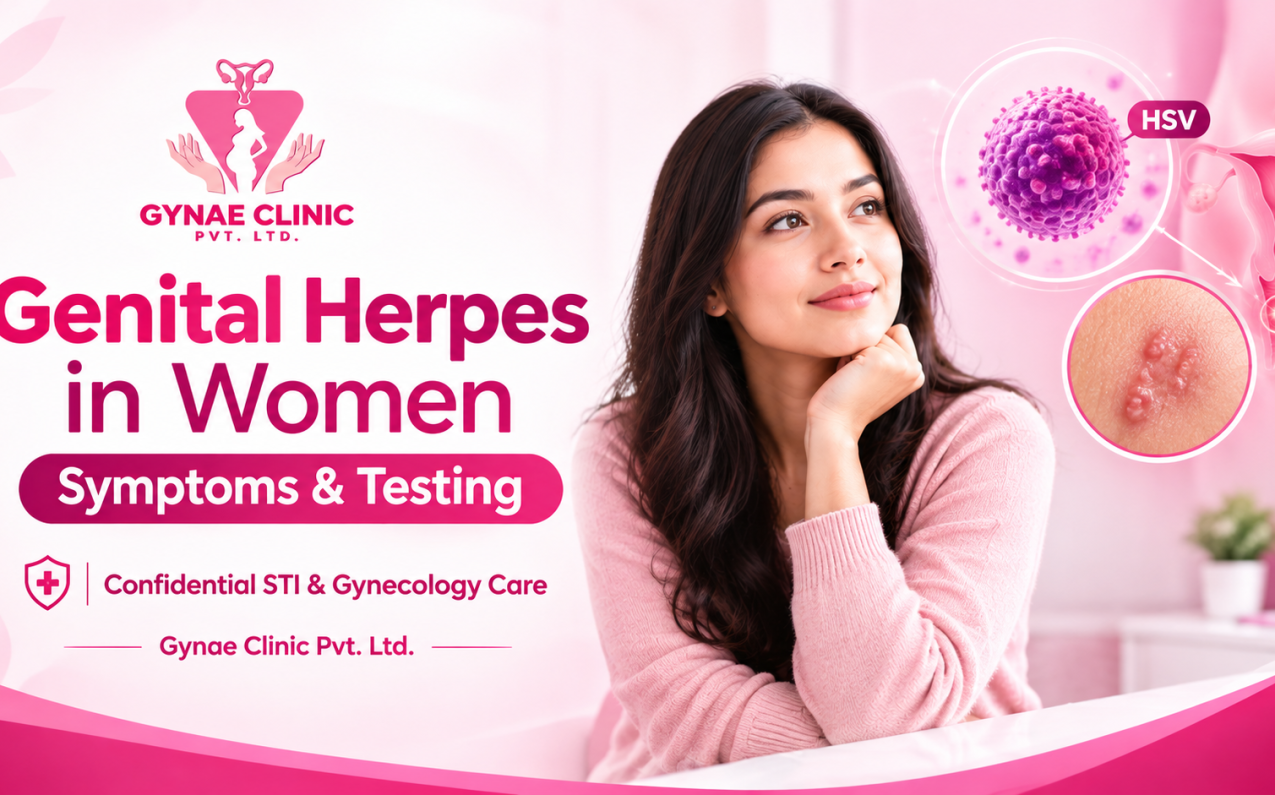
Genital herpes is a common sexually transmitted infection (STI) caused by herpes simplex virus (HSV). It can be caused by HSV-1 or HSV-2 and may affect the genital area, vulva, vagina, cervix, surrounding skin, or anal area.
One of the most important things to know is that genital herpes does not always cause obvious symptoms. Some women may have no noticeable symptoms, while others may develop painful blisters, sores, burning, itching, tingling, or discomfort when urinating. Because several other conditions can look similar, proper medical evaluation and appropriate testing are important.
If you are searching for genital herpes symptoms in women, herpes testing in Bhaktapur, STI testing in Bhaktapur, or confidential gynecological consultation in Madhyapur Thimi, understanding the symptoms and testing process can help you know when to seek care.
What Is Genital Herpes?
Genital herpes is an infection caused by herpes simplex virus.
The two main types are:
- HSV-1
- HSV-2
Both types can cause genital herpes. HSV-1 is also commonly associated with oral herpes, while HSV-2 has traditionally been more strongly associated with genital infection.
Genital herpes can be transmitted through sexual contact, including contact with infected skin or mucosal surfaces. Transmission can occur even when visible sores are not present.
This means that a person may have genital herpes and not know it.
For women concerned about possible STI exposure, you can also read STI Testing for Women: Which Tests May Be Needed?.
Genital Herpes Symptoms in Women
Symptoms can vary significantly from woman to woman.
Some women have a noticeable first outbreak, while others have mild symptoms that can be mistaken for another skin or vaginal condition. Some women have no symptoms at all.
Possible symptoms include:
1. Painful Blisters
Small fluid-filled blisters may develop around:
- The vulva
- Vaginal opening
- Genital skin
- Buttocks
- Anal area
- Upper thighs
The blisters may eventually break and form painful sores.
2. Genital Sores or Ulcers
After blisters break, they may develop into shallow, painful ulcers.
These sores can make sitting, walking, wearing tight clothing, or sexual intercourse uncomfortable.
A genital sore should not automatically be assumed to be herpes because other infections and non-infectious skin conditions can also cause genital ulcers.
3. Burning or Tingling
Some women experience unusual sensations before visible lesions appear.
These can include:
- Tingling
- Burning
- Itching
- Increased sensitivity
- Localized discomfort
These sensations may occur before an outbreak.
4. Pain or Burning During Urination
If sores are located near the urethral opening, urination can become painful.
Some women may describe the sensation as burning or stinging.
However, burning while urinating can also occur with urinary infections and other STIs, so it should not automatically be attributed to herpes.
5. Genital Itching or Irritation
Itching or irritation around the vulva or genital skin may occur.
Because itching is common with many vaginal and skin conditions, an examination may be necessary to determine the cause.
6. Swollen or Tender Lymph Nodes
During a first symptomatic episode, some women may experience swollen or tender lymph nodes in the groin.
7. Flu-Like Symptoms
A first outbreak can sometimes be accompanied by symptoms such as:
- Fever
- Body aches
- Headache
- Fatigue
- General feeling of illness
Not every woman experiences these symptoms.
8. No Symptoms at All
This is extremely important.
Many people with genital herpes do not have noticeable symptoms or may have symptoms that are so mild they mistake them for something else.
A woman may therefore have genital herpes without knowing she has it.
What Does a Genital Herpes Outbreak Look Like?
A typical symptomatic outbreak may progress through several stages.
It may begin with:
Tingling → burning/itching → small blisters → painful sores → healing
However, not every outbreak follows exactly the same pattern.
Some women may develop only a few small lesions, while others may have multiple painful sores.
Because genital herpes can resemble other conditions, visual appearance alone should not be used as a definite diagnosis.
Can Genital Herpes Be Mistaken for Something Else?
Yes.
Genital herpes can sometimes be confused with:
- Ingrown hairs
- Pimples
- Folliculitis
- Vaginal irritation
- Yeast infection
- Other genital infections
- Syphilis
- Other causes of genital ulcers or sores
This is one reason professional evaluation is important when new genital sores or blisters appear.
Gynae Clinic’s Genital Infection Evaluation in Bhaktapur page explains how genital symptoms may have several different causes and why appropriate testing can be important.
How Is Genital Herpes Diagnosed?
The diagnostic approach depends largely on whether visible lesions are present.
A healthcare professional may consider:
- Your symptoms
- The appearance and location of lesions
- Your medical and sexual history
- Whether this is a first episode or recurrent episode
- Laboratory testing when appropriate
CDC guidance recommends herpes testing for people who have genital symptoms that could represent herpes.
Genital Herpes Testing in Women
1. Swab From a Genital Lesion
When a fresh blister or sore is present, a healthcare professional may collect a sample from the lesion for laboratory testing.
This is often the most useful time to test because the virus can be detected directly from the lesion.
CDC notes that testing from a blister or sore works best when the lesion has not already crusted over or started healing.
Important:
If you notice a new genital blister or sore, do not wait unnecessarily for it to heal before seeking medical evaluation.
Early assessment can make lesion-based testing more useful.
2. PCR or NAAT Testing
Molecular tests can detect HSV genetic material from an appropriate lesion specimen.
These tests can be highly sensitive when collected correctly from a suitable lesion.
The exact test available depends on the healthcare facility and laboratory.
3. Blood Testing for Herpes
Type-specific blood tests can detect antibodies to HSV.
However, herpes blood testing is more complicated than many people realize.
A blood test may sometimes be considered when:
- There are symptoms but no active lesion to swab
- A sexual partner has genital herpes
- A healthcare professional believes herpes testing may be useful based on your circumstances
However, routine blood screening for genital herpes is not recommended for everyone without symptoms because current blood tests have limitations and false-positive results can occur.
This is why a “full STI panel” does not necessarily mean that herpes testing should automatically be included.
When Is the Best Time to Test for Genital Herpes?
If you have a fresh genital blister, sore, or ulcer, seek medical evaluation as soon as possible.
A fresh lesion may provide a better specimen for direct testing than an old, crusted, or healing lesion.
If you have no visible lesions but are concerned because a sexual partner has herpes, speak with a healthcare professional about whether blood testing is appropriate and when testing may be meaningful.
After a recent exposure, timing matters because antibodies may not be detectable immediately. CDC notes that it can take 16 weeks or more after exposure for currently available tests to detect infection in some circumstances.
Do You Need a Herpes Test If You Have No Symptoms?
Not necessarily.
This is an important difference between herpes testing and some other STI tests.
CDC does not recommend routine herpes testing for everyone without symptoms. The decision should be based on individual circumstances, symptoms, exposure history and discussion with a healthcare professional.
Testing may be considered in selected situations, such as when:
- You have genital symptoms
- Your partner has genital herpes
- A healthcare professional sees signs that could represent herpes
- Your medical history suggests that testing may be useful
Is Every Genital Sore Herpes?
No.
A genital sore can have several possible causes.
Possible causes include:
- Genital herpes
- Syphilis
- Other infections
- Skin conditions
- Trauma or irritation
- Ingrown hairs or folliculitis
- Other medical conditions
Therefore, if you develop an unexplained genital sore, it is better to have it evaluated rather than assuming it is herpes.
Can Genital Herpes Occur Without Blisters?
Yes.
Some people have mild symptoms that do not look like the classic cluster of blisters.
Symptoms can include:
- Mild burning
- Tingling
- Itching
- Small skin changes
- Minor irritation
- Recurrent discomfort
Some people have no symptoms whatsoever.
This is why a healthcare professional may need to consider your overall history rather than relying only on the appearance of the genital area.
Can Genital Herpes Come Back?
Yes.
After the initial infection, HSV remains in the body and can become inactive and later reactivate.
Some women experience recurrent outbreaks, while others may have very few or no further noticeable episodes.
The pattern varies from person to person.
What Can Trigger a Herpes Outbreak?
Recurrences can vary between individuals.
Some people notice outbreaks around periods of:
- Physical or emotional stress
- Illness
- Fatigue
- Reduced sleep
- Other individual triggers
However, there is no single trigger that causes outbreaks in everyone.
Is Genital Herpes Curable?
There is currently no cure that eliminates HSV from the body.
However, genital herpes can be managed.
Antiviral medicines can:
- Shorten or reduce the severity of outbreaks
- Help control symptoms
- Reduce the frequency of recurrent outbreaks in some people
- Reduce transmission risk in certain circumstances when used as prescribed
Treatment decisions should be individualized by a healthcare professional.
Do not take antiviral medicines without appropriate medical advice.
Can Genital Herpes Be Transmitted Without Symptoms?
Yes.
HSV can be transmitted even when visible sores are not present.
This is one reason why a person may transmit genital herpes without realizing that they have an active infection.
Using condoms consistently can reduce the risk, although condoms do not completely eliminate transmission because HSV can affect skin areas that are not covered by a condom.
What If My Partner Has Genital Herpes?
If your partner has genital herpes, do not panic.
It does not automatically mean that you have the infection.
Instead, discuss the situation with a healthcare professional.
The appropriate approach may depend on:
- Whether you have symptoms
- Whether your partner has confirmed herpes
- Whether the infection is HSV-1 or HSV-2
- When the diagnosis was made
- Whether you have had previous symptoms
- Your sexual history
- Whether testing is appropriate
CDC specifically recommends discussing herpes testing with a healthcare provider when a sexual partner has genital herpes.
Genital Herpes and Pregnancy
If you are pregnant and have genital herpes, or develop genital sores or blisters during pregnancy, tell your obstetrician or healthcare professional.
Pregnancy requires individualized assessment because herpes infection around the time of delivery can be important for newborn health.
Do not hide genital symptoms because you are embarrassed to discuss them.
Early communication allows your healthcare team to plan appropriate care.
When Should a Woman See a Gynecologist for Possible Herpes?
Consider a consultation if you develop:
- New genital blisters
- Painful genital sores
- Genital ulcers
- Burning or tingling around the genital area
- Painful urination associated with genital lesions
- Recurrent unexplained genital sores
- A sexual partner diagnosed with genital herpes
- A recent sexual exposure that concerns you
- Persistent genital irritation
- Unexplained genital skin changes
You should seek prompt medical evaluation if you have severe pain, fever, extensive lesions, difficulty passing urine, significant illness, or are pregnant with new genital lesions.
Genital Herpes Testing in Bhaktapur
If you are searching for genital herpes testing in Bhaktapur, STI testing in Madhyapur Thimi, STD testing near me, or confidential gynecological consultation, Gynae Clinic Pvt. Ltd. provides women-focused gynecological and sexual-health consultation.
Gynae Clinic Pvt. Ltd.
Address: Bode Planning, Madhyapur Thimi-9, Pani Tanki, Bhaktapur, Nepal
Contact: 9703940944 | 9703940945 | 9763615835
Website: www.gynaeclinic.com.np
Women from Bode, Madhyapur Thimi, Sanothimi, Kausaltar, Lokanthali, Gatthaghar, Radhe Radhe, Sallaghari, Suryabinayak, Jadibuti, Koteshwor, Baneshwor and surrounding areas can seek gynecological consultation according to their individual needs.
For broader information, read STD Clinic in Bhaktapur: Confidential STI Testing, Treatment & Venereology Care.
Confidential Consultation for Genital Herpes Concerns
Genital symptoms can be difficult to discuss.
Some women worry about:
- Being judged
- Privacy
- A partner discovering the diagnosis
- Whether a genital sore means an STI
- Whether testing will be painful
- What a positive result could mean for future relationships
These concerns are understandable.
A confidential medical consultation gives you an opportunity to discuss your symptoms and concerns respectfully and determine whether examination or testing is appropriate.
You can also read Confidential Gynecology Consultation in Bhaktapur.
Frequently Asked Questions About Genital Herpes in Women
Can women have genital herpes without symptoms?
Yes. Many people with genital herpes have no symptoms or symptoms that are mild enough to go unnoticed.
What are the first symptoms of genital herpes in women?
Possible early symptoms include tingling, burning, itching, genital discomfort, followed by blisters or painful sores. Some women have no noticeable symptoms.
Are genital herpes sores always painful?
No. They can be painful, but symptoms vary between individuals.
Can genital herpes look like a pimple?
Sometimes a herpes lesion may be mistaken for a pimple or ingrown hair. A healthcare professional can help determine whether testing is appropriate.
What is the best test for genital herpes?
When a fresh blister or sore is present, a sample taken directly from the lesion can be very useful. Molecular testing may be used depending on the clinical setting and laboratory.
Can a blood test detect genital herpes?
Type-specific blood tests can sometimes detect HSV antibodies, but they have limitations and are not recommended as routine screening for everyone without symptoms.
Should I test for herpes after unprotected sex?
It depends on the circumstances, timing, symptoms and whether your partner has herpes. Discuss the exposure with a healthcare professional rather than automatically ordering a herpes blood test.
Can genital herpes be cured?
There is no treatment that removes HSV from the body, but antiviral medicines can help manage outbreaks and reduce transmission risk in appropriate situations.
Can herpes come back after treatment?
Yes. HSV remains in the body and can reactivate. The frequency and severity of recurrences vary between individuals.
Does having herpes mean I cannot have a normal relationship?
No. Many people with genital herpes have healthy relationships and sexual lives. Appropriate medical advice, communication and risk-reduction strategies can help manage the infection.
Final Takeaway
Genital herpes in women can cause blisters, painful sores, burning, itching, tingling and painful urination—but some women have no noticeable symptoms at all.
Because genital herpes can resemble other genital infections and skin conditions, self-diagnosis is unreliable.
If you have a new genital sore or blister, getting evaluated while the lesion is fresh can be particularly useful because a sample from an active lesion may help confirm the diagnosis. Blood testing is more complicated and is not recommended as routine screening for everyone without symptoms.
If you are concerned about genital herpes, an STI exposure, or unexplained genital symptoms, confidential medical consultation can help determine whether examination or testing is appropriate.
Gynae Clinic Pvt. Ltd.
Bode Planning, Madhyapur Thimi-9, Pani Tanki, Bhaktapur, Nepal
9703940944 | 9703940945 | 9763615835
Compassionate Care for Every Women’s Health
Medical Disclaimer
This article is for general educational purposes and does not replace an individual medical consultation, diagnosis or treatment plan. Genital sores and similar symptoms can have different causes, so appropriate professional evaluation and testing are important. Do not self-medicate based solely on online information. Certain complex conditions may benefit from advanced specialist care.
Author
Gynae Clinic Pvt. Ltd. Medical Content Team


