
How accurate are STD tests? This is an important question for anyone who has had a possible sexual exposure, has STI symptoms, or wants reassurance about their sexual health.
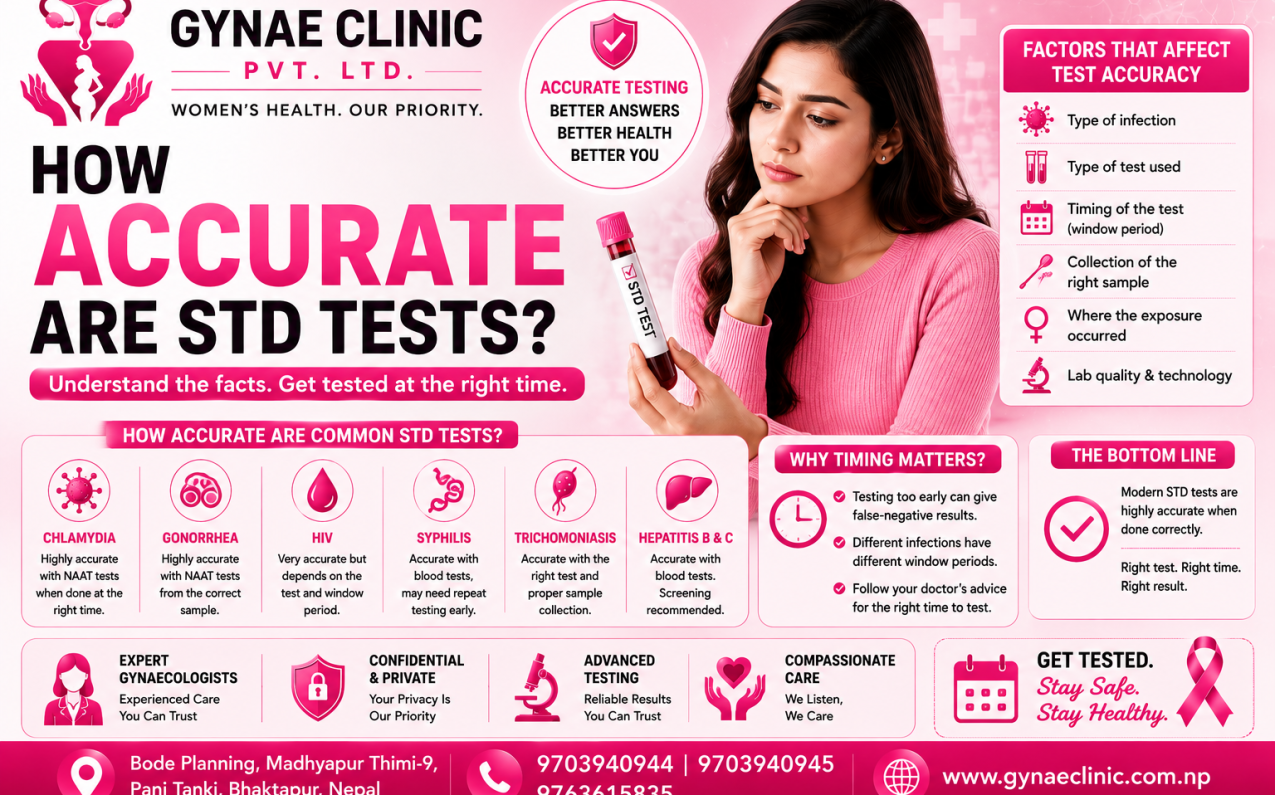
The good news is that modern STI tests are generally highly accurate when the correct test is used, the right sample is collected, and testing is performed at an appropriate time after exposure.
However, no medical test is perfect. A negative result can sometimes be misleading if testing is performed too early, the wrong body site is tested, or the infection requires a different type of test.
This guide explains how accurate STD tests are, what can cause false-negative or false-positive results, when to test after sex, and which STI tests are commonly used for women.
Quick Answer: Are STD Tests Accurate?
Yes, most modern STD/STI tests are highly accurate when used correctly.
But accuracy depends on several factors:
- Which STI is being tested
- Which test is used
- How long ago the exposure occurred
- Where the infection may be located
- Whether the correct sample is collected
- Whether you have symptoms
- Laboratory quality
- Whether follow-up or confirmatory testing is required
For example, NAATs are highly sensitive tests commonly used for chlamydia and gonorrhea, while HIV requires HIV-specific testing and syphilis requires appropriate serologic testing.
So instead of asking only, “Is an STD test accurate?”, it is better to ask:
“Was the right STI test performed at the right time using the right sample?”
What Does “Test Accuracy” Mean?
Two important terms help explain medical test accuracy:
Sensitivity
Sensitivity describes how well a test identifies people who actually have an infection.
A highly sensitive test is less likely to miss an infection.
Specificity
Specificity describes how well a test correctly identifies people who do not have the infection.
A highly specific test is less likely to produce a false-positive result.
A good STI test aims for both high sensitivity and high specificity.
Can an STD Test Be 100% Accurate?
No test should be considered 100% accurate in every situation.
Even highly accurate laboratory tests can occasionally produce:
- False-negative results
- False-positive results
- Inconclusive results
The risk depends on the infection, test method, timing and specimen.
The good news is that modern laboratory testing has significantly improved STI diagnosis.
For example, CDC guidance identifies NAATs as highly sensitive and specific methods for detecting chlamydia and gonorrhea.
Why Can an STD Test Be Negative When Someone Has an Infection?
A false-negative result means the test says negative even though the person has an infection.
One of the most common reasons is:
Testing Too Soon
After an infection occurs, it may take time before a test can detect it.
This period is often called the window period.
For example, HIV tests cannot detect a newly acquired infection immediately. The window period varies according to the type of HIV test.
Therefore:
A negative test immediately after sex does not necessarily rule out an infection acquired from that encounter.
How Accurate Are Chlamydia Tests?
Modern nucleic acid amplification tests (NAATs) are widely used for chlamydia testing.
They can be performed using appropriate specimens such as:
- Urine
- Vaginal samples
- Cervical samples
- Other site-specific specimens when appropriate
NAATs are considered highly sensitive and specific for chlamydia and gonorrhea compared with older testing approaches.
But timing still matters.
If testing occurs too soon after a possible exposure, infection may not yet be detectable.
If your healthcare professional believes the exposure was recent, repeat testing may sometimes be recommended.
How Accurate Are Gonorrhea Tests?
Gonorrhea is also commonly detected using NAATs.
These tests can be highly accurate when the appropriate sample is collected.
However, testing must consider where the exposure occurred.
For example, a woman who has had oral sexual exposure may potentially have an infection in the throat.
A urine or vaginal test alone may not evaluate that site.
Similarly, relevant anal exposure may require rectal testing.
CDC guidance recognizes the importance of testing appropriate anatomical sites for chlamydia and gonorrhea based on exposure.
How Accurate Are HIV Tests?
HIV tests are highly accurate when the appropriate test is performed at the appropriate time.
But HIV testing has an important window period.
Different HIV tests detect infection at different times.
For example, CDC information states that:
- Laboratory antigen/antibody testing using blood from a vein can usually detect HIV 18–45 days after exposure.
- Finger-stick antigen/antibody tests can take longer.
- NAT testing can detect HIV earlier, often around 10–33 days after infection.
This means a person who tests negative very soon after a possible exposure may need repeat testing depending on the test used and the timing.
Important
The accuracy of an HIV test depends heavily on when you take it.
How Accurate Is a Syphilis Test?
Syphilis is generally evaluated using blood tests.
However, syphilis testing can be more complicated than simply taking one test and assuming the answer is always definitive.
Different tests detect different aspects of the body’s response to infection.
If testing occurs very early after exposure, the infection may not yet be detectable.
If symptoms such as a suspicious genital sore or rash are present, clinical examination and appropriate testing are important.
A healthcare professional may recommend repeat testing when the timing of exposure makes an early negative result less conclusive.
How Accurate Are Trichomoniasis Tests?
Trichomoniasis can be diagnosed using specific laboratory tests.
Testing may be considered when a woman has symptoms such as:
- Vaginal discharge
- Vaginal odor
- Itching
- Irritation
- Burning
- Discomfort during sex
A negative result should always be interpreted in the context of the symptoms and type of test performed.
Can the Wrong Sample Affect STD Test Accuracy?
Yes.
The sample needs to come from an appropriate anatomical site.
For example:
Genital exposure
Testing may involve:
- Urine
- Vaginal sample
- Cervical sample
Oral exposure
A throat sample may be appropriate for certain infections.
Anal exposure
A rectal sample may be appropriate.
This is particularly important for chlamydia and gonorrhea because infections outside the genital tract can otherwise be missed.
Can You Have an STI With a Negative STD Test?
Yes, depending on the circumstances.
A negative result can be reassuring, but it does not necessarily mean every STI has been ruled out.
For example:
Negative chlamydia test ≠ negative HIV test
Negative HIV test ≠ negative gonorrhea test
Negative gonorrhea test ≠ negative syphilis test
Each infection requires the appropriate test.
Also, a test may not evaluate an anatomical site that was exposed.
Can You Have an STD Without Symptoms?
Absolutely.
Many sexually transmitted infections can cause few or no symptoms.
A woman can have an STI without:
- Vaginal discharge
- Pelvic pain
- Itching
- Odor
- Burning urination
- Genital sores
- Bleeding
This is one reason screening can be important even when someone feels completely healthy.
Does a Positive STD Test Always Mean You Have an STD?
A positive screening result does not always mean that a final diagnosis has been established.
Some screening tests can occasionally produce false-positive results.
Depending on the infection and testing method, a healthcare professional may recommend confirmatory or supplemental testing.
This is particularly relevant for certain HIV testing algorithms, where an initially reactive result is followed by additional tests to establish the diagnosis.
Therefore:
Do not panic after an initial reactive result.
Wait for the appropriate follow-up testing and professional interpretation.
What Can Cause a False-Negative STD Test?
Several factors can contribute to a false-negative result.
1. Testing too early
The infection may not yet be detectable.
2. Testing the wrong site
A genital test may not detect an infection located in the throat or rectum.
3. Incorrect sample collection
Poor or inadequate sampling can affect detection.
4. Using an inappropriate test
Different infections require different testing methods.
5. Recent treatment
Antibiotics or other treatment can sometimes affect whether an infection is detectable.
6. Very low levels of infection
Some infections may be harder to detect at certain stages.
7. Laboratory or specimen problems
Although uncommon, laboratory errors or specimen handling problems can occur.
What Can Cause a False-Positive STD Test?
A false-positive result means the test indicates infection even though the person does not actually have that infection.
Possible causes vary depending on the test.
They can include:
- Cross-reactivity
- Technical issues
- Certain medical conditions
- Testing in populations where the infection is uncommon
- Limitations of a particular screening test
This is why some reactive screening results require additional testing.
For example, HIV diagnosis uses a testing algorithm rather than relying on one isolated screening result.
Does Testing Too Early Affect STD Test Accuracy?
Yes. This is one of the most important factors.
Different STIs have different window periods.
There is no universal rule such as:
“Wait exactly seven days and every STD test will be accurate.”
Instead, timing depends on:
- The infection
- Test type
- Exposure
- Sample type
- Symptoms
- Whether repeat testing is required
If you recently had sex and are concerned about an STI, tell your healthcare professional the exact date of the possible exposure.
How Soon After Sex Should You Get an STD Test?
There is no single answer for every STI.
HIV
Different tests have different window periods. A laboratory antigen/antibody test may detect infection earlier than an antibody-only test, while NAT can detect infection earlier still.
Chlamydia and Gonorrhea
Testing too early can affect detection. Your healthcare professional can advise you about appropriate timing based on the exposure.
Syphilis
Early testing may not detect a newly acquired infection, so repeat testing can sometimes be necessary.
Other STIs
Timing varies depending on the infection and test.
If the exposure was recent, don’t assume one early negative test is the final answer.
Are Urine STD Tests Accurate?
Urine testing can be highly useful for certain infections, particularly:
- Chlamydia
- Gonorrhea
However, urine testing does not detect every STI.
It also may not be the best way to evaluate an infection at another anatomical site.
So:
Urine test = useful for certain STIs
but
Urine test ≠ complete STI screening.
Are Vaginal Swab STD Tests Accurate?
Vaginal samples can be highly useful for detecting certain genital infections.
Depending on the test, vaginal samples may be used to evaluate:
- Chlamydia
- Gonorrhea
- Trichomoniasis
- Other vaginal conditions
The correct specimen and test method are important for obtaining reliable results.
Is an STD Blood Test Accurate?
Blood tests are useful for specific infections, including:
- HIV
- Syphilis
- Hepatitis B
- Hepatitis C
But a blood test does not automatically detect every STI.
For example, chlamydia and gonorrhea are commonly tested using urine or genital specimens rather than simply using a general blood test.
Does a Normal Pap Smear Mean You Have No STI?
No.
A Pap smear is primarily used for cervical cancer screening.
A normal Pap result does not rule out:
- Chlamydia
- Gonorrhea
- HIV
- Syphilis
- Trichomoniasis
- Other STIs
If you are concerned about an STI, you may need specific STI testing.
What If Your STD Test Is Negative but You Still Have Symptoms?
Do not ignore persistent symptoms simply because an STI test was negative.
Symptoms such as:
- Vaginal discharge
- Vaginal odor
- Pelvic pain
- Burning urination
- Bleeding after sex
- Genital itching
- Genital sores
can have many causes.
For example, vaginal symptoms may be related to:
- Yeast infection
- Bacterial vaginosis
- Urinary infection
- Hormonal changes
- Cervical conditions
- Other gynecological problems
If symptoms continue, a healthcare professional may recommend further evaluation or repeat testing.
What If Your Partner Has an STI but Your Test Is Negative?
If your partner has been diagnosed with an STI, one negative test may not always be enough to settle the situation, depending on:
- Which STI your partner has
- When exposure occurred
- What test you received
- When you were tested
- Whether you received treatment
- Whether the relevant anatomical site was tested
Speak with a healthcare professional about whether repeat testing or treatment is appropriate.
How Can You Make STD Testing More Accurate?
You can improve the usefulness of testing by:
Tell your healthcare provider when the exposure occurred
The date can affect test interpretation.
Explain the type of sexual exposure
This helps determine which body sites may need testing.
Mention symptoms
Symptoms can change which tests are appropriate.
Tell them about previous STI testing
Previous results can provide important context.
Follow instructions for sample collection
Correct preparation can help produce reliable results.
Complete recommended repeat testing
If your healthcare provider recommends retesting, do not skip it simply because the first result was negative.
When Should Women Get STI Testing?
Consider discussing STI testing with a healthcare professional if you:
- Have a new sexual partner
- Have multiple sexual partners
- Had sex without a condom
- Had a condom break or slip
- Have a partner with an STI
- Have STI symptoms
- Are pregnant
- Are planning pregnancy
- Previously had an STI
- Are concerned about a recent sexual exposure
- Want routine sexual health screening
STD Testing in Bhaktapur
If you are searching for STD testing in Bhaktapur, STI testing in Bhaktapur, HIV testing in Bhaktapur, chlamydia testing in Bhaktapur, or professional women’s sexual health care, the most important step is choosing the right test at the right time.
At Gynae Clinic Pvt. Ltd., women can seek professional consultation for sexual and reproductive health concerns, including:
- STI/STD testing
- HIV testing concerns
- Chlamydia testing
- Gonorrhea testing
- Syphilis testing
- Trichomoniasis concerns
- Hepatitis-related concerns
- Vaginal discharge
- Vaginal odor
- Pelvic pain
- Burning while urinating
- Bleeding after sex
- Genital itching
- Genital sores or bumps
- Fertility concerns
- Pregnancy-related women’s health
Gynae Clinic Pvt. Ltd.
Address:
Bode Planning, Madhyapur Thimi-9, Pani Tanki, Bhaktapur, Nepal
Website:
Gynae Clinic Pvt. Ltd.
Contact:
9703940944 | 9703940945 | 9763615835
If you are uncertain about a previous STI test, bring your laboratory report to a healthcare professional so the type of test, timing and result can be properly interpreted.
Frequently Asked Questions
How accurate are STD tests?
Modern STI tests are generally highly accurate when the correct test is performed at the appropriate time and the correct specimen is collected. However, no test is perfect.
Can an STD test be wrong?
Yes. False-negative and false-positive results can occur, although modern testing methods are designed to minimize these problems.
Why can an STD test be negative when I have symptoms?
Testing may have been performed too early, the wrong infection may have been tested, the wrong anatomical site may have been sampled, or the symptoms may have another cause.
How accurate are chlamydia and gonorrhea tests?
NAATs are highly sensitive and specific tests commonly used for chlamydia and gonorrhea. Correct specimen collection and testing of the appropriate anatomical site remain important.
How accurate is an HIV test?
HIV tests are highly accurate when used appropriately, but the timing of the test matters because of the window period. Different HIV tests detect infection at different times.
Can I test negative for HIV too early?
Yes. Testing during the window period can produce a negative result even when infection has occurred. The appropriate timing depends on the HIV test used.
Does a negative STD test mean I am completely free of STDs?
Not necessarily. A negative result only tells you about the infection or infections that were tested for, at the site tested, at that point in time.
Can I have an STI without symptoms?
Yes. Many STIs can be present without noticeable symptoms.
Should I repeat an STD test?
Sometimes. Repeat testing may be recommended when the initial test was performed soon after exposure, when symptoms continue, or when a healthcare professional believes additional testing is appropriate.
Final Takeaway
STD tests are generally very accurate—but timing, test type and sample collection matter.
A highly accurate test can still produce a misleading negative result if:
- You test too soon after exposure
- The wrong STI is tested
- The wrong anatomical site is tested
- The sample is inadequate
- Follow-up testing is needed
Modern tests such as NAATs for chlamydia and gonorrhea provide highly accurate detection when appropriately used. HIV testing is also highly reliable, but the window period must be considered.
If you have symptoms or are worried about a recent sexual exposure, don’t rely on symptoms—or the timing of one test—alone.
Get the right test, at the right time, with professional guidance.
Gynae Clinic Pvt. Ltd.
Bode Planning, Madhyapur Thimi-9, Pani Tanki, Bhaktapur, Nepal
9703940944 | 9703940945 | 9763615835
Medical Disclaimer
This blog is for general health information only and does not replace professional medical advice, diagnosis or treatment. If you are concerned about an STI exposure or test result, consult a qualified healthcare professional.