
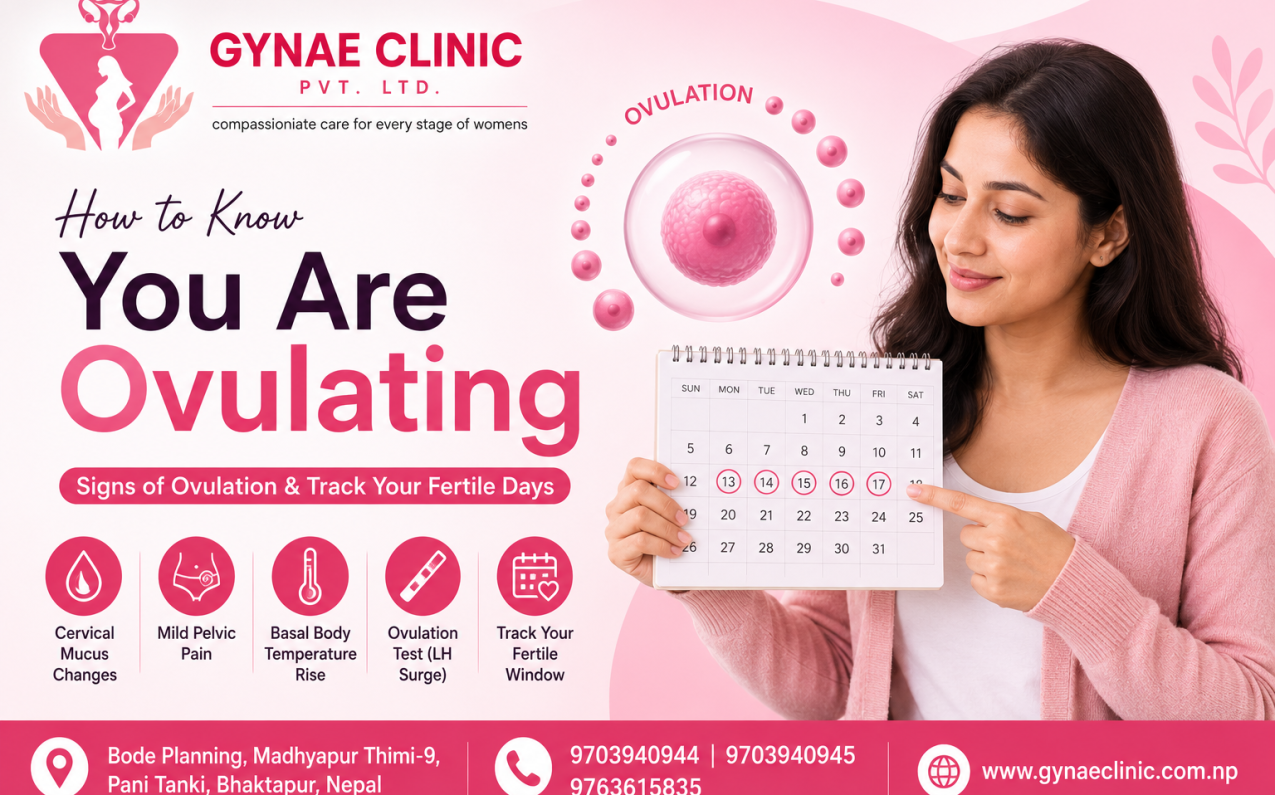
Ovulation is one of the most important parts of the menstrual cycle because it is when an ovary releases an egg. If you are trying to conceive, understanding when you are ovulating can help you identify your fertile days and plan intercourse around the time pregnancy is most likely.
Some women notice clear physical changes around ovulation, while others experience very few or no noticeable symptoms. Your cycle length can also change the timing of ovulation, especially if you have irregular periods or conditions such as PCOS.
This guide explains the common signs of ovulation, how to calculate your fertile window, how ovulation tests work, and when you may need medical evaluation.
What Is Ovulation?
Ovulation is the release of a mature egg from an ovary. The egg can potentially be fertilized after it is released, while sperm can remain capable of fertilization for several days.
Because of this, the fertile window is not limited to the exact day of ovulation. Pregnancy can occur from intercourse during the days leading up to ovulation as well as around ovulation.
Ovulation does not necessarily happen on Day 14 for every woman. The timing depends on the length and pattern of your menstrual cycle and may vary from one cycle to another.
10 Common Signs of Ovulation
Knowing the possible signs of ovulation can help you better understand your menstrual cycle.
1. Clear, Stretchy Vaginal Discharge
One of the most useful natural signs of approaching ovulation is a change in cervical mucus.
Around the fertile period, discharge may become:
- Clear
- Slippery
- Wet
- Stretchy
- Similar in consistency to raw egg white
This change happens because reproductive hormones alter cervical mucus around the fertile period.
If you notice clear, slippery and stretchy discharge, it may indicate that you are approaching ovulation.
If you are concerned about abnormal discharge, such as discharge with a strong odor, itching, burning or unusual color, it should not automatically be considered an ovulation symptom. A gynecological evaluation may be appropriate. You can learn more in Vaginal Discharge: Causes, STI Testing & Treatment.
2. Mild Lower Abdominal or Pelvic Pain
Some women experience mild pain or discomfort around the time of ovulation.
It may occur:
- On one side of the lower abdomen
- Around the middle of the cycle
- For a short period
- Occasionally for several hours
This is sometimes called ovulation pain.
However, severe, persistent or worsening pelvic pain should not simply be assumed to be ovulation. Conditions such as ovarian cysts, endometriosis, pelvic infection or other gynecological problems can also cause pelvic pain.
3. Increased Sexual Desire
Some women notice an increase in sexual desire around their fertile period.
Hormonal changes around ovulation may contribute to changes in libido. However, increased sexual desire is not a reliable way to confirm that ovulation has occurred.
It can be one clue when combined with other cycle changes.
4. Slight Rise in Basal Body Temperature
Basal body temperature (BBT) is your body’s resting temperature, usually measured immediately after waking and before getting out of bed.
After ovulation, progesterone can cause a small increase in basal body temperature.
Tracking BBT over several menstrual cycles may help you recognize your individual ovulation pattern.
However, there is an important limitation:
A temperature rise generally confirms that ovulation has already occurred rather than predicting it in advance.
5. Positive Ovulation Predictor Kit
Ovulation predictor kits (OPKs) detect a rise in luteinizing hormone (LH) in urine.
An LH surge usually occurs shortly before ovulation, so a positive test can indicate that ovulation may be approaching.
OPKs can be particularly useful for women who want a practical way to identify their fertile period at home.
However, a positive LH test does not guarantee that ovulation will definitely occur. This can be particularly relevant for women with certain hormonal conditions, including PCOS.
6. Breast Tenderness
Some women notice breast tenderness or sensitivity around ovulation.
Hormonal fluctuations throughout the menstrual cycle can affect breast tissue.
However, breast tenderness is not specific to ovulation and can also occur before menstruation or during other hormonal changes.
Therefore, it should be considered only as a possible supporting sign.
7. Bloating or Mild Abdominal Changes
Some women experience mild bloating or a feeling of fullness around the middle of their cycle.
Hormonal fluctuations can affect fluid balance and digestion, which may contribute to temporary changes.
Again, bloating alone cannot confirm ovulation.
8. Changes in Cervical Position
Some women who regularly track their fertility notice changes in the cervix during the fertile period.
The cervix may feel:
- Higher
- Softer
- More open
These changes can be difficult to assess accurately, particularly for someone who is new to fertility tracking.
For this reason, cervical position is generally more useful when combined with other signs rather than used alone.
9. Increased Energy or Mood Changes
Some women report changes in:
- Energy
- Mood
- Concentration
- General sense of well-being
around ovulation.
These experiences vary considerably between individuals and are not reliable medical indicators of ovulation.
10. A Combination of Fertility Signs
The most useful approach is often to look at several signs together.
For example:
Clear stretchy cervical mucus + positive LH test + cycle tracking
may give you a better understanding of your fertile period than relying on a single symptom.
When Does Ovulation Usually Happen?
Many people believe ovulation always occurs on Day 14.
That is not necessarily true.
For example, a woman with a 28-day cycle may ovulate around the middle of the cycle, but the exact timing can vary.
Ovulation can occur earlier or later depending on:
- Cycle length
- Hormonal changes
- Stress
- Illness
- Weight changes
- PCOS
- Thyroid problems
- Postpartum changes
- Other reproductive or medical factors
Therefore, counting calendar days alone cannot always tell you exactly when you are ovulating.
What Is the Fertile Window?
The fertile window is the period during which pregnancy is most likely.
Because sperm can survive for several days in the female reproductive tract, intercourse before ovulation can also result in pregnancy.
The fertile period is generally considered to include approximately the five days before ovulation and the day of ovulation, with the highest probability of conception around the days immediately before ovulation and around ovulation.
If you are trying to conceive, having intercourse regularly during the fertile window can increase your opportunity for pregnancy.
How to Track Ovulation at Home
You can use several methods to understand your cycle.
1. Track Your Period
Record:
- First day of each period
- Number of days your period lasts
- Length of each menstrual cycle
- Changes in bleeding
- Ovulation symptoms
After tracking several cycles, you may begin to notice a pattern.
However, calendar tracking is less reliable when periods are irregular.
2. Observe Cervical Mucus
Check for changes in vaginal discharge throughout your cycle.
When discharge becomes increasingly clear, wet and stretchy, you may be approaching your fertile period.
This is one of the simplest natural fertility-awareness methods.
3. Use an Ovulation Predictor Kit
An OPK can detect the LH surge in urine.
For women with predictable cycles, testing around the expected fertile period may help identify the approaching LH surge.
If your periods are highly irregular, however, you may need a more individualized approach.
4. Track Basal Body Temperature
Take your temperature every morning before getting out of bed.
Record the results over several cycles.
A sustained temperature increase can help you identify a pattern suggesting that ovulation has already occurred.
5. Consider Ultrasound Ovulation Monitoring
When pregnancy is taking longer than expected or ovulation is uncertain, a gynecologist may recommend follicular or ovulation monitoring by ultrasound.
Ultrasound can help assess the development of ovarian follicles and provide more direct information about the ovulation process.
Gynae Clinic’s fertility evaluation resources also discuss menstrual history, ovulation assessment, hormone testing and ultrasound monitoring for women with fertility concerns.
How Do You Know If You Are Not Ovulating?
Some women may not ovulate regularly, a condition sometimes called anovulation.
Possible clues include:
- Very irregular periods
- Very long menstrual cycles
- Missing periods
- Difficulty becoming pregnant
- No clear fertile cervical mucus pattern
- Repeatedly negative or confusing ovulation tests
However, symptoms alone cannot confirm whether ovulation is occurring.
If you have irregular periods or difficulty conceiving, a gynecologist may evaluate your menstrual history, hormones and reproductive health and may recommend ultrasound monitoring when appropriate.
PCOS and Ovulation
Polycystic ovary syndrome (PCOS) is a common reason for irregular ovulation.
Women with PCOS may experience:
- Irregular periods
- Long menstrual cycles
- Infrequent periods
- Acne
- Increased facial or body hair
- Difficulty identifying fertile days
- Difficulty becoming pregnant
PCOS does not mean that pregnancy is impossible. Many women with PCOS become pregnant with appropriate medical care.
If you have irregular periods and suspect PCOS, you can read PCOS Symptoms, Causes & Diagnosis in Bhaktapur.
Can You Ovulate Without Feeling Any Symptoms?
Yes.
Not every woman experiences noticeable ovulation symptoms.
You may ovulate without experiencing:
- Ovulation pain
- Increased libido
- Breast tenderness
- Noticeable discharge changes
- Mood changes
Therefore, having no symptoms does not necessarily mean that you are not ovulating.
If you need to know more precisely whether ovulation is occurring, medical assessment may be more useful than relying on symptoms alone.
Can You Get Pregnant Without Knowing When You Ovulate?
Yes.
You do not have to know the exact day of ovulation to become pregnant.
Because the fertile window extends across several days, regular intercourse throughout the cycle—particularly around the expected fertile period—can provide opportunities for conception.
If you are actively trying to conceive and want help identifying your fertile window, a gynecologist can help you understand your cycle and determine whether additional fertility evaluation is appropriate.
For women seeking fertility assessment, Female Fertility Testing in Bhaktapur provides information about ovulation assessment, hormonal evaluation and other fertility-related investigations.
When Should You See a Gynecologist About Ovulation?
Consider medical evaluation if:
- Your periods are consistently irregular
- You frequently miss periods
- Your cycles are very long or unpredictable
- You suspect you are not ovulating
- You have PCOS
- You have symptoms of thyroid or hormonal problems
- You have been trying to conceive without success
- You have a history of repeated pregnancy loss
- Ovulation predictor kits repeatedly give confusing results
Earlier evaluation may be appropriate depending on your age, symptoms and reproductive history.
If you have been trying to conceive, you can also read Infertility Treatment in Bhaktapur: Causes, Fertility Tests & Treatment.
Ovulation Tracking in Bhaktapur
Understanding ovulation can be helpful whether you are trying to become pregnant, planning your family or simply learning more about your menstrual cycle.
If your cycles are regular, tracking your period, observing cervical mucus and using an ovulation predictor kit may provide useful information. If your cycles are irregular or pregnancy is taking longer than expected, professional evaluation can help determine whether ovulation is occurring regularly and whether another fertility factor may be involved.
Gynae Clinic Pvt. Ltd. provides gynecological and fertility-related consultation in Bhaktapur for women seeking guidance about ovulation, irregular periods, PCOS, fertility and pregnancy planning.
The clinic is located in Bode Planning, Madhyapur Thimi-9, Pani Tanki, Bhaktapur, serving women from Madhyapur Thimi, Bode, Kausaltar, Lokanthali, Gatthaghar, Radhe Radhe, Sallaghari, Sanothimi, Jadibuti, Koteshwor, Baneshwor, Suryabinayak, Banepa and Dhulikhel.
Contact Gynae Clinic Pvt. Ltd.
Address: Bode Planning, Madhyapur Thimi-9, Pani Tanki, Bhaktapur, Nepal
Phone: 9703940944, 9703940945, 9763615835
Website: www.gynaeclinic.com.np
Compassionate care for every stage of womens
Frequently Asked Questions
What is the most obvious sign of ovulation?
Clear, slippery and stretchy cervical mucus is one of the commonly recognized physical signs that the fertile period is approaching.
How can I know exactly when I am ovulating?
No single home symptom can guarantee the exact timing. Combining cycle tracking, cervical mucus observation and an ovulation predictor kit can be helpful. When more precise assessment is needed, ultrasound monitoring may be recommended.
Is clear stretchy discharge a sign of ovulation?
It can be. Clear, wet and stretchy cervical mucus commonly occurs around the fertile period.
Does ovulation always happen on Day 14?
No. Ovulation timing varies according to individual cycle length and can change between cycles.
Can you ovulate without symptoms?
Yes. Some women have no noticeable symptoms when they ovulate.
Can PCOS affect ovulation?
Yes. PCOS can cause irregular or absent ovulation and may make the fertile window more difficult to predict.
How do I know if I am not ovulating?
Irregular or absent periods can be a clue, but they do not confirm anovulation. Medical evaluation may include menstrual assessment, selected hormone testing and ultrasound monitoring when appropriate.
What is the best way to track ovulation when trying to get pregnant?
Tracking your cycle and cervical mucus, using an ovulation predictor kit and understanding your fertile window can help. If your cycles are irregular or conception is taking longer than expected, consult a gynecologist.
Medical Disclaimer
This article is intended for general educational purposes and does not replace personalized medical consultation, diagnosis or treatment. Ovulation patterns vary between women, and symptoms alone cannot always confirm ovulation. Certain complex conditions may benefit from advanced specialist care.
Author: Gynae Clinic Pvt. Ltd.
Bode Planning, Madhyapur Thimi-9, Pani Tanki, Bhaktapur, Nepal