

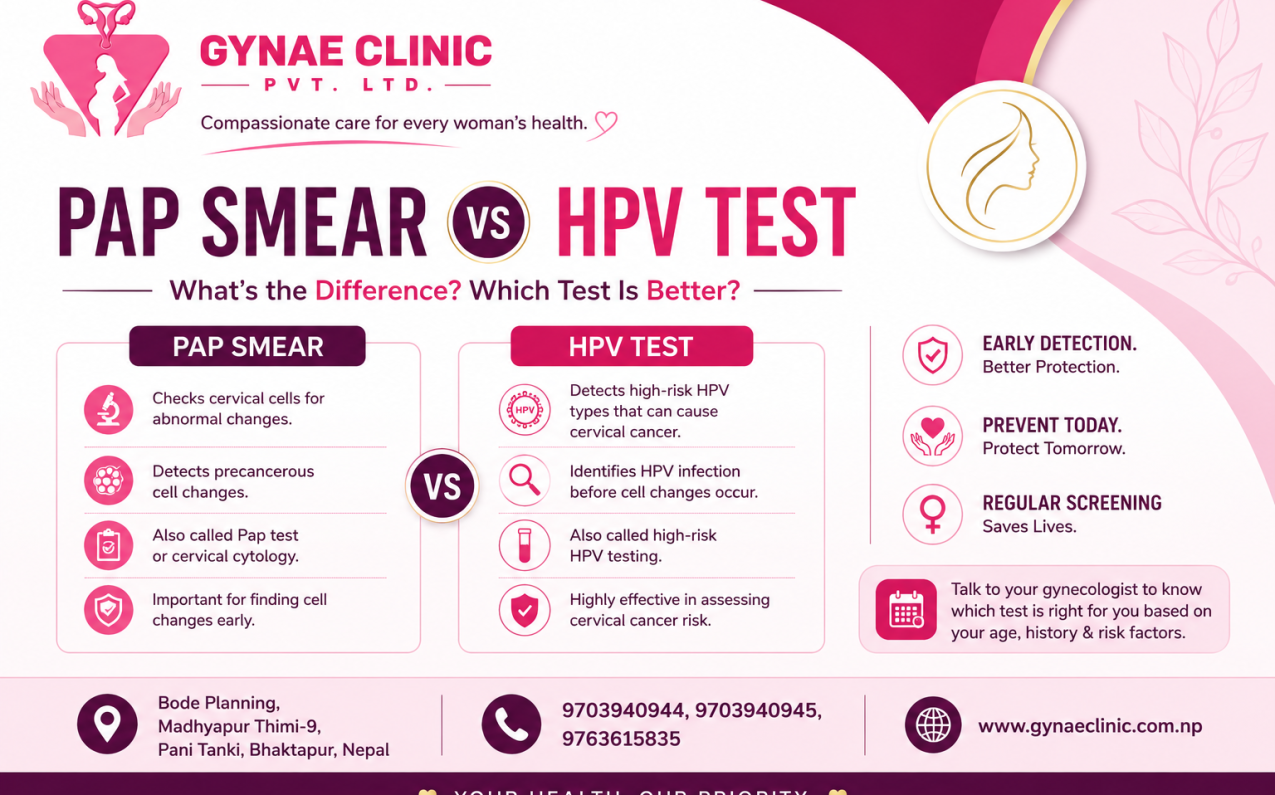
Pap smear and HPV testing are two important cervical cancer screening methods. Although both tests use a sample collected from the cervix, they look for different things.
A Pap smear checks cervical cells for abnormal changes, while an HPV test looks for high-risk types of human papillomavirus (HPV) that can cause cervical cancer. Both can play an important role in detecting cervical cancer risk before cancer develops.
If you are searching for Pap smear test in Bhaktapur, HPV test in Bhaktapur, HPV screening in Madhyapur Thimi, or a cervical cancer screening clinic near Bode, Gatthaghar or Kausaltar, Gynae Clinic Pvt. Ltd. provides women’s health and gynecological consultation at:
Gynae Clinic Pvt. Ltd.
Address: Bode Planning, Madhyapur Thimi-9, Pani Tanki, Bhaktapur, Nepal
Contact: 9703940944, 9703940945, 9763615835
Website: www.gynaeclinic.com.np
Pap Smear vs HPV Test at a Glance
| Pap Smear | HPV Test |
|---|---|
| Looks for abnormal cervical cells | Looks for high-risk HPV infection |
| Detects cellular changes | Detects HPV types associated with cervical cancer |
| Also called cervical cytology | Also called high-risk HPV testing |
| Can identify precancerous cell changes | Can identify HPV-related cervical cancer risk before cell changes become visible |
| Uses a sample from the cervix | Uses a sample from the cervix |
| May be used alone or with HPV testing depending on age and guidelines | May be used alone or with Pap testing depending on age and guidelines |
The key difference is simple:
Pap smear = “Are the cervical cells abnormal?”
HPV test = “Is a high-risk HPV infection present?”
What Is a Pap Smear?
A Pap smear, also called a Pap test or cervical cytology, examines cells collected from the cervix.
The laboratory looks for abnormal changes in these cells that could potentially develop into cervical cancer.
A Pap test can detect:
- Abnormal cervical cells
- Precancerous changes
- Certain cellular abnormalities
It does not primarily test for HPV itself.
What Is an HPV Test?
An HPV test looks for high-risk types of human papillomavirus associated with cervical cancer.
HPV infection is extremely common, and many HPV infections clear naturally. The concern is persistent infection with high-risk HPV types, which can lead to cervical cell changes over time.
HPV testing can identify high-risk HPV even before visible abnormal cellular changes develop.
Pap Smear vs HPV Test: Which Is Better?
There is no single answer for every woman.
The appropriate test depends on:
- Age
- Previous screening results
- Medical history
- Previous cervical abnormalities
- HPV vaccination status
- Availability of testing
- Current screening recommendations
- Individual risk factors
Importantly, HPV testing has become increasingly important in cervical cancer prevention. WHO identifies HPV testing as the preferred primary cervical cancer screening method in HPV-based screening programmes.
Updated 2026 ACOG guidance also identifies clinician-collected primary high-risk HPV screening as the preferred approach for average-risk individuals aged 30–65 where appropriate, while Pap testing alone and co-testing remain options in specific circumstances.
Can You Have an HPV Test and Pap Smear Together?
Yes.
When both are performed using cervical samples, this is called co-testing.
Co-testing provides two types of information:
HPV test: Looks for high-risk HPV.
Pap test: Looks for abnormal cervical cells.
Whether co-testing is appropriate depends on the woman’s age, history and the screening approach being used.
HPV Test vs Pap Smear: What Does Each Result Mean?
If the HPV Test Is Negative
A negative high-risk HPV test means the test did not detect the targeted high-risk HPV types.
This generally indicates a lower current risk of cervical precancer, although the recommended follow-up depends on the screening method and individual history.
If the HPV Test Is Positive
A positive HPV test does not mean you have cervical cancer.
It means high-risk HPV was detected.
Depending on the HPV type, age, previous screening results and clinical protocol, additional testing or follow-up may be recommended.
This can include:
- Pap/cytology testing
- Repeat HPV testing
- HPV genotyping
- Colposcopy
- Other evaluation
The appropriate next step depends on the individual result.
If the Pap Smear Is Abnormal
An abnormal Pap result does not automatically mean cancer.
It means that cervical cells show changes that may require further evaluation.
Possible follow-up depends on:
- The type of cell change
- HPV result
- Age
- Previous results
- Personal medical history
Some mild abnormalities disappear naturally, while more significant abnormalities may require closer monitoring or treatment.
Which Test Detects HPV?
The HPV test detects high-risk HPV.
A Pap smear does not primarily detect the virus. Instead, it examines cervical cells for abnormal changes.
This is why the two tests are complementary rather than identical.
Which Test Detects Cervical Cell Changes?
The Pap smear looks directly at cervical cells.
It can identify cellular abnormalities that may represent precancerous changes.
An HPV test can identify the viral risk that may lead to these changes.
Can an HPV Test Replace a Pap Smear?
In some screening programmes and age groups, primary HPV testing can be used without a Pap smear.
WHO recommends HPV-based screening as the preferred primary screening approach for cervical cancer prevention.
However, whether an HPV test alone is appropriate for you depends on the screening programme, available tests, your age, medical history and follow-up arrangements.
Do not decide to skip or replace a test solely based on an online article.
Pap Smear vs HPV Test by Age
Screening recommendations can differ between countries and organizations, so your gynecologist should advise you based on the screening system available to you.
Current 2026 ACOG guidance for average-risk women recommends:
Age 21–29
Cervical cytology (Pap testing) alone every 3 years is recommended.
Age 30–65
Primary high-risk HPV testing every 5 years is preferred in the updated ACOG guidance.
Co-testing every 5 years is an acceptable alternative, and Pap testing alone may be used when primary HPV testing or co-testing is unavailable or after appropriate counseling.
Over 65
Routine screening may be stopped in appropriately screened average-risk women who meet the required criteria. Women with inadequate previous screening or certain high-risk histories may need continued screening.
These recommendations are for average-risk women. Women with previous abnormal cervical results, cervical cancer, immunosuppression or other risk factors may need a different screening plan.
Is an HPV Test Painful?
HPV testing uses a cervical sample collected in a similar way to a Pap test.
During the examination:
- You lie on an examination table.
- A speculum is gently inserted into the vagina.
- The cervix is visualized.
- A small brush or sampling device collects cervical cells.
- The sample is sent for laboratory testing.
The procedure is generally quick. Some women experience temporary discomfort or mild cramping.
Is a Pap Smear Painful?
A Pap smear is usually a quick procedure.
You may experience:
- Pressure from the speculum
- Mild discomfort
- Brief cramping
- Light spotting afterward in some cases
If you are anxious or have previously experienced pain during examinations, tell your healthcare provider.
Do I Need Both Pap Smear and HPV Test?
Not necessarily.
Some women may need:
- Pap testing alone
- HPV testing alone
- HPV + Pap co-testing
The right choice depends on the woman’s age, risk factors, previous results and the screening system being followed.
A gynecologist can help determine which screening method is appropriate.
Can HPV Testing Prevent Cervical Cancer?
HPV testing itself does not prevent HPV infection.
Its importance is in early detection of women at increased risk of cervical precancer, allowing appropriate follow-up and treatment before cancer develops.
WHO emphasizes HPV-based screening as a key component of cervical cancer elimination strategies.
HPV vaccination is another important prevention strategy.
Do I Need a Pap Smear If My HPV Test Is Negative?
Not necessarily.
If primary HPV screening is being used and the result is negative, the recommended follow-up interval may be longer than with Pap testing alone.
However, your follow-up depends on the specific screening programme and your individual medical history.
Can HPV Be Positive Without Symptoms?
Yes.
HPV infection frequently causes no symptoms.
This is one reason cervical cancer screening is important even when you feel completely healthy.
You do not need to wait for symptoms before discussing cervical cancer screening.
Can a Pap Smear Detect Cervical Cancer?
A Pap smear is primarily a screening test for abnormal cervical cells and precancerous changes, not a definitive diagnostic test for cancer.
If screening produces concerning results, additional evaluation may be necessary.
Possible follow-up may include colposcopy and, when indicated, biopsy.
Does an HPV Positive Result Mean My Partner Cheated?
No.
An HPV-positive result cannot reliably determine when the infection was acquired or from whom.
HPV can remain undetected for a long period, and a positive result does not by itself establish recent transmission or infidelity.
Should Married Women Get HPV Testing?
Yes, if they fall within the recommended screening population.
HPV screening is based on cervical cancer risk and screening recommendations, not marital status.
Should Women Who Have Never Had Children Get a Pap Smear or HPV Test?
Having children is not the deciding factor for cervical cancer screening.
Screening recommendations are based primarily on age, risk factors and previous screening history.
HPV Test and Pap Smear in Bhaktapur
If you are searching for:
- HPV test in Bhaktapur
- Pap smear test in Bhaktapur
- HPV screening in Bhaktapur
- Cervical cancer screening in Bhaktapur
- Pap test near Madhyapur Thimi
- HPV test near Bode
- Pap smear near Gatthaghar
- Cervical cancer screening near Kausaltar
Gynae Clinic Pvt. Ltd. is located at:
Bode Planning, Madhyapur Thimi-9, Pani Tanki, Bhaktapur, Nepal
HPV Test and Pap Smear Near Bode
Women searching for HPV testing or Pap smear near Bode can contact Gynae Clinic Pvt. Ltd. for gynecological consultation and cervical health assessment.
HPV Test and Pap Smear Near Madhyapur Thimi
For women searching for Pap smear or HPV test in Madhyapur Thimi, Gynae Clinic Pvt. Ltd. is located in Bode Planning, Madhyapur Thimi-9.
HPV Test and Pap Smear Near Gatthaghar
Women from Gatthaghar can consider the nearby Madhyapur Thimi area for cervical cancer screening consultation.
HPV Test and Pap Smear Near Kausaltar
Women from Kausaltar searching for cervical screening can contact Gynae Clinic Pvt. Ltd. in Bode Planning.
HPV Test and Pap Smear Near Lokanthali
Women from Lokanthali can consider Gynae Clinic Pvt. Ltd. for women’s health and cervical screening consultation.
HPV Test and Pap Smear Near Balkumari
Women from Balkumari and surrounding areas can also seek gynecological consultation regarding HPV and Pap testing.
HPV Test and Pap Smear Near Thimi
If you are searching for HPV testing or Pap smear in Thimi, Gynae Clinic Pvt. Ltd. is located at Bode Planning, Madhyapur Thimi-9, Bhaktapur.
HPV Test and Pap Smear Near Nagadesh and Manohara
Women from Nagadesh, Manohara and nearby areas can consider the Bode–Madhyapur Thimi area for cervical screening services.
HPV Test and Pap Smear Near Sallaghari and Radhe Radhe
Women searching for Pap smear or HPV screening near Sallaghari and Radhe Radhe can consider Gynae Clinic Pvt. Ltd. in Bode Planning.
HPV Test and Pap Smear Near Suryabinayak
Women from Suryabinayak and surrounding Bhaktapur areas can contact the clinic for cervical health consultation.
HPV Test and Pap Smear Near Koteshwor, Jadibuti and Pepsicola
Gynae Clinic Pvt. Ltd. is also relevant for women searching for cervical screening from Koteshwor, Jadibuti, Pepsicola and surrounding areas.
Why Cervical Cancer Screening Matters
Cervical cancer can develop gradually, and precancerous changes may occur before symptoms appear.
Regular screening provides an opportunity to identify risk or abnormal cervical changes earlier.
ACOG notes that cervical cancer screening can include Pap testing, HPV testing or both, and that screening can detect changes before they develop into cervical cancer.
That means feeling healthy does not mean you should automatically skip recommended screening.
When Should You Talk to a Gynecologist?
Do not wait for your next routine screening if you experience:
- Bleeding after sex
- Bleeding between periods
- Unusual vaginal bleeding
- Persistent watery or unusual discharge
- Pelvic pain
- Pain during sex
- A previous abnormal Pap result
- A positive HPV test
- Concerns about an STI
These symptoms do not necessarily mean cervical cancer—many other conditions can cause them—but they deserve appropriate medical evaluation.
Book Your Cervical Screening Consultation in Bhaktapur
If you are unsure whether you need a Pap smear, HPV test or both, a gynecological consultation can help determine the appropriate screening approach.
Gynae Clinic Pvt. Ltd.
Address: Bode Planning, Madhyapur Thimi-9, Pani Tanki, Bhaktapur, Nepal
Contact:
9703940944
9703940945
9763615835
Website:
www.gynaeclinic.com.np
Compassionate care for every woman’s health.
Complex cases may need specialized referral.
Frequently Asked Questions
Is HPV testing better than a Pap smear?
HPV testing and Pap testing answer different questions. HPV testing detects high-risk HPV, while Pap testing identifies abnormal cervical cells. Current WHO guidance prioritizes HPV-based screening, and current ACOG guidance prefers primary high-risk HPV screening for average-risk women aged 30–65 where appropriate.
Which is more accurate, HPV test or Pap smear?
HPV testing is generally more sensitive for detecting cervical precancer than cytology alone, which is one reason HPV-based screening has become preferred in many programmes. However, the appropriate test depends on age, risk, availability and follow-up systems.
Can I do only an HPV test?
For some women, yes. Primary HPV testing is an accepted screening strategy and is preferred in current WHO guidance and updated ACOG guidance for average-risk women in certain age groups.
Can I do only a Pap smear?
Yes, Pap testing remains an accepted screening option in certain age groups and circumstances. The appropriate interval depends on age and risk.
Does a positive HPV test mean cancer?
No. A positive high-risk HPV test means that HPV was detected. It does not mean that you have cervical cancer. Appropriate follow-up is important.
Can HPV go away on its own?
Many HPV infections clear naturally, particularly in younger women. Persistent high-risk HPV infection is the major concern for cervical precancer and cancer.
Can an unmarried woman get an HPV test?
Yes. Screening decisions should be based on age, risk factors and medical recommendations—not marital status.
Do I need cervical screening if I feel healthy?
Yes, when you are within the recommended screening population. Cervical precancer and early cervical cancer may have no symptoms.
Final Takeaway
The difference between the two tests is easy to remember:
Pap smear → checks cervical cells for abnormal changes.
HPV test → checks for high-risk HPV linked to cervical cancer.
Neither result should be interpreted in isolation when follow-up is needed. Your age, previous results and medical history determine which screening strategy is appropriate.
If you are looking for Pap smear or HPV testing in Bhaktapur, Madhyapur Thimi, Bode, Gatthaghar, Kausaltar, Lokanthali, Balkumari, Thimi, Suryabinayak, Koteshwor, Jadibuti or Pepsicola, contact Gynae Clinic Pvt. Ltd. for a women’s health and cervical screening consultation.
Disclaimer
This article is for general health education and does not replace professional medical advice, diagnosis or treatment. Cervical cancer screening recommendations can vary according to age, medical history, previous test results, risk factors and local screening programmes. A qualified healthcare professional should determine the most appropriate screening and follow-up plan for you.
Author
Author: Gynae Clinic Pvt. Ltd. Medical Content Team
This article is prepared for general women’s health education. Individual diagnosis and treatment should be determined by a qualified healthcare professional.