
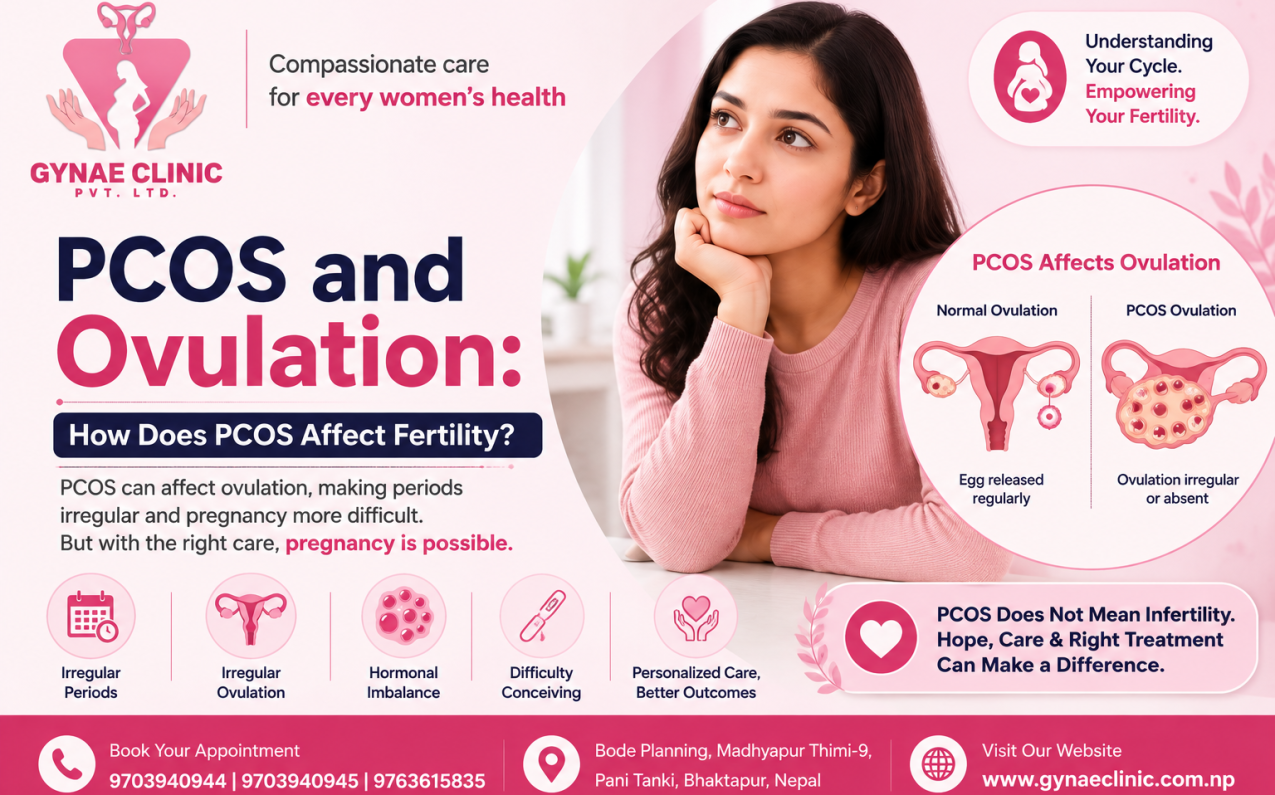
Polycystic Ovary Syndrome (PCOS) can affect fertility mainly by interfering with regular ovulation. When ovulation happens less often or becomes unpredictable, it can take longer to become pregnant because there are fewer predictable opportunities for an egg to be fertilized.
However, having PCOS does not mean you cannot get pregnant. Many women with PCOS conceive naturally, while others may need help identifying or managing ovulation. The right approach depends on your age, menstrual pattern, symptoms, reproductive goals and other fertility factors.
If you have PCOS and are trying to conceive, understanding the relationship between PCOS, ovulation and fertility can help you know when evaluation may be useful.
What Is Ovulation?
Ovulation is the release of a mature egg from an ovary.
For natural pregnancy to occur, an egg generally needs to be released and sperm needs to be available around the fertile window.
In a regular menstrual cycle, hormonal signals help a follicle develop and eventually release an egg. After ovulation, hormonal changes support the second part of the menstrual cycle.
With PCOS, this process can become irregular.
Instead of:
Follicle develops → ovulation → fertile window → period
the pattern may become:
Follicle develops → ovulation is delayed or does not occur → fertile window becomes unpredictable → period is delayed or missed
This is one of the main reasons PCOS can affect fertility.
How Does PCOS Affect Ovulation?
PCOS can interfere with the hormonal processes that control follicle development and ovulation.
Some women with PCOS may:
- Ovulate less frequently
- Ovulate later than expected
- Have unpredictable ovulation
- Have cycles in which ovulation does not occur
- Have long gaps between periods
When ovulation is irregular, it becomes harder to predict the fertile days.
This does not mean that the ovaries never release an egg. A woman with PCOS may ovulate in some cycles but not others.
That is why pregnancy can still occur naturally with PCOS.
Why Does Irregular Ovulation Make Pregnancy More Difficult?
Pregnancy is most likely when sperm and an egg are present around ovulation.
If ovulation happens regularly, identifying the fertile window is generally easier.
But with PCOS:
Irregular ovulation → unpredictable fertile window → more difficulty timing intercourse → potentially longer time to conception
A woman may believe she is ovulating on a particular day based on her calendar, but PCOS can make calendar-based predictions unreliable.
For women with irregular cycles, understanding ovulation may therefore be more useful than simply counting cycle days.
You can learn more about the fertile window in our guide to ovulation, the fertile window and pregnancy planning.
Does PCOS Mean You Are Infertile?
No.
This is one of the most important things women with PCOS should understand.
PCOS is not the same as permanent infertility.
PCOS can make conception more difficult because ovulation may not occur regularly, but many women with PCOS become pregnant naturally or with appropriate medical support.
The fertility impact can also vary significantly from one woman to another.
One woman with PCOS may ovulate regularly enough to conceive naturally, while another may have very infrequent ovulation and need help managing ovulation.
Can You Ovulate With PCOS?
Yes.
Having PCOS does not necessarily mean that ovulation completely stops.
You may:
- Ovulate occasionally
- Ovulate later than expected
- Ovulate irregularly
- Have some cycles without ovulation
This is why a woman with PCOS can sometimes become pregnant unexpectedly, even after months of irregular periods.
If you are not trying to become pregnant, irregular periods should not be considered protection against pregnancy.
How Can You Tell If You Are Ovulating With PCOS?
Determining ovulation can sometimes be difficult when cycles are irregular.
Several approaches may provide useful information.
1. Menstrual Cycle Tracking
Record the first day of every period.
This can help identify whether your cycles are consistently long, irregular or unpredictable.
However, cycle tracking alone may not accurately predict ovulation when PCOS is causing irregular cycles.
2. Cervical Mucus Changes
Around ovulation, cervical mucus may become:
- Clearer
- Wetter
- More slippery
- More stretchy
These changes can provide clues that ovulation may be approaching.
3. Ovulation Predictor Kits
Ovulation predictor kits detect hormonal changes associated with ovulation.
However, interpretation can sometimes be challenging in women with PCOS because hormonal patterns may be different.
A positive result should therefore be interpreted in context rather than treated as absolute proof that ovulation has occurred.
4. Blood Hormone Testing
Depending on your menstrual pattern and fertility history, a gynecologist may recommend hormonal testing.
The exact tests should be selected based on your individual circumstances rather than ordering every fertility test automatically.
5. Ultrasound Monitoring
Ultrasound can sometimes be used to monitor follicular development and help assess whether ovulation is occurring.
This can be particularly useful when a woman has very irregular cycles and is trying to conceive.
Gynae Clinic’s fertility guidance notes that women with PCOS may undergo menstrual assessment, ovulation assessment, hormonal evaluation and pelvic ultrasound depending on their individual situation.
Can PCOS Cause Irregular Periods and Fertility Problems at the Same Time?
Yes.
PCOS can affect both menstrual regularity and fertility because the two are closely connected through ovulation.
For example:
PCOS → irregular ovulation → irregular periods → unpredictable fertile window → difficulty timing conception
However, not every woman with irregular periods has PCOS, and not every woman with PCOS has obviously irregular periods.
Other conditions such as thyroid disorders, high prolactin, significant weight changes and other hormonal problems can also affect menstrual cycles and fertility.
What Other PCOS Symptoms Can Affect Fertility?
PCOS is not only about periods.
Some women may also experience:
Excess Facial or Body Hair
Higher androgen activity can contribute to increased coarse hair growth on the face or body.
Acne
Hormonal changes may contribute to persistent or recurrent acne.
Hair Thinning
Some women experience thinning of scalp hair.
Weight or Metabolic Changes
Some women with PCOS experience weight gain or insulin resistance, although PCOS can occur in women of any body size.
Difficulty Becoming Pregnant
Irregular ovulation can make conception more difficult.
These symptoms can vary considerably between women.
Does High AMH Mean You Have PCOS?
Not necessarily.
AMH, or Anti-Müllerian Hormone, is sometimes higher in women with PCOS, but a high AMH level by itself does not diagnose PCOS.
Likewise, AMH should not be used as a simple yes-or-no fertility test.
A proper assessment considers:
- Menstrual history
- Ovulation
- Androgen-related symptoms
- Hormonal testing when appropriate
- Ultrasound findings
- Other possible causes
If you are concerned about your AMH level, read our guide to the AMH test and what AMH means for fertility.
Can PCOS Affect Egg Quality?
PCOS primarily affects fertility through ovulation problems, but fertility is influenced by several factors, including age and overall reproductive health.
It is therefore not correct to assume that PCOS automatically means poor egg quality.
A fertility assessment should look at the whole picture rather than relying on one hormone test.
Age remains an important factor in female fertility, particularly as women move through their 30s and beyond.
Can You Get Pregnant Naturally With PCOS?
Yes.
Some women with PCOS become pregnant without fertility treatment.
This is more likely when ovulation occurs often enough for conception to happen.
If ovulation is very infrequent, however, conception may take longer.
If you have PCOS and are trying to conceive, it can be useful to determine whether you are ovulating rather than simply waiting for periods to become regular.
What If You Have PCOS and Are Trying to Conceive?
The first step is understanding your individual fertility situation.
Your gynecologist may consider:
- Your age
- How long you have been trying
- Your menstrual pattern
- Whether you are ovulating
- PCOS symptoms
- Previous pregnancies
- Previous miscarriages
- Medical history
- Medications
- Weight and metabolic health
- Other reproductive conditions
Depending on your situation, additional fertility evaluation may be appropriate.
Gynae Clinic’s fertility guidance specifically notes that women with PCOS may benefit from evaluation when periods are very irregular, ovulation is suspected to be irregular, or pregnancy has not occurred.
For a detailed overview, read Fertility Tests for Women: Female Fertility Testing in Bhaktapur.
What Tests May Be Used for PCOS and Fertility?
There is no single test that can determine whether a woman with PCOS will become pregnant.
Depending on your situation, evaluation may include:
Menstrual and Ovulation Assessment
Your cycle pattern can provide important information about whether ovulation is likely occurring regularly.
Hormonal Evaluation
Selected hormone tests may be recommended based on your symptoms and medical history.
Pelvic Ultrasound
Ultrasound can evaluate the uterus and ovaries and may provide information relevant to PCOS and fertility.
Ovarian Reserve Assessment
Tests such as AMH may be considered when clinically appropriate, but they should not be interpreted in isolation.
Fallopian Tube Evaluation
When indicated, testing may be used to assess whether the fallopian tubes are open.
Male Fertility Assessment
Fertility evaluation should not focus exclusively on the woman. Male factors can also contribute to difficulty conceiving, and semen analysis is commonly considered when appropriate.
Does Treating PCOS Improve Fertility?
It can, depending on the underlying problem.
PCOS management may involve different approaches depending on whether your priority is:
- Regulating menstrual cycles
- Managing acne or unwanted hair
- Improving metabolic health
- Preventing complications from prolonged absent periods
- Planning pregnancy
- Improving or monitoring ovulation
For women trying to conceive, treatment may focus specifically on ovulation management when irregular or absent ovulation is the main fertility problem.
There is no single PCOS treatment that is appropriate for every woman.
Can Lifestyle Changes Help With PCOS and Ovulation?
Lifestyle measures can be an important part of PCOS management.
Depending on your individual health, these may include:
Balanced Nutrition
A balanced eating pattern containing vegetables, fruits, whole grains, protein and healthy fats can support overall health.
Regular Physical Activity
Regular exercise can support metabolic health and general wellbeing.
Sustainable Weight Management
For women who are overweight, even modest and sustainable changes may improve some PCOS-related metabolic and reproductive outcomes.
However, not every woman with PCOS needs to lose weight, and PCOS also occurs in women who are not overweight.
Adequate Sleep
Consistent, good-quality sleep supports overall metabolic and hormonal health.
Stress Management
Managing chronic stress can support overall wellbeing, although stress should not automatically be blamed for PCOS-related menstrual changes.
How Long Should You Try to Get Pregnant With PCOS?
There is no need to wait a fixed amount of time if you have significant menstrual or ovulation problems.
For women without known fertility concerns, fertility evaluation is generally considered after:
- 12 months of trying if under 35
- 6 months of trying if 35 or older
However, earlier evaluation may be appropriate when periods are very irregular, ovulation is absent or there are known reproductive concerns.
If you have PCOS and your periods are very irregular, speaking with a gynecologist earlier can help determine whether ovulation is occurring.
When Should You See a Gynecologist?
Consider a consultation if:
- Your periods are very irregular
- You rarely have periods
- You go several months without menstruation
- You cannot identify your fertile period
- You have been trying to conceive without success
- You have known PCOS
- You have significant pelvic pain
- You have a history of reproductive problems
- You are concerned about declining fertility with age
A fertility evaluation can determine whether PCOS is affecting ovulation and whether another fertility factor may also be involved.
PCOS and Fertility: What Women Should Remember
PCOS can affect fertility primarily by making ovulation irregular, delayed or absent in some cycles.
But there is an important difference between:
Difficulty becoming pregnant
and
Being unable to become pregnant.
PCOS does not automatically mean infertility.
Many women with PCOS become pregnant naturally, while others benefit from appropriate ovulation assessment and fertility care.
The most useful approach is not to focus only on the diagnosis of PCOS. Instead, understand:
Are you ovulating?
How often are you ovulating?
Are there other factors affecting fertility?
What is the best approach for your pregnancy goals?
PCOS and Ovulation Care in Bhaktapur
If you are looking for PCOS and fertility care in Bhaktapur, ovulation assessment in Madhyapur Thimi, or gynecological consultation near Bode, Gatthaghar, Kaushaltar, Sallaghari, Lokanthali, Sanothimi, Jagati, Suryabinayak, Jadibuti, Koteshwor, Banepa or Dhulikhel, Gynae Clinic Pvt. Ltd. provides consultation for PCOS, menstrual problems, fertility concerns and reproductive health.
Gynae Clinic is located at:
Bode Planning, Madhyapur Thimi-9, Pani Tanki, Bhaktapur, Nepal
Appointments: 9703940944 | 9703940945 | 9763615835
Website: www.gynaeclinic.com.np
For broader information about PCOS, read PCOS Symptoms and Treatment in Nepal: A Complete Guide for Women.
If you are specifically concerned about infertility, read Infertility Treatment in Bhaktapur: Causes, Fertility Tests, Treatment & When to See a Doctor.
Frequently Asked Questions
Can PCOS stop ovulation?
PCOS can cause ovulation to become irregular or absent in some menstrual cycles. However, many women with PCOS still ovulate occasionally or regularly enough to become pregnant.
Can I get pregnant if I have PCOS?
Yes. PCOS does not mean that pregnancy is impossible. Many women with PCOS become pregnant naturally or with appropriate medical support.
Why does PCOS make it difficult to get pregnant?
The main fertility problem is often irregular ovulation. If ovulation does not occur regularly, there are fewer predictable opportunities for conception.
Can I ovulate with irregular periods?
Yes. A woman can still ovulate even when her periods are irregular, but the timing may be difficult to predict.
Can PCOS cause infertility?
PCOS can contribute to infertility by causing irregular or absent ovulation. However, PCOS-related fertility problems are often manageable, and many women with PCOS become pregnant.
Does high AMH mean I have PCOS?
No. AMH may be higher in some women with PCOS, but a high AMH level alone does not diagnose PCOS.
What is the best time to have intercourse with PCOS?
The most fertile time is around ovulation. Because PCOS can make ovulation unpredictable, cycle tracking alone may not always accurately identify the fertile window. Ovulation assessment may be helpful when pregnancy is being planned.
Should I get fertility testing if I have PCOS?
Fertility evaluation may be appropriate if you have very irregular periods, rarely menstruate, suspect you are not ovulating, or have been trying to conceive without success.
Does every woman with PCOS need fertility treatment?
No. The need for treatment depends on whether you are ovulating, your age, how long you have been trying and whether other fertility factors are present.
Medical Disclaimer
This article is for general educational purposes and does not replace individualized medical consultation, diagnosis or treatment. PCOS and fertility can vary considerably between women, and appropriate evaluation depends on age, symptoms, menstrual history, reproductive goals and other health factors. Certain complex conditions may benefit from advanced specialist care.
Author: Gynae Clinic Pvt. Ltd.
Gynae Clinic Pvt. Ltd.
Bode Planning, Madhyapur Thimi-9, Pani Tanki, Bhaktapur, Nepal
Appointments: 9703940944 | 9703940945 | 9763615835
Website: www.gynaeclinic.com.np