
Author: Gynae Clinic Pvt. Ltd.
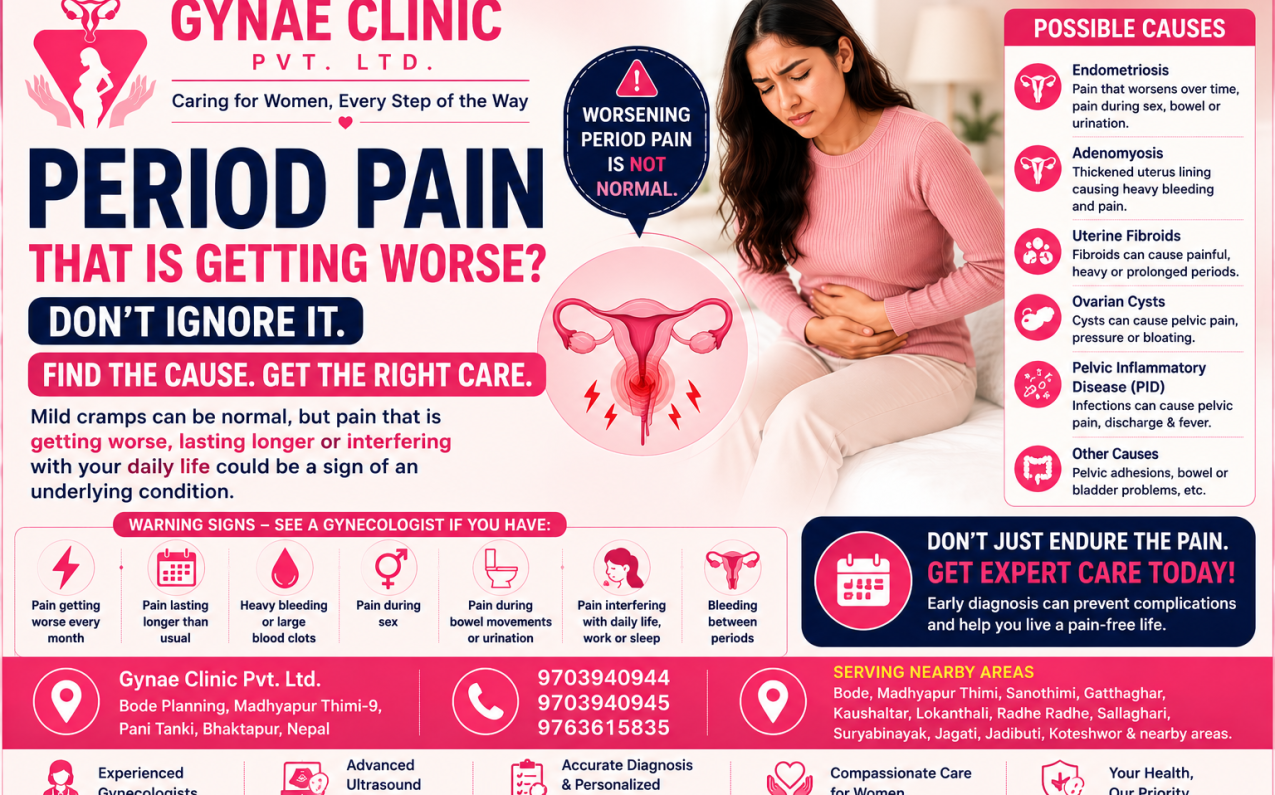
Period pain is common, but period pain that is becoming progressively worse should not simply be accepted as “normal.” Mild cramps for a day or two can occur because the uterus contracts during menstruation. However, pain that becomes stronger over time, lasts longer than usual, interferes with daily activities, or is accompanied by heavy bleeding, pain during sex, or pelvic symptoms may indicate an underlying condition.
If you are searching for “why are my periods becoming more painful?”, “period pain getting worse every month”, or “severe period pain treatment in Bhaktapur,” this guide explains the common causes, warning signs, tests and treatment options.
Is It Normal for Period Pain to Get Worse?
Occasional changes in menstrual discomfort can happen, but progressively worsening period pain deserves attention.
Typical menstrual cramps are usually caused by prostaglandins, natural chemicals that make the uterus contract during menstruation. Primary menstrual cramps often improve after the first few days of bleeding.
Pain that gets worse over time or lasts longer than your usual period cramps may be called secondary dysmenorrhea. It can be associated with conditions affecting the uterus, ovaries, fallopian tubes or pelvis.
1. Endometriosis
One of the most important causes of worsening period pain
Endometriosis occurs when tissue similar to the lining of the uterus grows outside the uterus.
It can cause:
- Increasingly painful periods
- Pelvic pain
- Pain before or during menstruation
- Pain that continues after the period
- Pain during sex
- Pain during bowel movements
- Pain during urination around menstruation
- Heavy menstrual bleeding
- Difficulty becoming pregnant
A particularly important warning sign is period pain that becomes progressively worse over the years. ACOG notes that endometriosis should be considered when menstrual pain worsens over time or is accompanied by bowel, bladder or sexual symptoms.
2. Adenomyosis
Adenomyosis occurs when tissue similar to the uterine lining grows into the muscular wall of the uterus.
It can cause:
- Increasingly painful periods
- Heavy periods
- Pelvic pressure
- Lower abdominal pain
- Enlarged or tender uterus in some women
Adenomyosis is an important possibility when periods are becoming both heavier and more painful, particularly later in reproductive life.
3. Uterine Fibroids
Fibroids are non-cancerous growths that develop in or around the uterus.
Depending on their size and location, fibroids may cause:
- Painful periods
- Heavy menstrual bleeding
- Longer periods
- Blood clots
- Pelvic pressure
- Lower abdominal discomfort
- Lower back pain
- Frequent urination
- Fertility concerns
Not every woman with fibroids has symptoms, but when symptoms occur, ultrasound can help assess the uterus.
Read more:
Uterine Fibroids Treatment in Bhaktapur: Symptoms, Diagnosis & Treatment
4. Ovarian Cysts
Some ovarian cysts are harmless and disappear without treatment, but certain cysts can cause pelvic pain.
Pain may be:
- More noticeable on one side
- Worse around menstruation
- Associated with pelvic pressure
- Associated with bloating
- Associated with pain during sex
Sudden severe one-sided pelvic pain requires urgent medical assessment because ovarian torsion or cyst rupture can sometimes cause acute pain.
5. Pelvic Inflammatory Disease (PID)
Pelvic inflammatory disease is an infection involving the female reproductive organs.
It may cause:
- Lower abdominal or pelvic pain
- Pain during sex
- Abnormal vaginal discharge
- Fever
- Bleeding between periods
- Bleeding after sex
- Pain or burning during urination
PID needs appropriate medical treatment because untreated infection can affect reproductive health.
6. Pelvic Infections or STIs
Some sexually transmitted infections can cause pelvic discomfort or develop into PID.
Possible symptoms include:
- Unusual vaginal discharge
- Bad vaginal odor
- Burning during urination
- Pain during sex
- Bleeding after sex
- Lower abdominal pain
Some infections may have few or no symptoms, so testing may be recommended when a clinician believes an infection is possible.
7. Primary Dysmenorrhea
Not every woman with painful periods has an underlying disease.
Primary dysmenorrhea is menstrual pain caused mainly by prostaglandins and uterine contractions rather than another pelvic condition. It commonly begins around the time periods start and may last one to a few days.
However, if your previously manageable cramps are becoming progressively worse, it is reasonable to discuss the change with a gynecologist rather than assuming it is simply primary dysmenorrhea.
8. Uterine Polyps or Other Uterine Conditions
Polyps and other structural conditions affecting the uterus can sometimes contribute to abnormal bleeding and pelvic symptoms.
They may be considered particularly when painful periods occur together with:
- Heavy bleeding
- Irregular bleeding
- Bleeding between periods
- Bleeding after sex
Your gynecologist can decide whether an ultrasound or additional evaluation is appropriate.
9. Pelvic Adhesions
Scar tissue inside the pelvis can sometimes develop after previous pelvic surgery, infection, endometriosis or other conditions.
Adhesions may cause chronic or recurrent pelvic pain.
They are one reason persistent pelvic pain can sometimes require more detailed evaluation rather than simply treating each painful period separately.
10. Problems Outside the Reproductive System
Not every pain occurring during a period originates from the uterus or ovaries.
Pelvic or lower abdominal pain may also be associated with:
- Urinary tract problems
- Bladder conditions
- Bowel disorders
- Gastrointestinal conditions
- Pelvic floor problems
ACOG notes that chronic pelvic pain can involve reproductive, urinary or gastrointestinal causes, and sometimes more than one condition can contribute to symptoms.
How Do You Know If Your Period Pain Needs Evaluation?
Ask yourself:
Has the pain become stronger?
If each period seems more painful than the previous one, it deserves attention.
Does pain last longer?
Pain that continues beyond the first few days of menstruation may be more concerning than typical menstrual cramps.
Are you missing work, school or normal activities?
Pain that prevents normal daily activities is a strong reason to seek medical advice.
Are your periods becoming heavier?
Worsening pain combined with heavy bleeding may occur with conditions such as adenomyosis or fibroids.
Do you have pain during sex?
Pain during sex can occur with endometriosis, pelvic infections, ovarian conditions and other pelvic problems.
Do you have pain when passing stool or urine during your period?
This pattern can be an important clue, particularly when endometriosis is being considered.
When Should You See a Gynecologist for Period Pain?
You should arrange a gynecology consultation if:
- Your period pain is getting worse
- Painkillers are no longer helping
- Pain interferes with work, school, exercise or sleep
- Your periods are becoming heavier
- Your periods are becoming irregular
- You have large blood clots
- You have pelvic pain between periods
- You experience pain during sex
- You have pain during bowel movements or urination around your period
- You have abnormal vaginal discharge
- You bleed between periods
- You have difficulty becoming pregnant
Medical guidance recommends evaluation when period pain becomes more painful, heavier or irregular, or when it interferes with normal activities.
When Is Severe Period Pain an Emergency?
Seek urgent medical care if pelvic or period pain is:
- Sudden and severe
- Much worse than usual
- Associated with fainting
- Associated with severe dizziness or weakness
- Associated with heavy vaginal bleeding
- Associated with fever
- Associated with persistent vomiting
- Severe and one-sided
- Occurring when pregnancy is possible
Sudden severe pelvic pain can sometimes occur with conditions such as ovarian torsion, ruptured ovarian cyst or ectopic pregnancy and requires prompt assessment.
What Tests Are Used for Worsening Period Pain?
There is no single test that explains every case of painful periods.
Your gynecologist may begin with a detailed history.
1. Menstrual History
Your doctor may ask:
- When did the pain begin?
- Has it been getting worse?
- How many days does it last?
- Is it before, during or after your period?
- How severe is the pain?
- Are your periods heavy?
- Do you pass large clots?
- Do you have pain during sex?
- Do you have bowel or urinary symptoms?
- Are your periods regular?
- Are you trying to become pregnant?
Keeping a period and pain diary can be extremely helpful.
2. Pelvic Examination
Depending on your symptoms, age and medical history, a gynecological examination may be recommended.
3. Pelvic Ultrasound
Ultrasound may help evaluate conditions such as:
- Fibroids
- Adenomyosis-related changes
- Ovarian cysts
- Uterine abnormalities
- Other pelvic conditions
ACOG notes that ultrasound may be recommended when painful periods are not adequately relieved with initial treatment or when secondary dysmenorrhea is suspected.
4. Blood or Other Laboratory Tests
Depending on your symptoms, your doctor may recommend tests for:
- Anemia
- Pregnancy
- Infection
- Thyroid problems
- Other conditions suggested by your history
Testing should be individualized rather than ordering every test for every woman.
5. Further Evaluation for Endometriosis
Endometriosis can sometimes be suspected from symptoms, examination and imaging. In selected cases, further evaluation may be necessary.
There is no single routine blood test that reliably diagnoses endometriosis. A specialist may discuss additional investigation or laparoscopy depending on the clinical situation.
How Is Worsening Period Pain Treated?
Treatment depends on why the pain is occurring.
Possible approaches include:
Pain-relieving medicines
Anti-inflammatory medicines can reduce menstrual pain in appropriate patients by reducing prostaglandin activity.
However, not every painkiller is suitable for every woman, particularly if you have certain medical conditions, take other medicines, have allergies, or could be pregnant.
Hormonal treatment
Depending on your situation and pregnancy plans, hormonal contraception may reduce menstrual bleeding and pain.
Treatment of the underlying condition
If the cause is:
- Endometriosis → individualized medical and/or surgical management
- Fibroids → medical, procedural or surgical treatment depending on symptoms
- Adenomyosis → individualized medication or other treatment
- PID → appropriate antibiotics
- Ovarian cyst → observation, follow-up or treatment depending on the cyst and symptoms
The right treatment depends on your diagnosis, age, symptoms and reproductive plans.
Can Worsening Period Pain Affect Fertility?
Sometimes.
Period pain itself does not automatically mean infertility.
However, some conditions that cause progressively painful periods—particularly endometriosis, pelvic inflammatory disease and certain uterine or ovarian conditions—can be associated with fertility problems.
If you are trying to conceive and your periods have become increasingly painful, tell your gynecologist.
Worsening Period Pain and Endometriosis: Signs to Watch
Endometriosis deserves particular attention when you have a combination of:
Worsening period pain + pelvic pain + pain during sex + bowel or bladder pain around menstruation + fertility concerns.
You do not need to have every symptom to have endometriosis.
If these symptoms are repeatedly occurring, discuss them with a gynecologist rather than relying only on pain medication.
What Can You Do at Home?
For mild-to-moderate uncomplicated menstrual cramps, some women find relief from:
- Applying a heating pad or hot-water bottle to the lower abdomen
- Taking a warm bath
- Regular physical activity
- Getting adequate sleep
- Gentle exercise
- Relaxation techniques
These measures may help with symptoms, but they should not replace medical evaluation when pain is progressively worsening.
Keep a Period Pain Diary
Before your appointment, record:
| What to track | What to note |
|---|---|
| Pain | Mild, moderate or severe |
| Timing | Before, during or after period |
| Duration | Number of days |
| Bleeding | Light, normal or heavy |
| Clots | Approximate size and frequency |
| Medication | What you took and whether it helped |
| Sex | Any pain during intercourse |
| Bowel symptoms | Pain or difficulty during periods |
| Urinary symptoms | Pain or burning |
| Fertility | Whether you are trying to conceive |
This information can help your gynecologist identify patterns that might otherwise be missed.
Period Pain Treatment in Bhaktapur
If you are searching for:
- Period pain treatment in Bhaktapur
- Severe period pain treatment in Bhaktapur
- Worsening menstrual pain in Bhaktapur
- Endometriosis evaluation in Bhaktapur
- Adenomyosis treatment in Bhaktapur
- Fibroid treatment in Bhaktapur
- Gynecologist for painful periods in Madhyapur Thimi
- Female gynecologist near Bode
- Gynecologist near Sanothimi
- Gynecologist near Gatthaghar
- Gynecologist near Kaushaltar
- Gynecologist near Lokanthali
- Gynecologist near Radhe Radhe
- Gynecologist near Sallaghari
- Gynecologist near Suryabinayak
- Gynecologist near Jagati
- Gynecologist near Jadibuti
- Gynecologist near Koteshwor
you can consult Gynae Clinic Pvt. Ltd.
Gynae Clinic Pvt. Ltd.
Address:
Bode Planning, Madhyapur Thimi-9, Pani Tanki, Bhaktapur, Nepal
Contact:
9703940944
9703940945
9763615835
Website:
www.gynaeclinic.com.np
Gynae Clinic is conveniently located for women from Bode, Madhyapur Thimi, Sanothimi, Gatthaghar, Kaushaltar, Lokanthali, Radhe Radhe, Sallaghari, Suryabinayak, Jagati, Jadibuti, Koteshwor and surrounding areas. The clinic provides gynecological consultation and women’s reproductive healthcare services.
Why You Should Not Ignore Period Pain That Is Getting Worse
Taking pain medicine every month may temporarily control symptoms, but it does not necessarily explain why your pain is changing.
If your periods used to be manageable and are now becoming increasingly painful, the change itself is clinically important.
A gynecological assessment can help determine whether you have ordinary menstrual cramps or whether conditions such as endometriosis, adenomyosis, fibroids, ovarian cysts, pelvic infection or another pelvic problem may be contributing.
“Period pain should not progressively take over your life—when the pain is getting worse, finding the cause is more important than simply enduring another painful cycle.”
Complex or persistent cases may require specialized gynecological evaluation and, when appropriate, referral for advanced care.
Frequently Asked Questions
Is it normal for period pain to get worse with age?
It is not something that should automatically be considered normal. Pain that becomes progressively worse may be associated with conditions such as endometriosis, adenomyosis or fibroids and should be evaluated.
Why are my periods suddenly more painful?
Possible causes include endometriosis, adenomyosis, fibroids, ovarian cysts, pelvic infection and other pelvic conditions. Sometimes menstrual cramps can also change without a serious underlying condition.
Why does my period pain last longer than before?
Pain that begins before menstruation, continues through the period or persists afterward can occur with secondary dysmenorrhea, including conditions such as endometriosis.
Can endometriosis cause worsening period pain?
Yes. Progressive menstrual pain is an important symptom of endometriosis, particularly when accompanied by pelvic pain, pain during sex, or bowel or bladder symptoms around menstruation.
Can fibroids cause painful periods?
Yes. Fibroids can cause pelvic pain or pressure and may also cause heavier or longer periods.
Can adenomyosis cause severe period pain?
Yes. Adenomyosis can cause painful periods and heavy menstrual bleeding, and the pain may become more pronounced over time.
Can ovarian cysts cause period pain?
Some ovarian cysts can cause pelvic pain or menstrual changes. Sudden severe one-sided pain requires urgent evaluation.
When should I see a gynecologist for period pain?
See a gynecologist when pain is getting worse, interferes with daily activities, does not respond adequately to usual treatment, or occurs with heavy bleeding, irregular periods, pain during sex, bowel/bladder symptoms or fertility concerns.
Final Takeaway
Period pain that is getting worse is worth investigating.
Mild cramps can be a normal part of menstruation, but progressively worsening pain may be a sign of endometriosis, adenomyosis, fibroids, ovarian cysts, pelvic infection or another condition.
If your pain is changing, becoming severe, lasting longer, affecting your daily life, or occurring with heavy bleeding or fertility problems, consult a gynecologist.
Early evaluation can help identify the cause and prevent you from having to simply endure increasingly painful periods every month.
Medical Disclaimer
This article is intended for general educational information and does not replace a personal medical consultation, examination or diagnosis. If you have sudden severe pelvic pain, fainting, heavy bleeding, fever, severe weakness, or possible pregnancy with pain or bleeding, seek urgent medical care.
Author: Gynae Clinic Pvt. Ltd.