


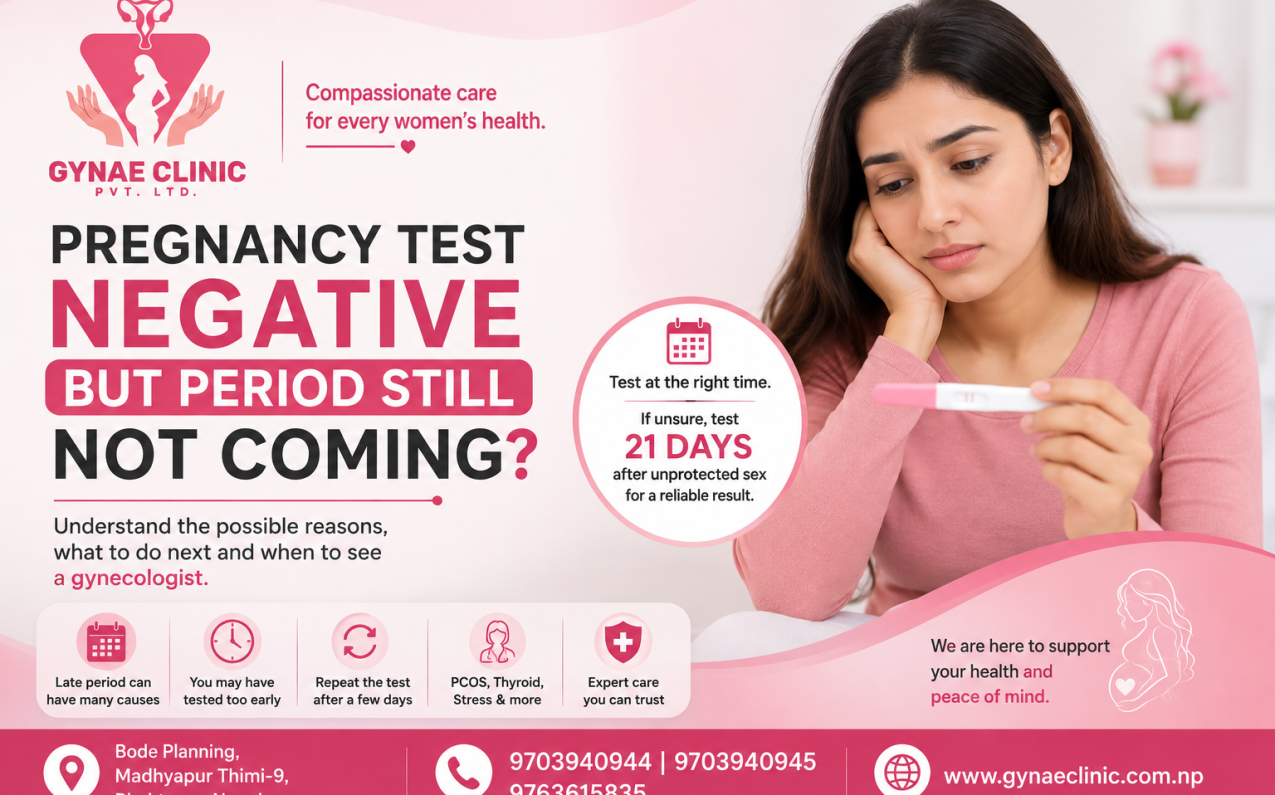
Pregnancy test negative but period still not coming? You are not alone. A late or missed period after a negative pregnancy test can be confusing and stressful, especially if you have recently had unprotected sex.
The good news is that a late period does not always mean pregnancy. However, pregnancy may still be possible if the test was taken too early.
A home pregnancy test is generally most reliable from the first day of a missed period. If you do not know when your next period is due, testing at least 21 days after the last unprotected sex is a useful timing rule.
Quick Answer
If your pregnancy test is negative but your period has not started:
- Check when you had unprotected sex.
- Check whether you tested too early.
- If the test was early, repeat it after a few days.
- If you do not know when your period was due, test at least 21 days after the last unprotected sex.
- If repeated pregnancy tests are negative and your period remains absent or irregular, see a gynecologist to look for other causes.
A negative result is less reliable than a positive result when the test is taken too early.
Why Is My Period Late If the Pregnancy Test Is Negative?
There are many possible reasons for a late period besides pregnancy.
Common causes include:
- Testing for pregnancy too early
- Stress or anxiety
- PCOS
- Thyroid problems
- Sudden weight loss
- Weight gain
- Excessive exercise
- Hormonal contraception
- Breastfeeding
- Changes in routine or lifestyle
- Irregular ovulation
- Perimenopause
- Certain medical conditions
Periods can naturally vary from cycle to cycle, and some women have irregular cycles even when there is no serious underlying problem.
1. You May Have Tested Too Early
This is one of the most important reasons for a negative pregnancy test when your period has not arrived.
Pregnancy tests detect human chorionic gonadotropin (hCG). The level of hCG increases after pregnancy develops, but it may be too low to detect very early in pregnancy.
For example:
Sex → ovulation → fertilization → implantation → hCG rises → pregnancy test becomes positive
Because these events do not happen immediately after sex, a test taken too soon can be negative even if pregnancy has occurred.
When should you test?
Most pregnancy tests can be used from the first day of a missed period.
If you do not know when your period should come, test at least 21 days after the last unprotected sex.
2. You May Need to Repeat the Pregnancy Test
If your first test was negative but your period still has not arrived, repeating the test can be appropriate.
The NHS advises waiting a few days and testing again if you still think you may be pregnant. If the second test is negative and your period has still not arrived, medical advice should be sought.
This is especially important if:
- You tested before your expected period.
- Your menstrual cycles are irregular.
- You are unsure when you ovulated.
- You had unprotected sex recently.
- You have pregnancy symptoms despite the negative test.
3. PCOS Can Cause a Late or Missed Period
Polycystic ovary syndrome (PCOS) is a common cause of irregular or delayed periods.
With PCOS, ovulation may occur less regularly. This can make menstrual cycles longer or unpredictable.
Some women with PCOS may also experience:
- Acne
- Increased facial or body hair
- Weight changes
- Difficulty getting pregnant
- Irregular or infrequent periods
If you frequently experience late periods and have other symptoms associated with PCOS, a gynecological evaluation may help identify the cause. PCOS is one of the recognized causes of irregular periods.
4. Stress Can Delay Your Period
Stress and anxiety can affect menstrual cycles.
Major emotional stress, poor sleep, changes in routine or significant lifestyle changes may be associated with delayed or missed periods.
If you have recently experienced significant stress and your pregnancy tests are negative, your period may simply be delayed.
However, persistent or recurrent missed periods should not automatically be blamed on stress. Other causes may need to be evaluated.
5. Thyroid Problems Can Affect Your Period
The thyroid gland plays an important role in regulating many body functions, including reproductive hormones.
Both an underactive thyroid and an overactive thyroid can affect menstrual regularity.
If late or irregular periods occur together with symptoms such as:
- Unusual tiredness
- Weight changes
- Feeling unusually cold or hot
- Changes in hair or skin
- Palpitations
- Mood changes
a doctor may consider thyroid testing as part of the evaluation.
6. Weight Changes Can Affect Your Menstrual Cycle
Significant weight loss or weight gain can affect menstrual cycles.
Very low calorie intake, rapid weight loss, excessive exercise and some eating-related problems can interfere with normal ovulation.
Being overweight can also be associated with menstrual irregularity.
If your period changed after a major change in weight, nutrition or exercise, discuss this with a healthcare professional.
7. Hormonal Contraception Can Change Your Period
Some hormonal contraceptive methods can alter menstrual bleeding or make periods lighter, irregular or absent.
This can happen with methods such as:
- Contraceptive pills
- Hormonal injections
- Hormonal intrauterine systems
Therefore, a late or absent period while using hormonal contraception does not automatically mean pregnancy. However, pregnancy testing may still be appropriate if there has been a contraceptive failure or concern about pregnancy.
8. Breastfeeding Can Delay Periods
If you are breastfeeding, hormonal changes associated with lactation can affect ovulation and menstrual cycles.
Periods may become irregular or may not return for some time.
However, breastfeeding is not a guaranteed method of preventing pregnancy in every situation. If you have had unprotected sex and are concerned about pregnancy, appropriate testing is still important.
9. Perimenopause Can Cause Irregular Periods
As women approach menopause, hormone levels can fluctuate and menstrual cycles may become irregular.
Perimenopause commonly begins between the ages of 45 and 55, although timing varies between women.
A late period during this stage does not necessarily mean pregnancy, but pregnancy can still occur until menopause has been established.
Can You Still Be Pregnant With a Negative Test?
Yes, it can happen if you tested too early.
A negative pregnancy test becomes more reassuring when it is taken at the appropriate time.
If your period is late and you recently had unprotected sex:
If your period is already due:
Take a pregnancy test.
If the test is negative:
Wait a few days and repeat the test if your period still has not started.
If you do not know when your period is due:
Test at least 21 days after the last unprotected sex.
What If the Second Pregnancy Test Is Also Negative?
If you have repeated the pregnancy test at an appropriate time and it remains negative, pregnancy becomes less likely.
At that point, the focus should shift toward identifying why your period is late.
A gynecologist may ask about:
- Your usual menstrual cycle
- Date of your last period
- Recent sexual activity
- Contraception
- Weight changes
- Stress
- Exercise
- Medications
- PCOS symptoms
- Thyroid symptoms
- Previous gynecological problems
Depending on your history, your doctor may recommend appropriate blood tests, hormonal evaluation or ultrasound.
Treatment depends on the underlying cause rather than simply trying to bring on a period.
Can a Blood Pregnancy Test Help?
A healthcare professional may recommend a blood beta-hCG pregnancy test when pregnancy status needs further clarification.
Blood testing can be useful in specific situations, particularly when symptoms, timing or previous test results make the diagnosis uncertain.
If pregnancy is suspected despite a negative urine test, discuss the most appropriate testing approach with a qualified healthcare professional.
When Should You See a Gynecologist for a Late Period?
Consider a gynecological consultation if:
- Your pregnancy test is negative but your period remains absent.
- Your periods are repeatedly late or irregular.
- You have missed several periods.
- You have significant weight changes.
- You have symptoms suggestive of PCOS.
- You have symptoms suggesting a thyroid problem.
- You are trying to become pregnant.
- You have unusual vaginal bleeding.
- You have persistent pelvic pain.
Repeatedly irregular periods deserve evaluation rather than being ignored.
🚨 When Is a Late Period an Emergency?
A late period with a negative pregnancy test is usually not an emergency by itself.
However, severe or unusual symptoms require prompt medical assessment.
Seek urgent medical care if you have:
- Severe or worsening abdominal pain
- Significant one-sided lower abdominal or pelvic pain
- Dizziness or fainting
- Shoulder-tip pain
- Unusual vaginal bleeding together with pelvic or abdominal pain
- Feeling extremely weak or unwell
An ectopic pregnancy can sometimes present with a missed period, pain or bleeding, and a negative pregnancy test does not absolutely exclude every early pregnancy situation. Symptoms suggesting ectopic pregnancy should therefore be assessed urgently rather than relying only on a home test.
Pregnancy Test Negative but Period Still Not Coming: What Should You Do?
Here is a simple approach:
Step 1: Check the timing
Ask yourself:
When was the last unprotected sex?
If it was less than 21 days ago and you do not know when your period is due, your test may have been too early.
Step 2: Repeat the test if necessary
If you tested early and your period remains absent, repeat the pregnancy test after a few days.
Step 3: Consider other causes
If pregnancy tests remain negative, consider causes such as:
PCOS → thyroid problems → stress → weight changes → exercise → contraception → hormonal changes
Step 4: Consult a gynecologist if the problem persists
If your periods continue to be absent or become repeatedly irregular, professional evaluation can identify the underlying cause.
Pregnancy Test Negative but No Period: Frequently Asked Questions
How many days late can a period be without pregnancy?
There is no single number that applies to every woman. Menstrual cycles naturally vary, and a period can be delayed by stress, PCOS, thyroid problems, weight changes, excessive exercise, hormonal contraception and other factors.
Can I be pregnant if my period is late but the test is negative?
Yes, particularly if you tested too early. Pregnancy tests are most reliable from the first day of a missed period. If you do not know when your period is due, test at least 21 days after the last unprotected sex.
Should I repeat a pregnancy test after a negative result?
If you tested early and still think you may be pregnant, waiting a few days and repeating the test is reasonable. If a second test is negative and your period still has not arrived, consult a healthcare professional.
What if my period is 7 days late but pregnancy test is negative?
A period that is 7 days late can happen for several reasons. If pregnancy is possible, make sure the test was taken at an appropriate time. If the test was too early, repeat it. If pregnancy tests remain negative, consider other causes such as PCOS, stress, thyroid problems or hormonal changes.
Can PCOS cause a late period?
Yes. PCOS can interfere with regular ovulation and is a recognized cause of irregular or delayed periods.
Can stress delay my period?
Yes. Stress and anxiety are recognized causes of delayed or irregular periods.
Can thyroid problems delay periods?
Yes. Both overactive and underactive thyroid conditions can affect menstrual regularity.
What if I missed three periods and pregnancy tests are negative?
Missing three consecutive periods should be medically evaluated, particularly if this is unusual for you.
Pregnancy and Women’s Health Care in Bhaktapur
If your pregnancy test is negative but your period is still not coming, a gynecological consultation can help determine whether the delay is related to pregnancy, PCOS, thyroid problems, hormonal changes, stress or another cause.
Gynae Clinic Pvt. Ltd.
Address: Bode Planning, Madhyapur Thimi-9, Bhaktapur, Nepal
Contact:
9703940944
9703940945
9763615835
Website: www.gynaeclinic.com.np
Gynae Clinic serves women from Bode, Madhyapur Thimi, Sallaghari, Radhe Radhe, Gatthaghar, Lokanthali, Kaushaltar, Sanothimi, Jadibuti, Koteshwor, Baneshwor, Kathmandu, Suryabinayak, Jagati, Banepa and Dhulikhel.
Final Takeaway
A negative pregnancy test with no period does not always mean that something is wrong.
The first question is whether the test was taken at the right time.
If your period is late:
Test from the first day of your missed period.
If you do not know when your period is due:
Test at least 21 days after the last unprotected sex.
If the result is negative but your period still does not come, repeat the test when appropriate and consider other causes such as PCOS, thyroid problems, stress, weight changes, excessive exercise, contraception or other hormonal conditions.
If the problem continues or you have concerning symptoms, consult a gynecologist for appropriate evaluation.
Medical Disclaimer
This article is for general educational purposes and does not replace an individual medical consultation. Pregnancy-test timing and menstrual changes can vary between women. Seek prompt medical care for severe pain, fainting, unusual bleeding or other concerning symptoms.
Author: Gynae Clinic Pvt. Ltd. Medical Content Team


