

Author: Gynae Clinic Pvt. Ltd.
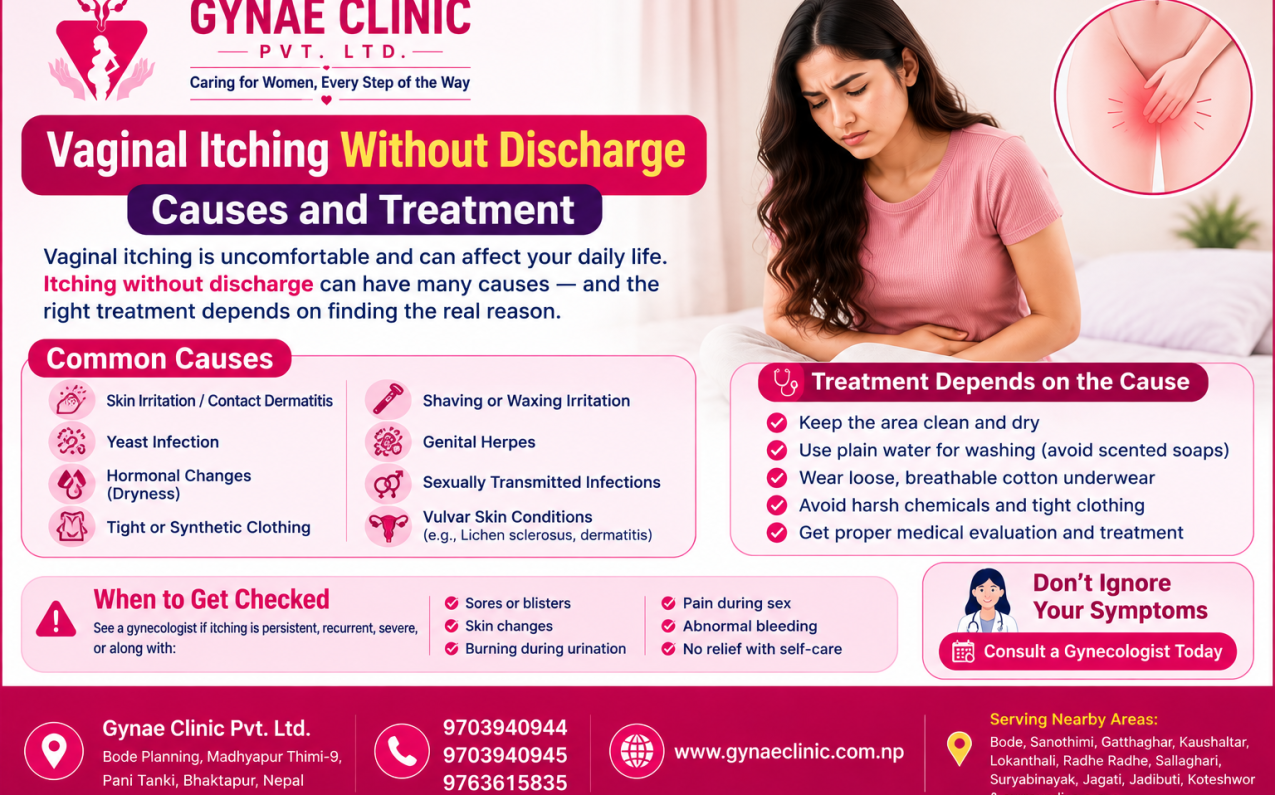
Vaginal or vulvar itching is a common problem, but itching does not always come with vaginal discharge. Many women assume that itching must mean a yeast infection, yet irritation of the external genital skin, allergic reactions, hormonal changes, skin conditions and some infections can all cause itching without obvious discharge.
The first step is to identify where the itching is coming from—inside the vagina or on the vulva (external genital skin)—because the causes and treatments can be different.
If itching is persistent, severe, recurrent, or accompanied by sores, skin changes, pain or burning, a gynecological examination can help determine the cause.
Can You Have a Yeast Infection Without Discharge?
Yes.
Vaginal yeast infection commonly causes itching and burning, and some women may have little or no noticeable change in discharge. The vulva may also become red, swollen, sore or irritated.
However, itching alone does not prove that you have a yeast infection.
Using an antifungal medicine without knowing the cause may delay the correct diagnosis if the problem is actually dermatitis, a skin condition, hormonal dryness or another infection.
Common Causes of Vaginal Itching Without Discharge
1. Skin Irritation or Contact Dermatitis
One of the most common possibilities is irritation of the vulvar skin.
It can happen after exposure to:
- Scented soaps
- Feminine washes
- Perfumes
- Scented sanitary pads
- Laundry detergents
- Fabric softeners
- Deodorant sprays
- Lubricants
- Certain fabrics
- Shaving products
Contact dermatitis can cause intense itching, burning, redness, rawness and irritation without producing vaginal discharge.
What can help?
Stop using products that may be irritating the area. Wash the vulva gently with plain lukewarm water and avoid rubbing or scratching.
2. Yeast Infection
A Candida yeast infection is another important possibility.
Typical symptoms include:
- Intense itching
- Burning
- Redness
- Swelling
- Soreness
- Burning during urination
- Discomfort during sex
Although thick white discharge is commonly associated with yeast infection, discharge does not have to be obvious in every case.
Risk can be higher with factors such as recent antibiotic use, pregnancy, diabetes and certain conditions affecting immunity.
3. Excessive Washing
The vagina is self-cleaning. Excessive washing or using soaps and cleansing products inside the vagina can disturb its normal environment and irritate sensitive tissue.
Avoid:
- Vaginal douching
- Feminine sprays
- Perfumed washes
- Strong soaps
- Talcum powders
- Internal cleansing products
ACOG recommends cleaning the vulva gently with warm water and avoiding douching and scented products.
4. Shaving or Waxing
Shaving and waxing can cause irritation or inflammation around the vulva.
You may notice:
- Itching
- Small bumps
- Redness
- Burning
- Tenderness
Hair follicles can also become inflamed after shaving or waxing. This is called folliculitis.
Avoid scratching or repeatedly shaving irritated skin until it has healed.
5. Tight or Damp Clothing
Heat, moisture and friction can irritate the vulvar area.
Symptoms may become worse when wearing:
- Very tight underwear
- Tight trousers
- Synthetic fabrics
- Wet clothing for long periods
- Sweaty exercise clothes
Changing out of wet clothes promptly and choosing breathable underwear can help reduce irritation.
6. Hormonal Changes
Lower estrogen levels can make vaginal and vulvar tissue thinner, drier and more sensitive.
This may happen during:
- Perimenopause
- Menopause
- Breastfeeding
- Some hormonal treatments
Symptoms can include:
- Itching
- Dryness
- Burning
- Irritation
- Pain during sex
- Urinary symptoms
This condition is commonly referred to as genitourinary syndrome of menopause (GSM) when associated with menopause-related hormonal changes.
Treatment depends on the cause and may include vaginal moisturizers, lubricants or prescribed local estrogen therapy when appropriate.
7. Vulvar Skin Conditions
Persistent itching without discharge can sometimes come from a skin condition rather than a vaginal infection.
Examples include:
- Lichen sclerosus
- Lichen simplex chronicus
- Lichen planus
- Contact dermatitis
- Other inflammatory skin conditions
These may cause changes such as:
- Thickened skin
- White patches
- Redness
- Cracks
- Scaling
- Burning
- Persistent itching
ACOG recommends medical assessment when there are changes to the vulvar skin or persistent itching, burning or pain.
8. Genital Herpes
Genital herpes can cause itching, tingling, burning or discomfort before visible sores appear.
Some women may have very mild symptoms and may not immediately recognize them as herpes.
Look for:
- Small blisters
- Painful sores
- Burning
- Tingling
- Pain during urination
- Tenderness around the genital area
If you notice blisters or sores, especially after sexual exposure, seek medical evaluation rather than treating yourself for a yeast infection.
9. Sexually Transmitted Infections
Some sexually transmitted infections can cause genital irritation, burning or itching, although many STIs can also occur without obvious symptoms.
The presence or absence of discharge alone cannot reliably determine whether an STI is present.
If you have:
- A new sexual partner
- Unprotected sex
- Genital sores
- Burning while urinating
- Pelvic pain
- Unusual bleeding
- Recurrent genital symptoms
talk to your gynecologist about whether STI testing is appropriate.
10. Diabetes
High blood sugar can increase the risk of recurrent Candida infections.
If you have repeated episodes of genital itching or yeast infections, especially if treatment does not work or symptoms repeatedly return, your doctor may consider whether diabetes or another underlying factor could be contributing.
11. Vulvodynia and Other Chronic Vulvar Problems
Some women experience persistent burning, irritation, stinging or discomfort without an obvious infection.
Vulvodynia is one condition that can cause chronic vulvar discomfort and may come and go or be triggered by touch, tight clothing, tampon insertion or sexual activity.
These conditions require a careful assessment because treatment is different from treatment for an infection.
Why Am I Itching but Have No Discharge?
This is an important question because no discharge does not rule out a medical cause.
Possible explanations include:
- Vulvar irritation
- Contact dermatitis
- Yeast infection
- Shaving-related irritation
- Dryness
- Hormonal changes
- Vulvar skin disorders
- Genital herpes
- Other infections
- Chronic vulvar conditions
The location of the itching and appearance of the skin are often important clues.
Vaginal Itching vs Vulvar Itching
These terms are often used interchangeably, but they are not exactly the same.
Vulvar itching
This affects the external genital skin.
Possible causes include:
- Contact dermatitis
- Shaving irritation
- Skin disorders
- Yeast infection
- Hormonal dryness
Vaginal itching
This refers more to discomfort inside the vaginal canal and may be associated with vaginitis or other conditions.
Because different problems can produce similar symptoms, an examination may be needed when symptoms persist.
How Is the Cause Diagnosed?
Your gynecologist may ask about:
- When the itching started
- Whether it is inside or outside
- Recent antibiotics
- New soaps or products
- Sexual activity
- Birth control
- Pregnancy
- Menstrual cycle
- Diabetes
- Previous vaginal infections
- Previous treatment
The doctor may examine the vulva and vagina.
Depending on your symptoms, testing may include a vaginal sample or other laboratory testing to identify infections. ACOG notes that samples of vaginal discharge may be tested when evaluating vaginitis.
If there is a persistent or unusual skin change, additional evaluation may sometimes be necessary.
Treatment for Vaginal Itching Without Discharge
Treatment depends on the cause.
There is no single medicine that is appropriate for every woman with genital itching.
If the cause is irritation
Treatment generally involves removing the irritant and allowing the skin to recover.
If it is a yeast infection
An appropriate antifungal treatment may be prescribed or recommended depending on the diagnosis.
If it is a bacterial or other infection
The appropriate antimicrobial treatment depends on the specific diagnosis.
If the cause is hormonal dryness
Moisturizers, lubricants or prescribed hormonal treatment may be considered depending on age, symptoms and medical history.
If it is a skin condition
Treatment may involve prescription creams or other therapies specifically selected for the diagnosed skin condition.
Should You Use an Antifungal Cream Without a Diagnosis?
It is better not to repeatedly self-treat every episode of itching as a yeast infection.
Yeast infection is common, but itching can have many causes. A medication intended for yeast will not treat dermatitis, a hormonal condition, herpes or a vulvar skin disorder. Unnecessary treatment can also delay the correct diagnosis.
If this is your first episode, symptoms are severe, symptoms keep returning, or previous treatment has not worked, see a gynecologist.
What Can You Do at Home?
While waiting for evaluation, you can reduce irritation by:
- Washing the vulva gently with lukewarm water
- Keeping the area dry
- Wearing breathable cotton underwear
- Avoiding tight clothing
- Changing out of wet clothes promptly
- Avoiding scented soaps and feminine washes
- Avoiding vaginal douching
- Avoiding perfumed pads or sprays
- Avoiding scratching
- Avoiding products that previously caused irritation
ACOG recommends avoiding scented products and douching and keeping the vulvar area clean and dry.
When Should You See a Gynecologist?
Make an appointment if:
- Itching lasts more than a few days
- It keeps coming back
- The itching is severe
- There is redness or swelling
- You develop sores or blisters
- The skin becomes white, thickened or cracked
- You have burning during urination
- Sex becomes painful
- You have abnormal bleeding
- You have pelvic pain
- You recently had unprotected sex
- You are pregnant
- Over-the-counter treatment has not worked
Persistent vulvar itching, burning or pain deserves medical evaluation even when there is no discharge.
When Is It More Urgent?
Seek prompt medical care if genital itching is accompanied by:
- Severe swelling
- Severe genital pain
- Blisters or open sores
- Fever
- Severe pelvic pain
- Difficulty urinating
- Rapidly worsening symptoms
- Significant skin changes
If you are pregnant and develop genital symptoms, discuss them with your healthcare provider rather than self-treating.
How Can You Prevent Vaginal and Vulvar Itching?
You can reduce irritation by following simple vulvar-care habits.
Avoid unnecessary products
The vagina does not need perfumes, deodorants or douches to stay clean.
Keep the area dry
Change wet underwear and clothes promptly.
Choose breathable underwear
Cotton underwear and loose clothing can reduce moisture and friction.
Avoid scratching
Scratching can damage the skin and create an itch-scratch cycle.
Practice safer sex
Condom use can reduce the risk of some sexually transmitted infections.
Do not repeatedly self-medicate
If symptoms keep returning, find out the cause instead of repeatedly using the same medicine.
Vaginal Itching Without Discharge in Bhaktapur
If you are searching for vaginal itching treatment in Bhaktapur, vaginal infection treatment in Bhaktapur, vulvar itching treatment in Bhaktapur, yeast infection treatment in Bhaktapur, gynecologist for vaginal itching near Bode, Madhyapur Thimi, Sanothimi, Gatthaghar, Kaushaltar, Lokanthali, Radhe Radhe, Sallaghari, Suryabinayak, Jagati, Jadibuti or Koteshwor, you can consult:
Gynae Clinic Pvt. Ltd.
Address:
Bode Planning, Madhyapur Thimi-9, Pani Tanki, Bhaktapur, Nepal
Contact:
9703940944 | 9703940945 | 9763615835
Website:
www.gynaeclinic.com.np
Gynae Clinic provides gynecological consultation for vaginal infections, itching, abnormal vaginal symptoms, menstrual problems, PCOS, fertility concerns and other women’s reproductive health conditions.
The clinic is located in Madhyapur Thimi, Bhaktapur, serving women from Bode, Sanothimi, Gatthaghar, Kaushaltar, Lokanthali, Radhe Radhe, Sallaghari, Suryabinayak, Jagati, Jadibuti, Koteshwor and surrounding areas.
Don’t Ignore Persistent Itching
Vaginal or vulvar itching without discharge may seem minor, but persistent itching can sometimes be the first sign of an infection, skin condition, hormonal change or another gynecological problem.
The absence of discharge does not mean there is no medical cause.
Avoid guessing the diagnosis and repeatedly using medicines that may not be appropriate.
“When itching keeps returning, treat the cause—not just the itch.”
Some complex or persistent vulvovaginal problems may require specialized gynecological evaluation and individualized care to identify the underlying cause.
Frequently Asked Questions
Can a yeast infection cause itching without discharge?
Yes. Itching and burning are common symptoms of vulvovaginal candidiasis, and some women may have little or no noticeable change in discharge.
Why am I itching down there but have no discharge?
Possible causes include irritation, contact dermatitis, yeast infection, shaving, dryness, hormonal changes, skin disorders and some infections.
Is vaginal itching always an infection?
No. Itching can be caused by infections as well as noninfectious conditions such as contact dermatitis, hormonal dryness and vulvar skin disorders.
Can soap cause vaginal itching?
Yes. Soaps, detergents, perfumes and other products can irritate sensitive vulvar skin.
Can stress cause vaginal itching?
Stress can sometimes worsen skin sensitivity and itching, but persistent genital itching should not automatically be blamed on stress. Other causes should be considered.
Should I use a yeast infection medicine?
If you are unsure whether the cause is yeast, it is better to consult a healthcare professional. Itching has several possible causes, and antifungal treatment will not treat non-yeast conditions.
Can menopause cause vaginal itching?
Yes. Lower estrogen levels around menopause can cause dryness, irritation, burning and itching.
When should I see a gynecologist for itching?
See a gynecologist if itching persists, repeatedly returns, is severe, or occurs with sores, skin changes, pain, burning during urination, abnormal bleeding or other symptoms.
Final Takeaway
Vaginal itching without discharge can have many causes.
Yeast infection is one possibility, but irritation from soaps or sanitary products, shaving, hormonal dryness, vulvar skin disorders, herpes and other conditions can also cause itching.
The best treatment depends on the cause.
If itching is persistent, recurrent or accompanied by skin changes, sores, pain or burning, get evaluated instead of repeatedly self-treating.
Author: Gynae Clinic Pvt. Ltd.
Medical Disclaimer
This article is for general educational purposes and does not replace an individual medical consultation, examination, diagnosis or treatment plan. If you have severe pain, significant swelling, fever, genital sores, difficulty urinating or rapidly worsening symptoms, seek prompt medical care.