
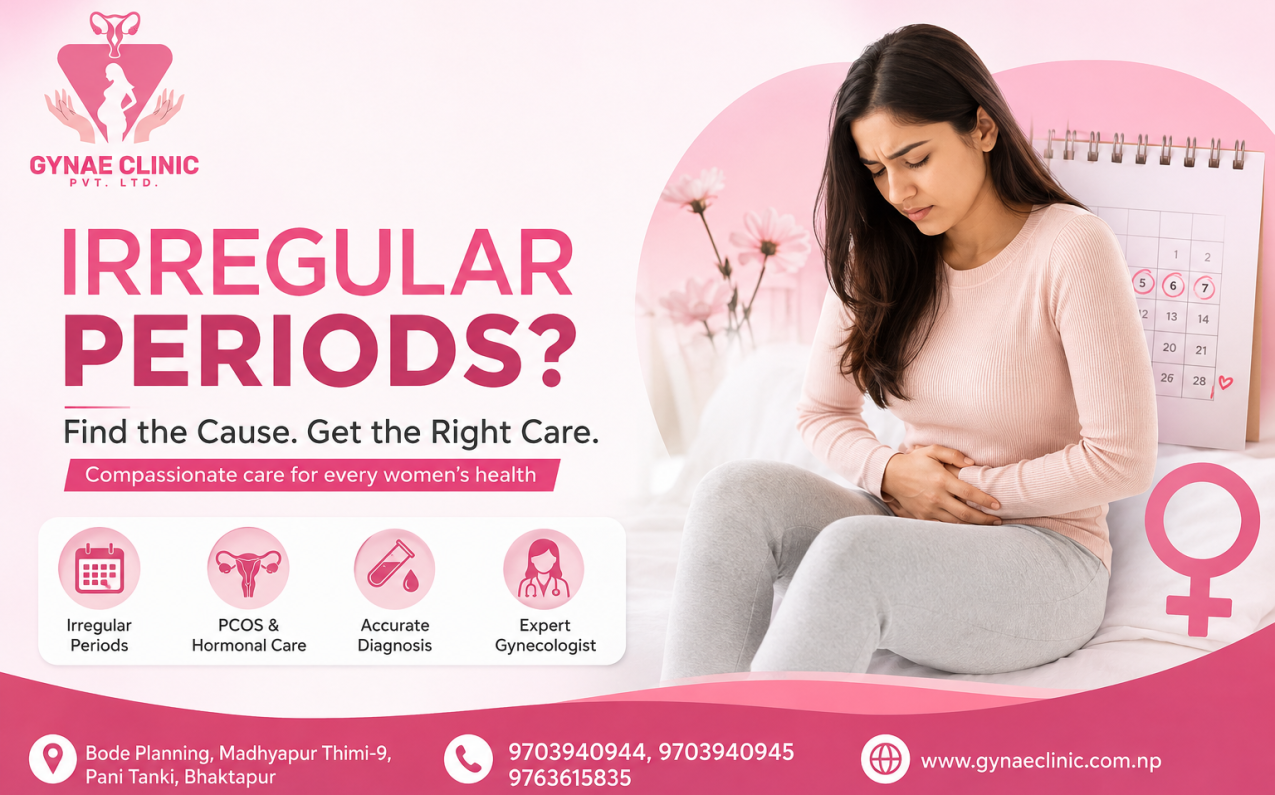
Irregular periods can be worrying, especially when your menstrual cycle suddenly changes, periods become delayed, you start skipping periods, or bleeding becomes unusually heavy or unpredictable.
An occasional change in the timing of a period can happen. Stress, changes in weight, illness, travel, lifestyle changes and hormonal fluctuations can all affect the menstrual cycle. However, when irregular periods happen repeatedly, it is important to understand the possible cause instead of repeatedly taking medicine simply to bring on a period.
If you are looking for irregular period treatment in Bhaktapur, PCOS treatment in Bhaktapur, hormonal imbalance treatment, or a gynecologist for missed periods, a proper gynecological consultation can help identify what may be affecting your menstrual cycle.
At Gynae Clinic Pvt. Ltd., women can seek professional consultation for menstrual problems, PCOS, hormonal concerns, fertility-related concerns, pregnancy care and other gynecological health issues in a private and supportive environment.
Gynae Clinic Pvt. Ltd.
Bode Planning, Madhyapur Thimi-9, Pani Tanki, Bhaktapur, Nepal
Contact: 9703940944, 9703940945, 9763615835
What Are Irregular Periods?
An irregular period means that your menstrual cycle does not follow your usual pattern.
For many adults, menstrual cycles commonly occur approximately every 21 to 35 days, although individual patterns can vary. A cycle may be considered irregular when the timing changes significantly, periods repeatedly arrive much earlier or later than expected, or periods are frequently missed.
You may notice:
- Periods coming earlier or later than usual
- Frequently delayed periods
- Missed periods
- No period for several months
- A cycle that changes significantly from month to month
- Very heavy or unusually light bleeding
- Bleeding between periods
- Periods lasting longer than usual
- A sudden change in a previously regular cycle
- Increasing menstrual pain
The most important question is not simply:
“How can I bring my period?”
The more important question is:
“Why has my menstrual cycle become irregular?”
Finding the possible cause helps guide the most appropriate treatment.
Common Causes of Irregular Periods
Irregular periods can have many possible causes. The same symptom may have different causes in different women.
1. PCOS
Polycystic Ovary Syndrome, commonly known as PCOS, is one of the conditions associated with irregular or missed periods.
PCOS can affect ovulation. When ovulation does not happen regularly, periods may become delayed, unpredictable or absent.
Some women with PCOS may also experience:
- Irregular periods
- Missed periods
- Acne
- Increased facial or body hair
- Hair thinning
- Weight or metabolic changes
- Difficulty predicting ovulation
- Difficulty becoming pregnant
However, irregular periods alone do not mean that you have PCOS.
A proper evaluation is important because several other conditions can cause similar menstrual symptoms.
For more information about this condition, women can also read our detailed guide on PCOS symptoms and treatment in Nepal. PCOS Symptoms and Treatment in Nepal
2. Hormonal Changes
Hormones play an important role in regulating ovulation and menstruation.
Changes involving reproductive hormones, thyroid hormones, prolactin or other hormonal systems may affect menstrual regularity.
Possible symptoms that may occur alongside irregular periods include:
- Acne
- Oily skin
- Excess facial or body hair
- Hair thinning
- Weight changes
- Changes in energy levels
- Difficulty becoming pregnant
Hormonal symptoms should not automatically be self-diagnosed. A proper consultation can help determine whether further evaluation is necessary.
You can also read our detailed guide on hormonal imbalance in women. Hormonal Imbalance in Women: Symptoms, Causes, Tests and Treatment in Bhaktapur
3. Thyroid Problems
The thyroid gland can influence many body functions, including menstrual health.
Both underactive and overactive thyroid conditions may contribute to changes in menstrual timing or bleeding patterns.
Women experiencing irregular periods together with symptoms such as unexplained weight changes, unusual tiredness, changes in skin or hair, or other persistent symptoms may benefit from appropriate medical evaluation.
Read our guide on thyroid problems and irregular periods for more information. Thyroid and Irregular Periods: Can Thyroid Problems Affect Your Menstrual Cycle?
4. Pregnancy
If pregnancy is possible and a period is late or missed, pregnancy should be considered.
A pregnancy test may be an appropriate first step depending on your individual circumstances.
Do not assume that every missed period is caused by PCOS, stress or hormonal imbalance.
5. Stress and Lifestyle Changes
Significant emotional or physical stress can affect hormonal signals involved in ovulation and menstruation.
Other factors that may influence the menstrual cycle include:
- Major weight changes
- Rapid weight loss
- Excessive exercise
- Poor nutrition
- Significant lifestyle changes
- Ongoing stress
- Certain medications
However, persistent irregular periods should not automatically be blamed on stress without considering other possible causes.
6. Changes After Stopping Hormonal Birth Control
Some women notice changes in their menstrual pattern after stopping certain forms of hormonal contraception.
The time it takes for periods to become predictable again can vary from person to person.
If periods remain persistently irregular or you have other concerning symptoms, a gynecological consultation may help determine whether further evaluation is appropriate.
You can read more in our guide on irregular periods after stopping birth control. Irregular Periods After Stopping Birth Control: What to Expect
Image Suggestion 1
Featured image placement: Place directly below the blog title.
Recommended visual:
A premium, professional women’s healthcare image showing a woman privately discussing menstrual health with a female healthcare professional in a modern, clean clinic environment. Use a soft pink, blush and white medical color palette consistent with Gynae Clinic Pvt. Ltd. branding.
When Should You See a Gynecologist for Irregular Periods?
An occasional change in your cycle may not always indicate a serious health problem.
However, consider professional gynecological evaluation if:
- Your periods repeatedly become irregular
- Your previously regular periods suddenly change
- You miss periods repeatedly
- You have no period for several months without a clear explanation
- Your periods are unusually heavy
- Bleeding lasts longer than usual
- You experience bleeding between periods
- You have severe menstrual or pelvic pain
- You have symptoms that may suggest PCOS
- You are having difficulty becoming pregnant
- Your menstrual pattern changes significantly
Heavy bleeding, prolonged bleeding, faintness, severe pain or other concerning symptoms may require more prompt medical attention.
Women can also read our complete guide on when to visit a gynecologist in Bhaktapur. When Should You Visit a Gynecologist? Complete Women’s Health Guide in Bhaktapur
How Is the Cause of Irregular Periods Evaluated?
There is no single test that explains every irregular period.
A gynecologist may begin by understanding your menstrual history, symptoms and individual health situation.
You may be asked questions such as:
- When was your last period?
- How often do your periods usually occur?
- How long does bleeding usually last?
- Has your menstrual pattern recently changed?
- Is your bleeding unusually heavy?
- Do you experience significant menstrual pain?
- Could pregnancy be possible?
- Have you recently gained or lost weight?
- Are you experiencing acne or excess facial hair?
- Are you taking any medicines or hormonal treatments?
- Are you trying to become pregnant?
Keeping track of your periods can be helpful. You may record:
- The first day of each period
- The number of days bleeding lasts
- Whether bleeding is light, moderate or heavy
- Pain levels
- Bleeding between periods
- Other symptoms such as acne, hair changes or pelvic pain
Tests That May Be Recommended
The appropriate investigation depends on your symptoms, medical history and clinical assessment.
A gynecologist may recommend selected tests when appropriate.
Pregnancy Test
A pregnancy test may be considered when pregnancy is possible and a period is delayed or missed.
Blood Tests
Selected blood tests may help investigate certain hormonal, thyroid or other medical causes when clinically appropriate.
Pelvic Ultrasound
Ultrasound may help assess the uterus, ovaries and other pelvic structures in selected situations.
Not every woman with irregular periods requires every possible test.
The goal should be to select investigations based on the individual patient rather than ordering unnecessary tests.
For more information about women’s health and gynecological care, visit our complete guide to women’s health and gynecological care in Bhaktapur. Gynecologist in Bhaktapur: Complete Women’s Health Guide
Image Suggestion 2
Image placement: After the “Tests That May Be Recommended” section.
Recommended visual:
A clean educational illustration showing the menstrual cycle with subtle representations of the uterus and ovaries. The design should be medically professional, simple and easy to understand, using premium pink and white tones.
Irregular Period Treatment in Bhaktapur
There is no single medicine or treatment that is right for every woman with irregular periods.
Treatment depends on the underlying cause.
A treatment plan may consider:
- The cause of menstrual irregularity
- Your symptoms
- Your age
- Your general health
- Whether pregnancy is possible
- Whether you are planning pregnancy
- Your fertility goals
- The severity of bleeding or other symptoms
Possible approaches may include the following.
Lifestyle and Health Support
For some women, menstrual irregularity may be influenced by lifestyle factors.
Depending on the individual situation, supportive measures may include:
- Maintaining balanced nutrition
- Avoiding extreme dieting
- Managing stress
- Maintaining an appropriate level of physical activity
- Improving sleep
- Addressing significant weight changes
Lifestyle changes should not replace medical evaluation when symptoms are persistent, severe or unusual.
PCOS Management
When PCOS is diagnosed, management may depend on the woman’s individual symptoms and health goals.
Care may focus on:
- Menstrual management
- Hormonal symptoms
- Metabolic health
- Acne or unwanted hair
- Ovulation
- Fertility planning
Because PCOS can affect women differently, management should be individualized.
Treatment of Hormonal or Thyroid Conditions
If a hormonal or thyroid condition is contributing to menstrual irregularity, treatment should focus on the underlying condition.
This is why identifying the cause is more useful than repeatedly taking medication without understanding why the periods are irregular.
Fertility-Focused Evaluation
Irregular periods can sometimes indicate irregular ovulation.
For women planning pregnancy, identifying the reason for irregular cycles can be an important part of fertility evaluation.
Irregular periods do not automatically mean that pregnancy is impossible. However, irregular ovulation may make it more difficult to predict fertile days or conceive in some situations.
Can Irregular Periods Affect Pregnancy?
They can sometimes affect the chances of conception, depending on the underlying cause.
Ovulation is an important part of the reproductive process. If ovulation does not happen regularly, pregnancy timing can become less predictable.
Conditions such as PCOS and some hormonal disorders may affect ovulation.
However:
Irregular periods do not mean that you cannot become pregnant.
Women who are planning pregnancy and have persistently irregular cycles may benefit from professional evaluation.
No Period for Three Months: Should You Be Concerned?
If you previously had periods and they stop for several months without an expected reason, it is important to understand why.
Pregnancy, PCOS, thyroid conditions, stress, significant weight changes and other medical factors may contribute to absent periods.
For a detailed explanation, read our guide on no period for three months and possible causes. No Period for 3 Months: Causes and What to Do
Image Suggestion 3
Image placement: Before the FAQ section.
Recommended visual:
A premium women’s health consultation image showing compassionate and confidential communication between a woman and a female gynecology professional. Modern clinic interior, soft natural lighting, elegant pink medical branding, realistic and professional.
Frequently Asked Questions About Irregular Periods
What is considered an irregular period?
Periods may be considered irregular when the timing between cycles changes significantly, periods repeatedly come very early or late, or periods are frequently missed.
Individual menstrual patterns can vary, so a sudden or persistent change from your usual pattern is also important.
Is PCOS the main cause of irregular periods?
PCOS is a common cause of irregular periods, but it is not the only cause.
Pregnancy, thyroid conditions, stress, significant weight changes, excessive exercise, medications and other hormonal or gynecological conditions can also affect menstrual cycles.
Can stress cause irregular periods?
Yes. Significant stress can influence the hormonal signals involved in ovulation and menstruation.
However, persistent irregular periods should not automatically be attributed to stress without considering other possible causes.
Can thyroid problems cause irregular periods?
Yes. Thyroid conditions can affect menstrual patterns.
Appropriate evaluation may be considered when irregular periods occur alongside symptoms that suggest a possible thyroid or hormonal problem.
Can I get pregnant if my periods are irregular?
Yes, pregnancy is possible.
However, some causes of irregular periods can affect ovulation, which may make conception more difficult or less predictable.
Do I always need an ultrasound for irregular periods?
No.
Whether an ultrasound is appropriate depends on your symptoms, medical history and clinical assessment.
Should I take medicine to bring on my period?
It is generally better to understand why your period is delayed or irregular before taking medication.
The appropriate treatment depends on the cause and should be determined by a qualified healthcare professional.
When should I see a gynecologist for a missed period?
Consider medical evaluation if periods repeatedly become irregular, you miss several periods, your menstrual pattern changes suddenly, pregnancy is possible, or you experience additional symptoms such as heavy bleeding, severe pain or hormonal changes.
Irregular Period Treatment Near Madhyapur Thimi and Bhaktapur
Women searching for:
- Irregular period treatment in Bhaktapur
- Missed period treatment in Bhaktapur
- PCOS treatment in Bhaktapur
- Hormonal imbalance treatment in Bhaktapur
- Female gynecologist near Madhyapur Thimi
- Gynecologist for irregular periods near Bode
- Period problem doctor near Pani Tanki
- Gynecology clinic near Gatthaghar
- Women’s health clinic near Lokanthali
- Gynecologist near Jadibuti
- Gynecology consultation near Koteshwor
can seek professional women’s healthcare at Gynae Clinic Pvt. Ltd.
Gynae Clinic Pvt. Ltd.
Address:
Bode Planning, Madhyapur Thimi-9, Pani Tanki, Bhaktapur, Nepal
Contact:
9703940944
9703940945
9763615835
Website:
Gynae Clinic Pvt. Ltd. Official Website
Gynae Clinic Pvt. Ltd. provides women’s healthcare and gynecological consultation for menstrual concerns, PCOS, hormonal health, pregnancy-related concerns, fertility-related concerns and other women’s health needs.
Final Thoughts
Irregular periods are common, but repeated changes in your menstrual cycle deserve attention.
PCOS is one possible cause, but it is not the only explanation. Hormonal changes, thyroid problems, pregnancy, stress, major weight changes and other medical or gynecological conditions can also affect the menstrual cycle.
Instead of repeatedly trying to force a period to come without understanding the cause, consider finding out what may be affecting your menstrual health.
If you are looking for irregular period treatment in Bhaktapur, a professional gynecological consultation can help assess your symptoms and determine whether monitoring, lifestyle support, further investigation or treatment may be appropriate.
Medical Disclaimer
This article is for general health education and does not replace an individual medical consultation, diagnosis or treatment plan. Persistent menstrual changes, unusually heavy bleeding, severe pain or other concerning symptoms should be assessed by an appropriate healthcare professional. Certain complex conditions may benefit from advanced specialist care.
Author: Gynae Clinic Pvt. Ltd.