
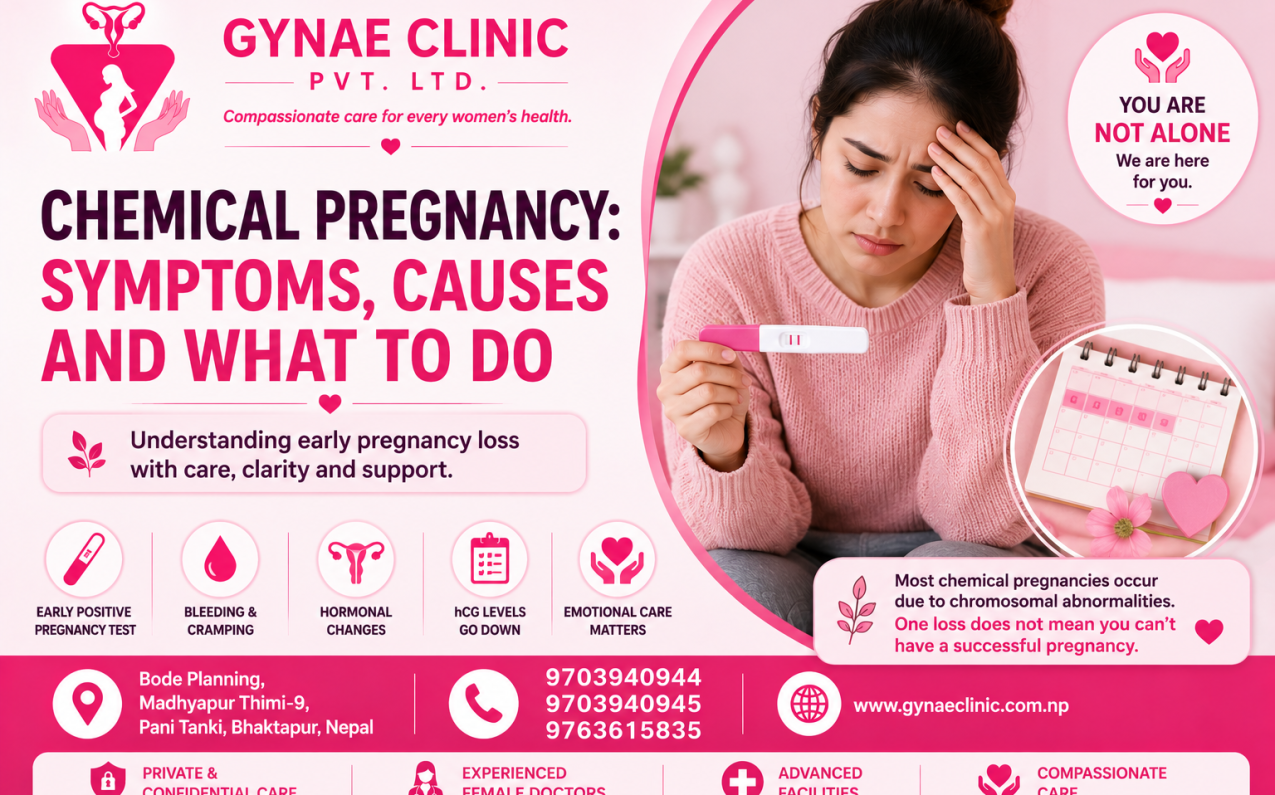
A chemical pregnancy is a very early pregnancy loss that happens shortly after implantation, usually before the pregnancy can be seen on ultrasound. It is also called a biochemical pregnancy.
Many women discover a chemical pregnancy because they first get a positive pregnancy test, followed by bleeding and a negative test a few days or weeks later. Because it happens so early, some women may mistake it for a late or unusually heavy period.
Experiencing a chemical pregnancy can be emotionally difficult, especially when you have been trying to conceive. Importantly, one chemical pregnancy does not mean you cannot have a healthy pregnancy in the future.
For women seeking pregnancy and gynecological care around Bhaktapur, Madhyapur Thimi, Kausaltar, Lokanthali, Jadibuti and Koteshwor, Gynae Clinic Pvt. Ltd. provides women’s healthcare from Bode Planning, Madhyapur Thimi-9, Pani Tanki, Bhaktapur, Nepal.
What Is a Chemical Pregnancy?
A chemical pregnancy is a very early miscarriage, generally occurring before about five weeks of pregnancy and before an ultrasound can usually confirm a developing pregnancy.
The pregnancy produces hCG (human chorionic gonadotropin), which is detected by a urine or blood pregnancy test. If the pregnancy stops developing, hCG levels begin to fall, and a pregnancy test may subsequently become negative.
In simple terms:
Positive pregnancy test → very early pregnancy develops → pregnancy stops developing → hCG falls → bleeding may occur → pregnancy test becomes negative
Because pregnancy tests are increasingly sensitive, more women can now detect these extremely early pregnancies that might previously have gone unnoticed.
Is a Chemical Pregnancy a Real Pregnancy?
Yes.
A chemical pregnancy is a pregnancy that was detected through biochemical evidence, such as a positive urine or blood hCG test, but ended before it could be confirmed on ultrasound.
The term “chemical” refers to the fact that hCG is detectable, not that the pregnancy was unreal or unimportant.
For someone who has been hoping for a baby, even a very early pregnancy loss can be emotionally significant.
What Are the Symptoms of a Chemical Pregnancy?
Some women have no obvious symptoms and may never know they experienced a chemical pregnancy.
When symptoms do occur, they can include:
- Positive pregnancy test followed by a negative test
- Period arriving later than expected
- Vaginal bleeding
- Heavier-than-usual bleeding
- Menstrual-like cramps
- Stronger abdominal cramps than usual
- Passing small blood clots
- Pregnancy symptoms that were present and then decrease
- A positive pregnancy test followed by bleeding around the expected period
The bleeding can look similar to a menstrual period, which is why chemical pregnancies often go unnoticed.
What Does Chemical Pregnancy Bleeding Look Like?
Chemical pregnancy bleeding can vary from woman to woman.
You may experience:
- Light spotting initially
- Bleeding similar to a period
- Heavier bleeding than your normal period
- Blood clots
- Stronger menstrual-like cramps
Some women may have bleeding around the time their period was expected.
However, bleeding after a positive pregnancy test should not automatically be assumed to be a chemical pregnancy. Other causes of early-pregnancy bleeding, including ectopic pregnancy and other types of miscarriage, need to be considered when clinically appropriate.
If you have significant pain, heavy bleeding, dizziness or fainting, seek prompt medical assessment.
Chemical Pregnancy vs Late Period
A chemical pregnancy can easily be confused with a late period.
Late period
You may have:
- Negative pregnancy test
- Period several days late
- Normal menstrual bleeding when it arrives
Chemical pregnancy
You may have:
- Positive pregnancy test
- Period later than expected
- Bleeding that may be heavier or more painful
- Pregnancy test becoming negative afterward
The important difference is that a chemical pregnancy involves detectable hCG from an early pregnancy.
If you had a positive pregnancy test followed by bleeding, it is worth discussing with a healthcare professional rather than automatically assuming it was simply a late period.
For related information, read our Pregnancy Test Negative but Period Is Late: What Does It Mean?.
Chemical Pregnancy vs Implantation Bleeding
These two conditions are often confused.
Implantation-related spotting, when it occurs, happens around the time an early pregnancy implants and does not mean the pregnancy has ended.
A chemical pregnancy, on the other hand, is a pregnancy loss.
If you have a positive pregnancy test followed by bleeding, particularly if bleeding becomes heavy or is accompanied by pain, you should not assume it is implantation bleeding.
For more information, read our Bleeding in Early Pregnancy: Causes and When to Seek Care.
What Causes a Chemical Pregnancy?
In many cases, the exact cause cannot be identified.
The most common explanation is believed to be a chromosomal problem in the early embryo that prevents normal development. These abnormalities can occur randomly during the formation of the egg, sperm or early embryo.
A chemical pregnancy is usually not caused by something the woman did.
It is important not to blame yourself.
Can Stress Cause a Chemical Pregnancy?
There is no good evidence that ordinary emotional stress directly causes miscarriage.
Pregnancy loss is often related to factors beyond a woman’s control, particularly chromosomal abnormalities in the developing pregnancy.
If you have experienced a chemical pregnancy, blaming yourself for normal daily activities, work, exercise or emotional stress is not appropriate.
Can Exercise Cause a Chemical Pregnancy?
Normal physical activity is not considered a typical cause of early pregnancy loss.
Chemical pregnancies most often occur because the early pregnancy cannot continue developing normally, frequently because of chromosomal abnormalities.
Can Sex Cause a Chemical Pregnancy?
Normal sexual activity is not considered a typical cause of miscarriage.
If you experience bleeding or pain after a positive pregnancy test, however, it is important to discuss the symptoms with a healthcare professional.
Does PCOS Cause Chemical Pregnancy?
PCOS can be associated with fertility and pregnancy complications, but it is not correct to assume that every chemical pregnancy is caused by PCOS.
If chemical pregnancies occur repeatedly, your gynecologist may consider your menstrual pattern, ovulation, thyroid function, metabolic health and other possible factors as part of an individualized assessment.
If you are concerned about PCOS and fertility, read our PCOS Treatment Near Koteshwor and Bhaktapur guide and speak with a gynecologist about your individual situation.
Can Thyroid Problems Cause Early Pregnancy Loss?
Thyroid disorders can affect reproductive health and pregnancy, particularly when they are not appropriately controlled.
If you have thyroid disease and experience recurrent pregnancy loss, discuss appropriate thyroid evaluation and pregnancy planning with your gynecologist.
Not every chemical pregnancy is caused by thyroid problems, so testing should be guided by your individual history.
Does Age Increase the Risk of Chemical Pregnancy?
The risk of miscarriage generally increases with maternal age, partly because chromosomal abnormalities become more common with increasing age.
However, a chemical pregnancy can occur at any reproductive age.
A single early pregnancy loss does not automatically indicate a fertility problem.
How Is a Chemical Pregnancy Diagnosed?
A chemical pregnancy may be suspected when there is:
Positive pregnancy test → falling hCG → subsequent negative test and/or bleeding
Your healthcare professional may recommend:
1. Urine pregnancy test
A home pregnancy test may initially be positive and later become negative.
2. Quantitative Beta hCG
A blood test can measure the amount of hCG.
Repeating the test can show whether hCG is rising or falling. A declining hCG level can support the diagnosis of an early pregnancy loss.
3. Ultrasound
Because chemical pregnancies occur so early, an ultrasound usually cannot visualize a developing pregnancy.
However, ultrasound may be appropriate depending on symptoms, pregnancy dating and hCG results, particularly when another diagnosis needs to be excluded.
Can a Chemical Pregnancy Be Seen on Ultrasound?
Usually, no.
A chemical pregnancy ends before the pregnancy can generally be visualized on ultrasound. This is one of the key differences between a chemical pregnancy and a later clinically recognized miscarriage.
If you have a positive pregnancy test and later develop pain or significant bleeding, however, medical evaluation may still be important because an ectopic pregnancy can sometimes present before an intrauterine pregnancy is visible.
What Should You Do After a Chemical Pregnancy?
If you believe you have experienced a chemical pregnancy:
Step 1: Contact a healthcare professional if needed
A clinician can determine whether additional testing is necessary.
Step 2: Monitor bleeding and pain
Mild cramping and bleeding can occur, but heavy bleeding or severe pain requires medical attention.
Step 3: Consider hCG follow-up
Your doctor may recommend repeat Beta hCG testing to confirm that pregnancy hormone levels are falling appropriately.
Step 4: Take care of yourself emotionally
Pregnancy loss can be emotionally difficult regardless of how early it occurs.
Give yourself time to process the experience.
Step 5: Discuss future pregnancy plans
If you want to try again, your gynecologist can advise you based on your medical history and whether this was an isolated event or part of a recurrent pattern.
Does a Chemical Pregnancy Need Treatment?
A chemical pregnancy itself usually does not require a procedure because it occurs extremely early and the body generally passes the pregnancy tissue naturally.
However, medical assessment can still be important to make sure the diagnosis is correct and to determine whether hCG needs monitoring.
If bleeding is unusually heavy, pain is severe, or symptoms suggest another condition, additional evaluation may be required.
How Long Does Bleeding Last After a Chemical Pregnancy?
The duration varies.
Some women experience bleeding around the time of their expected period, while others may have bleeding for several days or longer.
The amount and duration can depend on how early the pregnancy ended and how quickly hCG levels fall.
Seek medical advice if bleeding becomes very heavy, persists unexpectedly, or is accompanied by significant pain, dizziness, weakness or other concerning symptoms.
When Is Chemical Pregnancy Bleeding an Emergency?
Seek urgent medical assessment if you experience:
- Heavy vaginal bleeding
- Severe abdominal or pelvic pain
- Severe one-sided pain
- Fainting
- Severe dizziness
- Marked weakness
- Shoulder-tip pain associated with concerning symptoms
- Rapidly worsening symptoms
These symptoms should not simply be attributed to a chemical pregnancy because conditions such as ectopic pregnancy can require urgent treatment.
Can You Have an Ectopic Pregnancy After a Positive Test?
Yes.
A positive pregnancy test with pain or bleeding needs appropriate assessment because an ectopic pregnancy can also cause early pregnancy bleeding and pain.
This is particularly important when pain is severe or one-sided, or when bleeding occurs with dizziness or fainting.
Do not assume that every positive test followed by bleeding is a chemical pregnancy.
Can You Get Pregnant Again After a Chemical Pregnancy?
Yes.
A chemical pregnancy does not usually mean that you will have difficulty becoming pregnant in the future.
Ovulation can return relatively quickly after an early pregnancy loss, and many people go on to have successful pregnancies after a chemical pregnancy.
Your healthcare professional can advise you about when to try again based on your individual circumstances.
How Soon Can You Try to Conceive After a Chemical Pregnancy?
Many women can ovulate again soon after a chemical pregnancy.
However, the appropriate timing to try again can depend on:
- Your physical recovery
- Bleeding
- hCG levels
- Any underlying health condition
- Whether the pregnancy loss was uncomplicated
- Your emotional readiness
- Your doctor’s advice
If you have experienced only one uncomplicated chemical pregnancy, there may not be a need for a prolonged delay in trying again, but individualized advice is best.
Does One Chemical Pregnancy Mean I Have Infertility?
No.
One chemical pregnancy does not mean that you are infertile.
Early pregnancy loss is common, and many people subsequently have healthy pregnancies.
However, if you have repeated chemical pregnancies or repeated miscarriages, a gynecologist may recommend further evaluation.
What If I Have Repeated Chemical Pregnancies?
Repeated early pregnancy losses deserve medical attention.
Depending on your history, your doctor may consider evaluating factors such as:
- Ovulation
- Thyroid function
- Diabetes or metabolic problems
- Uterine structure
- Hormonal factors
- Genetic factors
- Other reproductive or medical conditions
The appropriate evaluation depends on your individual history.
If you are trying to conceive and have experienced repeated early losses, consider a Fertility Checkup Near Koteshwor and Bhaktapur or consultation with a gynecologist.
Can a Chemical Pregnancy Be Prevented?
Unfortunately, there is no guaranteed way to prevent a chemical pregnancy.
Because many are associated with random chromosomal abnormalities in the early embryo, they may happen despite healthy habits and appropriate care.
You can still improve overall pregnancy health by:
- Taking recommended prenatal vitamins
- Avoiding smoking
- Avoiding alcohol
- Managing chronic health conditions
- Maintaining appropriate nutrition
- Reviewing medications before pregnancy
- Attending preconception and prenatal care
- Seeking medical advice when needed
Does a Chemical Pregnancy Affect Future Pregnancy?
Usually, one chemical pregnancy does not prevent a future healthy pregnancy.
Many people who experience an early pregnancy loss later have successful pregnancies.
If you are planning another pregnancy, consider arranging preconception care, particularly if you have PCOS, thyroid disease, diabetes, previous pregnancy complications or recurrent pregnancy loss.
You can also read our First Pregnancy Checkup: When Should You See a Gynecologist? guide when you become pregnant again.
Chemical Pregnancy and Pregnancy Symptoms
A chemical pregnancy may occur before noticeable pregnancy symptoms develop.
You may have:
- A positive pregnancy test
- No nausea
- No breast tenderness
- No fatigue
- No obvious pregnancy symptoms
This does not mean the test was necessarily wrong.
The pregnancy may simply have ended very early.
Our related article explains Positive Pregnancy Test but No Pregnancy Symptoms: Is It Normal?.
Chemical Pregnancy and Pregnancy Test Results
One common pattern is:
Day 1: Positive pregnancy test
Following days: Bleeding begins
Later: Pregnancy test becomes faint or negative
This happens because hCG begins falling after the pregnancy stops developing.
If your test remains positive for longer than expected, or you have significant pain or bleeding, consult a healthcare professional rather than assuming the cause.
Chemical Pregnancy Near Bhaktapur, Madhyapur Thimi and Kathmandu
If you are searching for chemical pregnancy care near Bhaktapur, early pregnancy consultation near Madhyapur Thimi, or gynecological care near Kausaltar, Lokanthali, Jadibuti or Koteshwor, Gynae Clinic Pvt. Ltd. provides women’s reproductive healthcare.
Gynae Clinic Pvt. Ltd.
Address:
Bode Planning, Madhyapur Thimi-9, Pani Tanki, Bhaktapur, Nepal
Contact:
9703940944
9703940945
9763615835
Website:
www.gynaeclinic.com.np
The clinic serves women from nearby areas including:
Bode, Madhyapur Thimi, Kausaltar, Lokanthali, Jadibuti, Koteshwor, Balkumari, Gatthaghar, Radhe Radhe, Sallaghari, Sanothimi, Suryabinayak, Jagati, Banepa and Dhulikhel.
If you have had a positive pregnancy test followed by bleeding, a gynecological consultation can help determine whether further pregnancy testing, Beta hCG monitoring or ultrasound is appropriate.
Frequently Asked Questions About Chemical Pregnancy
What is a chemical pregnancy?
A chemical pregnancy is a very early pregnancy loss, usually occurring before about five weeks, before the pregnancy can generally be seen on ultrasound.
What is the most common sign of a chemical pregnancy?
A common pattern is a positive pregnancy test followed by bleeding and a negative pregnancy test. Some women have no obvious symptoms.
Does a chemical pregnancy mean I am infertile?
No. One chemical pregnancy does not mean infertility, and many women subsequently have healthy pregnancies.
Why do chemical pregnancies happen?
The exact cause is often unknown, but chromosomal abnormalities in the early embryo are considered a major cause of very early pregnancy loss.
Can stress cause a chemical pregnancy?
Ordinary emotional stress is not considered a typical direct cause of miscarriage. Most chemical pregnancies occur because the pregnancy cannot continue developing normally.
Do I need an ultrasound after a chemical pregnancy?
An ultrasound usually cannot see a chemical pregnancy because it occurs very early. Your doctor may recommend ultrasound depending on your symptoms, hCG levels and the need to rule out other conditions.
Do I need Beta hCG after a chemical pregnancy?
Sometimes. Your healthcare professional may recommend quantitative Beta hCG testing and repeat testing to confirm that levels are falling appropriately.
How soon can I become pregnant again?
Ovulation can return quickly after an early pregnancy loss. Your healthcare professional can advise you about trying again based on your individual situation.
Can I have a healthy pregnancy after a chemical pregnancy?
Yes. Many women go on to have healthy pregnancies after experiencing a chemical pregnancy.
When should I see a gynecologist?
Seek consultation after a positive pregnancy test followed by bleeding, especially if you have significant pain, repeated pregnancy losses, persistent positive tests or concerns about future fertility.
Chemical Pregnancy: Final Takeaway
A chemical pregnancy is a very early pregnancy loss that occurs before the pregnancy can usually be seen on ultrasound.
The most common pattern is:
Positive pregnancy test → hCG begins to fall → bleeding → negative pregnancy test.
The exact cause is often unknown, but chromosomal abnormalities in the early pregnancy are a major suspected cause. A chemical pregnancy is generally not caused by something you did, and one chemical pregnancy does not mean you cannot have a healthy pregnancy in the future.
If you have experienced a chemical pregnancy, appropriate follow-up may include clinical assessment, Beta hCG testing and, when indicated, ultrasound. If you have heavy bleeding, severe or one-sided abdominal pain, dizziness, fainting or significant weakness, seek urgent medical assessment.
If chemical pregnancies happen repeatedly, discuss fertility and early pregnancy evaluation with a gynecologist.
Gynae Clinic Pvt. Ltd.
Bode Planning, Madhyapur Thimi-9, Pani Tanki, Bhaktapur, Nepal
9703940944 | 9703940945 | 9763615835
www.gynaeclinic.com.np
Compassionate care for every women’s health.
Medical Disclaimer
This article is for general educational purposes and does not replace an individual medical consultation. Bleeding or pain after a positive pregnancy test should be assessed appropriately because not every early pregnancy loss is a chemical pregnancy. Complex cases may need specialized referral.
Author
Gynae Clinic Pvt. Ltd.
Bode Planning, Madhyapur Thimi-9, Pani Tanki, Bhaktapur, Nepal