


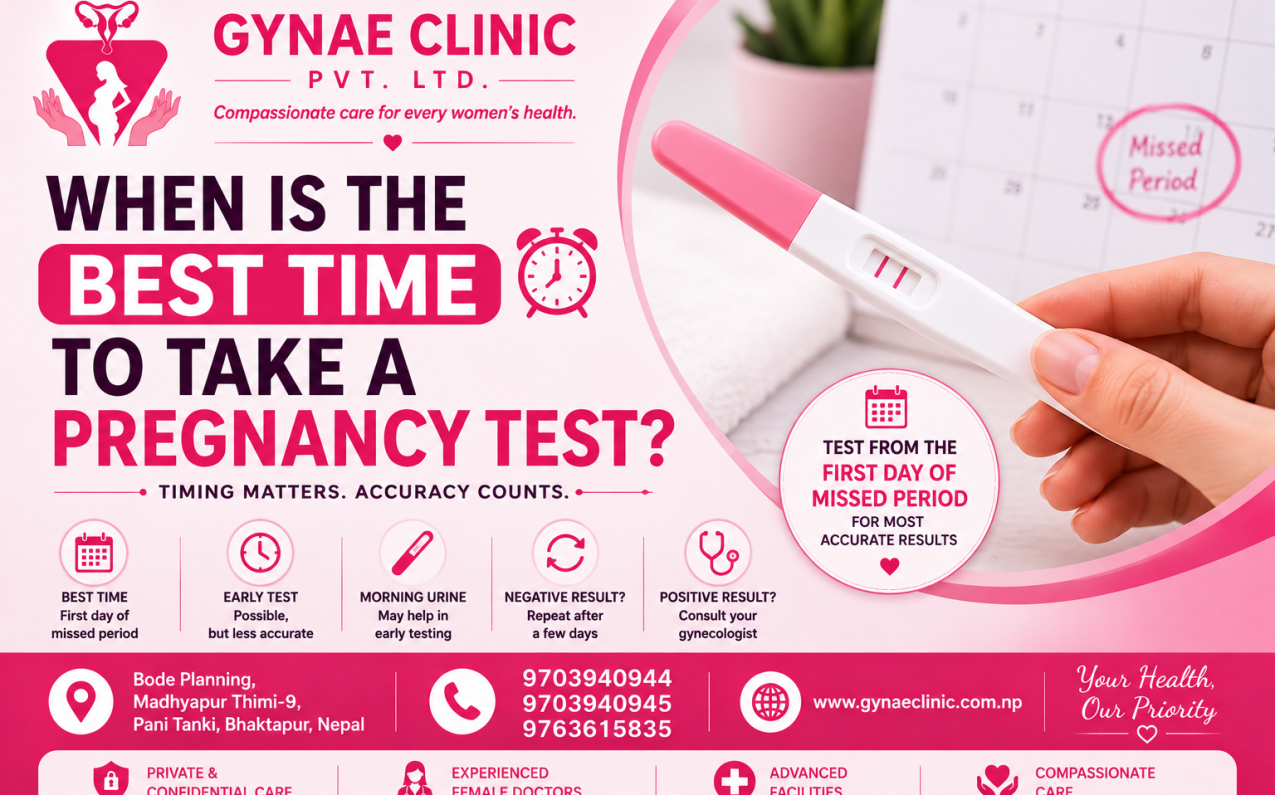
If you are wondering when is the best time to take a pregnancy test, timing can make a major difference in getting an accurate result.
For most women, the best time to take a home urine pregnancy test is from the first day of a missed period. Testing earlier may sometimes detect pregnancy, but an early negative result can be less reliable.
If you do not know when your next period is due, a practical guideline is to test at least 21 days after the last unprotected sex.
At Gynae Clinic Pvt. Ltd., Bode Planning, Madhyapur Thimi-9, Bhaktapur, women can seek pregnancy testing, Beta hCG testing, pregnancy consultation and related women’s healthcare.
Quick Answer: When Should You Take a Pregnancy Test?
| Situation | When to test |
|---|---|
| Regular menstrual cycle | From the first day of a missed period |
| You want to test before your period | Some sensitive tests may detect pregnancy earlier, but negative results can be less reliable |
| Irregular periods | At least 21 days after the last unprotected sex if you cannot determine when your period is due |
| Negative test but period still absent | Repeat the test after a few days |
| Positive test | Arrange appropriate pregnancy care |
Why Is the First Day of a Missed Period the Best Time?
Pregnancy tests detect human chorionic gonadotropin (hCG), a hormone produced during pregnancy.
Early in pregnancy, hCG levels increase. If you test too soon, there may not be enough hCG in your urine for the test to detect.
This means:
Too early → hCG may be too low → negative test
Later:
More hCG → easier detection → more reliable result
This is why waiting until your period is due or late generally improves the reliability of a home pregnancy test.
Can You Take a Pregnancy Test Before Your Period?
Yes, some sensitive pregnancy tests can be used before a missed period.
However, an early negative result should be interpreted carefully.
If you test several days before your expected period and receive a negative result, you may still be pregnant.
If your period subsequently does not arrive, repeat the pregnancy test.
The NHS notes that some sensitive tests can be used before a missed period, but most pregnancy tests are most reliable from the first day of the missed period.
Best Time to Take a Pregnancy Test After Unprotected Sex
If you know when your period should arrive, testing from the first day of a missed period is generally the most practical approach.
If you have irregular periods or do not know when your next period is due, use the 21-day guideline:
Test at least 21 days after the last unprotected sex.
This is particularly useful for women whose cycles are unpredictable.
What If You Test Too Early?
Testing too early can result in a false-negative pregnancy test.
This happens because the pregnancy may be present but hCG has not reached a detectable level in the urine.
For example:
Unprotected sex → conception → implantation → hCG rises → pregnancy test becomes positive
The timing of these events varies between women, so there is no single exact day when every pregnancy will produce a positive home test.
Is Morning Urine the Best for a Pregnancy Test?
You can perform a pregnancy test using urine collected at different times of the day. It does not have to be morning urine.
However, when testing very early, some women prefer first-morning urine because it is generally more concentrated.
For the best result:
- Follow the test instructions carefully.
- Check the expiry date.
- Avoid drinking excessive amounts of fluid immediately before testing.
- Read the result within the manufacturer’s recommended time.
Can Drinking Too Much Water Affect a Pregnancy Test?
Yes, excessive fluid intake immediately before testing can dilute your urine.
Diluted urine may contain a lower concentration of hCG, which can make early pregnancy detection more difficult.
If you are testing very early, avoiding excessive fluids immediately beforehand may help.
When Is the Best Time to Take a Pregnancy Test in the Morning?
If you want to test in the morning, first-morning urine can be a practical choice, especially when you are testing early.
But the most important factor is generally when you test in relation to your expected period, not simply whether you test in the morning.
A test performed at the right time can provide a reliable result regardless of the specific time of day.
What If My Pregnancy Test Is Negative but My Period Is Late?
Do not immediately assume that you are definitely not pregnant.
A negative result can happen because:
- You tested too early.
- You ovulated later than expected.
- Your cycle is irregular.
- The urine was diluted.
- The test was not used correctly.
If your period remains absent, repeat the test after a few days.
Our related guide explains this in more detail: Pregnancy Test Negative but Period Is Late: What Does It Mean?.
What If Two Pregnancy Tests Are Negative but My Period Has Not Come?
If repeated pregnancy tests are negative but your period remains absent, pregnancy may not be the only explanation.
Other possible causes include:
- PCOS
- Stress
- Thyroid problems
- Hormonal changes
- Significant weight changes
- Excessive exercise
- Illness
- Other menstrual or reproductive health conditions
If the problem continues, a gynecological consultation can help determine the cause.
When Should You Take a Blood Pregnancy Test?
A Beta hCG blood test measures pregnancy hormone in the blood and can provide quantitative information.
It may be useful when:
- Very early pregnancy confirmation is clinically important.
- A urine test is unclear.
- Pregnancy needs closer early monitoring.
- A healthcare professional recommends quantitative hCG testing.
Gynae Clinic’s pregnancy-testing information includes both urine pregnancy testing and Beta hCG blood testing.
Urine Pregnancy Test vs Beta hCG Blood Test
Urine Pregnancy Test
A urine pregnancy test is:
- Convenient
- Quick
- Commonly used at home
- Useful for initial pregnancy detection
Beta hCG Blood Test
A blood test:
- Measures hCG in blood
- Can provide a quantitative result
- May be useful for earlier or more detailed clinical assessment
The appropriate test depends on your individual situation.
What If the Pregnancy Test Is Positive?
A correctly performed positive pregnancy test is generally a strong indication of pregnancy.
After a positive test, you should arrange appropriate pregnancy care.
A first pregnancy consultation may include discussion of:
- Last menstrual period
- Estimated pregnancy age
- Previous pregnancies
- Medical history
- Current medications
- Folic acid and other recommended supplements
- Appropriate blood tests
- Ultrasound timing
- Pregnancy warning signs
Gynae Clinic provides pregnancy checkup services including pregnancy monitoring, ultrasound, laboratory testing and nutritional guidance.
You can also read our related guide: First Pregnancy Checkup: When Should You See a Gynecologist?.
Can Pregnancy Symptoms Tell You When to Take a Test?
Not reliably.
Some women experience:
- Nausea
- Breast tenderness
- Fatigue
- Frequent urination
- Mild cramps
- Increased sensitivity to smells
Others have no symptoms at all during early pregnancy.
Therefore, do not wait for morning sickness or breast tenderness before testing.
If pregnancy is possible and your period is late, a pregnancy test is more useful than relying on symptoms alone.
What If Your Periods Are Irregular?
Irregular periods can make pregnancy testing more confusing.
If you have PCOS or another cause of irregular menstruation, you may not know exactly when your period is due.
In this situation, counting from the last unprotected sexual intercourse can be more useful.
If you do not know when your period is expected, test at least 21 days after the last unprotected sex.
If you regularly experience irregular periods, consider discussing the pattern with a gynecologist.
Best Time to Take a Pregnancy Test for Women With PCOS
Women with PCOS may have unpredictable ovulation and menstrual cycles.
Because the expected period may be difficult to predict, testing based only on the calendar can sometimes be misleading.
If pregnancy is possible and you have irregular periods, consider the 21-day guideline after the last unprotected sex.
For ongoing irregular periods, PCOS evaluation and menstrual-cycle management may also be appropriate.
When Should You See a Gynecologist?
Consider a gynecological consultation if:
- Your period is repeatedly late.
- You have irregular periods.
- Pregnancy tests remain negative but your period does not come.
- You have a positive pregnancy test.
- You have unusual vaginal bleeding.
- You have significant pelvic or abdominal pain.
- You are trying to conceive.
- You have PCOS or suspected hormonal problems.
Seek urgent medical care if possible pregnancy is accompanied by severe or one-sided abdominal pain, heavy bleeding, fainting, severe dizziness or significant weakness.
Pregnancy Test Near Bhaktapur, Madhyapur Thimi, Koteshwor & Jadibuti
If you are searching for a pregnancy test in Bhaktapur, pregnancy test near Madhyapur Thimi, or pregnancy consultation near Koteshwor, Jadibuti, Lokanthali or Kausaltar, Gynae Clinic Pvt. Ltd. is located at:
Bode Planning, Madhyapur Thimi-9, Pani Tanki, Bhaktapur, Nepal
The clinic provides women’s reproductive healthcare including pregnancy testing, Beta hCG testing, pregnancy consultation and pregnancy checkups.
Women from nearby areas including:
- Bode
- Madhyapur Thimi
- Kausaltar
- Lokanthali
- Jadibuti
- Koteshwor
- Balkumari
- Gatthaghar
- Radhe Radhe
- Sallaghari
- Sanothimi
- Suryabinayak
- Jagati
- Banepa
- Dhulikhel
can consider the clinic for women’s health and reproductive care.
Frequently Asked Questions
Is the first day of a missed period the best time to take a pregnancy test?
Yes. For most home pregnancy tests, this is the most reliable practical time to test.
Can I take a pregnancy test before my period is due?
Yes, some sensitive tests can detect pregnancy earlier, but a negative result is less reliable when testing early.
How many days after unprotected sex should I take a pregnancy test?
If you do not know when your period is due, test at least 21 days after the last unprotected sex.
Should I take a pregnancy test in the morning?
Morning urine can be useful when testing early, but pregnancy tests can be performed at other times of day as well.
What if the test is negative but my period is late?
Repeat the test after a few days if pregnancy remains possible. If your period continues to be absent, consider consulting a gynecologist.
What if the test is positive?
Arrange appropriate pregnancy care and discuss the timing of your first pregnancy checkup and any necessary investigations with a gynecologist.
Can I be pregnant without pregnancy symptoms?
Yes. Some women have few or no symptoms during early pregnancy.
Final Takeaway
The best time to take a pregnancy test is generally from the first day of your missed period.
If you do not know when your period is due, take a test at least 21 days after the last unprotected sex. Testing earlier can sometimes produce a negative result even when pregnancy has occurred.
If your test is negative but your period remains absent, repeat the test after a few days or seek professional advice.
If your test is positive, arrange appropriate pregnancy care rather than relying only on pregnancy symptoms.
Gynae Clinic Pvt. Ltd.
Bode Planning, Madhyapur Thimi-9, Pani Tanki, Bhaktapur, Nepal
9703940944 | 9703940945 | 9763615835
www.gynaeclinic.com.np
Compassionate care for every women’s health.
Medical Disclaimer
This article is for general educational purposes and does not replace an individual medical consultation. Pregnancy-test timing and menstrual cycles vary between women, and individual circumstances may require different evaluation. Seek prompt medical care for severe pain, heavy bleeding, fainting or other concerning symptoms.
Author
Gynae Clinic Pvt. Ltd.
Bode Planning, Madhyapur Thimi-9, Pani Tanki, Bhaktapur, Nepal


