


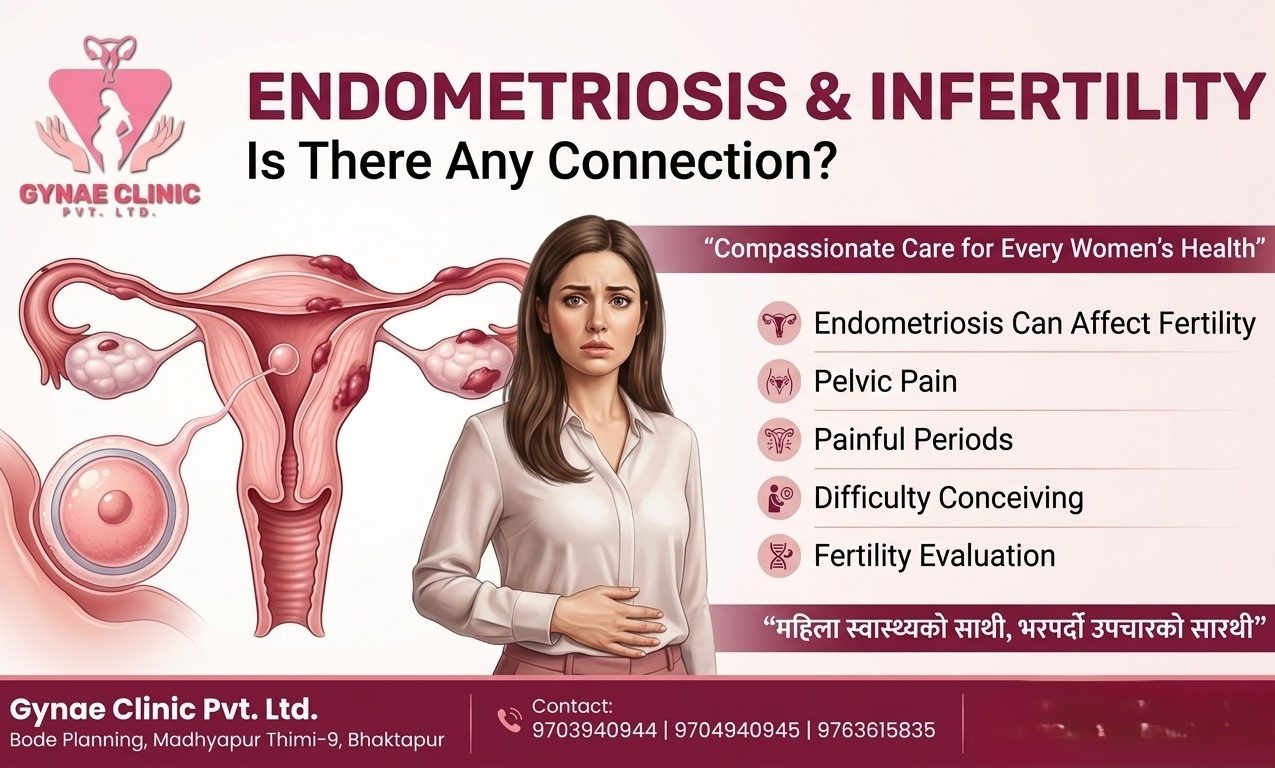
Yes. Endometriosis and infertility can be connected, but having endometriosis does not mean that a woman cannot become pregnant. Endometriosis is associated with fertility problems in some women, and the effect can vary depending on the extent of disease, pelvic anatomy, ovarian involvement, age and other fertility factors.
For women experiencing severe period pain, chronic pelvic pain, painful sex and difficulty becoming pregnant, endometriosis is one of the conditions that may need to be considered during a fertility evaluation.
What Is Endometriosis?
Endometriosis is a chronic condition in which tissue similar to the lining of the uterus grows outside the uterus. It can cause inflammation and scar tissue and commonly affects structures within the pelvis.
Common symptoms include:
- Severe period pain
- Chronic pelvic pain
- Pain during or after sex
- Pain with bowel movements
- Sometimes pain with urination
- Heavy menstrual bleeding
- Bloating or nausea
- Fatigue
- Difficulty becoming pregnant
Can Endometriosis Cause Infertility?
It can contribute to difficulty becoming pregnant, but the relationship is complex.
Endometriosis is associated with infertility, and WHO identifies infertility as one of the possible impacts of the disease. However, not every woman with endometriosis will have fertility problems.
Endometriosis may affect fertility through several possible pathways, particularly when the disease causes inflammation, ovarian involvement, adhesions or changes to normal pelvic anatomy. Some of the biological mechanisms are still not completely understood.
How Can Endometriosis Affect Fertility?
1. Pelvic Adhesions Can Affect Reproductive Anatomy
Endometriosis can cause inflammation and scar tissue, sometimes leading to adhesions.
Significant adhesions may alter the normal relationship between the ovaries, fallopian tubes and surrounding pelvic structures, potentially making it more difficult for the egg and sperm to meet.
This is particularly relevant in more extensive endometriosis.
2. Ovarian Endometriosis May Affect the Ovary
Endometriosis can sometimes form an ovarian cyst called an endometrioma.
Depending on the circumstances, ovarian endometriosis and its treatment may affect ovarian function or the number of eggs that can be retrieved during fertility treatment. Decisions about surgery therefore need to be individualized rather than assuming that every endometrioma should automatically be removed.
3. Inflammation May Play a Role
Endometriosis involves inflammatory processes within the pelvis.
Researchers believe that inflammation and changes in the pelvic environment may contribute to reduced fertility, although the exact mechanisms linking endometriosis to infertility are not completely established.
4. Pain Can Make Conception More Difficult
Endometriosis can cause significant pain during or after sexual intercourse.
For some couples, frequent painful intercourse can reduce the frequency of intercourse during the fertile window, indirectly making conception more difficult. WHO recognizes painful intercourse as one of the ways endometriosis can affect sexual health.
5. Advanced Disease Can Distort Pelvic Anatomy
More extensive endometriosis can cause adhesions and anatomical changes around the ovaries and fallopian tubes.
This may interfere with normal reproductive function and can be an important consideration when evaluating infertility.
Does Every Woman With Endometriosis Become Infertile?
No.
This is one of the most important things women should understand.
A diagnosis of endometriosis does not mean that pregnancy is impossible. Many women with endometriosis become pregnant naturally, while others may need fertility assistance.
Your fertility outlook depends on several factors, including:
- Age
- Duration of infertility
- Extent of endometriosis
- Ovarian involvement
- Fallopian tube condition
- Ovulation
- Ovarian reserve
- Previous pelvic surgery
- Other reproductive conditions
- Male-factor fertility issues
Therefore, fertility should be evaluated individually rather than based on the diagnosis of endometriosis alone.
What If I Have Endometriosis and Am Trying to Conceive?
If you have known or suspected endometriosis and are trying to become pregnant, do not assume you simply need to keep trying indefinitely.
Earlier fertility assessment may be appropriate when there is known endometriosis, significant pelvic pain or another factor that could affect fertility. Gynae Clinic’s fertility information also recommends considering evaluation earlier when endometriosis or other known reproductive concerns are present.
A fertility consultation can help determine what should be evaluated first.
When Should You Seek a Fertility Evaluation?
As a general guideline, fertility evaluation is commonly recommended after:
If you are under 35
Seek evaluation after 12 months of regular unprotected intercourse without pregnancy.
If you are 35 or older
Consider evaluation after 6 months without pregnancy.
But you may not need to wait
Earlier assessment can be appropriate if you have:
- Known endometriosis
- Severe period pain
- Chronic pelvic pain
- Previous pelvic surgery
- Previous pelvic infection
- Irregular or absent periods
- Known ovulation problems
- Previous reproductive problems
- Concerns about ovarian reserve
- Another known fertility risk
What Tests May Be Considered?
There is no single test that can determine whether a woman is fertile.
Depending on your symptoms and reproductive history, a gynecologist may consider:
Menstrual and Ovulation Assessment
Your doctor may review:
- Cycle length
- Period regularity
- Ovulation pattern
- Previous pregnancies
- Duration of trying to conceive
Pelvic Ultrasound
Ultrasound can help assess the:
- Uterus
- Ovaries
- Pelvic structures
- Ovarian cysts
- Endometriomas
- Other possible causes of pelvic symptoms
However, a normal ultrasound does not necessarily rule out endometriosis. Gynae Clinic’s fertility information notes that endometriosis evaluation may involve symptoms, examination and imaging, with additional assessment when necessary.
Ovarian Reserve Assessment
Depending on the individual situation, tests such as AMH may be considered.
However, AMH should not be interpreted as a simple yes-or-no fertility test. It provides information about ovarian reserve and must be considered together with age, medical history and other findings.
Fallopian Tube Evaluation
Because the fallopian tubes are important for natural conception, your doctor may recommend an appropriate tubal assessment when indicated.
Evaluation of Both Partners
Infertility is not always caused by a female reproductive condition.
When a couple is having difficulty conceiving, both partners may need appropriate evaluation rather than assuming the problem is caused by endometriosis alone.
Does Treating Endometriosis Automatically Improve Fertility?
Not necessarily.
This is an important distinction.
Treatment for endometriosis may be very useful for controlling pain and other symptoms, but treatment decisions for women who specifically want pregnancy need to consider fertility goals.
Hormonal treatments used to suppress endometriosis generally prevent ovulation while they are being used, so they are not fertility treatments themselves.
For women trying to conceive, the treatment strategy may therefore be different from the strategy used primarily to control pain.
Can Surgery Help Fertility?
In selected women, surgery may be considered.
However, surgery is not automatically the best option for every woman with endometriosis and infertility.
The decision can depend on:
- Age
- Severity of symptoms
- Extent of endometriosis
- Ovarian endometrioma
- Tubal involvement
- Previous surgery
- Ovarian reserve
- How long the woman has been trying to conceive
- Whether fertility treatment is being considered
ESHRE’s endometriosis guideline emphasizes individualized decision-making for both symptom management and infertility associated with endometriosis.
Importantly, repeated or extensive ovarian surgery can potentially affect ovarian function, so the possible benefits and risks should be discussed carefully before surgery.
What About IVF?
For some women with endometriosis-associated infertility, assisted reproductive treatment such as IVF may be considered.
WHO notes that fertility treatments including ovulation induction, intrauterine insemination (IUI) and IVF may be recommended for individuals struggling to conceive because of endometriosis.
The appropriate treatment depends on the individual situation.
Factors such as age, ovarian reserve, duration of infertility, disease severity, tubal function and previous treatment all matter when deciding whether continued natural attempts, IUI, IVF or another approach is appropriate.
Endometriosis, Age and Fertility
Age is an important factor in fertility whether or not a woman has endometriosis.
As age increases, female fertility generally declines, so women with known endometriosis who are planning pregnancy may benefit from discussing their reproductive goals with a gynecologist rather than postponing evaluation unnecessarily.
This becomes particularly important when endometriosis is combined with:
- Age-related fertility decline
- Previous ovarian surgery
- Ovarian endometriomas
- Reduced ovarian reserve
- Long duration of infertility
Can You Get Pregnant Naturally With Endometriosis?
Yes.
Endometriosis does not automatically prevent natural conception.
Some women with mild or moderate disease become pregnant without fertility treatment. Others may require assistance depending on their individual fertility factors.
The important message is:
Endometriosis can be associated with infertility, but endometriosis is not the same thing as infertility.
Symptoms That May Suggest Endometriosis and Fertility Problems
If you are experiencing several of the following together, it is reasonable to discuss them with a gynecologist:
- Very painful periods
- Pain that gets worse over time
- Chronic pelvic pain
- Pain during sexual intercourse
- Pain during bowel movements, especially around periods
- Pain with urination around menstruation
- Heavy periods
- Recurrent bloating
- Fatigue
- Difficulty becoming pregnant
- Previous diagnosis of endometriosis
- Previous ovarian endometrioma
These symptoms do not prove that you have endometriosis, but they can help your doctor decide whether further evaluation is appropriate.
Does Endometriosis Mean I Should Freeze My Eggs?
Not necessarily.
Fertility preservation is an individualized decision. It may be discussed in selected women, particularly when there are concerns about ovarian reserve, ovarian endometriosis, planned ovarian surgery, age or future reproductive plans.
A fertility specialist or gynecologist can help you understand whether fertility preservation is relevant to your circumstances.
Endometriosis and Infertility: What Women Should Remember
The connection between endometriosis and infertility is real, but it is not a simple cause-and-effect relationship.
Endometriosis may affect fertility through pelvic inflammation, adhesions, anatomical changes, ovarian involvement and other factors. However, many women with endometriosis can become pregnant, either naturally or with appropriate fertility support.
If you have severe period pain plus difficulty conceiving, don’t ignore the combination.
A proper evaluation can help determine whether endometriosis is present and whether another fertility factor may also be contributing.
Endometriosis and Fertility Consultation in Bhaktapur
If you are searching for endometriosis and infertility evaluation in Bhaktapur, Gynae Clinic Pvt. Ltd. provides gynecology consultation and fertility evaluation guidance in Bode Planning, Madhyapur Thimi-9, Pani Tanki, Bhaktapur. The clinic’s fertility information specifically recognizes endometriosis as a possible factor requiring earlier fertility evaluation in appropriate situations.
You can also explore:
- Infertility Treatment in Bhaktapur: Causes, Fertility Tests, Treatment & When to See a Doctor
- Fertility Tests for Women in Bhaktapur
- Pelvic Pain in Women: Causes, Symptoms, Diagnosis & Treatment in Bhaktapur
- When Should You Visit a Gynecologist?
Gynae Clinic Pvt. Ltd.
Address: Bode Planning, Madhyapur Thimi-9, Pani Tanki, Bhaktapur, Nepal
Contact: 9703940944 | 9704940945 | 9763615835
WhatsApp: 9703940944
Website: www.gynaeclinic.com.np
Women from Madhyapur Thimi, Bode, Kausaltar, Lokanthali, Gatthaghar, Radhe Radhe, Sallaghari, Jadibuti, Koteshwor and surrounding Bhaktapur and Kathmandu areas can consider gynecological and fertility consultation based on their needs.
Medical Disclaimer
This article is for general educational purposes and does not replace an individual medical consultation. Endometriosis and infertility can have multiple causes, and evaluation and treatment should be individualized.
Author: Gynae Clinic Pvt. Ltd. Medical Content Team
Last Updated: September 2026


