
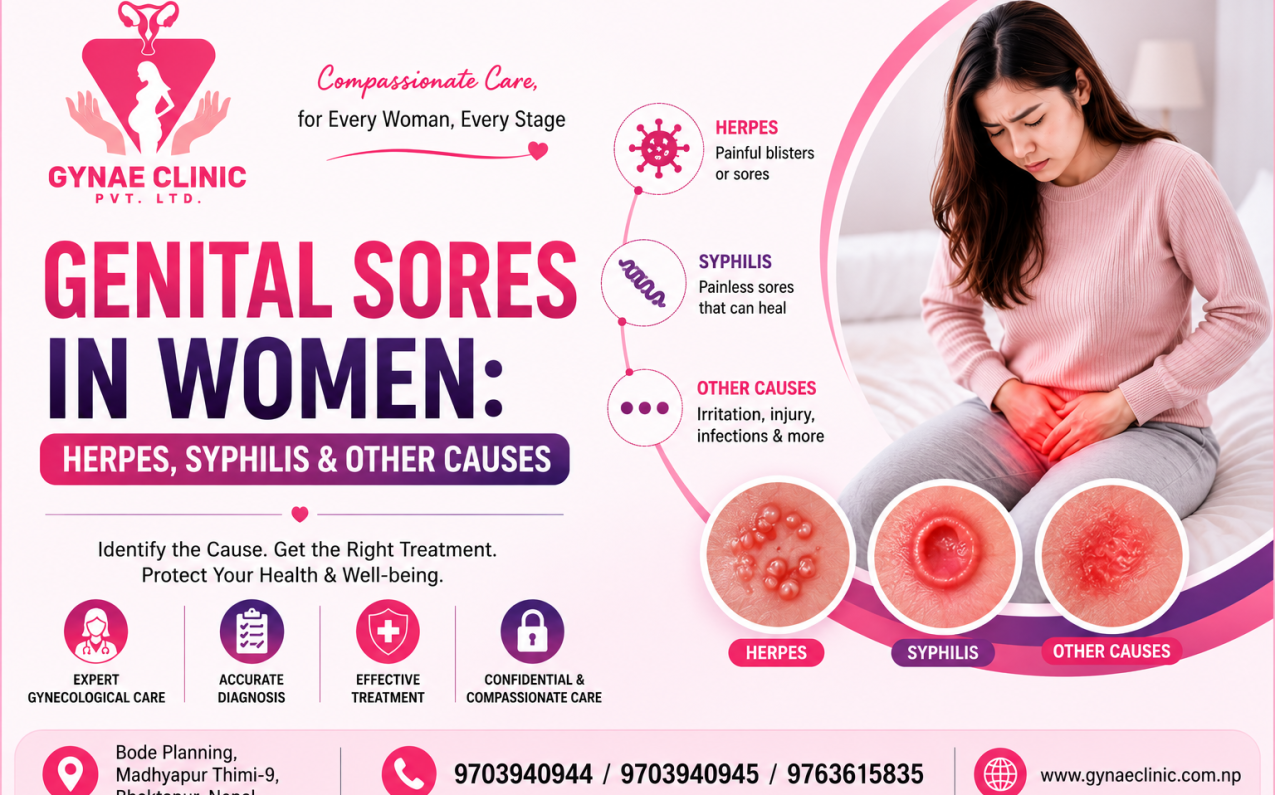
Genital sores in women should not be ignored. A sore, blister, ulcer, cut, or unusual lesion around the vagina, vulva, anus, or genital area can have several causes. Genital herpes and syphilis are important sexually transmitted infections (STIs) to consider, but not every genital sore is caused by an STI.
Other possibilities include friction or injury, ingrown hairs, blocked glands, skin conditions, irritation, vaginal infections, and other medical conditions.
Because different causes can look similar, a physical examination and appropriate testing may be needed to identify the cause accurately.
At Gynae Clinic Pvt. Ltd., Bode Planning, Madhyapur Thimi-9, Bhaktapur, women can receive confidential gynecological consultation, genital sore evaluation, STI testing guidance, and individualized treatment.
What Are Genital Sores in Women?
Genital sores are breaks, lesions, ulcers, blisters, or areas of damaged skin affecting the genital region.
They may appear on:
- Vulva
- Labia
- Vaginal opening
- Around the vagina
- Perineum
- Area around the anus
- Nearby genital skin
A genital lesion may look like:
- A small blister
- A painful ulcer
- An open sore
- A red bump
- A cluster of blisters
- A cut or crack
- A crusted lesion
- A painless ulcer
- A swollen area
The appearance alone is not enough to determine the cause.
Are Genital Sores Always an STI?
No.
Genital sores can be caused by STIs, but there are also non-sexually transmitted causes.
Possible causes include:
Sexually transmitted causes
- Genital herpes
- Syphilis
- Chancroid in areas where it occurs
- Other sexually transmitted infections that may cause genital lesions
Non-STI causes
- Friction or sexual trauma
- Ingrown hairs
- Folliculitis
- Irritation or allergic reaction
- Skin diseases
- Cysts or blocked glands
- Aphthous-type genital ulcers
- Other inflammatory conditions
Therefore, having a genital sore does not automatically mean that someone has an STI.
Genital Herpes in Women
Genital herpes is one of the most important causes of genital blisters and painful ulcers.
It is caused by herpes simplex virus (HSV), most commonly HSV-2, although HSV-1 can also cause genital infection.
Herpes can spread through sexual or intimate skin-to-skin contact.
Common Symptoms of Genital Herpes
Symptoms can include:
- Small blisters around the genitals
- Painful sores after blisters break
- Burning or tingling
- Itching
- Genital pain
- Pain while urinating
- Vaginal or genital irritation
- Swollen lymph nodes
- Fever or flu-like symptoms during some initial outbreaks
Some people have very mild symptoms or no noticeable symptoms.
What Do Herpes Sores Look Like?
Herpes may begin with:
Tingling → small blisters → painful ulcers → healing
The sores can occur:
- On the vulva
- Around the vaginal opening
- Around the anus
- On nearby genital skin
However, not every blister or ulcer is herpes.
A healthcare professional may need to examine the lesion and perform appropriate testing.
Can Genital Herpes Cause Painful Urination?
Yes.
Urination can become painful when urine comes into contact with open herpes sores around the genital area.
Women may also experience:
- Burning
- Tingling
- Genital tenderness
- Pain during intercourse
If painful urination occurs with genital sores, professional evaluation is recommended.
Syphilis and Genital Sores in Women
Syphilis is another STI that can cause genital sores.
It is caused by the bacterium Treponema pallidum and spreads primarily through sexual contact.
The first stage of syphilis can cause a chancre, which is typically a painless ulcer at the site where the infection entered the body.
The sore may occur on:
- Vulva
- Vagina
- Cervix
- Around the anus
- Mouth or lips
Because a syphilis sore may be painless, it can easily go unnoticed.
What Does a Syphilis Sore Look Like?
A typical primary syphilis lesion is often:
- Painless
- Firm or well-defined
- An ulcer rather than a cluster of blisters
Nearby lymph nodes may become enlarged.
The sore can heal on its own even without treatment.
Important:
A sore disappearing does not mean the infection has disappeared.
Untreated syphilis can progress through additional stages and potentially cause serious complications.
If syphilis is suspected, appropriate testing and treatment are important.
Herpes vs Syphilis: What’s the Difference?
| Feature | Genital Herpes | Syphilis |
|---|---|---|
| Typical lesion | Blisters that become ulcers | Usually a single painless ulcer |
| Pain | Often painful | Often painless initially |
| Itching/tingling | Common | Less typical at the sore |
| Multiple lesions | Common | Usually one lesion, but can vary |
| Can heal without treatment? | Lesions can heal, but infection remains | Initial sore can heal, but infection remains |
| Testing | Specific herpes testing when indicated | Blood tests and other testing as appropriate |
| Treatment | Antiviral medication | Antibiotic treatment |
| STI | Yes | Yes |
These are general patterns, not a way to self-diagnose.
Other Causes of Genital Sores in Women
Not every genital ulcer or lesion is caused by herpes or syphilis.
1. Friction or Sexual Injury
Rough or prolonged intercourse, insufficient lubrication, or accidental trauma can cause:
- Small cuts
- Tears
- Tender areas
- Bleeding
- Burning
If a wound is large, painful, infected-looking, or does not heal, seek medical evaluation.
2. Ingrown Hair
An ingrown hair can produce:
- A red bump
- Tenderness
- Swelling
- Pus
- Local irritation
They are more likely in areas that are shaved or waxed.
An ingrown hair can sometimes be mistaken for an STI lesion.
3. Folliculitis
Inflammation or infection around a hair follicle can cause small red or painful bumps.
It can occur after:
- Shaving
- Waxing
- Friction
- Sweating
4. Skin Irritation or Allergic Reaction
Genital skin can react to:
- Scented soaps
- Vaginal washes
- Lubricants
- Condoms
- Laundry products
- Sanitary products
- Shaving products
Irritation may cause redness, itching, burning, cracks, or raw skin.
5. Cysts and Blocked Glands
A blocked gland near the vaginal opening can form a lump or cyst.
Some cysts are painless, while others may become painful or infected.
6. Dermatological Conditions
Certain skin disorders can affect the genital area and produce:
- Itching
- Cracks
- Ulcers
- White patches
- Redness
- Skin thickening
- Soreness
Persistent genital skin changes should be evaluated by a healthcare professional.
Can a Yeast Infection Cause Genital Sores?
A typical vaginal yeast infection usually causes itching, redness, irritation, and discharge, rather than classic genital ulcers.
However, severe inflammation and scratching can damage the skin and create cracks or small breaks.
If you have actual blisters, ulcers, or open sores, do not automatically assume they are caused by yeast.
Herpes, syphilis, trauma, and other conditions may need to be considered.
Can BV Cause Genital Sores?
Genital sores are not a typical symptom of bacterial vaginosis (BV).
BV more commonly causes:
- Thin vaginal discharge
- Fishy vaginal odor
- Increased discharge
If you have both abnormal discharge and genital sores, another condition may be responsible and should be evaluated.
Genital Sores After Sex: Does It Mean an STI?
Not necessarily.
A lesion appearing after sex can result from:
- Friction
- Minor trauma
- Irritation
- Condom or lubricant reaction
- Herpes
- Syphilis
- Another STI
The timing alone cannot determine the cause.
If the sore follows sexual contact with a new partner, unprotected sex, or another potential STI exposure, STI testing should be discussed with a healthcare professional.
When Should You Get an STI Test?
Consider STI testing if you have genital sores and:
- A new sexual partner
- Sex without a condom
- A partner with an STI
- A partner whose STI status is unknown after a potential exposure
- Genital blisters
- Genital ulcers
- Unusual vaginal discharge
- Burning while urinating
- Pelvic pain
- Bleeding after sex
- Pain during intercourse
Remember that some STIs can cause few or no symptoms.
Testing is particularly important when there has been a potential exposure.
What Tests Are Used for Genital Sores?
The appropriate test depends on the appearance of the lesion, timing, symptoms, and potential exposure.
A gynecologist may recommend:
Herpes testing
When a fresh lesion is present, a swab from the sore may be used for laboratory testing when clinically appropriate.
Syphilis testing
Blood testing is commonly used to evaluate for syphilis.
Other STI testing
Depending on symptoms and sexual history, testing may be considered for:
- Chlamydia
- Gonorrhea
- Trichomoniasis
- HIV
- Other STIs when appropriate
Physical examination
A clinician may carefully examine:
- Vulva
- Labia
- Vaginal opening
- Perineum
- Surrounding genital skin
The goal is to determine whether the lesion is infectious, traumatic, dermatological, or another condition.
Why Is Testing Better Than Looking at a Picture Online?
Many genital conditions can look similar.
For example:
- A herpes lesion may be confused with irritation.
- An ingrown hair may resemble another type of bump.
- A syphilis ulcer may be painless and easy to overlook.
- A skin condition can resemble infection.
Online images cannot reliably diagnose an individual genital lesion.
A healthcare professional can evaluate the actual lesion and decide which tests are appropriate.
Can Genital Herpes Be Cured?
Currently, there is no cure that eliminates HSV from the body.
However, antiviral medicines can:
- Shorten outbreaks
- Reduce symptom severity
- Reduce the frequency of recurrences
- Reduce the risk of transmission in certain circumstances
A healthcare professional can discuss treatment options based on the individual’s symptoms and circumstances.
Can Syphilis Be Cured?
Yes. Syphilis is treatable with appropriate antibiotics.
Early diagnosis and treatment are important because untreated syphilis can progress and cause serious health problems.
Treatment does not reverse every complication that may have already developed, which is why timely testing and treatment matter.
If syphilis is diagnosed, sexual partners may also need evaluation and treatment.
What Should You Do If You Have a Genital Sore?
Until you know the cause:
- Do not squeeze or pick the sore.
- Avoid applying harsh antiseptics or unknown creams.
- Avoid sexual contact if the lesion is painful, open, or an STI is suspected.
- Do not share prescription medication.
- Arrange a gynecological or sexual-health evaluation.
- Tell the healthcare professional about any possible STI exposure.
- Follow recommended testing and treatment.
If herpes or another STI is suspected, avoiding sexual contact until you receive appropriate medical advice can reduce the risk of transmission.
How Can Genital STIs Be Prevented?
No method eliminates STI risk completely, but several measures can reduce risk.
Helpful steps include:
- Use condoms correctly and consistently.
- Discuss STI testing with sexual partners.
- Get tested after a potential exposure.
- Avoid sexual contact when genital sores or lesions are present.
- Follow treatment instructions if an STI is diagnosed.
- Ensure partners receive evaluation or treatment when recommended.
- Consider appropriate vaccination, such as HPV vaccination, according to local medical guidance.
Genital Sores During Pregnancy
If you are pregnant and develop a new genital sore, blister, ulcer, or lesion, contact your healthcare professional promptly.
Certain infections, including herpes and syphilis, can have important implications during pregnancy and require appropriate evaluation and management.
Do not self-treat an unexplained genital lesion during pregnancy.
When Are Genital Sores an Emergency?
Seek prompt medical care if genital sores are accompanied by:
- Severe pain
- Fever
- Rapidly worsening swelling
- Difficulty urinating
- Severe pelvic pain
- Significant bleeding
- Feeling very unwell
- Pregnancy with a new genital lesion
- Extensive or rapidly spreading lesions
A painful genital lesion with significant swelling or difficulty passing urine should not be ignored.
When Should You See a Gynecologist?
Arrange a consultation if:
- You have a new genital sore.
- You notice blisters around the vagina.
- You have a painless genital ulcer.
- A sore keeps returning.
- A lesion does not heal.
- You have genital itching or burning.
- You have unusual vaginal discharge.
- You have burning while urinating.
- You have pelvic pain.
- You have bleeding after sex.
- You have had a possible STI exposure.
- You are worried about herpes or syphilis.
A new genital lesion deserves evaluation, even if it does not hurt.
Frequently Asked Questions About Genital Sores in Women
Is every genital sore herpes?
No. Genital sores can result from herpes, syphilis, friction, ingrown hairs, skin conditions, irritation, cysts, and other causes.
Are herpes sores painful?
They often are, particularly during an initial outbreak, but symptoms can vary.
Can syphilis cause a painless genital sore?
Yes. The first stage of syphilis commonly causes a painless ulcer, although presentations can vary.
Can a genital sore disappear without treatment?
Some lesions can heal on their own, but healing does not necessarily mean the underlying infection is gone. This is particularly important for herpes and syphilis.
Can I have herpes without visible sores?
Yes. HSV can be present without obvious lesions and can sometimes be transmitted when symptoms are not noticeable.
Can I have syphilis without symptoms?
Yes. Syphilis can progress through stages in which symptoms may be absent or difficult to recognize.
Should I get tested if I have only one genital sore?
Yes, especially if the cause is unclear or there has been a potential STI exposure.
Can shaving cause genital sores?
Shaving can cause irritation, cuts, ingrown hairs, or folliculitis that may resemble some genital lesions.
Should I put cream on a genital sore?
Do not use random creams, steroid preparations, antibiotics, or antiseptics without knowing the cause. Some products can worsen irritation or obscure the clinical appearance.
Can genital sores be caused by an STI even if my partner has no symptoms?
Yes. Some STIs can be asymptomatic, so a partner appearing healthy does not completely rule out infection.
Genital Sores in Women: The Bottom Line
Genital sores should never be diagnosed based on appearance alone.
A painful cluster of blisters may suggest genital herpes, while a painless ulcer can be associated with syphilis. But friction, shaving, skin conditions, irritation, cysts, and other non-STI conditions can produce genital bumps, cuts, ulcers, or sores as well.
The safest approach is:
New genital sore → Don’t guess → Get examined → Test when appropriate → Treat the actual cause.
Early evaluation is particularly important when there has been a possible STI exposure, because some infections can be treated effectively and transmission can be reduced.
Confidential Genital Sore & STI Care in Bhaktapur
If you are experiencing genital sores, genital blisters, ulcers, itching, burning, unusual vaginal discharge, painful urination, pelvic pain, or concerns about herpes or syphilis, professional evaluation can help determine the cause.
At Gynae Clinic Pvt. Ltd., women can discuss sensitive gynecological and sexual-health concerns in a confidential, respectful, and supportive clinical environment.
Gynae Clinic Pvt. Ltd.
📍 Bode Planning, Madhyapur Thimi-9, Bhaktapur, Nepal
📞 9703940944
📞 9703940945
📞 9763615835
Consult a Gynecologist for:
- Genital sores
- Genital blisters
- Genital ulcers
- Suspected herpes
- Syphilis concerns
- STI testing
- Abnormal vaginal discharge
- Vaginal itching
- Burning while urinating
- Pain during sex
- Bleeding after sex
- Recurrent genital lesions
Don’t hide or ignore a genital sore. Confidential evaluation can help identify the cause and guide the right treatment.
Gynae Clinic Pvt. Ltd. — Confidential women’s healthcare in Madhyapur Thimi, Bhaktapur.
Author; Gynae Clinic Pvt. Ltd.