


Author: Gynae Clinic Pvt. Ltd.
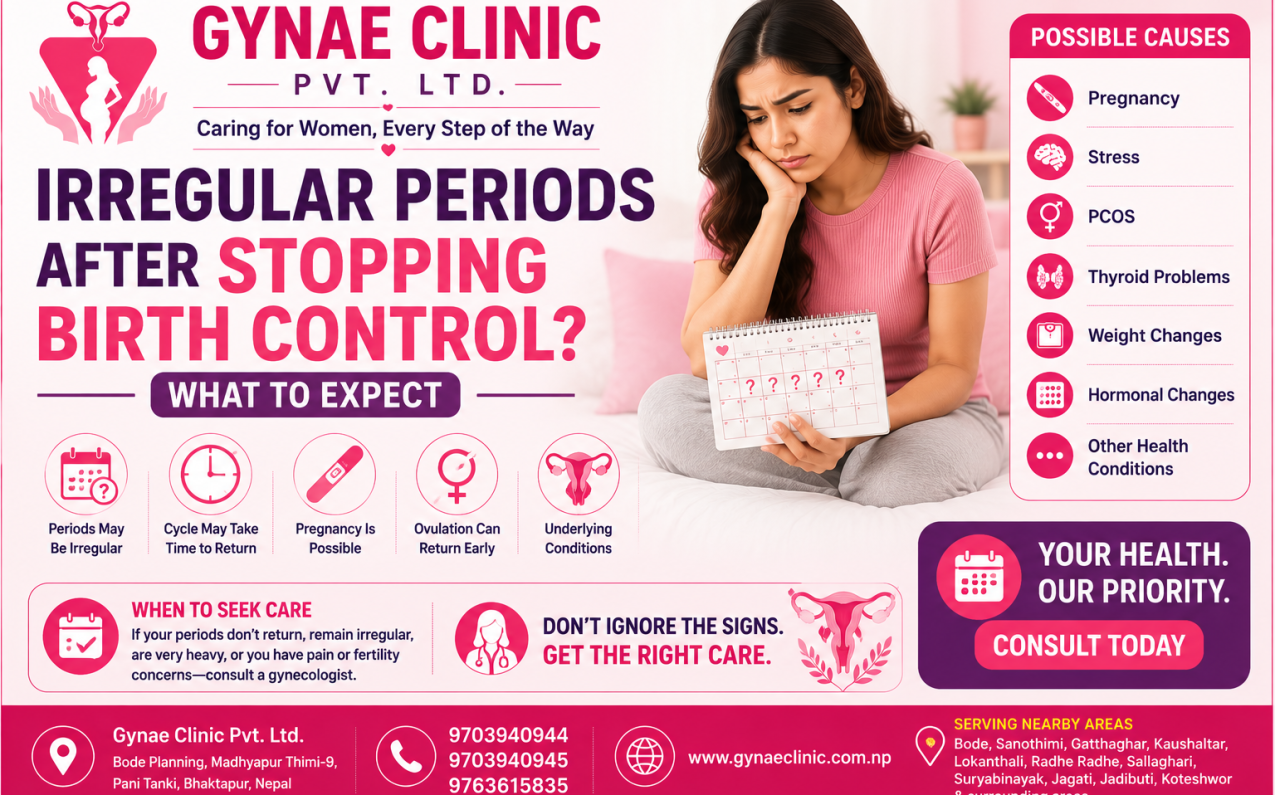
Stopping birth control can bring changes to your menstrual cycle. Some women get their usual periods quickly, while others notice irregular periods, spotting, heavier or lighter bleeding, or delayed periods for a period of time.
For most women, fertility can return quickly after stopping hormonal birth control. However, if your periods remain irregular or do not return, it is important to look for other possible causes rather than assuming birth control is the only reason.
This guide explains what you may experience after stopping birth control, when irregular periods are expected, when pregnancy should be considered, and when to see a gynecologist.
What Happens to Your Period After Stopping Birth Control?
Hormonal birth control can change the way your menstrual cycle works while you are using it.
After stopping, your body resumes its natural hormonal cycle and ovulation.
You may notice:
- Your period returns quickly
- Your cycle is temporarily irregular
- Your first few periods are different from usual
- Spotting occurs
- Bleeding becomes lighter or heavier
- Ovulation returns before your first natural period
- Pregnancy becomes possible soon after stopping contraception
For combined birth-control pills, fertility can return quickly after stopping. A temporary period of cycle adjustment can occur, and some women may take a couple of months to return to their previous ovulation pattern.
How Long Does It Take for Periods to Become Regular?
There is no exact number of days or weeks that applies to every woman.
Some women return to their previous cycle almost immediately. Others notice irregularity for a short time.
The type of contraception matters.
For example:
- Combined pills
- Progestin-only pills
- Hormonal injections
- Hormonal implants
- Hormonal IUDs
do not all affect menstrual patterns in exactly the same way.
Some contraceptive methods can suppress ovulation or menstruation while being used, so the return to a natural cycle can vary.
Can You Get Pregnant Immediately After Stopping Birth Control?
Yes.
With many hormonal contraceptive methods, fertility can return quickly after stopping.
For combined birth-control pills, ACOG notes that fertility returns after stopping the pill or vaginal ring.
This means you can potentially ovulate before your first natural period.
Therefore:
If you do not want pregnancy
Use another reliable contraceptive method immediately after stopping your previous method.
If you want pregnancy
You can begin trying once contraception has been stopped, unless your doctor has advised otherwise.
Why Are My Periods Irregular After Stopping Birth Control?
There are several possible explanations.
1. Your Natural Cycle Is Returning
If birth control was controlling your cycle, your natural menstrual pattern may become visible again after stopping.
If your periods were irregular before starting birth control, the underlying irregularity may return after stopping it.
2. PCOS
Polycystic ovary syndrome (PCOS) is a common cause of irregular periods.
If you had:
- Irregular periods before birth control
- Long gaps between periods
- Acne
- Increased facial or body hair
- Difficulty with weight management
- Difficulty becoming pregnant
PCOS may be worth evaluating.
Birth control may have made periods appear more regular while you were taking it, but it does not cure the underlying condition.
3. Pregnancy
If you have had unprotected sex after stopping birth control and your period is late, take a pregnancy test.
Pregnancy is one of the most common causes of a missed period.
If the first test is negative but your period still does not arrive, repeating the test or consulting a healthcare professional may be appropriate.
4. Stress
Stopping contraception may coincide with changes in relationships, work, sleep, travel or emotional stress.
Stress can affect ovulation and make periods:
- Late
- Early
- Irregular
- Occasionally absent
Stress is a recognized cause of irregular or missed periods.
5. Weight Changes
Significant weight loss or weight gain can affect ovulation.
This may lead to irregular or missed periods.
If your menstrual changes started around the same time as a major weight change, mention this during your consultation.
6. Thyroid Problems
Thyroid disorders can affect menstrual cycles.
Irregular periods combined with symptoms such as:
- Unusual tiredness
- Weight changes
- Feeling unusually cold or hot
- Hair changes
- Mood changes
may warrant thyroid evaluation.
7. High Prolactin
Elevated prolactin can interfere with normal ovulation.
Possible symptoms include:
- Irregular periods
- Missed periods
- Difficulty becoming pregnant
- Unexpected breast milk production
Your gynecologist may recommend hormone testing if appropriate.
8. Perimenopause
For women approaching their 40s or 50s, irregular periods may be related to the natural transition toward menopause.
The timing of this transition varies, and age and other symptoms are important when assessing the cause.
What If My Period Was Irregular Before Birth Control?
This is particularly important.
If your periods were irregular before starting birth control and become irregular again after stopping, the contraception may not be the underlying cause.
Conditions such as PCOS, thyroid disorders, weight-related hormonal changes and other causes of ovulatory dysfunction may need to be considered.
In this situation, simply restarting birth control to make periods regular may hide the underlying problem rather than explain it.
What If I Am Trying to Get Pregnant After Stopping Birth Control?
Irregular periods can make pregnancy planning more difficult because ovulation may be unpredictable.
However:
Irregular periods do not automatically mean infertility.
Many causes of irregular ovulation can be evaluated and treated.
Your gynecologist may consider:
- Menstrual history
- Ovulation pattern
- Pregnancy testing
- Hormonal blood tests
- Thyroid testing
- Pelvic ultrasound
- PCOS evaluation
- Other fertility investigations when appropriate
If you are trying to conceive, tell your doctor exactly when you stopped contraception and what type you were using. This information can be useful when assessing your cycle and fertility.
Can You Ovulate Before Your First Period?
Yes.
This is an important point many women do not realize.
Your first ovulation after stopping contraception can occur before your first natural menstrual period.
Therefore:
- Pregnancy can occur before your first period.
- A missed period after stopping birth control may be pregnancy-related.
- Do not assume that you are temporarily infertile simply because your cycle has not returned to normal.
What About the Birth-Control Injection?
The contraceptive injection can behave differently from pills or some other methods.
Return to regular ovulation and fertility may take longer after stopping injectable contraception than after stopping some other hormonal methods.
If you previously used contraceptive injections and your periods remain absent or irregular, tell your gynecologist the date of your last injection.
What About Hormonal IUDs and Implants?
Hormonal IUDs and implants can alter bleeding patterns while they are being used.
Some women may have:
- Very light periods
- Spotting
- Irregular bleeding
- No periods
After removal, natural menstrual function generally resumes, but individual experiences vary.
The type and duration of contraception should therefore be considered when evaluating changes after stopping it.
When Should You See a Gynecologist?
Make an appointment if:
- Your periods remain irregular
- You repeatedly miss periods
- Your usual cycle pattern changes significantly
- You have very heavy bleeding
- You bleed between periods
- You bleed after sex
- You have significant pelvic pain
- You have symptoms of PCOS
- You have unusual vaginal discharge
- You are trying to conceive and your cycles remain irregular
- You have concerns about fertility
Medical guidance recommends evaluation when normal menstrual patterns become irregular or change significantly.
What If I Have No Period After Stopping Birth Control?
A missed period does not automatically mean something is wrong.
However, if pregnancy is possible:
Step 1
Take a pregnancy test.
Step 2
If the test is negative and your period still does not return, monitor the cycle and consider repeating the test if appropriate.
Step 3
If you continue to have absent or irregular periods, consult a gynecologist.
ACOG advises women to see an ob-gyn if periods are irregular for an unknown reason or if someone who is not taking birth control has gone 3 months or more without a period.
What Tests Might Be Needed?
There is no single test for every woman with irregular periods.
Depending on your symptoms, a gynecologist may recommend:
Pregnancy Test
To rule out pregnancy when applicable.
Blood Tests
These may include tests for:
- Thyroid function
- Prolactin
- Other reproductive hormones
- Anemia when bleeding is heavy
Pelvic Ultrasound
Ultrasound can evaluate the uterus and ovaries and may help identify conditions such as:
- PCOS-related ovarian features
- Ovarian cysts
- Fibroids
- Other pelvic abnormalities
The tests should be selected according to your symptoms and medical history.
Keep a Period Diary
After stopping birth control, tracking your cycle can be extremely useful.
Record:
- Date your period starts
- Date your period ends
- Number of days between periods
- Amount of bleeding
- Spotting
- Pelvic pain
- Pregnancy-test results
- Medications
- Changes in weight
- Symptoms such as acne or increased hair growth
This information can help your gynecologist understand whether your natural cycle is returning or whether further evaluation is needed.
When Is Irregular Bleeding an Emergency?
Seek urgent medical care if you experience:
- Severe or sudden pelvic pain
- Fainting
- Severe dizziness
- Very heavy bleeding
- Severe weakness
- Shoulder-tip pain
- Significant pain or bleeding when pregnancy is possible
Pregnancy-related complications, including ectopic pregnancy, can cause pain and bleeding and require urgent evaluation.
Heavy bleeding that soaks through a pad or tampon every hour is also a reason to seek urgent medical attention.
Should You Worry About Irregular Periods After Stopping Birth Control?
Not necessarily.
A temporary change in your menstrual pattern can occur after stopping hormonal contraception.
The more important question is:
Does your cycle gradually return, or does the irregularity continue?
If periods remain irregular, it is important to consider whether another condition—such as PCOS, thyroid disease, pregnancy, weight change or another hormonal problem—is responsible.
Irregular Period Treatment in Bhaktapur
If you are searching for irregular periods treatment in Bhaktapur, irregular periods after stopping birth control, menstrual irregularity treatment in Madhyapur Thimi, PCOS evaluation in Bhaktapur, hormonal imbalance treatment in Bhaktapur, gynecologist for irregular periods near Bode, Sanothimi, Gatthaghar, Kaushaltar, Lokanthali, Radhe Radhe, Sallaghari, Suryabinayak, Jagati, Jadibuti or Koteshwor, you can consult:
Gynae Clinic Pvt. Ltd.
Address:
Bode Planning, Madhyapur Thimi-9, Pani Tanki, Bhaktapur, Nepal
Contact:
9703940944
9703940945
9763615835
Website:
www.gynaeclinic.com.np
Gynae Clinic provides gynecological care for menstrual problems, PCOS, fertility concerns, pregnancy care and other women’s health conditions.
The clinic serves women from Bode, Madhyapur Thimi, Sanothimi, Gatthaghar, Kaushaltar, Lokanthali, Radhe Radhe, Sallaghari, Suryabinayak, Jagati, Jadibuti, Koteshwor and surrounding areas.
What Women Should Remember
Stopping birth control does not mean that something is wrong if your period does not immediately look exactly as it did before.
Your body may need time to resume its natural hormonal pattern, depending on the contraceptive method you used.
But persistent irregular periods should not automatically be blamed on stopping birth control.
If your cycles were irregular before contraception, if you have symptoms of PCOS, if pregnancy is possible, or if your periods remain absent or unpredictable, a proper evaluation can help identify the real cause.
“Stopping birth control is a change—not a diagnosis. If your periods remain irregular, listen to the pattern and find out why.”
Some complex or persistent menstrual problems may require specialized gynecological evaluation and individualized care based on the underlying cause.
Frequently Asked Questions
How long does it take for periods to return after stopping birth control?
It varies according to the type of contraception and the individual. Some women resume periods quickly, while others may take longer to establish their previous cycle pattern.
Is it normal to have irregular periods after stopping the pill?
A temporary change in cycle pattern can occur. However, persistent irregular periods should be evaluated, particularly if your cycles were irregular before starting the pill.
Can I get pregnant immediately after stopping birth control?
Yes. Fertility can return quickly after stopping many hormonal contraceptives, including combined pills.
Why are my periods irregular after stopping birth control?
Possible reasons include your natural cycle returning, PCOS, stress, pregnancy, weight changes, thyroid problems and other hormonal conditions.
Can birth control cause infertility?
For combined pills, fertility returns after stopping; using them does not permanently reduce fertility.
Can PCOS become noticeable after stopping birth control?
Yes. If hormonal contraception was making your periods more predictable, irregular cycles caused by an underlying condition such as PCOS may become noticeable again after stopping it.
When should I see a gynecologist?
See a gynecologist if your periods remain irregular, you miss several periods, have heavy or abnormal bleeding, experience pelvic pain, or are having difficulty becoming pregnant.
Final Takeaway
Irregular periods after stopping birth control are often manageable, but they should be understood rather than ignored.
Your natural menstrual cycle may take some time to re-establish, and fertility can return quickly. Pregnancy, PCOS, stress, thyroid problems, weight changes and other conditions can also cause irregular periods.
If your periods do not return, remain unpredictable, become very heavy or are associated with pain or fertility concerns, consult a gynecologist to identify the underlying cause.
Author: Gynae Clinic Pvt. Ltd.
Medical Disclaimer
This article is for general educational purposes only and does not replace an individual medical consultation, examination, diagnosis or treatment plan. If you have severe pelvic pain, fainting, very heavy bleeding, or pain/bleeding when pregnancy is possible, seek urgent medical care.


