
Author: Gynae Clinic Pvt. Ltd.
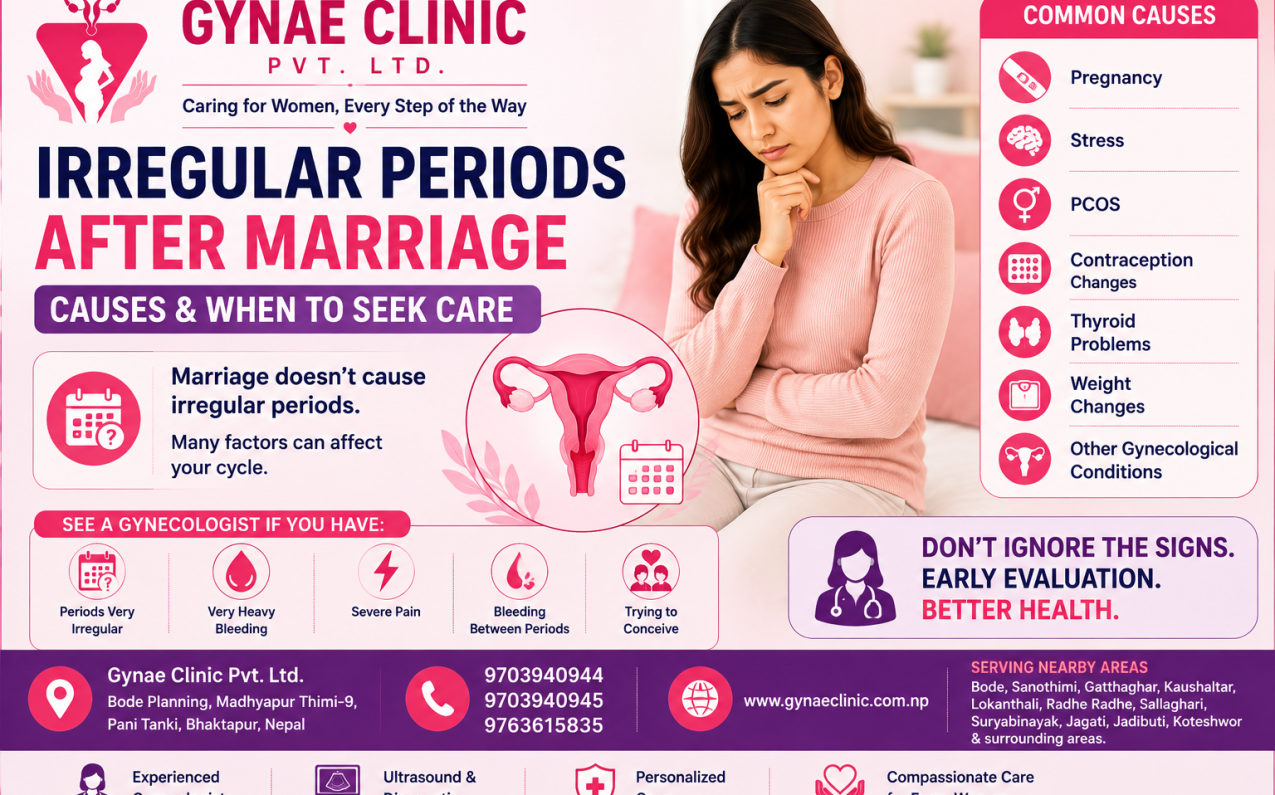
Getting married does not itself cause irregular periods. However, changes in stress, sleep, weight, lifestyle, contraception, sexual activity, pregnancy, and underlying hormonal conditions can make menstrual cycles change after marriage.
If your periods have suddenly become irregular after marriage, it is important to look beyond the timing of the wedding and consider what has changed in your body and daily routine.
What Are Irregular Periods?
A menstrual cycle is considered irregular when the timing between periods varies significantly or your usual pattern changes.
You may notice:
- Periods coming earlier than expected
- Periods coming late
- Skipping a period
- Periods occurring more frequently
- Longer or shorter menstrual bleeding
- Changes in the amount of bleeding
- Occasional spotting between periods
An occasional change does not always mean there is a serious problem. Repeated or persistent irregular periods should be evaluated, particularly when other symptoms are present.
Does Marriage Cause Irregular Periods?
Marriage itself does not directly cause irregular menstruation.
However, life changes around marriage can affect the menstrual cycle.
Common changes include:
- Emotional stress
- Changes in sleeping patterns
- Changes in diet
- Weight gain or weight loss
- Increased or reduced physical activity
- Travel
- Changes in daily routine
- Starting hormonal contraception
- Stopping contraception
- Pregnancy
Therefore, if your periods become irregular after marriage, the timing may be related to lifestyle or reproductive changes rather than marriage itself.
Common Causes of Irregular Periods After Marriage
1. Pregnancy
If you are sexually active and your period is late or absent, pregnancy should be considered first.
Early pregnancy can sometimes cause symptoms such as:
- Missed period
- Breast tenderness
- Nausea
- Fatigue
- Increased urination
- Mild abdominal discomfort
A home urine pregnancy test is usually a useful first step when a period is delayed.
If the test is negative but your period remains absent, repeating the test or consulting a gynecologist may be appropriate.
2. Stress
Marriage can involve significant emotional and practical changes.
Stress can affect the hormones responsible for ovulation and may result in:
- Late periods
- Early periods
- Missed periods
- Lighter or heavier bleeding
Stress-related menstrual changes may improve once the underlying stress and routine changes settle.
3. Polycystic Ovary Syndrome (PCOS)
PCOS is one of the common causes of irregular periods in reproductive-age women.
Women with PCOS may experience:
- Irregular periods
- Infrequent periods
- Difficulty predicting ovulation
- Acne
- Increased facial or body hair
- Weight gain or difficulty losing weight
- Difficulty becoming pregnant
Marriage does not cause PCOS, but some women may only seek evaluation after marriage because they begin monitoring their periods more closely or start planning pregnancy.
If irregular periods are persistent, PCOS may be one of the conditions your gynecologist considers.
4. Hormonal Contraception
If you recently started or stopped:
- Birth-control pills
- Hormonal injections
- Hormonal implants
- Hormonal intrauterine contraception
your menstrual pattern may change.
Depending on the method, you may experience lighter periods, irregular bleeding, spotting or temporary changes in your cycle.
Tell your doctor which contraceptive method you are using and when you started or stopped it.
5. Thyroid Problems
The thyroid gland plays an important role in reproductive hormone regulation.
Both an underactive and overactive thyroid can affect menstruation.
Possible associated symptoms include:
- Changes in weight
- Fatigue
- Feeling unusually cold or hot
- Hair changes
- Changes in heart rate
- Mood changes
- Menstrual irregularity
If irregular periods persist, your doctor may recommend thyroid testing depending on your symptoms.
6. Weight Changes
Significant weight gain or weight loss can affect ovulation.
Very low body weight, restrictive dieting, obesity and sudden changes in weight may contribute to menstrual irregularity.
Maintaining a balanced diet and healthy lifestyle can support reproductive health.
7. Excessive Exercise
Very intense exercise, especially when combined with inadequate calorie intake, can interfere with normal ovulation.
This can lead to:
- Delayed periods
- Missed periods
- Irregular cycles
8. High Prolactin Levels
Prolactin is a hormone involved in breast milk production.
Abnormally high prolactin levels can sometimes interfere with ovulation and cause:
- Irregular periods
- Missed periods
- Difficulty becoming pregnant
- Unexpected breast milk production
Your gynecologist may recommend a prolactin test if your symptoms suggest this possibility.
9. Perimenopause
For women approaching their 40s or 50s, changing menstrual patterns can sometimes be related to perimenopause, the transition toward menopause.
Periods may become:
- Shorter
- Longer
- Heavier
- Lighter
- Less predictable
Age and associated symptoms help determine whether this is likely.
10. Other Gynecological Conditions
Irregular bleeding can sometimes be related to conditions involving the uterus or ovaries, including:
- Uterine fibroids
- Endometrial polyps
- Ovarian cysts
- Adenomyosis
- Endometriosis
- Pelvic infections
Not every irregular period is caused by a hormonal problem.
Irregular Periods After Marriage and Pregnancy Planning
Many women become more concerned about their menstrual cycle after marriage because they want to become pregnant.
If your periods are irregular, ovulation may also be unpredictable.
This can make it harder to identify the fertile window.
However, irregular periods do not automatically mean infertility.
Conditions such as PCOS, thyroid disorders and other hormonal problems can sometimes affect ovulation, and many of these conditions can be evaluated and treated.
If you are trying to conceive and your periods remain irregular, a gynecological consultation can help determine whether you are ovulating regularly.
When Should You See a Gynecologist?
You should consider a consultation if:
- Your periods remain irregular for several cycles
- You repeatedly miss periods
- Your periods suddenly become very different from your previous pattern
- You have very heavy bleeding
- You experience bleeding between periods
- You bleed after sex
- You have significant pelvic pain
- You have unusual vaginal discharge
- You have symptoms suggesting PCOS
- You are trying to conceive but your periods are irregular
- You have repeatedly negative pregnancy tests but your periods remain absent
When Is a Late Period More Concerning?
A late period can happen for many reasons, including pregnancy, stress, hormonal changes and changes in weight.
However, a missed period accompanied by severe pelvic pain, dizziness, fainting or abnormal bleeding requires urgent medical evaluation, particularly if pregnancy is possible.
These symptoms can sometimes occur with an ectopic pregnancy, which requires prompt medical attention.
What Tests May Be Needed?
Your gynecologist will choose tests according to your symptoms.
Possible evaluation may include:
Pregnancy Test
Important when pregnancy is possible.
Blood Tests
Depending on your symptoms, these may include:
- Thyroid testing
- Prolactin
- Other reproductive hormones
- Blood count if bleeding is heavy
Pelvic Ultrasound
Ultrasound may help assess the uterus and ovaries and identify conditions such as fibroids, ovarian cysts or other structural abnormalities.
PCOS Evaluation
PCOS is diagnosed using a combination of medical history, symptoms, examination and appropriate investigations rather than a single test.
How Can You Track Your Periods?
If your periods have become irregular, start recording:
- First day of each period
- Number of bleeding days
- Amount of bleeding
- Spotting between periods
- Pelvic pain
- Pregnancy-test results
- Medications or contraception
- Major weight changes
- Other symptoms
A period-tracking app or simple calendar can make this information easier to discuss during your consultation.
Should You Worry If Your Period Changes After Marriage?
Not necessarily.
One irregular cycle does not automatically indicate a disease.
But if your menstrual pattern continues to change, especially if you have missed periods, heavy bleeding, pelvic pain, PCOS symptoms or difficulty becoming pregnant, it is better to identify the cause rather than repeatedly waiting for the cycle to normalize.
Irregular Period Treatment in Bhaktapur
If you are looking for irregular period treatment in Bhaktapur, irregular menstruation evaluation in Madhyapur Thimi, PCOS evaluation in Bhaktapur, hormonal problems treatment in Bhaktapur, gynecologist for irregular periods near Bode, gynecologist near Sanothimi, Gatthaghar, Kaushaltar, Lokanthali, Radhe Radhe, Sallaghari, Suryabinayak, Jagati, Jadibuti or Koteshwor, you can consult:
Gynae Clinic Pvt. Ltd.
Address: Bode Planning, Madhyapur Thimi-9, Pani Tanki, Bhaktapur, Nepal
Contact:
9703940944 | 9703940945 | 9763615835
Website: www.gynaeclinic.com.np
Gynae Clinic provides gynecological care for menstrual irregularities, PCOS, fertility concerns, pregnancy-related care and other women’s health conditions.
A Simple Message for Women
Marriage should not be blamed for menstrual changes. Your body may be responding to stress, lifestyle changes, contraception, pregnancy or an underlying hormonal or gynecological condition.
If your periods are repeatedly irregular, finding the cause is more useful than simply waiting for the next period.
“An irregular period is a symptom, not a diagnosis—understanding the reason is the first step toward the right care.”
Some complex or persistent menstrual problems may require specialized gynecological evaluation and individualized care based on the underlying cause.
Frequently Asked Questions
Can marriage make periods irregular?
Marriage itself does not directly make periods irregular. Stress, lifestyle changes, contraception, pregnancy and underlying health conditions around the time of marriage may affect menstrual cycles.
Can pregnancy cause a late period?
Yes. A missed or late period can be an early sign of pregnancy. If pregnancy is possible, a pregnancy test is recommended.
Can PCOS cause irregular periods after marriage?
PCOS can cause irregular or infrequent periods. Marriage does not cause PCOS, but it may be the time when women begin seeking evaluation because of menstrual or fertility concerns.
Can stress delay periods?
Yes. Significant stress can interfere with the hormonal signals involved in ovulation and may delay or occasionally stop menstruation.
Can irregular periods make it difficult to get pregnant?
Irregular periods can indicate irregular ovulation, which may make timing conception more difficult. The underlying cause should be evaluated.
What should I do if my periods are irregular after marriage?
First consider pregnancy if applicable, track your cycles and seek a gynecological consultation if irregularity persists or is accompanied by pain, heavy bleeding or fertility concerns.
Final Takeaway
Irregular periods after marriage are not necessarily caused by marriage itself.
Pregnancy, stress, contraception, PCOS, thyroid problems, weight changes and other hormonal or gynecological conditions can affect your menstrual cycle.
If your periods have become consistently irregular, unusually heavy, painful or unpredictable—or you are trying to conceive—a gynecological evaluation can help identify the underlying cause and guide appropriate treatment.
Author: Gynae Clinic Pvt. Ltd.
Medical Disclaimer
This article is for general educational purposes only and does not replace an individual medical consultation, examination, diagnosis or treatment plan. Seek urgent medical attention for severe pelvic pain, fainting, severe dizziness or heavy bleeding, especially when pregnancy is possible.