
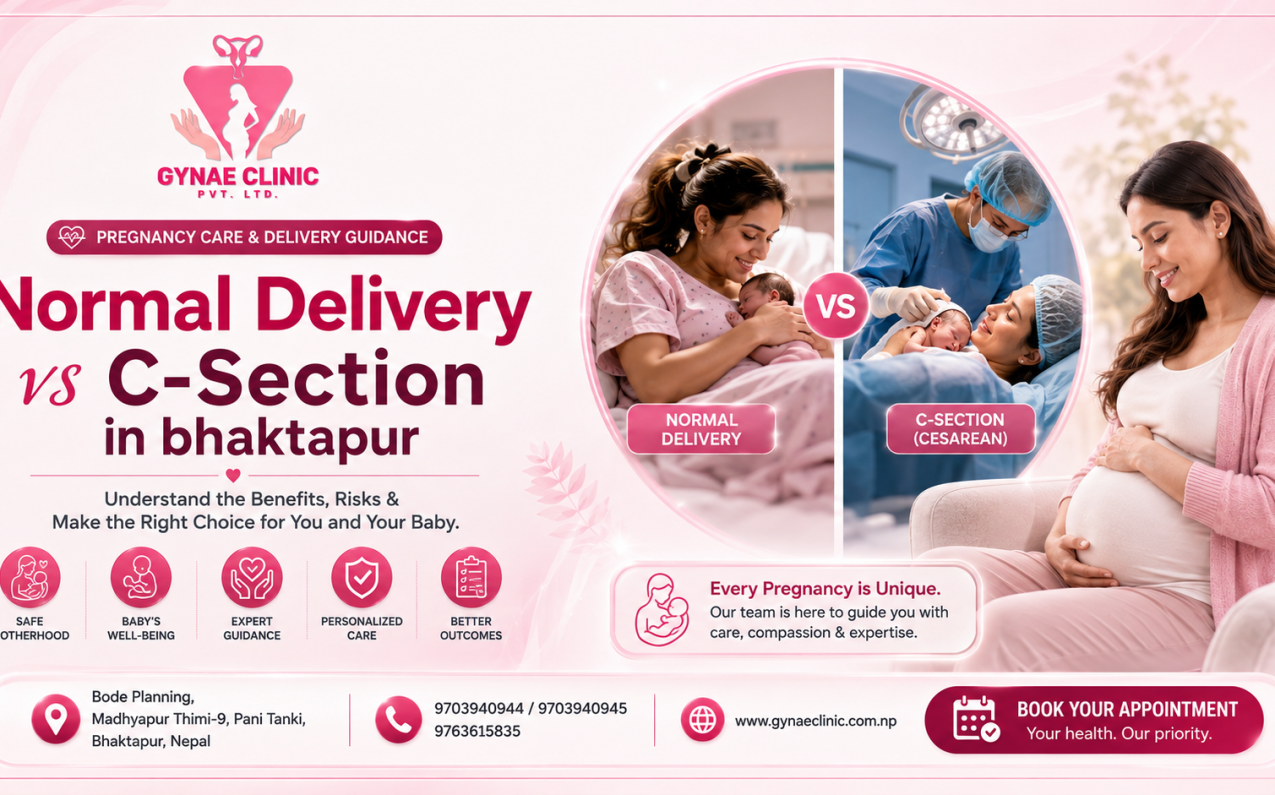
Normal delivery or C-section—which is better? This is one of the most common questions women have during pregnancy. The truth is that there is no single delivery method that is best for every mother or baby.
For many pregnancies, vaginal delivery (normal delivery) is possible and may offer a faster recovery because it does not involve major abdominal surgery. In other situations, a cesarean section (C-section) may be the safest option for the mother, baby, or both.
The safest delivery plan depends on your pregnancy, medical history, baby’s position, placental location, labor progress, fetal condition and other clinical factors.
If you are searching for normal delivery in Bhaktapur, C-section in Bhaktapur, pregnancy care in Nepal, antenatal care, or a female gynecologist in Bhaktapur, this guide explains the important differences between vaginal birth and cesarean delivery.
Gynae Clinic Pvt. Ltd. provides antenatal consultation, pregnancy counselling, ultrasound guidance, high-risk pregnancy assessment and appropriate referral for delivery care.
Location: Bode Planning, Madhyapur Thimi-9, Pani Tanki, Bhaktapur, Nepal
What Is Normal Vaginal Delivery?
A normal vaginal delivery is the birth of a baby through the vagina without abdominal surgery.
During vaginal birth, labor usually involves:
- Contractions that help the cervix open.
- Progressive cervical dilation.
- Descent of the baby through the birth canal.
- Delivery of the baby.
- Delivery of the placenta.
Vaginal birth is appropriate for many pregnancies when there are no medical reasons requiring a C-section.
However, having a preference for vaginal delivery does not guarantee that it will be possible. Circumstances can change during pregnancy or labor, and a cesarean may become necessary if continuing labor becomes unsafe.
What Is a Cesarean Section (C-Section)?
A cesarean section, commonly called a C-section, is a surgical procedure used to deliver a baby through an incision made in the mother’s abdomen and uterus.
A C-section may be:
- Planned (elective) when there is a known reason to deliver surgically.
- Emergency when an unexpected problem develops during pregnancy or labor.
Cesarean delivery can be an important and sometimes life-saving procedure when vaginal delivery would pose a significant risk.
Normal Delivery vs C-Section: What’s the Difference?
| Feature | Vaginal Delivery | C-Section |
|---|---|---|
| Method | Baby is delivered through the birth canal | Baby is delivered through abdominal and uterine incisions |
| Surgery | No major abdominal surgery | Major abdominal surgery |
| Recovery | Often shorter, but varies | Usually requires a longer recovery |
| Hospital stay | Often shorter | Usually longer than uncomplicated vaginal birth |
| Pain | Labor pain is common; pain relief options may be available | Anesthesia is used during surgery; surgical discomfort afterward is expected |
| Wound care | May be needed if tearing or episiotomy occurs | Surgical incision requires care |
| Future pregnancy | Usually no uterine scar from delivery | Uterine scar may affect some future pregnancy and delivery decisions |
Individual experiences vary considerably.
Benefits of Normal Delivery
When vaginal birth is medically appropriate, possible advantages include:
1. Avoiding Major Abdominal Surgery
Vaginal birth does not involve an abdominal surgical incision.
2. Often Faster Recovery
Many women are able to return to normal daily activities sooner after an uncomplicated vaginal delivery compared with a C-section.
3. Shorter Hospital Stay
An uncomplicated vaginal birth often requires a shorter hospital stay than a cesarean birth.
4. Lower Risk of Surgical Complications
Because there is no abdominal surgery, vaginal birth avoids some complications associated with surgery, such as surgical wound problems and certain postoperative infections.
However, vaginal delivery can also involve complications, including significant bleeding, tears, assisted delivery or emergency C-section.
Benefits of a C-Section
A C-section can be the safest option when there is a medical indication.
It may be recommended in situations such as:
- Certain fetal positions, such as some breech presentations
- Placenta previa or certain other placenta-related complications
- Some multiple pregnancies
- Certain previous uterine surgeries
- Labor that is not progressing safely
- Concerning fetal heart-rate changes
- Certain maternal medical conditions
- Other situations where vaginal delivery may be unsafe
The exact indication should be assessed by an obstetrician.
A C-section should not be considered a “failure” of normal delivery. When medically necessary, it is an important part of modern obstetric care.
When Might a C-Section Be Recommended?
The decision depends on the individual pregnancy.
Baby’s Position
Most babies move into a head-down position before labor. If the baby remains in a position that makes vaginal birth unsafe or unsuitable, a C-section may be recommended depending on the circumstances.
Placenta Problems
Some placenta-related conditions can make vaginal delivery dangerous.
For example, placenta previa, where the placenta covers or is very close to the cervical opening, may require cesarean delivery.
Labor Not Progressing
Sometimes the cervix does not continue to dilate or the baby does not descend despite adequate labor.
If continued labor is considered unsafe or unlikely to result in a safe vaginal birth, a C-section may be recommended.
Fetal Distress
Changes in the baby’s heart rate may indicate that the baby is not tolerating labor well.
Depending on the situation, urgent delivery—including C-section—may be required.
Previous C-Section
Having a previous C-section does not automatically mean that every future pregnancy requires another C-section.
Some women may be candidates for VBAC (vaginal birth after cesarean), while others may have reasons that make repeat cesarean delivery safer.
Can I Have a Normal Delivery After a Previous C-Section?
Yes, some women may be candidates for VBAC, but it is not appropriate for everyone.
The decision depends on several factors, including:
- Reason for the previous C-section
- Type of uterine incision
- Number of previous C-sections
- Previous vaginal births
- Current pregnancy
- Baby’s position
- Placental location
- Other maternal or fetal conditions
- Availability of appropriate emergency obstetric care
A previous cesarean should therefore be discussed with your obstetrician early in pregnancy.
Is Normal Delivery Always Better Than C-Section?
No.
Vaginal delivery may be preferable when it is safe and appropriate, but a C-section can be the safer choice when medical complications are present.
The goal of maternity care is not simply to achieve a vaginal delivery. The priority is safe delivery for both mother and baby.
For example, attempting vaginal delivery when there is a serious medical reason for cesarean delivery may increase risks. Conversely, performing a C-section without a medical indication exposes the mother to the risks associated with major surgery.
The delivery method should therefore be based on an individualized clinical assessment.
Is C-Section Painful?
During a C-section, anesthesia is used so that you do not feel the surgical pain in the usual way.
You may experience:
- Pressure or pulling sensations during surgery
- Discomfort after the anesthesia wears off
- Incision pain
- Difficulty moving comfortably during the early recovery period
Pain-relieving medicines are commonly used after surgery.
Recovery varies between women and depends on factors such as the reason for surgery, overall health and whether complications occurred.
Recovery After Normal Delivery
Recovery following vaginal birth varies considerably.
You may experience:
- Vaginal bleeding for several weeks
- Perineal soreness
- Temporary pelvic discomfort
- Pain after tearing or an episiotomy
- Breast and uterine changes
- Tiredness
Most women gradually return to normal activities, but recovery should be individualized.
Your healthcare provider can advise when it is appropriate to resume exercise, sexual activity, driving and other activities.
Recovery After a C-Section
A C-section is major abdominal surgery, so recovery generally takes longer than after an uncomplicated vaginal birth.
Recovery may involve:
- Surgical wound care
- Pain management
- Temporary activity restrictions
- Difficulty getting up or moving comfortably
- Follow-up appointments
- Gradual return to normal activities
Follow your doctor’s instructions regarding wound care, lifting, exercise and other activities.
Seek medical attention if you develop concerning symptoms such as heavy bleeding, fever, worsening wound pain, redness or discharge from the incision, severe abdominal pain or breathing difficulties.
How Can I Increase My Chances of a Healthy Vaginal Delivery?
No one can guarantee a normal delivery, but appropriate pregnancy care can help identify and manage problems early.
Important steps include:
Attend Regular Antenatal Checkups
Regular prenatal visits allow your healthcare provider to monitor:
- Mother’s health
- Blood pressure
- Weight
- Baby’s growth
- Fetal position
- Placental concerns
- Pregnancy complications
Follow Recommended Tests
Your healthcare provider may recommend blood tests, urine testing, ultrasound and other assessments depending on your stage of pregnancy and medical history.
Maintain a Healthy Pregnancy Lifestyle
Follow advice regarding:
- Balanced nutrition
- Physical activity
- Appropriate weight gain
- Medication use
- Sleep and rest
- Avoiding tobacco and alcohol
Discuss Your Birth Preferences
Tell your healthcare provider what type of birth you hope for, but keep your birth plan flexible because medical circumstances can change.
Does Baby’s Size Determine Whether I Need a C-Section?
Not necessarily.
Estimated fetal weight from ultrasound is not perfectly accurate, and fetal size is only one factor considered when assessing delivery options.
Your obstetrician will consider the complete clinical picture rather than relying on a single measurement.
Does a C-Section Affect Future Pregnancies?
A C-section creates a scar on the uterus.
For some women, a previous C-section can influence decisions about future pregnancies and delivery, including whether VBAC may be appropriate.
There can also be increased risks associated with multiple cesarean deliveries, including certain placental complications.
If you have had a previous C-section, discuss future pregnancy planning with your gynecologist or obstetrician.
What Is a Birth Plan?
A birth plan is a way of discussing your preferences for labor, delivery and immediate postpartum care with your healthcare team.
You may wish to discuss:
- Preference for vaginal birth
- Pain relief options
- Who may accompany you
- What happens if labor does not progress
- Circumstances that may require C-section
- Newborn care preferences
A birth plan should be flexible.
The safest delivery method may change because of circumstances that develop during labor.
When Should You Discuss Delivery Options With Your Gynecologist?
Ideally, discuss your delivery preferences during antenatal care rather than waiting until labor begins.
You should especially discuss delivery planning if you have:
- Previous C-section
- Previous difficult delivery
- Multiple pregnancy
- Breech or abnormal fetal position
- Placental problems
- High blood pressure
- Diabetes during pregnancy
- Previous uterine surgery
- High-risk pregnancy
- Other maternal or fetal concerns
Early counselling gives you time to understand your options and ask questions.
Pregnancy Care and Delivery Counselling in Bhaktapur
If you are searching for normal delivery in Bhaktapur, C-section in Bhaktapur, pregnancy care in Nepal, antenatal care near me, or a female gynecologist in Bhaktapur, professional antenatal care can help you understand your delivery options.
Gynae Clinic Pvt. Ltd.
Address:
Bode Planning, Madhyapur Thimi-9, Pani Tanki, Bhaktapur, Nepal
Pregnancy Services
- Antenatal care
- Pregnancy counselling
- Ultrasound guidance
- High-risk pregnancy assessment
- Pregnancy monitoring
- Delivery planning
- Referral for delivery care when required
- Women’s gynecological healthcare
Contact:
9703940944 / 9703940945 / 9763615835
Website:
www.gynaeclinic.com.np
Frequently Asked Questions
Which is better: normal delivery or C-section?
Neither method is universally better. Vaginal delivery is appropriate for many pregnancies, while C-section can be the safest option when there are medical indications.
Is C-section safer than normal delivery?
Safety depends on the individual pregnancy. A C-section can be life-saving when medically necessary, but it is major surgery and carries surgical risks.
How long does it take to recover from a C-section?
Recovery varies. Because a C-section involves abdominal surgery, physical recovery generally takes longer than after an uncomplicated vaginal delivery.
Can I have normal delivery after C-section?
Some women can have a vaginal birth after cesarean (VBAC). Eligibility depends on factors such as the previous uterine incision, reason for the previous C-section and current pregnancy circumstances.
Can I choose a C-section?
A planned C-section may be appropriate in certain situations, but the decision should be discussed with your obstetrician. Medical benefits, risks and individual circumstances should be considered.
Does normal delivery hurt?
Labor and vaginal birth can involve pain, but various pain-relief options may be available. Your obstetrician or maternity team can explain the options available to you.
Does C-section affect future pregnancy?
A previous C-section can affect some future pregnancy and delivery decisions. However, many women have healthy pregnancies after a cesarean.
Where can I get pregnancy counselling in Bhaktapur?
You can visit Gynae Clinic Pvt. Ltd., Bode Planning, Madhyapur Thimi-9, Pani Tanki, Bhaktapur, Nepal for antenatal consultation, pregnancy counselling and delivery planning guidance.
Normal Delivery vs C-Section: The Most Important Takeaway
There is no competition between normal delivery and C-section.
The right delivery method is the one that provides the safest outcome for the mother and baby based on the circumstances of that pregnancy.
If vaginal delivery is safe, it may avoid the risks associated with major abdominal surgery and often allows a quicker recovery.
If a medical problem makes vaginal birth unsafe, a C-section may be the safest and most appropriate option.
Your pregnancy care team should evaluate your health, your baby’s condition and the progress of pregnancy before making delivery recommendations.
Book Pregnancy Counselling in Bhaktapur
If you are looking for:
- Normal delivery in Bhaktapur
- C-section in Bhaktapur
- Normal delivery vs C-section
- Pregnancy care in Bhaktapur
- Antenatal care in Nepal
- Female gynecologist in Bhaktapur
- Pregnancy delivery options
- Delivery planning in Bhaktapur
Contact:
Gynae Clinic Pvt. Ltd.
Bode Planning, Madhyapur Thimi-9, Pani Tanki, Bhaktapur, Nepal
Phone: 9703940944 / 9703940945 / 9763615835
Website: www.gynaeclinic.com.np
Pregnancy Care | Antenatal Services | Women’s Health | Gynecology | Ultrasound Guidance
Conclusion
Choosing between normal delivery and C-section is an individual medical decision. For many women, vaginal birth is possible and may provide a shorter recovery, while cesarean delivery is an essential and potentially life-saving option when complications make vaginal birth unsafe.
Regular antenatal care, pregnancy monitoring and open communication with your gynecologist can help you understand your delivery options and prepare for different possibilities.
Your birth preference matters, but your plan should remain flexible. The safest delivery method can only be determined by considering the mother, baby and circumstances of the pregnancy.
For pregnancy care, antenatal counselling and delivery planning in Bhaktapur, contact Gynae Clinic Pvt. Ltd.
Gynae Clinic Pvt. Ltd.
Bode Planning, Madhyapur Thimi-9, Pani Tanki, Bhaktapur, Nepal
9703940944 / 9703940945 / 9763615835
www.gynaeclinic.com.np
Author; Gynae Clinic Pvt. Ltd.