
Author: Gynae Clinic Pvt. Ltd.
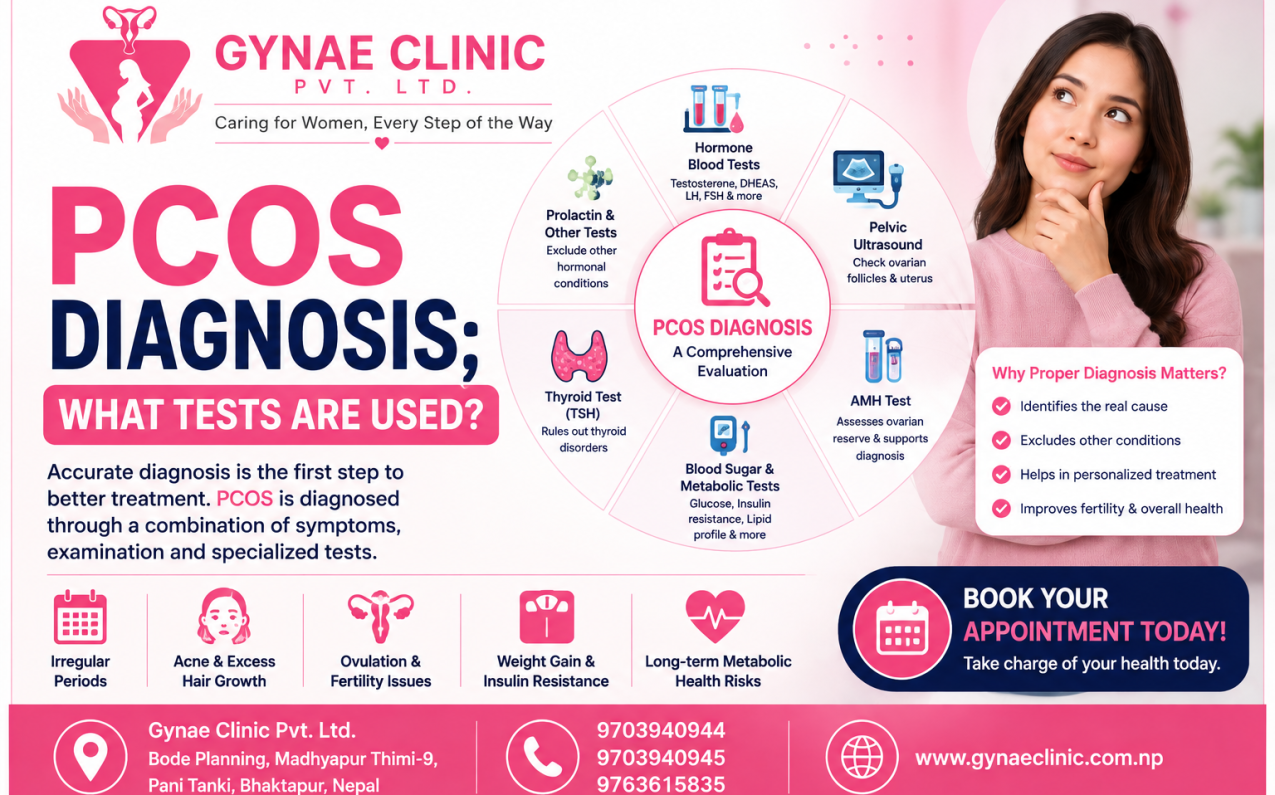
Polycystic Ovary Syndrome (PCOS) is a common hormonal and metabolic condition that can affect menstrual cycles, ovulation, androgen levels, fertility, skin, hair and metabolic health. But there is no single blood test, ultrasound scan or symptom that can diagnose PCOS on its own.
A proper PCOS diagnosis involves looking at your menstrual pattern, symptoms, physical findings and selected hormone tests, while also excluding other conditions that can cause similar symptoms.
At Gynae Clinic Pvt. Ltd., women experiencing irregular periods, acne, excess facial hair, hair thinning, difficulty conceiving or other hormonal concerns can receive an individualized gynecological evaluation.
How Is PCOS Diagnosed?
For adults, current international guidance generally uses a combination of three main features:
- Clinical or biochemical hyperandrogenism — signs or laboratory evidence of increased androgen activity
- Ovulatory dysfunction — irregular or absent ovulation, often reflected by irregular menstrual cycles
- Polycystic ovarian morphology (PCOM) on ultrasound or, in adults, an appropriately interpreted AMH level
In adults, when irregular menstrual cycles and hyperandrogenism are both present, an ovarian ultrasound or AMH test is not necessarily required to establish the diagnosis, provided other causes have been excluded.
This is why a woman should not be diagnosed with PCOS simply because an ultrasound report says “polycystic ovaries.”
1. Medical History and Menstrual Cycle Assessment
The first part of a PCOS evaluation is often simply a detailed discussion with your gynecologist.
Your doctor may ask about:
- Age when periods started
- Length of your menstrual cycles
- Number of periods each year
- Missed or delayed periods
- Changes in menstrual pattern
- Acne
- Facial or body hair growth
- Scalp hair thinning
- Weight changes
- Fertility concerns
- Previous pregnancies
- Medications
- Family history of PCOS or diabetes
Your menstrual pattern provides important clues about whether ovulation may be occurring regularly.
In adults, cycles occurring less frequently than expected can indicate ovulatory dysfunction. The exact definition of an irregular cycle varies by age and reproductive stage.
Internal link: PCOS Symptoms in Women: Signs, Causes & Diagnosis in Bhaktapur
2. Physical Examination
A physical examination may look for signs associated with increased androgen activity or metabolic concerns.
Your gynecologist may assess:
- Excess facial or body hair
- Acne
- Scalp hair thinning
- Weight and BMI
- Blood pressure
- Signs that may suggest insulin resistance
- Other physical findings that could indicate a different hormonal condition
Not every woman with PCOS has obvious physical signs.
For example, some women may have biochemical androgen elevation without prominent facial hair or acne.
3. Testosterone Blood Test
Total and Free Testosterone
Testosterone testing is one of the most important laboratory assessments when biochemical hyperandrogenism is suspected.
The international PCOS guideline recommends total testosterone and free testosterone to assess biochemical hyperandrogenism. Free testosterone may be assessed directly using an appropriate validated method or estimated using the free androgen index.
If testosterone is not elevated but clinical suspicion remains, additional androgen testing may sometimes be considered.
4. DHEAS and Androstenedione
If testosterone does not explain the clinical picture, your doctor may consider:
- DHEAS (dehydroepiandrosterone sulfate)
- Androstenedione
These tests can sometimes provide additional information about androgen excess.
However, they are generally less specific than testosterone for diagnosing biochemical hyperandrogenism in PCOS.
Very high androgen levels or rapidly developing symptoms require careful evaluation because conditions other than PCOS, including androgen-producing tumors and other endocrine disorders, may occasionally cause androgen excess.
5. Pelvic Ultrasound
A pelvic ultrasound may be used to examine the ovaries and uterus.
Depending on the technique, ultrasound can assess:
- Ovarian follicle number
- Ovarian volume
- Uterus
- Endometrial lining
- Other pelvic abnormalities
In adults, modern ultrasound criteria for polycystic ovarian morphology include assessment of follicle number and/or ovarian enlargement. The current international guideline recommends follicle number per ovary as an important ultrasound marker when appropriate technology and image quality are available.
But an important point:
Polycystic-looking ovaries do not automatically mean PCOS.
A woman can have polycystic ovarian morphology without having the full clinical syndrome.
Conversely, a woman can have PCOS without an ultrasound showing polycystic ovarian morphology.
Therefore, ultrasound should be interpreted together with symptoms, menstrual history and laboratory findings.
6. AMH Test for PCOS
AMH (Anti-Müllerian Hormone) is an increasingly important part of PCOS diagnosis in adults.
The 2023 international guideline allows AMH to be used as an alternative to ultrasound for defining polycystic ovarian morphology in adults, when used within the diagnostic algorithm.
However:
AMH should NOT be used as a single test to diagnose PCOS.
An elevated AMH alone does not prove that a woman has PCOS.
AMH can also be influenced by factors such as age, BMI, hormonal contraception and ovarian surgery, and appropriate population- and assay-specific interpretation is important.
Internal link: Female Fertility Tests in Bhaktapur
7. Thyroid Test – TSH
A thyroid disorder can cause symptoms that resemble PCOS, particularly:
- Irregular periods
- Changes in menstrual flow
- Difficulty becoming pregnant
- Changes in weight
- Other hormonal symptoms
For this reason, TSH (thyroid-stimulating hormone) may be checked when evaluating suspected PCOS.
This helps your doctor distinguish PCOS from thyroid-related menstrual problems.
8. Prolactin Test
Prolactin may also be measured when appropriate.
High prolactin levels can interfere with reproductive hormones and cause:
- Irregular periods
- Absent periods
- Difficulty ovulating
- Fertility problems
- Sometimes breast milk production when not breastfeeding
Because elevated prolactin can mimic some PCOS features, it may need to be excluded as part of the diagnostic evaluation.
9. 17-Hydroxyprogesterone Test
A 17-hydroxyprogesterone (17-OHP) test may be used to help exclude non-classic congenital adrenal hyperplasia, a condition that can cause androgen excess and symptoms resembling PCOS.
It is not a test that confirms PCOS.
Rather, it can help your doctor rule out another hormonal disorder before making the diagnosis.
10. FSH and Other Hormone Tests
Depending on your symptoms and menstrual history, your doctor may recommend additional reproductive hormone testing.
FSH and LH may be useful in selected situations, particularly when there is significant menstrual dysfunction or concern about another cause of abnormal reproductive hormone function.
However, these tests should not be interpreted in isolation.
A commonly searched question is:
“Can LH/FSH ratio diagnose PCOS?”
No.
An LH/FSH ratio is not sufficient by itself to diagnose PCOS.
The diagnosis should be based on the overall clinical picture and appropriate diagnostic criteria.
11. Pregnancy Test
If your period is late or absent and pregnancy is possible, a pregnancy test may be appropriate before assuming that PCOS is responsible.
Pregnancy itself can explain a missed period.
This is particularly important when a woman with previously irregular periods suddenly has a longer-than-usual gap between periods.
12. Blood Sugar and Metabolic Testing
PCOS is also associated with an increased risk of impaired glucose tolerance and type 2 diabetes.
Therefore, PCOS evaluation should consider metabolic health, not just reproductive hormones.
Depending on your individual risk factors, your doctor may recommend:
- Fasting blood glucose
- HbA1c
- 75-g oral glucose tolerance test (OGTT)
- Lipid profile
- Blood pressure assessment
- Other metabolic investigations
The international PCOS guideline considers the 75-g OGTT the most accurate test for assessing glycemic status in women with PCOS, including regardless of BMI.
Is Insulin Level Testing Needed to Diagnose PCOS?
This is an important misconception.
An insulin blood test does NOT diagnose PCOS.
Although insulin resistance is common in PCOS, currently available insulin assays have limited clinical usefulness and are not recommended as a routine test for diagnosing or assessing insulin resistance in PCOS.
Your doctor may instead focus on appropriate glucose testing and your overall metabolic risk.
Internal link: PCOS and Insulin Resistance: What Is the Connection?
Can Ultrasound Alone Diagnose PCOS?
No.
This is one of the most important things women should know.
An ultrasound may show multiple small follicles, but that finding alone does not establish PCOS.
PCOS is a clinical diagnosis based on a combination of features and exclusion of other causes.
A woman with:
Irregular periods + high androgen activity
may meet diagnostic criteria without needing an ultrasound in adulthood.
Can AMH Alone Diagnose PCOS?
No.
AMH may be useful as an alternative to ultrasound for defining polycystic ovarian morphology in adults, but it should not be used as a standalone diagnostic test.
A high AMH does not automatically mean you have PCOS.
What Tests Are Used to Rule Out Other Conditions?
Before diagnosing PCOS, your doctor may consider other conditions that can produce similar symptoms.
Depending on your symptoms, these may include:
- Thyroid disease
- Hyperprolactinemia
- Non-classic congenital adrenal hyperplasia
- Pregnancy
- Hypothalamic or pituitary disorders
- Cushing syndrome
- Androgen-producing ovarian or adrenal conditions
- Other endocrine disorders
The exact testing depends on your symptoms and clinical findings. Not every woman needs every test.
What About Teenagers With Suspected PCOS?
PCOS diagnosis in adolescents is different from diagnosis in adults.
During adolescence, menstrual irregularity and ovarian appearance can overlap with normal puberty.
The international guideline recommends that adolescents generally require both ovulatory dysfunction and hyperandrogenism for a PCOS diagnosis, after other causes have been excluded. Ultrasound and AMH are not recommended for diagnosing PCOS in adolescents because of their limited specificity during this stage of development.
This helps reduce the risk of incorrectly labeling normal pubertal changes as PCOS.
Does Every Woman With Suspected PCOS Need All These Tests?
No.
This is extremely important.
A doctor does not need to order every possible hormone test, ultrasound and metabolic investigation for every woman.
The appropriate evaluation depends on:
- Age
- Menstrual pattern
- Symptoms
- Androgen-related signs
- Pregnancy possibility
- Fertility goals
- Medical history
- Medications
- Family history
- Metabolic risk
- Physical examination
For example, an adult with clear irregular cycles and clinical hyperandrogenism may need a different investigation plan from a teenager with recently irregular periods.
Good PCOS diagnosis is not about ordering the maximum number of tests—it is about choosing the right tests for the individual woman.
How Long Does PCOS Diagnosis Take?
There is no fixed timeline.
Some women can be assessed relatively quickly when the clinical features are clear.
Others may require:
- Additional blood tests
- Repeat testing
- Ultrasound
- Assessment of menstrual patterns
- Exclusion of other hormonal disorders
- Metabolic evaluation
Your doctor may need to combine several pieces of information before making a diagnosis.
What Happens After PCOS Is Diagnosed?
Diagnosis is only the beginning.
Once PCOS is confirmed, your doctor can discuss management according to your goals.
Your priorities may include:
If you are not trying to become pregnant
Treatment may focus on:
- Menstrual cycle management
- Acne
- Excess hair
- Metabolic health
- Long-term health monitoring
If you are trying to become pregnant
Management may focus on:
- Ovulation
- Fertility evaluation
- Metabolic health
- Preconception care
- Appropriate fertility treatment when needed
PCOS does not automatically mean infertility. Many women with PCOS can become pregnant naturally, while others may benefit from ovulation treatment or other fertility care.
When Should You See a Gynecologist for PCOS Testing?
Consider a PCOS evaluation if you have:
- Very irregular periods
- Repeatedly missed periods
- Excess facial or body hair
- Persistent acne
- Scalp hair thinning
- Difficulty becoming pregnant
- Unexplained hormonal symptoms
- Concerns about insulin resistance
- A family history of PCOS or type 2 diabetes
You do not need to wait until symptoms become severe.
Internal link: PCOS Symptoms and Treatment in Nepal: Complete Guide for Women
PCOS Diagnosis in Bhaktapur
If you are searching for PCOS diagnosis in Bhaktapur, PCOS testing in Bhaktapur, or a gynecologist for irregular periods and hormonal symptoms, an individualized evaluation is the right starting point.
At Gynae Clinic Pvt. Ltd., women can seek consultation for:
- PCOS evaluation
- Irregular periods
- Hormonal concerns
- Ovulation problems
- Fertility concerns
- PCOS-related metabolic concerns
- Pregnancy planning
- Women’s reproductive health
Internal link: Gynecologist in Bhaktapur – Complete Women’s Health Guide
Book a PCOS Consultation in Bhaktapur
Gynae Clinic Pvt. Ltd.
Bode Planning, Madhyapur Thimi-9, Pani Tanki, Bhaktapur, Nepal
Contact:
9703940944 | 9703940945 | 9763615835
Website:
https://www.gynaeclinic.com.np/
“When PCOS symptoms are complex or overlap with other hormonal conditions, specialized evaluation can turn confusing symptoms into a clear, personalized diagnosis and care plan.”
Frequently Asked Questions About PCOS Diagnosis
What is the main test for PCOS?
There is no single main test. Diagnosis combines menstrual/ovulatory history, evidence of androgen excess and, when necessary, ultrasound or AMH in adults, while excluding other causes.
Can a blood test confirm PCOS?
Blood tests can identify biochemical hyperandrogenism and help exclude other conditions, but no single blood test confirms PCOS in every woman.
Is ultrasound necessary for PCOS diagnosis?
Not always. In an adult who has both irregular menstrual cycles and hyperandrogenism, ultrasound may not be necessary for diagnosis.
Is AMH a PCOS test?
AMH can be used as an alternative to ultrasound for defining polycystic ovarian morphology in adults, but it should not be used alone to diagnose PCOS.
Can LH and FSH diagnose PCOS?
No. LH and FSH can be useful in selected hormonal evaluations, but the LH/FSH ratio is not a standalone diagnostic test for PCOS.
Do I need an insulin test if I have PCOS?
Routine insulin assays are not recommended for diagnosing insulin resistance in PCOS. Appropriate glucose testing is more clinically useful.
Can I have PCOS with normal ultrasound results?
Yes. Ultrasound is only one component of the diagnostic process. An adult may meet PCOS criteria without polycystic ovarian morphology on ultrasound.
Can I have polycystic ovaries without PCOS?
Yes. Polycystic ovarian morphology alone does not establish the diagnosis.
Does PCOS testing differ for teenagers?
Yes. Diagnosis in adolescents requires greater caution because normal puberty can resemble PCOS. Ultrasound and AMH are not recommended for diagnosis in adolescents.
Medical Disclaimer
This article is for general educational purposes and does not replace an individual medical consultation, diagnosis or treatment plan. PCOS diagnosis should be made by a qualified healthcare professional after considering symptoms, menstrual history, examination and appropriate investigations. Not every woman needs every test.
Author: Gynae Clinic Pvt. Ltd.