


Author: Gynae Clinic Pvt. Ltd.
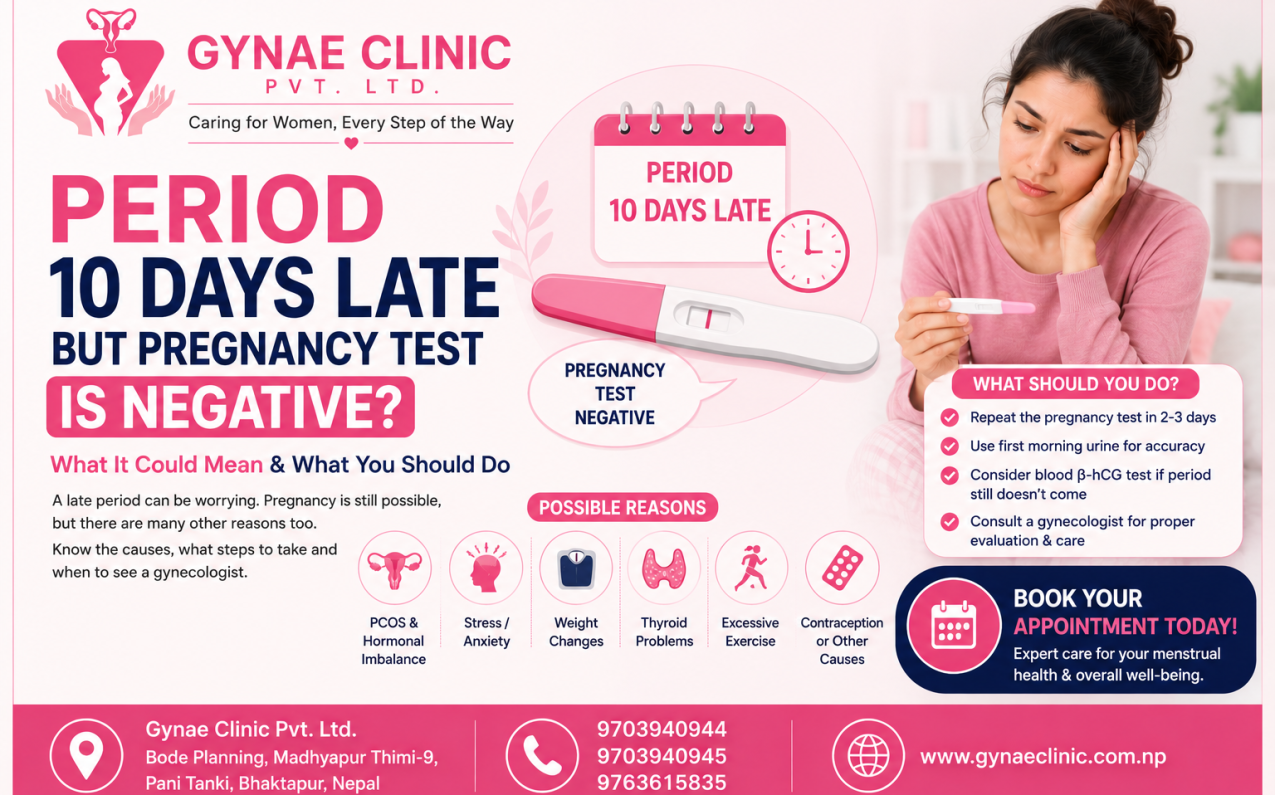
A period that is 10 days late with a negative pregnancy test can be confusing and stressful, especially if pregnancy is possible. A negative home pregnancy test makes pregnancy less likely, but it does not always completely rule it out, particularly if ovulation occurred later than usual or the test was taken too early.
A delayed period can also happen because of PCOS, stress, weight changes, excessive exercise, thyroid problems, hormonal changes, breastfeeding, contraception or other medical conditions.
This guide explains what a 10-day delayed period with a negative pregnancy test can mean, when to repeat the test, when a blood pregnancy test may be useful, and when you should see a gynecologist.
Is Pregnancy Still Possible If My Period Is 10 Days Late but the Test Is Negative?
Yes, pregnancy can still be possible in some situations.
Home pregnancy tests detect human chorionic gonadotropin (hCG) in urine. If the test is taken before enough hCG has accumulated, it can produce a false-negative result. The timing of ovulation and implantation can also affect when hCG becomes detectable.
This is particularly relevant if:
- Your menstrual cycles are irregular
- You have PCOS
- You ovulated later than usual
- You are unsure when your period was actually due
- The test was taken very early
- The urine was diluted
- The test instructions were not followed correctly
Therefore, one negative pregnancy test does not always provide the complete answer when your period is significantly delayed.
What Should You Do If Your Period Is 10 Days Late?
If pregnancy is possible, the next step is usually straightforward.
Step 1: Repeat the Pregnancy Test
If your first test was negative and your period has not started, repeat the test after a few days.
For the best chance of detecting early pregnancy, use first-morning urine, when urine is generally more concentrated. Also check the test’s expiry date and follow the manufacturer’s instructions carefully.
The NHS advises repeating a pregnancy test after a few days if the first test is negative but pregnancy is still suspected.
Step 2: Consider a Blood β-hCG Test
If your period remains absent and pregnancy is still possible, your doctor may recommend a blood β-hCG pregnancy test.
A blood test can be useful when:
- The urine test remains negative
- Your period is significantly delayed
- You are unsure when ovulation occurred
- You have symptoms suggesting pregnancy
- You need a more definitive pregnancy assessment
If pregnancy is confirmed, your doctor can determine what further evaluation is appropriate.
Why Can a Pregnancy Test Be Negative When You Are Pregnant?
Several factors can contribute to a false-negative urine pregnancy test.
1. Testing Too Early
This is one of the most common explanations.
If ovulation occurred later than expected, conception may also have occurred later. As a result, your actual pregnancy may be earlier than you think.
hCG rises rapidly during early pregnancy, so a test that is negative at one point can become positive a few days later.
2. Irregular Ovulation
If you do not ovulate regularly, it becomes difficult to predict when your period should arrive.
This can happen with:
- PCOS
- Stress
- Major weight changes
- Certain hormonal conditions
- Other menstrual disorders
Irregular cycles can therefore make both the expected period date and pregnancy-test timing less predictable.
3. Diluted Urine
Drinking a large amount of fluid before taking a urine pregnancy test can dilute the urine and potentially make hCG more difficult to detect.
First-morning urine can be useful when testing for a very early pregnancy.
4. Incorrect Test Use
A pregnancy test may be less reliable if:
- The instructions are not followed
- The result is checked too early or too late
- The test is expired
- The control indicator does not appear
Always follow the instructions supplied with the specific test.
What If the Second Pregnancy Test Is Also Negative?
If you repeat the test and it remains negative but your period still does not arrive, it is important to consider other causes of delayed menstruation.
A late period does not always mean pregnancy.
Common causes include:
- PCOS
- Stress or anxiety
- Sudden weight loss
- Weight gain
- Excessive exercise
- Thyroid disorders
- Hormonal changes
- Breastfeeding
- Hormonal contraception
- Perimenopause
- Other medical conditions
If pregnancy has been reasonably excluded and the delay continues or keeps happening, a gynecological evaluation can help identify the underlying cause.
Can PCOS Cause a Period to Be 10 Days Late?
Yes.
PCOS is one of the common causes of irregular or delayed periods.
PCOS can interfere with regular ovulation. When ovulation occurs later than expected—or does not occur during a particular cycle—the next period may also be delayed.
Women with PCOS may also experience:
- Irregular periods
- Missed periods
- Acne
- Excess facial or body hair
- Scalp hair thinning
- Difficulty becoming pregnant
- Weight or metabolic concerns
If your periods frequently arrive late rather than this happening only once, PCOS may be worth discussing with a gynecologist.
PCOS Symptoms in Women: Signs, Causes & Diagnosis in Bhaktapur
Can Stress Delay Your Period?
Yes.
Stress can affect the hormonal signals involved in ovulation and menstruation.
Significant emotional stress, changes in sleep, demanding work or lifestyle changes may contribute to a delayed or irregular period. Stress is recognized as one of the common causes of missed or late periods.
However, it is better not to automatically blame stress for a significantly delayed period when pregnancy is possible or when delayed periods are happening repeatedly.
Can Thyroid Problems Cause a Late Period?
Yes.
Both underactive thyroid (hypothyroidism) and overactive thyroid (hyperthyroidism) can affect menstrual regularity.
If you repeatedly have delayed or irregular periods, particularly with symptoms such as tiredness, weight changes, feeling unusually cold or hot, palpitations or other hormonal symptoms, your doctor may consider thyroid testing.
Can Weight Changes Delay Your Period?
Yes.
Significant weight loss, weight gain or inadequate nutrition can affect normal reproductive hormone function and ovulation.
Similarly, excessive physical activity can sometimes disrupt menstrual cycles.
A delayed period should therefore be considered in the context of your recent:
- Weight changes
- Diet
- Exercise
- Sleep
- Stress
- General health
What Tests May Be Needed If Your Period Does Not Come?
The appropriate tests depend on your symptoms, age, menstrual history and pregnancy possibility.
Your gynecologist may consider:
1. Pregnancy Testing
A repeat urine pregnancy test or blood β-hCG may be appropriate when pregnancy remains possible.
2. Hormonal Blood Tests
Depending on your symptoms, your doctor may recommend selected hormone tests to investigate possible hormonal causes.
3. Thyroid Testing
A TSH test may be considered when thyroid dysfunction could be contributing to menstrual irregularity.
4. PCOS Evaluation
If you have recurrent irregular periods, acne, excess hair growth or fertility concerns, your doctor may evaluate for PCOS.
5. Pelvic Ultrasound
An ultrasound may help assess the uterus and ovaries and investigate other gynecological causes of abnormal menstruation.
Not every woman with a late period needs every test. Testing should be individualized. Gynae Clinic’s guidance on irregular periods similarly emphasizes selecting investigations according to symptoms, medical history and examination.
Can You Be Pregnant Without Pregnancy Symptoms?
Yes.
Not every woman experiences obvious early pregnancy symptoms.
Some women may experience:
- Breast tenderness
- Nausea
- Fatigue
- Increased urination
- Changes in appetite
- Mild cramping
- Increased vaginal discharge
Others may have very few or no noticeable symptoms during early pregnancy.
Therefore, symptoms alone cannot confirm or exclude pregnancy.
What If You Have PCOS and Your Period Is 10 Days Late?
If you have PCOS, a late period may simply reflect delayed or absent ovulation—but pregnancy should still be considered if you have had unprotected sex.
PCOS does not prevent pregnancy. In fact, ovulation can occur unpredictably, meaning pregnancy can sometimes occur even after a long or irregular cycle.
If pregnancy is possible:
Do not assume that a late period is only because of PCOS.
Repeat the pregnancy test at an appropriate interval or discuss blood β-hCG testing with your doctor.
When Should You See a Gynecologist?
Consider a gynecological consultation if:
- Your period is 10 days or more late and pregnancy remains possible
- Repeat pregnancy tests remain negative but your period does not come
- Your cycles are repeatedly irregular
- You have missed several periods
- You have symptoms suggestive of PCOS
- You have symptoms suggestive of thyroid problems
- You are trying to become pregnant
- You have unexplained weight changes
- Your periods have suddenly changed from their usual pattern
Repeated or persistent menstrual irregularity deserves evaluation rather than repeatedly waiting for the period to return.
When Is a Late Period an Emergency?
A late period with a negative pregnancy test is usually not an emergency by itself.
However, urgent medical assessment is important if you develop symptoms such as:
- Severe lower abdominal pain
- One-sided pelvic pain
- Heavy vaginal bleeding
- Dizziness or fainting
- Severe weakness
- Abdominal pain with unusual vaginal bleeding
An ectopic pregnancy can sometimes present with concerning symptoms even when a pregnancy test has not yet been positive, so significant pain or bleeding should not be ignored if pregnancy is possible.
How Long Can a Period Be Late Without Pregnancy?
There is no single number of days that applies to every woman.
Occasional cycle variation can happen, but repeatedly delayed or missed periods should be evaluated, especially when accompanied by other symptoms.
The cause matters more than simply counting the number of days.
For example:
10 days late once may be temporary cycle variation.
But:
10 days late repeatedly + acne + excess facial hair + irregular cycles
may suggest PCOS.
Similarly:
Delayed periods + significant weight change + fatigue
may require evaluation for another hormonal or medical cause.
What Should You NOT Do?
If your period is late and pregnancy testing is negative:
Do not immediately take hormonal tablets to bring on your period.
First determine why your period is late and whether pregnancy has been adequately excluded.
Do not assume a negative test always means pregnancy is impossible.
Timing matters.
Do not diagnose yourself with PCOS from an ultrasound alone.
PCOS diagnosis involves the overall clinical picture.
Do not ignore repeated irregular periods.
Persistent menstrual changes can sometimes indicate an underlying hormonal or reproductive health issue.
A Simple Action Plan
If your period is 10 days late and your pregnancy test is negative, consider this approach:
Day 1:
Confirm that the test was performed correctly and check whether pregnancy is possible.
After a few days:
Repeat the urine pregnancy test, preferably using first-morning urine if testing very early.
If still negative and no period:
Consider consultation and, when appropriate, a blood β-hCG test.
If pregnancy is excluded:
Your doctor can investigate causes such as PCOS, thyroid problems, stress, weight changes or other hormonal conditions.
If this keeps happening:
Do not simply continue repeating pregnancy tests—arrange a gynecological evaluation.
Period 10 Days Late but Pregnancy Test Negative: Key Takeaway
A 10-day late period with a negative pregnancy test does not automatically mean something is wrong, but it should not always be dismissed either.
Pregnancy may still be possible if testing was too early or ovulation occurred later than expected. Repeating the test after a few days is reasonable, and a blood β-hCG test may be considered if pregnancy remains a concern.
If pregnancy is excluded, the next step is to understand why your period is late. PCOS, stress, thyroid disorders, weight changes and other hormonal factors can all affect menstrual timing.
The goal is not simply to make the period come—it is to identify and appropriately manage the reason it is delayed.
“When a delayed period comes with uncertainty, specialized gynecological evaluation can turn a confusing cycle into a clear diagnosis and personalized care plan.”
Pregnancy & Delayed Period Care in Bhaktapur
Gynae Clinic Pvt. Ltd. provides gynecological consultation for delayed periods, pregnancy testing, PCOS, hormonal concerns, fertility and women’s reproductive health.
Gynae Clinic Pvt. Ltd.
Bode Planning, Madhyapur Thimi-9, Pani Tanki, Bhaktapur, Nepal
Contact: 9703940944 | 9703940945 | 9763615835
Gynae Clinic Pvt. Ltd. – Official Website
Early Pregnancy Symptoms and Pregnancy Consultation in Bhaktapur
Frequently Asked Questions
Is being 10 days late with a negative pregnancy test normal?
It can happen and does not necessarily indicate a serious problem. Pregnancy should first be appropriately excluded, after which other causes of delayed menstruation can be considered.
Should I repeat a pregnancy test if it is negative?
Yes, if pregnancy is still possible and your period has not started. Guidance from the NHS recommends repeating the test after a few days when pregnancy is still suspected.
When is a pregnancy test most accurate?
Home pregnancy tests are generally more reliable after the first day of a missed period. If you do not know when your period was due, the NHS advises testing at least 21 days after the last unprotected sex.
Can PCOS cause a period to be 10 days late?
Yes. PCOS can cause irregular ovulation and delayed or missed periods.
Can stress make your period late?
Yes. Stress is a recognized cause of delayed or irregular menstruation.
Can thyroid problems delay periods?
Yes. Both an overactive and underactive thyroid can affect menstrual regularity.
What if my pregnancy tests remain negative but my period does not come?
If your period remains absent, particularly if this is unusual for you, consult a gynecologist. Further evaluation may include pregnancy blood testing, hormonal investigations or pelvic ultrasound depending on your symptoms.
Can I be pregnant if my urine pregnancy test is negative?
Yes, particularly if the test was taken too early or ovulation occurred later than expected. A repeat test or blood β-hCG testing may be appropriate when pregnancy remains possible.
What symptoms require urgent medical attention?
Severe or one-sided abdominal/pelvic pain, heavy bleeding, dizziness, fainting or significant weakness should receive urgent medical assessment when pregnancy is possible.
Medical Disclaimer
This article is for general educational purposes and does not replace an individual medical consultation, diagnosis or treatment plan. A delayed period can have several causes, and the appropriate investigation depends on your symptoms, medical history, menstrual pattern and pregnancy possibility.
Author: Gynae Clinic Pvt. Ltd.


