
Passing a blood clot during your period can be normal, especially on heavier days. Menstrual blood contains blood, tissue and mucus from the uterine lining, and when bleeding is heavy, some of it can clot before leaving the uterus.
However, frequent, large or increasing period blood clots, particularly when accompanied by very heavy bleeding, severe period pain, weakness, dizziness or irregular bleeding, may need medical evaluation.
If you are searching for period blood clot treatment in Bhaktapur, large blood clots during periods, heavy menstrual bleeding treatment in Bhaktapur, or a gynecologist for heavy periods near Madhyapur Thimi, Gynae Clinic Pvt. Ltd. provides gynecological consultation at Bode Planning, Madhyapur Thimi-9, Pani Tanki, Bhaktapur, Nepal.
Is It Normal to Have Blood Clots During Your Period?
Small blood clots during menstruation can be normal.
You may notice clots particularly when:
- Your period is heavier than usual
- You have heavier bleeding during the first few days
- Blood remains in the uterus or vagina long enough to clot
- You have occasional heavier menstrual flow
A clot by itself does not necessarily mean that something is wrong.
The size, frequency and amount of bleeding are more important when deciding whether further assessment is needed.
What Do Period Blood Clots Look Like?
Menstrual blood clots can appear:
- Dark red
- Deep red
- Brownish-red
- Jelly-like
- Thick or soft
- Small and irregular in shape
Older menstrual blood may look darker because it has taken longer to leave the uterus.
When Are Period Blood Clots a Concern?
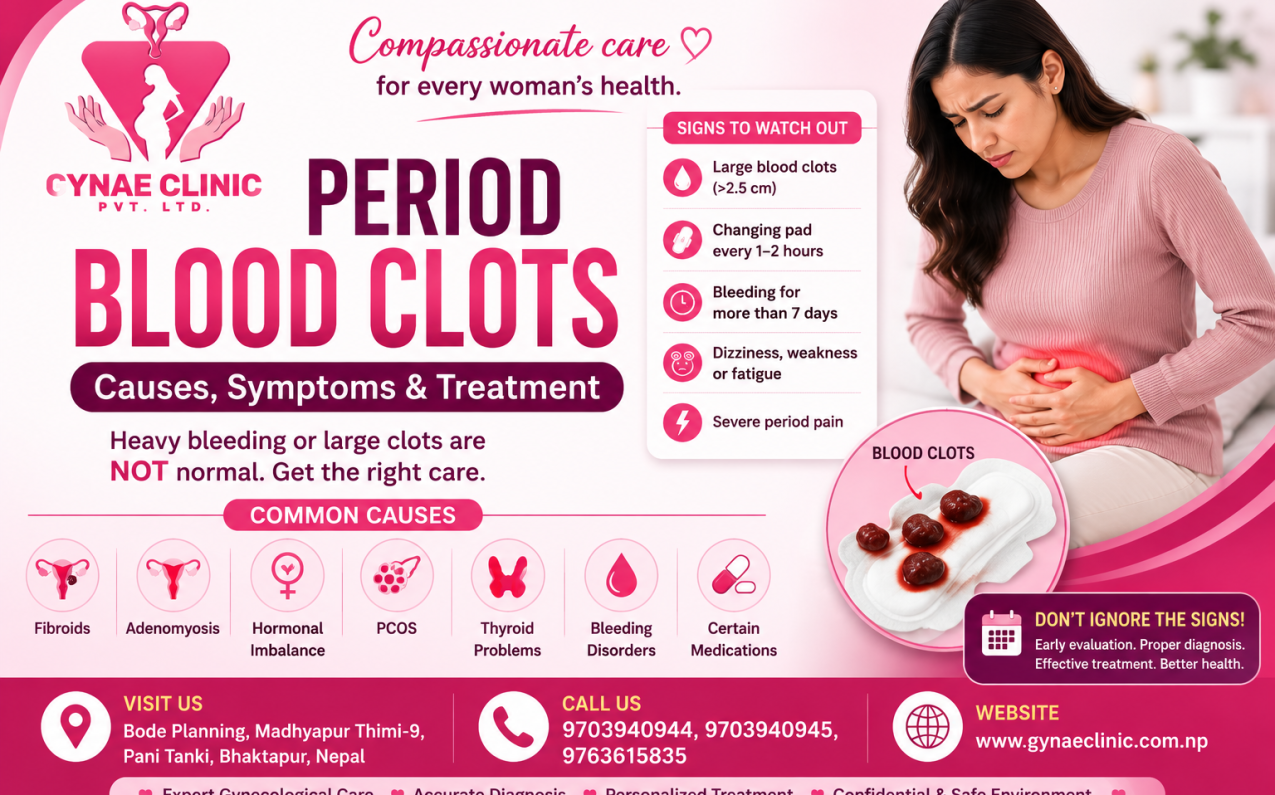
You should consider speaking with a gynecologist if your periods regularly involve:
- Large blood clots
- Very heavy bleeding
- Bleeding for more than 7 days
- Changing a pad or tampon every 1–2 hours
- Bleeding through clothes or bedding
- Severe period pain
- Increasing menstrual pain
- Dizziness or faintness
- Excessive tiredness
- Shortness of breath
- Bleeding between periods
- Bleeding after sex
ACOG considers bleeding that requires changing a pad or tampon more than once every 1–2 hours, periods lasting more than 7 days, or bleeding associated with dizziness or fainting to be signs that medical assessment may be needed.
The NHS also lists clots larger than approximately 2.5 cm as one sign that periods may be heavy.
Why Do Period Blood Clots Happen?
There are several possible reasons for passing menstrual blood clots.
1. Heavy Menstrual Bleeding
When menstrual bleeding is very heavy, blood can accumulate and clot before leaving the body.
Heavy periods may occur occasionally, but persistent heavy bleeding should be evaluated.
2. Hormonal Imbalance
Hormonal changes can affect ovulation and the thickness of the uterine lining.
When the lining becomes thicker, menstrual bleeding may be heavier and may contain more clots.
Hormonal problems can also cause:
- Irregular periods
- Delayed periods
- Heavy periods
- Prolonged bleeding
3. Uterine Fibroids
Uterine fibroids are non-cancerous growths in the uterus.
Depending on their size and location, fibroids can cause:
- Heavy periods
- Large menstrual blood clots
- Longer periods
- Pelvic pressure
- Pelvic pain
- Frequent urination
If heavy bleeding is caused by fibroids, treatment depends on the size, location, symptoms, age, reproductive plans and other factors.
4. Adenomyosis
Adenomyosis occurs when tissue similar to the uterine lining grows into the muscular wall of the uterus.
It can cause:
- Heavy periods
- Painful periods
- Pelvic pain
- Enlarged uterus
- Blood clots during menstruation
Women with increasingly painful and heavy periods should discuss their symptoms with a gynecologist.
5. Endometriosis
Endometriosis can cause significant period pain and other menstrual symptoms.
Possible symptoms include:
- Severe menstrual pain
- Pelvic pain
- Pain during sex
- Pain with bowel movements
- Heavy or irregular bleeding
- Difficulty becoming pregnant
Not every woman with endometriosis has heavy bleeding or clots, but significant menstrual symptoms deserve assessment.
6. PCOS and Irregular Ovulation
Polycystic ovary syndrome (PCOS) can affect menstrual regularity.
Women with PCOS may experience:
- Irregular periods
- Infrequent periods
- Heavy bleeding after a long gap
- Difficulty with ovulation
- Acne
- Excess facial or body hair
- Weight changes
If irregular periods are followed by unusually heavy bleeding or large clots, a gynecological evaluation may be appropriate.
7. Thyroid Problems
Thyroid disorders can affect menstrual cycles.
Depending on the condition, women may experience:
- Heavy periods
- Irregular periods
- Longer or shorter cycles
- Changes in menstrual flow
If menstrual changes are persistent, your doctor may consider thyroid testing depending on your symptoms and medical history.
8. Bleeding Disorders
Some women have an underlying bleeding disorder that can cause unusually heavy menstrual bleeding.
A bleeding disorder may be more likely if you have:
- Very heavy periods since your first menstruation
- Easy bruising
- Frequent nosebleeds
- Excessive bleeding after dental procedures
- Excessive bleeding after surgery
- A family history of abnormal bleeding
ACOG notes that bleeding disorders should be considered when evaluating women with excessive menstrual bleeding, particularly when there is a relevant personal or family history.
9. Certain Medicines
Some medicines can affect menstrual bleeding.
For example, medicines that affect blood clotting may increase bleeding.
If your menstrual bleeding changed after starting a medication, tell your doctor about all medicines and supplements you take.
Large Blood Clots During Periods: What Size Is Too Large?
There is no single clot size that automatically means a woman has a serious condition.
However, repeatedly passing clots around 2.5 cm or larger, particularly with heavy bleeding, is a reason to discuss your periods with a healthcare professional. The NHS uses clots larger than about 2.5 cm as one indicator of heavy periods.
More important than one isolated clot is the overall pattern:
Are your periods becoming heavier?
Are the clots getting larger or more frequent?
Are you bleeding for longer?
Are you becoming tired, dizzy or weak?
If yes, evaluation is advisable.
Period Blood Clots With Heavy Bleeding
Heavy bleeding together with clots deserves particular attention.
You may have heavy menstrual bleeding if you:
- Need to change your pad every 1–2 hours
- Bleed for more than 7 days
- Need multiple period products at once
- Leak through clothing or bedding
- Frequently pass large clots
- Feel tired or short of breath
- Avoid normal activities because of your period
These are recognized features of heavy menstrual bleeding.
Period Blood Clots With Severe Pain
Small clots with mild cramps can occur during a normal period.
However, large clots plus severe or worsening period pain should not simply be ignored.
Conditions such as fibroids, adenomyosis and endometriosis can contribute to painful or heavy periods.
Can Period Blood Clots Cause Infertility?
The clot itself does not usually cause infertility.
However, some conditions associated with heavy periods and clots may affect reproductive health.
For example:
- Endometriosis
- Fibroids
- Adenomyosis
- Certain hormonal disorders
- Some pelvic conditions
Therefore, if you have heavy periods and are also having difficulty becoming pregnant, discuss both concerns with a gynecologist.
Period Blood Clots After a Missed Period
If you have missed a period and then experience unusual heavy bleeding or clots, pregnancy should be considered, particularly if pregnancy is possible.
Bleeding during early pregnancy can have several causes, including miscarriage and ectopic pregnancy.
If unusual bleeding occurs together with abdominal or pelvic pain after a missed period, prompt medical assessment is important because ectopic pregnancy needs to be ruled out.
Period Blood Clots After Pregnancy or Miscarriage
Bleeding after pregnancy, miscarriage or a pregnancy-related procedure is different from a routine menstrual period.
If you are recently pregnant and experience heavy bleeding, large clots, severe pain, fever, fainting or feeling unwell, seek medical attention promptly.
Do not assume that heavy post-pregnancy bleeding is simply a normal period.
How Are Large Period Blood Clots Diagnosed?
Your gynecologist may first ask detailed questions about your menstrual pattern.
You may be asked:
- How long your period lasts
- How often you change pads
- How large the clots are
- How frequently you pass clots
- Whether your periods are regular
- How severe your pain is
- Whether you bleed between periods
- Whether you bleed after sex
- Whether pregnancy is possible
- Whether you have previous gynecological conditions
- Whether you have a history of anemia
- Whether there is a family history of bleeding disorders
Depending on your symptoms, evaluation may include:
- Physical or pelvic examination when appropriate
- Pregnancy test
- Blood tests
- Hemoglobin or complete blood count
- Iron-related testing when indicated
- Thyroid testing when appropriate
- Ultrasound
- Other investigations depending on the suspected cause
ACOG notes that evaluation of abnormal periods may involve medical history, examination, pregnancy testing, STI testing when relevant, blood tests and ultrasound depending on the individual situation.
Period Blood Clot Treatment in Bhaktapur
There is no single treatment for period blood clots.
Treatment depends on why the bleeding is occurring.
Possible treatment approaches may include:
Treatment for hormonal causes
Hormonal treatment may be considered when menstrual problems are related to hormonal or ovulatory disorders.
Treatment for heavy menstrual bleeding
Depending on the cause and individual circumstances, medicines may be used to reduce menstrual bleeding.
Treatment for anemia
If heavy periods have caused iron deficiency or anemia, your healthcare provider may recommend appropriate iron treatment and investigate the cause of blood loss.
Treatment for fibroids
Treatment depends on fibroid size, location, symptoms, age and reproductive plans.
Treatment for endometriosis or adenomyosis
Management may include medication and other individualized treatment options depending on symptoms and reproductive goals.
The goal is not simply to stop clots—it is to identify and treat the underlying cause of abnormal bleeding.
Can You Prevent Period Blood Clots?
You cannot always prevent menstrual clots because they can occur naturally during heavier menstrual flow.
However, you can help your doctor identify a problem early by tracking:
- Period dates
- Number of bleeding days
- Number of pads used
- Clot size
- Frequency of clots
- Pain severity
- Bleeding between periods
Keeping a menstrual record can make it easier to explain changes in your cycle during a consultation. ACOG also recommends tracking bleeding patterns when evaluating menstrual problems.
When Should You See a Gynecologist for Period Blood Clots?
Make an appointment if:
- You regularly pass large clots
- Your periods are becoming heavier
- Your period lasts more than 7 days
- You need to change pads every 1–2 hours
- You have severe menstrual pain
- You feel unusually tired
- You experience dizziness
- You have shortness of breath
- You bleed between periods
- You bleed after sex
- Your periods have suddenly changed
- Heavy periods are affecting your daily life
When Is Period Bleeding an Emergency?
Seek urgent medical care if bleeding is extremely heavy, especially if you are soaking through pads rapidly and experiencing:
- Fainting
- Severe dizziness
- Weakness
- Shortness of breath
- Rapid heartbeat
- Severe abdominal or pelvic pain
Very heavy bleeding can lead to significant blood loss and anemia. ACOG identifies heavy bleeding with dizziness or fainting as a reason to seek medical attention.
Period Blood Clots Treatment in Madhyapur Thimi
If you are searching for period blood clot treatment in Madhyapur Thimi, heavy period treatment near Bode, or a gynecologist for large menstrual clots near Thimi, Gynae Clinic Pvt. Ltd. is located at:
Bode Planning, Madhyapur Thimi-9, Pani Tanki, Bhaktapur, Nepal
Women from surrounding areas can contact the clinic for gynecological consultation regarding heavy periods, menstrual clots, painful periods and other menstrual concerns.
Period Blood Clot Treatment Near Bode
For women living in Bode, Gynae Clinic Pvt. Ltd. is located in Bode Planning itself.
If your periods have become unusually heavy or you are frequently passing large clots, a gynecological assessment can help determine whether further investigation is needed.
Period Blood Clot Treatment Near Gatthaghar
Women searching for period blood clot treatment near Gatthaghar can consider gynecological consultation in the nearby Madhyapur Thimi area.
Period Blood Clot Treatment Near Kausaltar
Women from Kausaltar experiencing heavy periods, large menstrual clots or severe period pain can seek gynecological consultation at Gynae Clinic Pvt. Ltd. in Bode Planning, Madhyapur Thimi-9.
Period Blood Clot Treatment Near Lokanthali
For women searching for heavy period treatment near Lokanthali, the Bode–Madhyapur Thimi area is a nearby option for gynecological consultation.
Period Blood Clot Treatment Near Balkumari
Women from Balkumari and surrounding areas can also consider Gynae Clinic Pvt. Ltd. for evaluation of heavy menstrual bleeding and menstrual problems.
Period Blood Clot Treatment in Thimi
If you are searching for period blood clot treatment in Thimi, Gynae Clinic Pvt. Ltd. is located at Bode Planning, Madhyapur Thimi-9, Bhaktapur.
Period Blood Clot Treatment in Bhaktapur
Gynae Clinic Pvt. Ltd. is located in Madhyapur Thimi-9, Bhaktapur, and is relevant for women searching for gynecological care from:
- Bode
- Madhyapur Thimi
- Thimi
- Gatthaghar
- Kausaltar
- Lokanthali
- Balkumari
- Nagadesh
- Manohara
- Sallaghari
- Radhe Radhe
- Suryabinayak
- Bhaktapur
- Koteshwor
- Jadibuti
- Pepsicola
- Kathmandu and surrounding areas
Frequently Asked Questions About Period Blood Clots
Is it normal to have blood clots during periods?
Small clots can occur during menstruation, especially during heavier bleeding. Frequent or large clots accompanied by heavy bleeding may need evaluation.
Why am I getting large blood clots during my period?
Possible causes include heavy menstrual bleeding, hormonal problems, fibroids, adenomyosis, endometriosis, bleeding disorders and other conditions. The cause cannot be determined from clot size alone.
Are large period blood clots a sign of fibroids?
They can occur with fibroids, but large clots do not automatically mean you have fibroids. An appropriate evaluation, and sometimes an ultrasound, may be needed.
What size period blood clot is concerning?
Clots around 2.5 cm or larger, particularly when they occur repeatedly with heavy bleeding, can be a sign of heavy periods and deserve medical discussion.
Can PCOS cause blood clots during periods?
PCOS can cause irregular ovulation and irregular periods. Some women may have heavier bleeding after a long gap between periods. A gynecological assessment can help determine the cause.
Should I worry about blood clots if my period is otherwise normal?
An occasional small clot without unusually heavy bleeding or other symptoms is often less concerning. However, any persistent change in your usual menstrual pattern should be discussed with a healthcare professional.
Can anemia happen because of heavy periods?
Yes. Repeated heavy menstrual bleeding can cause iron deficiency and anemia. Symptoms may include tiredness, weakness, dizziness or shortness of breath.
Period Blood Clot Treatment in Bhaktapur at Gynae Clinic Pvt. Ltd.
If you are concerned about large period blood clots, heavy menstrual bleeding, painful periods or sudden changes in your menstrual cycle, do not ignore persistent symptoms.
Gynae Clinic Pvt. Ltd. provides gynecological consultation for women in Bhaktapur and nearby areas.
Gynae Clinic Pvt. Ltd.
Address: Bode Planning, Madhyapur Thimi-9, Pani Tanki, Bhaktapur, Nepal
Contact: 9703940944, 9703940945, 9763615835
Website: www.gynaeclinic.com.np
Compassionate care for every woman’s health.
Complex cases may need specialized referral.
Final Takeaway
Period blood clots are not always abnormal. Small occasional clots can occur during normal menstruation, especially when bleeding is heavier.
However, repeated large clots, very heavy bleeding, periods lasting more than 7 days, severe pain, dizziness, weakness or a sudden change in your menstrual pattern should be evaluated.
The most important step is to identify the underlying cause rather than treating the clot itself.
Disclaimer
This article is for general health education and does not replace an examination, diagnosis or individualized medical advice. Menstrual blood clots can have different causes, and appropriate tests depend on your symptoms, age, medical history and pregnancy possibility. Seek urgent medical care for extremely heavy bleeding, fainting, severe dizziness, severe pain or other serious symptoms.
Author
Author: Gynae Clinic Pvt. Ltd. Medical Content Team
This article is prepared for general women’s health education. Individual diagnosis and treatment should be determined by a qualified healthcare professional.