

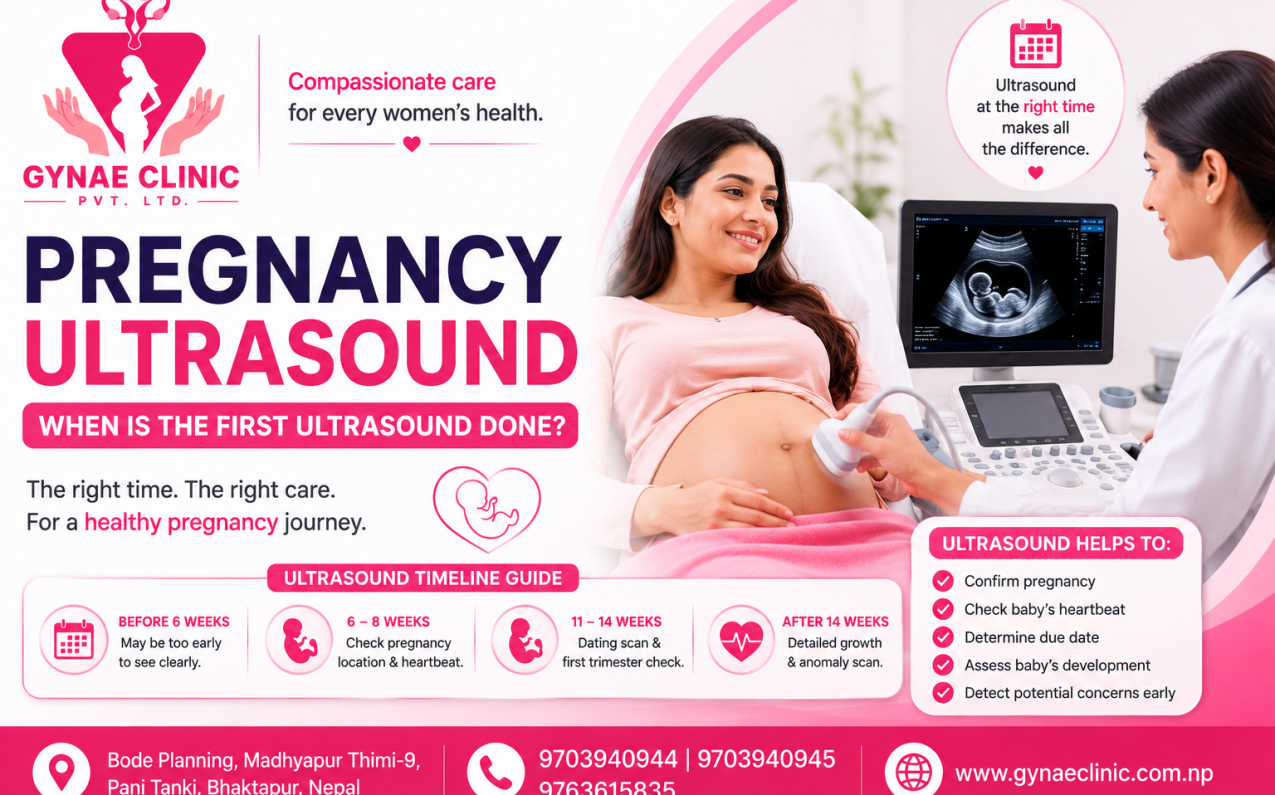
A pregnancy ultrasound is one of the most important investigations during early pregnancy. It can help confirm the location of the pregnancy, estimate how far along the pregnancy is, assess fetal development and, at the appropriate stage, evaluate the number of babies and early fetal anatomy.
But one common question is: “I just got a positive pregnancy test—when should I have my first ultrasound?”
The answer depends on how many weeks pregnant you are, your symptoms, your menstrual-cycle regularity and your medical history. An ultrasound performed too early may not show all the expected pregnancy structures, so timing matters.
At Gynae Clinic Pvt. Ltd., Bode Planning, Madhyapur Thimi-9, Bhaktapur, pregnancy care includes pregnancy consultation, ultrasound monitoring and laboratory investigations according to individual pregnancy needs.


5
When Is the First Pregnancy Ultrasound Done?
There is no single week that is right for every woman.
For a healthy pregnancy without concerning symptoms, an ultrasound is commonly performed during the first trimester to establish pregnancy dating and assess development. WHO recommends at least one ultrasound before 24 weeks, with the first-trimester period being particularly useful for estimating gestational age.
Depending on the situation, your gynecologist may recommend an ultrasound:
- Very early in pregnancy when there is a clinical reason
- Around 6–8 weeks to assess an early pregnancy when appropriate
- Around 11–14 weeks for dating and first-trimester assessment
- Earlier than this if you have pain, bleeding, uncertain dates or risk factors
The exact timing should be individualized.
Why Is the First Pregnancy Ultrasound Important?
A first ultrasound can provide information that a pregnancy test cannot.
It may help assess:
1. Location of the pregnancy
Ultrasound can help determine whether the pregnancy is located inside the uterus.
This is particularly important when a woman has pain or bleeding because an ectopic pregnancy can be serious.
2. Pregnancy development
As pregnancy progresses, ultrasound can assess structures and fetal development appropriate to the gestational age.
3. Gestational age
Ultrasound measurements can help estimate how far along the pregnancy is and establish or confirm the expected due date.
First-trimester ultrasound is particularly useful for pregnancy dating.
4. Number of babies
Ultrasound can identify whether there is:
- One pregnancy
- Twin pregnancy
- Multiple pregnancy
It can also provide information about the pregnancy configuration in multiple pregnancies.
5. Fetal cardiac activity
When the pregnancy has reached the appropriate developmental stage, ultrasound can assess fetal cardiac activity.
Can You Have an Ultrasound Immediately After a Positive Pregnancy Test?
You can, but it may be too early for a useful scan.
A positive urine pregnancy test means that hCG has been detected. It does not necessarily mean that an ultrasound will already show a clearly visible embryo.
Very early in pregnancy, ultrasound findings develop progressively.
With transvaginal ultrasound, a gestational sac may become visible around the early fifth week, although timing varies.
If an ultrasound is performed too early and the pregnancy is not yet clearly visible, this does not automatically mean that something is wrong.
Your doctor may recommend:
- Repeat beta-hCG testing
- Repeat ultrasound
- Waiting several days
- Another clinical assessment
This is why ultrasound should be interpreted together with your pregnancy dates and symptoms.
First Ultrasound Around 5–6 Weeks
An ultrasound around 5–6 weeks may sometimes be useful when early assessment is clinically indicated.
Depending on the exact gestational age, ultrasound may begin to show:
- Gestational sac
- Yolk sac
- Early embryo
- Developing cardiac activity
However, every pregnancy does not develop at exactly the same rate, and the date calculated from the last menstrual period may not always represent the actual conception or ovulation date.
This is especially important for women with:
- Irregular periods
- PCOS
- Late ovulation
- Uncertain last menstrual period
Therefore, an ultrasound that appears “too early” should not be interpreted without considering the full clinical picture.
First Ultrasound Around 6–8 Weeks
For many women, an ultrasound around 6–8 weeks can provide considerably more information than an extremely early scan.
Depending on gestational age, the scan may help assess:
- Pregnancy location
- Gestational sac
- Yolk sac
- Embryo
- Fetal cardiac activity
- Crown-rump length
- Number of pregnancies
Your gynecologist may recommend this timing if there is a reason to establish early pregnancy development.
First-Trimester Dating Ultrasound Around 11–14 Weeks
Another important ultrasound window is around 11–14 weeks.
At this stage, ultrasound can provide more comprehensive first-trimester assessment and pregnancy dating.
It may assess:
- Crown-rump length
- Gestational age
- Fetal development
- Number of fetuses
- Early anatomy
- Nuchal translucency when part of an appropriate screening assessment
The exact timing depends on the purpose of the scan and the screening protocol being followed.
WHO recommends first-trimester ultrasound as an effective way to estimate gestational age.
Which Is Better: 6–8 Weeks or 11–14 Weeks?
Neither is universally “better.” They answer different clinical questions.
An earlier ultrasound may be useful for:
- Confirming pregnancy location
- Assessing early pregnancy development
- Evaluating pain or bleeding
- Assessing pregnancy after fertility treatment
- Investigating uncertain pregnancy dates
- Previous ectopic pregnancy
- Other clinical concerns
An 11–14 week ultrasound may be useful for:
- More accurate first-trimester dating
- First-trimester fetal assessment
- Multiple-pregnancy assessment
- Certain early screening measurements
Your gynecologist can determine which scan is appropriate for your situation.
When Should You Have an Early Pregnancy Ultrasound?
You may need an earlier ultrasound if you have:
- Vaginal bleeding
- Abdominal pain
- One-sided pelvic pain
- Previous ectopic pregnancy
- Previous pregnancy complications
- Uncertain pregnancy dates
- Irregular periods
- Pregnancy after IVF or other fertility treatment
- Other medical concerns
An early scan is particularly important when symptoms could indicate an ectopic pregnancy.
Pregnancy Ultrasound If You Have Bleeding
Bleeding during early pregnancy should not automatically be assumed to be implantation bleeding or a normal period.
If you are pregnant and develop bleeding, contact a healthcare professional for advice.
Urgent assessment is especially important if bleeding occurs together with:
- Severe abdominal pain
- One-sided pain
- Dizziness
- Fainting
- Shoulder-tip pain
- Severe weakness
- Heavy bleeding
These symptoms can occur with ectopic pregnancy or other pregnancy complications.


5
What Happens During a First Pregnancy Ultrasound?
The type of ultrasound depends on your pregnancy stage and clinical situation.
Transabdominal ultrasound
A probe is moved over the abdomen after applying ultrasound gel.
It is commonly used as pregnancy progresses and can provide a broad view of the uterus and pregnancy.
Transvaginal ultrasound
A specially designed ultrasound probe is gently placed inside the vagina.
It can provide a clearer view of very early pregnancy because the probe is closer to the uterus.
Your doctor may recommend a transvaginal scan when the pregnancy is very early or when more detailed early assessment is needed.
Is Pregnancy Ultrasound Safe?
Ultrasound uses sound waves rather than ionizing radiation.
It is widely used in obstetric care.
WHO recommends ultrasound before 24 weeks to help estimate gestational age and improve detection of multiple pregnancies and fetal anomalies.
However, ultrasound should still be performed for appropriate medical reasons and interpreted by a qualified healthcare professional.
Does a Positive Pregnancy Test Mean You Need an Ultrasound Immediately?
Not always.
A positive pregnancy test and an ultrasound serve different purposes.
A pregnancy test helps detect pregnancy through hCG.
An ultrasound helps assess:
- Location
- Development
- Gestational age
- Number of pregnancies
- Other pregnancy-related findings
If you are feeling well and have no concerning symptoms, your gynecologist can determine the most useful timing for your first scan.
What If the Ultrasound Shows Nothing?
This is one of the most stressful situations for women who have just discovered they are pregnant.
If the pregnancy is very early, it may simply be too soon to see the expected structures.
Possible reasons include:
- Pregnancy is earlier than estimated
- Ovulation occurred later than expected
- Implantation occurred later
- Menstrual dates are uncertain
- The pregnancy is not developing normally
Your doctor may recommend a repeat ultrasound and/or beta-hCG testing rather than making a conclusion from one very early scan.
What If My Periods Are Irregular?
If your periods are irregular, the date of your last period may not accurately indicate when ovulation occurred.
This is common with:
- PCOS
- Irregular ovulation
- Long menstrual cycles
- Recent hormonal contraceptive use
In such situations, ultrasound can be particularly helpful for establishing pregnancy dates.
Pregnancy Test in Bhaktapur: Best Time, Types, Accuracy and Confidential Care
What If I Had IVF or Fertility Treatment?
Pregnancies following fertility treatment may require individualized early monitoring.
Tell your gynecologist if your pregnancy occurred after:
- IVF
- IUI
- Ovulation induction
- Fertility medicines
- Other assisted reproductive treatment
Your doctor may recommend an early ultrasound to assess the pregnancy according to your treatment history.
First Pregnancy Ultrasound: Simple Timeline
| Pregnancy stage | What the ultrasound may help assess |
|---|---|
| Very early pregnancy | Pregnancy location when clinically indicated |
| Around 5–6 weeks | Early gestational structures may become visible |
| Around 6–8 weeks | Early pregnancy development and cardiac activity when appropriate |
| Around 8–10 weeks | Pregnancy development and dating |
| Around 11–14 weeks | First-trimester dating and screening assessment |
| Before 24 weeks | WHO recommends at least one ultrasound for routine pregnancy care |
The exact timing should be individualized rather than based only on a calendar week.
First Pregnancy Ultrasound in Bhaktapur
If you are looking for a pregnancy ultrasound in Bhaktapur, Gynae Clinic Pvt. Ltd. provides pregnancy checkup and ultrasound services at:
Bode Planning, Madhyapur Thimi-9, Pani Tanki, Bhaktapur, Nepal
The clinic provides pregnancy monitoring, ultrasound and laboratory investigations according to individual pregnancy needs.
Women seeking pregnancy care from nearby areas can visit from:
Bode, Madhyapur Thimi, Sallaghari, Radhe Radhe, Gatthaghar, Lokanthali, Kaushaltar, Sanothimi, Jadibuti, Koteshwor, Pepsicola, Tinkune, Baneshwor, Suryabinayak, Jagati, Banepa and Dhulikhel.
Gynae Clinic Pvt. Ltd.
Address: Bode Planning, Madhyapur Thimi-9, Pani Tanki, Bhaktapur, Nepal
Contact:
9703940944
9703940945
9763615835
Website: www.gynaeclinic.com.np
Pregnancy Checkup at Gynae Clinic
Frequently Asked Questions
When should I have my first pregnancy ultrasound?
It depends on your pregnancy and medical history. An early scan may be appropriate around 6–8 weeks when clinically indicated, while first-trimester dating and screening assessment is commonly performed around 11–14 weeks.
Can ultrasound detect pregnancy at 4 weeks?
A pregnancy may be too early to clearly visualize at 4 weeks. Transvaginal ultrasound can sometimes identify very early pregnancy structures shortly afterward, but visibility depends on actual gestational age.
Is 6 weeks too early for an ultrasound?
Not necessarily. A 6-week ultrasound can be useful in selected circumstances, particularly when early pregnancy location or development needs assessment. However, findings can still be limited at this stage.
Is 8 weeks a good time for the first ultrasound?
For many women, an ultrasound around 8 weeks can provide useful information about pregnancy location and development. Your doctor will determine whether this timing is appropriate.
When is the dating ultrasound done?
Dating ultrasound is generally most useful during the first trimester. Depending on the healthcare system and purpose, it may be performed around 11–14 weeks.
Can ultrasound show twins in early pregnancy?
Yes. Ultrasound can identify multiple pregnancies, although the timing and clarity of the findings depend on gestational age.
Can an ultrasound tell exactly how many weeks pregnant I am?
Ultrasound can estimate gestational age, particularly when performed during the first trimester, but it is still an estimate rather than an exact measurement of the date of conception.
What if my ultrasound is too early and nothing is seen?
Your doctor may recommend repeating the ultrasound after an appropriate interval and/or checking beta-hCG levels. One very early scan should not be interpreted without considering your dates and clinical symptoms.
Is transvaginal ultrasound safe in early pregnancy?
Transvaginal ultrasound is commonly used for early pregnancy assessment. Your healthcare provider will determine whether it is appropriate for your circumstances.
Do I need an ultrasound after every positive pregnancy test?
No. The appropriate timing and number of ultrasounds depend on your pregnancy, symptoms, medical history and clinical needs.
Final Takeaway
The first pregnancy ultrasound does not have to be performed immediately after a positive pregnancy test.
For some women, an ultrasound around 6–8 weeks can provide useful early information. For others, the first planned scan may be around 11–14 weeks for dating and first-trimester assessment.
The right timing depends on:
Your pregnancy dates + symptoms + menstrual regularity + previous pregnancy history + medical needs.
If you have bleeding, severe abdominal pain, one-sided pain, dizziness, fainting or other concerning symptoms, seek prompt medical assessment rather than waiting for a routine ultrasound.
Early pregnancy care is about having the right scan at the right time, not simply having as many scans as possible.
Medical Disclaimer
This article is for general educational purposes and does not replace an individual medical consultation. The timing and type of pregnancy ultrasound should be determined according to gestational age, symptoms, medical history and clinical findings.
Author: Gynae Clinic Pvt. Ltd. Medical Content Team