
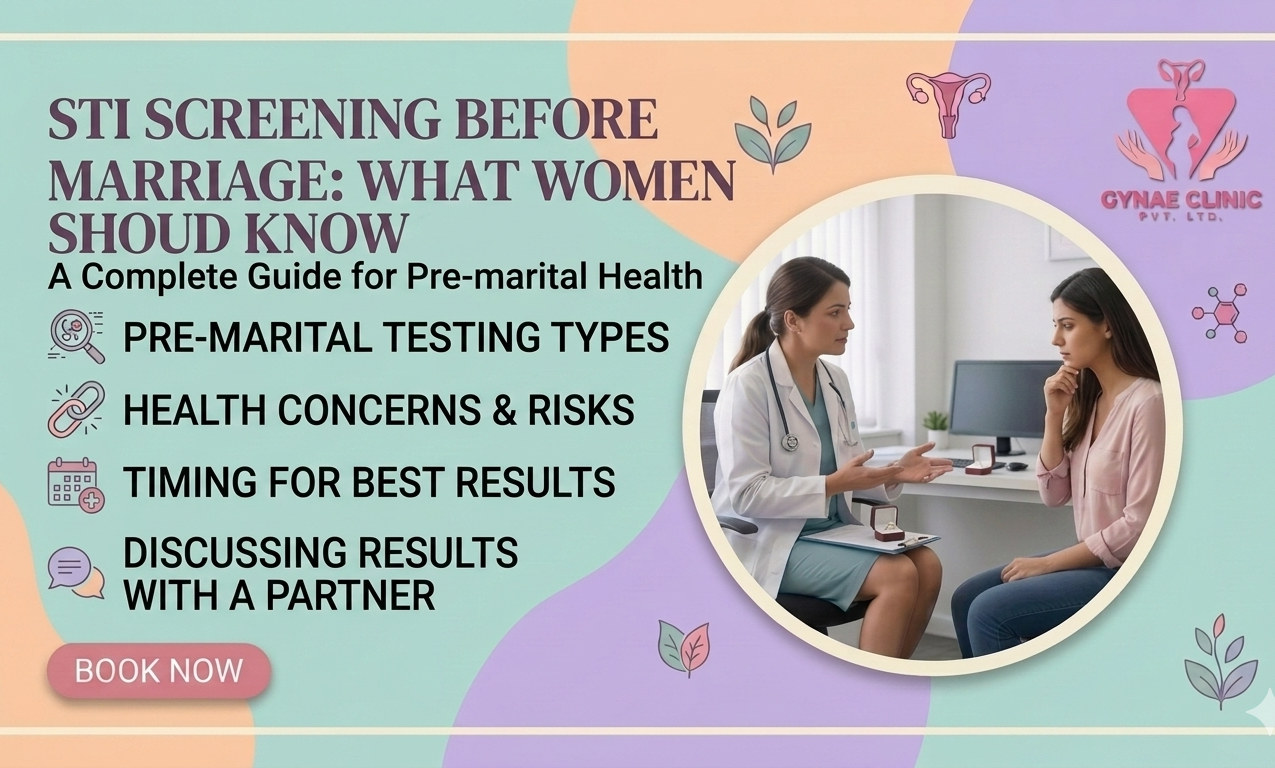
Getting married is an important life event, and sexual and reproductive health deserves attention before marriage. STI screening before marriage can help women understand their health status, identify infections that may not cause symptoms, and address concerns before starting a new stage of life.
Many sexually transmitted infections (STIs) can be present without obvious symptoms. A woman may feel completely healthy and still have an infection. Therefore, STI testing should not be considered only something to do when symptoms appear.
At Gynae Clinic Pvt. Ltd., Bhaktapur, women can discuss confidential sexual and reproductive health concerns and receive appropriate medical guidance based on their individual circumstances.
What Is STI Screening Before Marriage?
STI screening means testing for selected sexually transmitted infections when testing is appropriate based on a woman’s health, sexual history, possible exposure, symptoms, pregnancy plans, or other risk factors.
Pre-marriage sexual health screening may help identify infections such as:
- Chlamydia
- Gonorrhea
- Syphilis
- HIV
- Hepatitis B
- Hepatitis C
- Trichomoniasis
- Other infections when clinically indicated
There is no single test that detects every STI.
The tests recommended for one woman may be different from those recommended for another.
Should Every Woman Get STI Screening Before Marriage?
There is no universal STI test package that every woman must have before marriage.
However, a pre-marriage sexual health consultation can be worthwhile if you:
- Have had previous sexual exposure
- Have had unprotected sex
- Have a new partner
- Have had more than one sexual partner
- Have previously been diagnosed with an STI
- Have symptoms suggestive of an STI
- Have a partner who has or previously had an STI
- Are unsure about a previous partner’s sexual health
- Are planning pregnancy soon after marriage
- Simply want to discuss sexual and reproductive health before marriage
A healthcare professional can help determine which tests, if any, are appropriate.
Why STI Screening Before Marriage Can Be Important
1. Some STIs Have No Symptoms
One of the biggest misconceptions about STIs is that an infection will always cause obvious symptoms.
That is not true.
Some infections can be asymptomatic or cause symptoms so mild that they are not noticed.
A woman may therefore have no:
- Vaginal discharge
- Genital itching
- Pain
- Sores
- Burning urination
- Pelvic pain
and still require testing based on her individual circumstances.
2. It Can Identify an Infection Before Pregnancy
Many couples plan to have children after marriage.
A preconception or pre-marriage consultation provides an opportunity to discuss infections that may affect pregnancy and reproductive health.
Depending on individual circumstances, a healthcare professional may discuss testing for infections such as:
- HIV
- Syphilis
- Hepatitis B
- Hepatitis C
- Chlamydia
- Gonorrhea
- Other infections when appropriate
Finding and appropriately managing an infection before pregnancy can be an important part of reproductive healthcare.
3. Some Untreated Infections Can Affect Reproductive Health
Certain untreated sexually transmitted infections can cause complications.
For example, some genital infections can contribute to pelvic inflammatory disease (PID), which can potentially affect the reproductive system and fertility.
This does not mean that having an STI automatically causes infertility.
The important message is that appropriate diagnosis and treatment can help reduce the risk of complications.
4. It Can Give You an Opportunity to Ask Questions
A pre-marriage sexual health consultation is not only about laboratory tests.
It is also an opportunity to discuss:
- STI prevention
- Condom use
- HPV vaccination
- Hepatitis B vaccination
- Cervical cancer screening
- Menstrual health
- Vaginal health
- Sexual pain
- Contraception
- Pregnancy planning
- Previous STI concerns
- Reproductive health
You do not need to wait until you have a problem to discuss these topics.
What STI Tests May Be Considered Before Marriage?
The appropriate tests depend on your individual situation.
HIV Testing
HIV testing may be recommended based on individual risk, exposure and clinical circumstances.
Syphilis Testing
Syphilis is a sexually transmitted infection that can be detected through blood testing.
Hepatitis B Testing
Hepatitis B can be transmitted sexually and can also affect pregnancy and long-term health.
Testing and vaccination status may be discussed during a pre-marriage or preconception consultation.
Hepatitis C Testing
Hepatitis C is primarily blood-borne but can also be sexually transmitted in certain circumstances. Testing may be appropriate depending on individual risk factors.
Chlamydia and Gonorrhea Testing
These bacterial STIs can sometimes cause no symptoms.
Testing may involve urine or genital swab testing, depending on the situation and testing method.
Trichomoniasis Testing
Trichomoniasis can cause vaginal symptoms but may also occur without obvious symptoms.
Testing is considered when symptoms or individual circumstances make it appropriate.
Is HPV Testing Part of STI Screening Before Marriage?
HPV deserves special attention in women’s healthcare.
Human papillomavirus (HPV) is very common, and many infections do not cause noticeable symptoms.
Certain HPV types can cause genital warts, while persistent infection with certain high-risk types can contribute to cervical cancer.
However, HPV testing is not simply a routine STI test for every woman before marriage.
Cervical cancer screening recommendations depend on factors such as age, previous screening, medical history and local guidelines.
Talk to your gynecologist about the screening that is appropriate for you.
Is a Pap Smear the Same as STI Screening?
No.
A Pap smear or cervical screening test is different from STI testing.
Cervical screening is designed to identify cervical abnormalities and, depending on the screening method, HPV-related risk.
If you are going for a pre-marriage sexual health consultation, tell your doctor whether you have had cervical screening previously.
Your doctor can advise whether screening is appropriate.
What If a Woman Has No Symptoms?
This is an important question.
Having no symptoms does not automatically mean that STI testing is unnecessary.
The decision depends on individual circumstances.
For example, a woman who has never had sexual exposure may have different screening needs from a woman who has had previous unprotected sexual contact.
A woman with a partner diagnosed with an STI may need evaluation even if she feels completely healthy.
This is why a consultation is often more useful than simply choosing a large collection of tests without medical guidance.
What If a Woman Had a Previous Sexual Partner?
A previous sexual relationship does not automatically mean that you have an STI.
However, if there was possible exposure, particularly unprotected sexual contact, it may be appropriate to discuss STI testing with a healthcare professional.
You can simply tell your doctor:
“I had a previous sexual partner and I would like confidential advice about STI screening before marriage.”
You do not need to feel ashamed.
This information helps your healthcare professional provide appropriate medical advice.
What If My Future Partner Has Had Previous Sexual Partners?
The same principle applies.
A partner’s previous sexual history does not automatically mean that they have an STI.
However, open communication about sexual health and appropriate testing can help couples make informed decisions.
If your partner has previously been diagnosed with an STI, tell your healthcare professional.
Depending on the infection and circumstances, partner testing or treatment may be recommended.
Should Both Partners Get Tested Before Marriage?
There is no universal requirement that every couple undergoes the exact same STI tests.
However, both partners can consider discussing sexual health and appropriate screening with healthcare professionals, particularly when there has been previous sexual exposure or another reason for testing.
Couples may choose to have a pre-marriage sexual health discussion covering:
- STI testing
- HIV testing when appropriate
- Hepatitis screening when appropriate
- Previous STI history
- HPV vaccination
- Hepatitis B vaccination
- Pregnancy planning
- Contraception
- Cervical screening
- Sexual health concerns
The goal should be health, informed decision-making and prevention—not fear or stigma.
When Should STI Testing Be Done Before Marriage?
Timing matters.
If you have had a recent possible STI exposure, testing immediately may not detect every infection.
Different infections and different tests have different detection windows.
The appropriate timing depends on:
- Which infection is being considered
- Type of exposure
- Date of exposure
- Test being used
- Presence or absence of symptoms
- Partner’s diagnosis
If your wedding is approaching and you are concerned about a recent exposure, speak with a healthcare professional rather than waiting until the last moment.
What If the STI Test Is Positive?
A positive STI result can be stressful, but it does not mean your health or future is ruined.
Many STIs can be treated or managed appropriately.
Your healthcare professional can explain:
- What the result means
- Whether treatment is necessary
- What treatment is recommended
- Whether your partner should be tested
- Whether your partner requires treatment
- Whether sexual activity should temporarily be avoided
- Whether follow-up testing is necessary
- How to reduce the risk of reinfection
Do not self-medicate.
The correct treatment depends on the specific infection.
What If the STI Test Is Negative?
A negative result can be reassuring, but it should be interpreted according to the test and timing.
If testing was performed very soon after a possible exposure, your healthcare professional may recommend repeat testing depending on the infection being considered.
A negative result for one STI also does not mean that you have been tested for every other STI.
Ask what was actually tested.
Can an STI Affect a Future Pregnancy?
Some untreated infections can affect pregnancy or reproductive health.
This is why women planning pregnancy should discuss relevant sexual and reproductive health concerns with a healthcare professional.
If you are preparing for marriage and hope to become pregnant soon afterward, a preconception consultation can be especially useful.
It can address:
- STI screening when appropriate
- Vaccination
- Cervical screening
- Menstrual health
- Fertility concerns
- Medical conditions
- Medications
- Pregnancy planning
STI Screening Before Marriage Does Not Mean You Should Be Ashamed
There is still significant stigma around sexual health.
Some women may think:
“If I ask for an STI test, the doctor will think badly of me.”
That should not be the case.
STI testing is healthcare.
A woman may request testing because she wants to:
- Understand her health
- Protect a future pregnancy
- Address a previous exposure
- Respond to a partner’s diagnosis
- Start a marriage with greater health awareness
- Discuss sexual health privately with a professional
Seeking medical care is a responsible decision.
Confidential STI Screening for Women in Bhaktapur
If you are searching for:
“STI screening before marriage in Bhaktapur”
“STI test in Bhaktapur”
“STD test before marriage”
“women’s sexual health checkup in Bhaktapur”
or
“confidential gynecologist in Bhaktapur,”
Gynae Clinic Pvt. Ltd. provides confidential women’s gynecological and sexual health consultations.
You can discuss concerns related to:
- STI screening
- STD testing
- HIV testing
- Syphilis testing
- Chlamydia testing
- Gonorrhea testing
- Hepatitis testing
- HPV concerns
- Genital symptoms
- Vaginal discharge
- Genital itching
- Genital sores
- Pain during sex
- Burning urination
- Sexual health before marriage
- Pregnancy planning
- Reproductive health
Your consultation can be based on your individual circumstances rather than unnecessary testing.
What Should Women Ask During a Pre-Marriage Sexual Health Consultation?
You may want to ask:
“Do I need STI screening?”
Your healthcare professional can assess your individual circumstances.
“Which STI tests are appropriate for me?”
Not every test is necessary for every woman.
“When should I get tested?”
This is particularly important if there has been a recent possible exposure.
“Should my partner also be tested?”
The answer depends on the infection and individual circumstances.
“Do I need cervical screening?”
Your age, previous screening and medical history can determine whether screening is appropriate.
“Should I get the HPV vaccine?”
Discuss your vaccination history and eligibility with your healthcare professional.
“Are there any tests I should consider before pregnancy?”
A preconception consultation can help answer this.
Pre-Marriage Sexual Health Checklist for Women
Before marriage, consider discussing the following with a healthcare professional:
☐ Previous STI history
☐ Possible previous STI exposure
☐ Current vaginal or genital symptoms
☐ STI screening when appropriate
☐ HIV testing when appropriate
☐ Syphilis testing when appropriate
☐ Hepatitis testing when appropriate
☐ Chlamydia and gonorrhea testing when appropriate
☐ HPV vaccination
☐ Hepatitis B vaccination
☐ Cervical screening
☐ Menstrual health
☐ Contraception
☐ Pregnancy planning
☐ Sexual pain or discomfort
☐ Any concerns about a partner’s STI status
You do not necessarily need every item on this list. Your healthcare professional can help determine what is appropriate for you.
Frequently Asked Questions
Is STI screening necessary before marriage?
Not every woman requires the same STI tests before marriage. Testing may be appropriate depending on sexual history, previous exposure, symptoms, partner status, pregnancy plans and other individual factors.
Can I have an STI without symptoms?
Yes. Some STIs can be asymptomatic, so absence of symptoms does not always rule out infection.
Should both partners get STI testing?
Both partners can consider discussing sexual health and appropriate screening, particularly when there has been previous sexual exposure or another reason for testing.
How soon before marriage should I get an STI test?
There is no universal timing. If there has been a recent possible exposure, the appropriate timing depends on the infection and test. Speak with a healthcare professional rather than relying on a fixed number of days.
Is an STI test the same as a Pap smear?
No. STI testing and cervical screening are different.
Does a positive STI test mean I cannot get married?
No. A positive STI result does not automatically prevent marriage or pregnancy. Appropriate diagnosis, treatment or management and partner care may be necessary depending on the infection.
Can an STI affect fertility?
Some untreated STIs can cause complications that may affect reproductive health. Early diagnosis and appropriate treatment are important.
Should I tell my doctor about a previous sexual partner?
Yes. Providing accurate medical and sexual exposure information helps your healthcare professional recommend appropriate care.
Final Takeaway: Know Your Sexual Health Before Marriage
STI screening before marriage is not about suspicion, shame or judgment. It is about informed healthcare.
Some STIs can exist without symptoms, and certain untreated infections can affect reproductive health or pregnancy.
If you have had previous sexual exposure, experienced symptoms, had unprotected sex, have a partner with an STI, or simply have concerns about your sexual health before marriage, a confidential consultation can help you understand whether testing is appropriate.
You do not need to order every available STI test.
The right approach is individualized medical advice, appropriate testing, accurate interpretation of results and proper treatment when needed.
Gynae Clinic Pvt. Ltd. – Confidential Women’s Sexual Health Care in Bhaktapur
Clinic: Gynae Clinic Pvt. Ltd.
Address: Bode Planning, Madhyapur Thimi-9, Pani Tanki, Bhaktapur, Nepal
Website: www.gynaeclinic.com.np
Contact: 9703940944, 9703940945, 9763615835
Confidential gynecological, sexual health and reproductive health consultation for women in Bhaktapur.
Medical Disclaimer: This article is for general educational purposes and does not replace an individual medical consultation, examination, diagnosis or treatment plan. STI testing recommendations vary according to individual exposure, symptoms, medical history, pregnancy status and the infection being considered.
Author; Gynae Clinic Pvt. Ltd.