
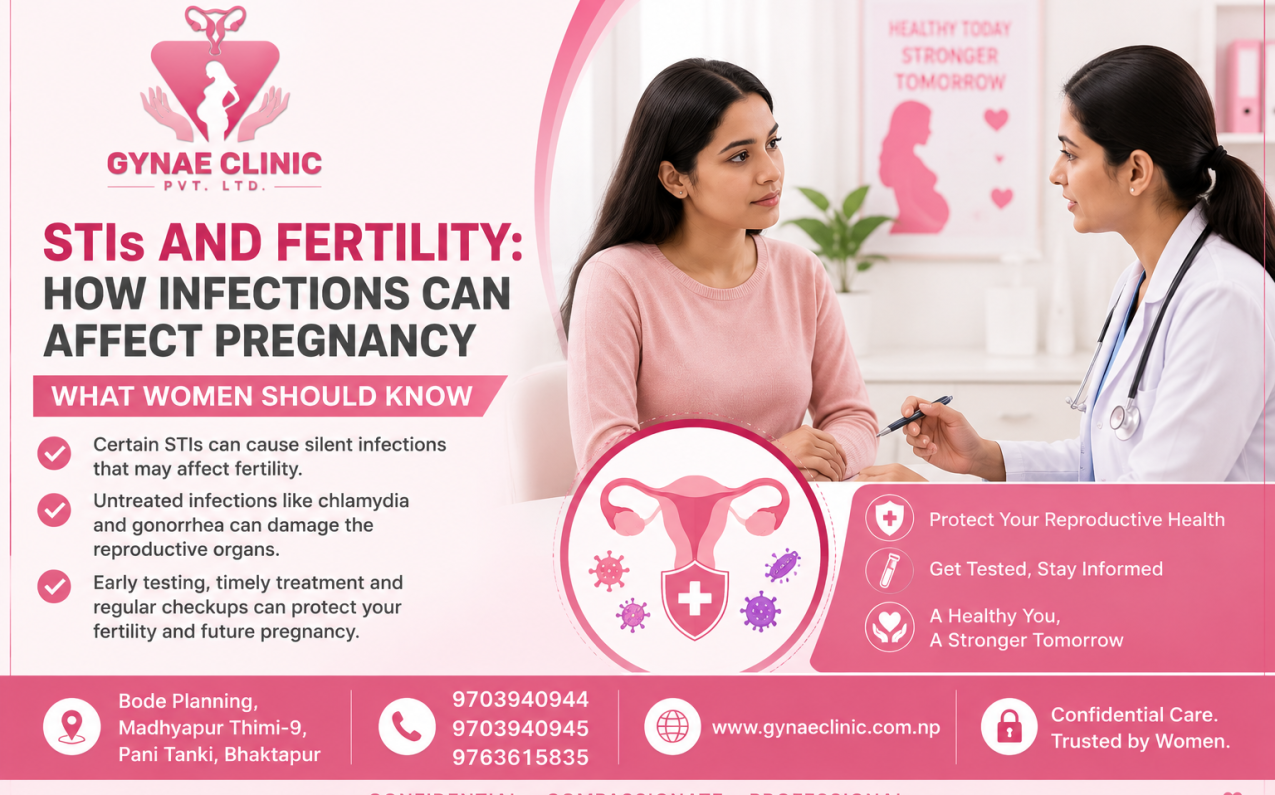
Trying to conceive is an important stage in a woman’s life, and protecting reproductive health before pregnancy can make a meaningful difference. One issue that should not be overlooked is sexually transmitted infections (STIs).
Some STIs can cause no noticeable symptoms, yet certain untreated infections—particularly chlamydia and gonorrhea—can damage the reproductive system and contribute to pelvic inflammatory disease (PID), infertility and ectopic pregnancy. STIs can also affect pregnancy after conception, with some infections capable of passing from mother to baby.
The good news is that many STIs are preventable, detectable and treatable. Knowing when to seek testing and treatment can help protect both fertility and future pregnancy.
At Gynae Clinic Pvt. Ltd., Bhaktapur, women can discuss STI testing, fertility concerns, pregnancy planning and other confidential gynecological health issues.
What Is the Connection Between STIs and Fertility?
Fertility depends on healthy ovaries, fallopian tubes, uterus, hormones and reproductive health.
Certain untreated STIs can cause inflammation and infection in the reproductive tract. In women, chlamydia and gonorrhea are important causes of pelvic inflammatory disease, which can damage the fallopian tubes. Tubal damage can make it harder for sperm and egg to meet and can increase the risk of ectopic pregnancy.
Importantly, having an STI does not automatically mean that a woman will become infertile.
The greatest concern is often an infection that remains untreated or causes complications.
Which STIs Can Affect Fertility?
1. Chlamydia and Female Fertility
Chlamydia is one of the most important STIs to consider when discussing female fertility.
It is frequently asymptomatic, meaning a woman may not know she has it. If untreated, chlamydia can cause pelvic inflammatory disease and damage the reproductive tract.
Potential complications include:
- Pelvic inflammatory disease
- Damage to the fallopian tubes
- Tubal-factor infertility
- Increased risk of ectopic pregnancy
- Chronic pelvic or abdominal pain
Early diagnosis and appropriate treatment can reduce the risk of complications.
2. Gonorrhea and Fertility
Gonorrhea is another bacterial STI that can affect reproductive health.
Like chlamydia, gonorrhea can sometimes occur without obvious symptoms. Untreated infection can contribute to pelvic inflammatory disease and infertility.
A woman may not realize that an infection has affected her reproductive system until she later experiences:
- Difficulty becoming pregnant
- Pelvic pain
- Problems related to the fallopian tubes
- Ectopic pregnancy
This is one reason appropriate STI testing and treatment matter.
What Is Pelvic Inflammatory Disease (PID)?
Pelvic inflammatory disease (PID) is an infection and inflammation involving the upper female reproductive organs.
It can involve structures such as the:
- Uterus
- Fallopian tubes
- Ovaries
- Surrounding pelvic tissues
STIs such as chlamydia and gonorrhea are important causes of PID.
PID does not always cause severe symptoms.
Some women may experience:
- Lower abdominal or pelvic pain
- Pain during sex
- Abnormal vaginal discharge
- Fever
- Bleeding between periods
- Painful urination
Other women may have mild symptoms or not realize they have an infection.
How Can PID Affect Fertility?
This is one of the most important reasons to take STI symptoms seriously.
Inflammation caused by PID can lead to scarring of the fallopian tubes.
If the tubes become damaged or blocked:
Sperm may have difficulty reaching the egg → fertilization may become more difficult → fertility can be affected.
Tubal damage can also increase the risk of an ectopic pregnancy, where a pregnancy develops outside the uterus.
Not every woman with PID develops infertility, but the risk can increase when infection is untreated or complications occur.
Can an STI Cause Infertility Without Symptoms?
Yes, it is possible.
This is an important reason not to rely only on symptoms.
Many STIs are asymptomatic, and a woman may not realize that an infection is present.
For example, untreated chlamydia can cause reproductive complications even when the initial infection produced little or no noticeable discomfort.
This does not mean every woman without symptoms needs every STI test.
Testing should be based on individual risk, exposure, symptoms, medical history and professional recommendations.
Can STIs Affect Pregnancy After You Become Pregnant?
Yes.
Some STIs can affect pregnancy or be transmitted from mother to baby during pregnancy or childbirth. WHO notes that STIs can contribute to complications such as stillbirth, prematurity, low birth weight and neonatal infections.
The impact depends on the specific infection.
For example:
Syphilis
Untreated syphilis during pregnancy can result in serious pregnancy and newborn complications, including stillbirth and congenital syphilis.
HIV
HIV can be transmitted from mother to baby, but appropriate medical care can substantially reduce transmission risk.
Hepatitis B
Hepatitis B can be sexually transmitted and can also be transmitted from mother to baby. Knowing a mother’s status helps healthcare professionals plan appropriate newborn care.
Chlamydia and Gonorrhea
These infections can be associated with pregnancy complications and can be transmitted to the newborn, including during delivery.
Does Having an STI Mean You Cannot Get Pregnant?
No.
An STI diagnosis does not automatically mean infertility.
Many STIs are curable, and early diagnosis and treatment can help prevent complications.
However, if an infection has already caused damage to the reproductive organs—particularly the fallopian tubes—fertility may be affected.
Therefore, the goal is not to fear an STI diagnosis.
The goal is to detect infections early, treat them appropriately and protect reproductive health.
How Long Can an STI Affect Fertility?
There is no single timeframe.
The effect depends on:
- Which STI is present
- How long the infection has been present
- Whether it has spread to the upper reproductive tract
- Whether PID developed
- Whether treatment was received
- Whether reproductive organs were damaged
An infection can sometimes be treated before permanent complications develop.
That is why delaying evaluation because symptoms seem mild is not a good idea.
What Symptoms May Suggest an STI or Pelvic Infection?
See a healthcare professional if you develop:
Unusual vaginal discharge
Especially discharge that is new, heavy, foul-smelling, yellow or green.
Burning while urinating
This can occur with urinary infections as well as some STIs.
Pelvic or lower abdominal pain
Persistent pelvic pain should not simply be ignored.
Pain during sex
Repeated pain during intercourse deserves gynecological evaluation.
Genital sores or blisters
These should be assessed rather than self-diagnosed.
Genital bumps or warts
New genital growths should be examined by a healthcare professional.
Bleeding after sex
Repeated or unexplained bleeding after intercourse should be evaluated.
Bleeding between periods
This can have many causes, including infections, hormonal conditions and cervical problems.
What If You Have No Symptoms?
You can still discuss STI screening with your doctor if you have:
- Had previous unprotected sexual contact
- Had a new sexual partner
- Had multiple sexual partners
- Had a previous STI
- Have a partner with an STI
- Are unsure about a previous partner’s STI status
- Are planning pregnancy
- Have fertility concerns
Your doctor can determine which tests are appropriate.
Should Women Get STI Testing Before Trying to Conceive?
A preconception consultation is a good opportunity to discuss sexual and reproductive health.
Depending on your circumstances, your doctor may consider testing for infections such as:
- Chlamydia
- Gonorrhea
- Syphilis
- HIV
- Hepatitis B
- Hepatitis C
- Trichomoniasis
- Other infections when clinically indicated
There is no universal STI test package that every woman needs.
The appropriate tests depend on your individual situation.
What About STI Testing During Pregnancy?
If you are already pregnant, it is not too late to discuss STI screening.
Antenatal care commonly includes important infectious disease screening. WHO recommends testing pregnant women for HIV, syphilis and hepatitis B at least once during pregnancy, as early as possible.
Additional testing may be recommended depending on symptoms, exposure, partner status and other risk factors.
What If Your Partner Has an STI?
If your partner has been diagnosed with an STI, tell your healthcare professional even if you feel completely healthy.
Depending on the infection, you may need:
- STI testing
- Treatment
- Repeat testing
- Partner treatment
- Temporary avoidance of sexual contact
- Pregnancy planning advice
Partner management is an important part of STI care.
Can STIs Affect Male Fertility Too?
Yes.
STIs are not only a women’s fertility issue.
Some infections can affect the male reproductive tract and may contribute to fertility problems.
Therefore, if a couple is experiencing difficulty conceiving or one partner has an STI, both partners may need appropriate evaluation.
Infertility can have many causes, and it should not automatically be blamed on an STI.
STI Prevention and Fertility Protection
Protecting fertility begins with preventing infections and seeking care when exposure occurs.
Important steps include:
Use condoms correctly
Consistent and correct condom use is an effective way to reduce the risk of many STIs.
Get appropriate STI testing
Testing can identify infections that may not cause symptoms.
Treat infections promptly
Do not ignore symptoms or delay treatment.
Follow partner treatment advice
If an STI is diagnosed, your partner may also need evaluation or treatment.
Consider vaccination
Vaccines are available for HPV and hepatitis B, two important infections relevant to sexual and reproductive health.
Have a preconception consultation
If you are planning pregnancy, discuss your sexual and reproductive health before trying to conceive.
Can STI Treatment Restore Fertility?
Treatment can cure certain infections and prevent further damage, but treatment cannot always reverse damage that has already occurred.
For example, antibiotics can treat bacterial infections such as chlamydia and gonorrhea, but if an infection has already caused significant tubal scarring, the existing damage may not necessarily be reversed.
This is why early diagnosis matters.
What If You Have Been Trying to Get Pregnant Without Success?
If you have been trying to conceive without success, do not assume an STI is the cause.
Infertility can result from many factors involving:
- Ovulation
- Fallopian tubes
- Uterus
- Endometriosis
- Hormones
- Age-related fertility changes
- Male-factor infertility
- Other medical conditions
- Unexplained factors
WHO notes that infertility can result from abnormalities involving the ovaries, uterus, fallopian tubes and endocrine system, among other causes.
If you have a history of STI or PID, tell your gynecologist because that information may be relevant to your evaluation.
When Should You See a Gynecologist About STI and Fertility?
Consider a consultation if:
- You have a known STI exposure
- Your partner has an STI
- You have symptoms of an STI
- You have previously had PID
- You have a history of untreated STI
- You are planning pregnancy
- You have concerns about fertility
- You have been trying to conceive without success
- You are worried that a previous STI may have affected your reproductive health
Early consultation can help determine whether STI testing, fertility evaluation or another type of examination is appropriate.
STI & Fertility: Important Facts at a Glance
| Concern | What women should know |
|---|---|
| Chlamydia | Can be asymptomatic and, if untreated, may cause PID, infertility and ectopic pregnancy |
| Gonorrhea | Can cause PID and reproductive complications if untreated |
| PID | Can damage the fallopian tubes and affect fertility |
| Syphilis | Can cause serious pregnancy and newborn complications if untreated |
| HIV | Requires appropriate medical care during pregnancy to reduce transmission risk |
| Hepatitis B | Can be sexually transmitted and can affect newborn health |
| Symptoms | Some STIs cause no noticeable symptoms |
| Testing | Should be based on individual circumstances |
| Treatment | Early treatment can prevent some complications |
| Fertility | STI history does not automatically mean infertility |
Frequently Asked Questions
Can an STI make a woman infertile?
Certain untreated STIs, particularly chlamydia and gonorrhea, can cause PID and damage the fallopian tubes, potentially affecting fertility.
Can I have an STI and still become pregnant?
Yes. An STI diagnosis does not automatically mean that pregnancy is impossible. Appropriate diagnosis and treatment are important.
Can chlamydia affect fertility?
Yes. Untreated chlamydia can cause PID, infertility and ectopic pregnancy.
Can gonorrhea affect fertility?
Yes. Gonorrhea can contribute to PID and infertility when untreated.
Can an STI affect my baby?
Some STIs can be transmitted during pregnancy or childbirth and may cause complications for the baby.
Should I get tested before pregnancy?
If you have had possible STI exposure, symptoms, previous STI history, a partner with an STI or concerns about reproductive health, discuss testing with a healthcare professional.
What if I had an STI years ago?
Tell your gynecologist. Your previous infection and treatment history may be relevant to your reproductive health and current testing needs.
Does treating an STI guarantee that fertility will be normal?
No. Treatment can cure certain infections and help prevent complications, but it cannot necessarily reverse reproductive-system damage that has already occurred.
Final Takeaway: Protect Your Sexual Health, Protect Your Fertility
STIs and fertility are closely connected, particularly when infections such as chlamydia or gonorrhea remain undiagnosed and untreated.
The important message is not to panic about STIs—it is to test when appropriate, treat infections promptly and seek medical advice when there is a possible exposure or fertility concern.
If you are planning pregnancy, have a history of STI or PID, have experienced possible exposure, or simply want to understand your reproductive health, a confidential gynecological consultation can help you determine the next appropriate step.
Your sexual health today can be an important part of protecting your reproductive health tomorrow.
Gynae Clinic Pvt. Ltd. – Women’s Sexual & Reproductive Health Care in Bhaktapur
Clinic: Gynae Clinic Pvt. Ltd.
Address: Bode Planning, Madhyapur Thimi-9, Pani Tanki, Bhaktapur, Nepal
Website: www.gynaeclinic.com.np
Contact: 9703940944, 9703940945, 9763615835
Confidential gynecological, STI, fertility and reproductive health consultation for women in Bhaktapur.
Medical Disclaimer: This article is for general educational purposes and does not replace an individual medical consultation, examination, diagnosis or treatment plan. STI testing and fertility evaluation should be individualized according to symptoms, exposure, medical history, reproductive goals and clinical assessment.
Author; Gynae Clinic Pvt. Ltd.