
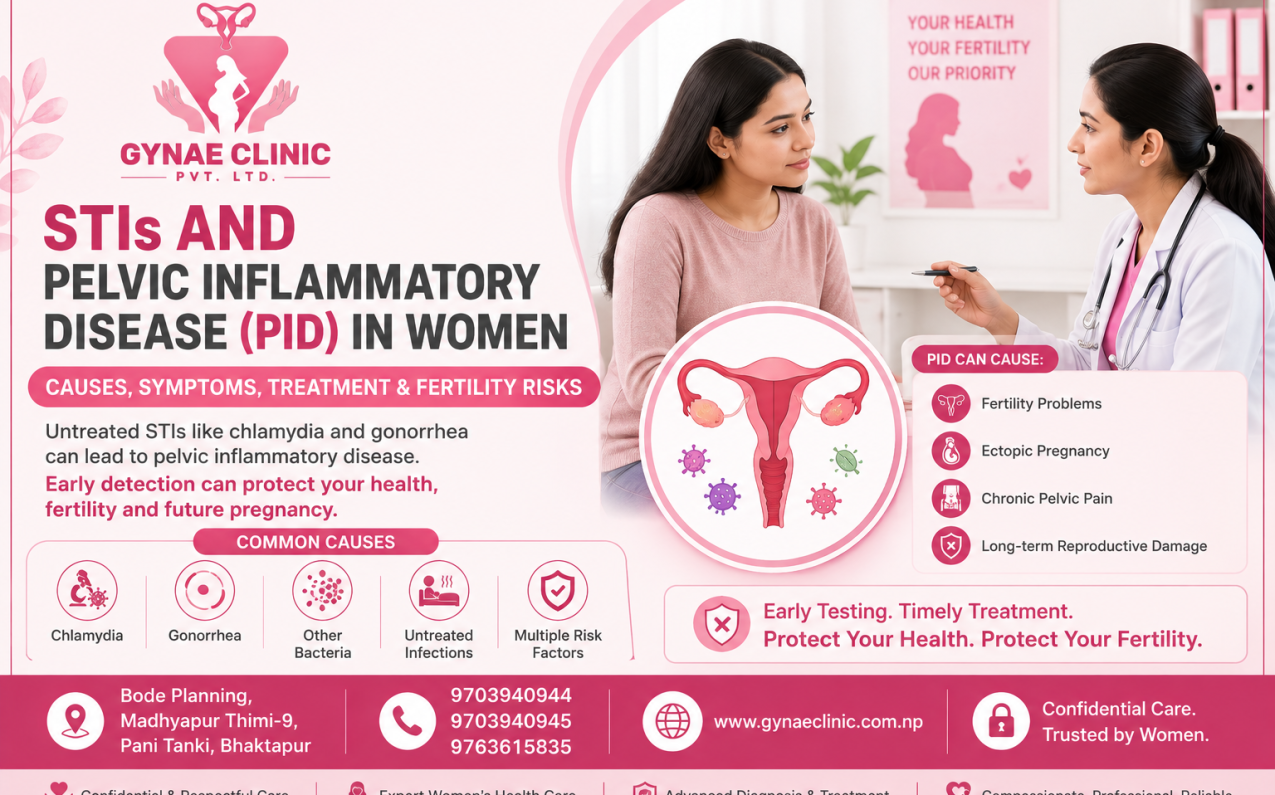
Pelvic inflammatory disease (PID) is an infection of the female reproductive organs that can affect the uterus, fallopian tubes and surrounding pelvic tissues. It is an important women’s health condition because untreated sexually transmitted infections—especially chlamydia and gonorrhea—are major causes of PID.
The problem is that PID does not always cause obvious symptoms. Some women may have mild symptoms or may not realize that an infection has reached the upper reproductive tract.
When PID is diagnosed and treated early, treatment can help prevent complications. Delayed or untreated PID can cause chronic pelvic pain, fallopian-tube damage, infertility and an increased risk of ectopic pregnancy.
At Gynae Clinic Pvt. Ltd., Bhaktapur, women can receive confidential gynecological and sexual health consultation for STI concerns, pelvic pain, abnormal discharge and reproductive health problems.
What Is Pelvic Inflammatory Disease?
Pelvic inflammatory disease is an infection involving the upper female reproductive system.
It may affect:
- Uterus
- Fallopian tubes
- Ovaries
- Surrounding pelvic tissues
PID can develop when bacteria from the lower genital tract move upward into the reproductive organs.
Chlamydia and gonorrhea are important sexually transmitted causes of PID, although PID can also involve other bacteria that are not necessarily sexually transmitted.
How Are STIs Connected to PID?
The connection can occur gradually:
STI → infection of the cervix → bacteria move upward → inflammation of reproductive organs → PID → possible reproductive complications
Chlamydia and gonorrhea are particularly important because they may cause few or no symptoms while infection continues.
WHO identifies chlamydia and gonorrhea as major causes of PID and infertility in women.
This is why simply feeling healthy does not always rule out an STI.
Can an STI Cause PID Without Symptoms?
Yes.
Many STIs are asymptomatic, and PID itself can sometimes be mild or difficult to recognize.
A woman may not have severe pelvic pain or fever but may still have an infection requiring medical evaluation.
This is one reason appropriate STI testing is important when there has been possible exposure or other risk factors.
Which STIs Are Most Commonly Associated With PID?
Chlamydia
Chlamydia is a major concern because it can be completely asymptomatic.
If untreated, chlamydia can lead to PID and may subsequently contribute to infertility or ectopic pregnancy.
Gonorrhea
Gonorrhea is another important sexually transmitted cause of PID.
Like chlamydia, it may sometimes occur without obvious symptoms.
Other Bacteria
PID is not caused exclusively by STIs.
Other bacteria from the genital tract can also contribute to PID. Therefore, having PID does not automatically prove that a woman has an STI.
What Are the Symptoms of PID?
PID can present differently from woman to woman.
Possible symptoms include:
- Lower abdominal pain
- Pelvic pain
- Pain during sexual intercourse
- Abnormal vaginal discharge
- Unusual vaginal odor
- Bleeding between periods
- Bleeding after sex
- Burning while urinating
- Fever
- Pain or tenderness in the lower abdomen
- Feeling unwell
Some women may have relatively mild symptoms.
Do not wait for severe pain before seeking medical advice.
Lower Abdominal Pain: Could It Be PID?
Lower abdominal or pelvic pain has many possible causes.
It can be related to:
- PID
- Urinary tract infection
- Ovarian cyst
- Endometriosis
- Menstrual-related conditions
- Pregnancy-related problems
- Ectopic pregnancy
- Other gynecological conditions
Therefore, pelvic pain should not automatically be diagnosed as PID—or as an STI—without medical assessment.
If you have pelvic pain together with unusual discharge, fever, pain during sex, abnormal bleeding or a possible STI exposure, seek gynecological evaluation.
Can PID Affect Fertility?
Yes.
This is one of the most important complications of PID.
Inflammation can cause scarring inside the fallopian tubes. If the tubes become damaged or blocked, sperm and egg may have difficulty meeting.
WHO identifies untreated STIs as a cause of tubal disorders and female infertility.
This does not mean that every woman with PID will become infertile.
However, the risk of reproductive complications is an important reason to diagnose and treat PID promptly.
How Can PID Cause Infertility?
A simplified process looks like this:
Infection
↓
Inflammation
↓
Damage to the reproductive tract
↓
Scar tissue inside or around the fallopian tubes
↓
Difficulty with normal movement of the egg
↓
Possible difficulty becoming pregnant
The amount of damage varies from woman to woman.
Some women with PID become pregnant normally, while others may experience fertility problems.
Can PID Increase the Risk of Ectopic Pregnancy?
Yes.
Damage to the fallopian tubes can increase the risk of an ectopic pregnancy, in which a fertilized egg implants outside the uterus, most commonly in a fallopian tube. WHO recognizes ectopic pregnancy as one of the possible long-term reproductive consequences associated with untreated STIs and tubal damage.
An ectopic pregnancy can become a medical emergency.
If you have a positive pregnancy test and develop severe one-sided abdominal pain, dizziness, fainting or vaginal bleeding, seek urgent medical care.
Can PID Cause Chronic Pelvic Pain?
Yes.
Inflammation and scarring following PID can contribute to persistent or recurrent pelvic pain.
However, chronic pelvic pain has many possible causes, so persistent pain should be evaluated rather than automatically attributed to previous PID.
Who Is More Likely to Develop PID?
Risk can be increased when a woman:
- Has an untreated STI
- Has a partner with an STI
- Has had a previous episode of PID
- Has multiple sexual partners
- Has unprotected sex
- Has a new sexual partner
- Has a history of STI exposure
These factors do not mean that a woman definitely has PID.
They simply indicate situations where sexual health evaluation may be particularly important.
Can You Have PID Even If You Have Never Had an STI?
Yes.
Although STIs such as chlamydia and gonorrhea are important causes, PID can also be caused by other bacteria that are not sexually transmitted.
Therefore, a diagnosis of PID should not automatically be interpreted as proof of infidelity or a recent STI.
Medical evaluation is needed to determine the likely cause and appropriate treatment.
How Is PID Diagnosed?
There is no single test that can always confirm PID.
A healthcare professional may consider:
Medical history
Your doctor may ask about:
- Pelvic pain
- Vaginal discharge
- Abnormal bleeding
- Sexual exposure
- Previous STI history
- Previous PID
- Pregnancy possibility
Physical examination
A gynecological examination may help identify pelvic tenderness or other signs of infection.
STI testing
Depending on your symptoms and history, your doctor may recommend testing for infections such as:
- Chlamydia
- Gonorrhea
- HIV
- Syphilis
- Other infections when appropriate
Urine or vaginal/cervical samples
Depending on the suspected infection, laboratory testing may involve urine or genital samples.
Pregnancy testing
Pregnancy may need to be ruled out when pelvic pain is present because ectopic pregnancy can mimic some symptoms.
Other investigations
Ultrasound or additional tests may sometimes be considered depending on symptoms and the clinical situation.
Is There a Specific Test Called a “PID Test”?
Not usually.
PID is primarily a clinical diagnosis based on symptoms, examination and supporting investigations.
An STI test can identify an underlying infection such as chlamydia or gonorrhea, but a negative STI test does not necessarily exclude PID because PID can involve organisms other than those tested.
This is why a woman with pelvic pain should receive an appropriate gynecological evaluation rather than relying on one laboratory test.
Can PID Be Treated?
Yes.
PID is treated with appropriate antibiotics selected according to the clinical situation.
Treatment should be started promptly when PID is suspected because delaying treatment can increase the risk of long-term complications.
Treatment may involve:
- Appropriate antibiotics
- Follow-up evaluation
- STI testing
- Partner evaluation when an STI is suspected or confirmed
- Temporary avoidance of sexual activity as advised
- Additional treatment or hospital care in severe cases
Do not self-medicate with antibiotics.
The correct medication and duration depend on the diagnosis and clinical circumstances.
Does PID Treatment Reverse Existing Fertility Damage?
Treatment can eliminate the infection and help prevent additional damage, but existing scar tissue may not always be reversible.
This is why early diagnosis matters.
Treating an STI before it progresses to PID is one of the best ways to reduce the risk of reproductive complications.
What Happens If an STI Is Found?
If testing identifies an STI, your doctor can explain:
- Which infection was detected
- What treatment is needed
- Whether your partner needs testing
- Whether your partner needs treatment
- Whether repeat testing is needed
- When sexual activity can safely resume
- How to reduce the risk of reinfection
Partner management is particularly important for infections such as chlamydia and gonorrhea.
Can PID Come Back?
Yes.
A woman who has had PID can develop another episode if she is exposed to another infection or if an underlying infection is not adequately addressed.
This is why preventing future STI exposure and following medical advice are important.
How Can Women Reduce the Risk of PID?
1. Get STI Testing When Appropriate
Because many STIs can be asymptomatic, testing may be important after a possible exposure or when recommended by a healthcare professional.
2. Treat STIs Promptly
Do not ignore symptoms or delay treatment.
3. Make Sure Partners Receive Appropriate Care
If an STI is diagnosed, partner evaluation and treatment may be necessary.
4. Use Condoms Correctly
Consistent and correct condom use reduces the risk of many STIs.
5. Avoid Self-Medication
Taking incomplete or inappropriate antibiotics can make proper treatment more difficult.
6. Seek Care for Persistent Symptoms
Unusual discharge, pelvic pain, bleeding after sex or genital symptoms should not simply be ignored.
What Women Should Know About PID and Pregnancy
If you are planning pregnancy and have:
- Previous PID
- Previous chlamydia
- Previous gonorrhea
- A history of untreated STI
- Previous ectopic pregnancy
- Difficulty becoming pregnant
- Chronic pelvic pain
tell your gynecologist.
A history of PID does not mean that pregnancy is impossible.
However, your medical history may be relevant when assessing fertility and pregnancy planning.
STI and PID Testing in Bhaktapur
If you are searching for:
“PID treatment in Bhaktapur”
“STI test in Bhaktapur”
“chlamydia test in Bhaktapur”
“gonorrhea test in Bhaktapur”
“pelvic pain treatment in Bhaktapur”
or
“gynecologist for PID in Bhaktapur,”
Gynae Clinic Pvt. Ltd. provides confidential women’s gynecological and sexual health consultation.
Women can discuss concerns related to:
- Pelvic inflammatory disease
- STI screening
- Chlamydia testing
- Gonorrhea testing
- Vaginal discharge
- Genital itching
- Genital sores
- Burning urination
- Pelvic pain
- Pain during sex
- Abnormal vaginal bleeding
- Fertility concerns
- Pre-pregnancy sexual health
- Reproductive health
When Should You See a Gynecologist?
Make an appointment if you have:
☐ Persistent lower abdominal or pelvic pain
☐ Unusual vaginal discharge
☐ Foul-smelling discharge
☐ Pain during sex
☐ Burning while urinating
☐ Bleeding between periods
☐ Bleeding after sex
☐ Fever with pelvic symptoms
☐ A known STI exposure
☐ A partner diagnosed with an STI
☐ Previous untreated chlamydia or gonorrhea
☐ Previous PID
☐ Fertility concerns
Seek urgent medical attention if:
You have severe or worsening pelvic/abdominal pain, fainting, dizziness, heavy bleeding, high fever, vomiting, or possible pregnancy with significant abdominal pain or bleeding.
These symptoms can indicate conditions requiring urgent assessment, including ectopic pregnancy or severe pelvic infection.
Frequently Asked Questions
Is PID always caused by an STI?
No. Chlamydia and gonorrhea are important causes, but other bacteria can also contribute to PID.
Can chlamydia cause PID?
Yes. Untreated chlamydia can lead to PID and reproductive complications such as infertility and ectopic pregnancy.
Can gonorrhea cause PID?
Yes. Gonorrhea is another major sexually transmitted cause of PID.
Can PID cause infertility?
Yes. PID can damage the fallopian tubes and contribute to infertility.
Can I have PID without severe symptoms?
Yes. PID can sometimes be mild or have few noticeable symptoms.
Can PID be cured?
The infection can be treated with appropriate antibiotics, but treatment may not reverse reproductive damage that has already occurred.
Should my partner be tested if I have PID?
If an STI is suspected or confirmed, partner evaluation and treatment may be recommended.
Can I become pregnant after PID?
Yes. Many women with a history of PID become pregnant. However, PID can increase the risk of fertility problems and ectopic pregnancy, depending on the extent of reproductive-tract damage.
Final Takeaway
STIs and pelvic inflammatory disease are important women’s health issues because untreated infections can sometimes cause lasting damage to the reproductive system.
Chlamydia and gonorrhea are major causes of PID, and many STI infections can occur without obvious symptoms.
The most important steps are:
Recognize symptoms → test when appropriate → treat infections promptly → manage partners when necessary → protect future fertility.
If you have pelvic pain, unusual discharge, abnormal bleeding, a possible STI exposure, previous PID or concerns about fertility, don’t ignore it.
Gynae Clinic Pvt. Ltd. – Women’s Sexual & Reproductive Health Care in Bhaktapur
Clinic: Gynae Clinic Pvt. Ltd.
Address: Bode Planning, Madhyapur Thimi-9, Pani Tanki, Bhaktapur, Nepal
Website: www.gynaeclinic.com.np
Contact: 9703940944, 9703940945, 9763615835
Confidential gynecological, STI and reproductive health consultation for women in Bhaktapur.
Medical Disclaimer: This article is for general educational purposes and does not replace an individual medical consultation, examination, diagnosis or treatment plan. Pelvic pain and suspected PID require professional medical assessment. Do not self-treat with antibiotics.
Author; Gynae Clinic Pvt. Ltd.