
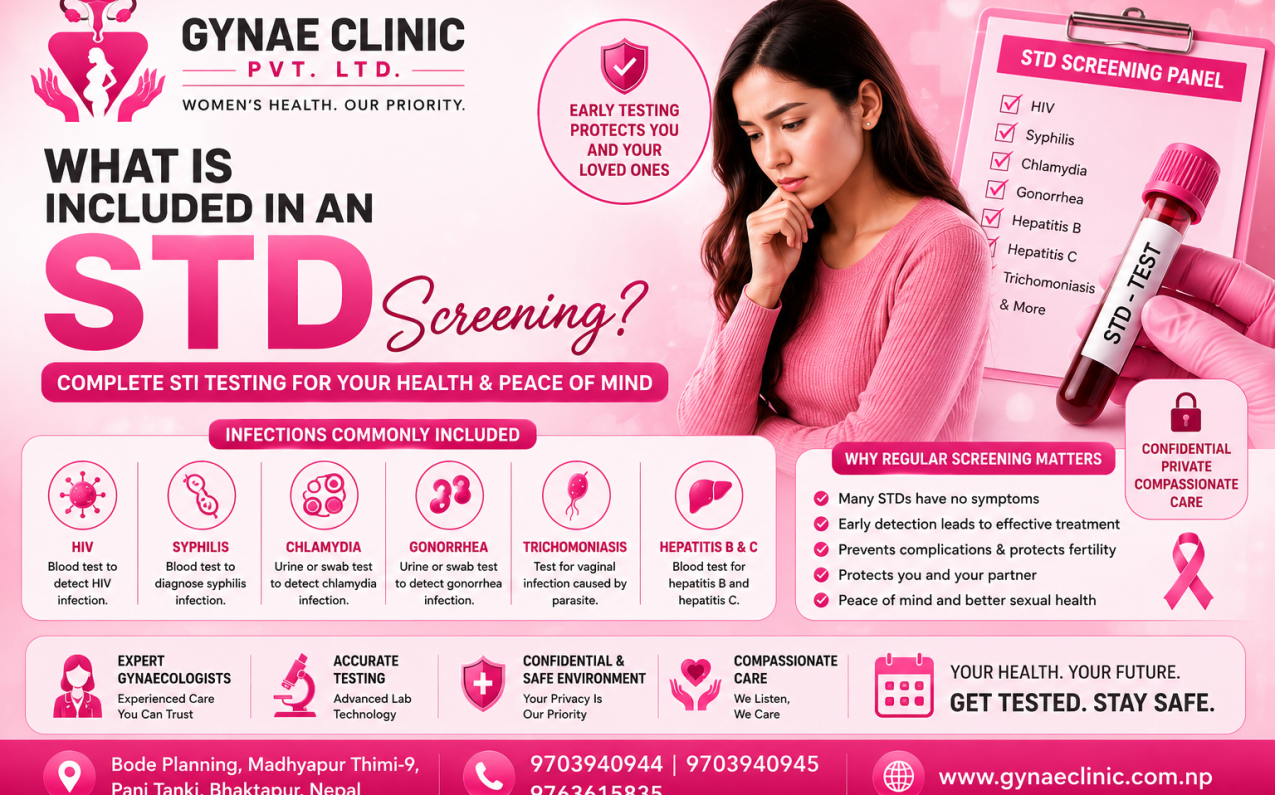
What is included in an STD screening? This is one of the most common questions women have when considering sexual health testing.
The important thing to understand is that there is no single universal “STD test” that checks for every sexually transmitted infection (STI). The tests included depend on your symptoms, sexual history, possible exposure, pregnancy status, age, risk factors and the services offered by the clinic or laboratory.
An STD/STI screening may include tests for HIV, syphilis, chlamydia, gonorrhea and other infections, but not every person needs every test. For example, chlamydia and gonorrhea are commonly tested with urine or genital samples, while HIV and syphilis are generally tested using blood. Testing from the throat or rectum may also be appropriate depending on the type of sexual exposure.
If you are searching for STD testing in Bhaktapur, understanding what an STI screening actually includes can help you ask for the right tests and avoid assuming that one negative result rules out every infection.
What Is an STD Screening?
An STD screening, also called STI screening, is a group of tests used to check for sexually transmitted infections.
Screening can be performed:
- When you have no symptoms but may have had an exposure
- When you have symptoms suggestive of an STI
- Before or during pregnancy when recommended
- After a partner is diagnosed with an STI
- After unprotected sexual contact
- As part of routine sexual health care
- When a healthcare professional recommends testing
Many STIs can cause no noticeable symptoms, so feeling healthy does not necessarily mean that an infection is absent.
What Is Usually Included in an STD Screening?
Depending on the individual situation, STI screening may include some combination of:
- HIV
- Syphilis
- Chlamydia
- Gonorrhea
- Trichomoniasis
- Hepatitis B
- Hepatitis C
- Other tests when clinically appropriate
However, these are not automatically included in every STD package.
Always ask the clinic:
“Which infections are included in my STD screening?”
This is especially important for HIV because an “STD test” does not necessarily mean that HIV was tested.
1. HIV Testing
HIV testing is an important part of sexual health screening.
HIV can be sexually transmitted and may remain without obvious symptoms for a long time.
Depending on the test used, HIV testing may involve:
- Blood testing
- Rapid testing
- Laboratory antigen/antibody testing
A fourth-generation laboratory HIV antigen/antibody test is one of the established testing methods used for HIV diagnosis.
If you have recently had a possible HIV exposure, testing time matters because no HIV test can detect an infection immediately after transmission.
Important:
A negative chlamydia or gonorrhea test does not mean that you are HIV-negative.
HIV requires an HIV-specific test.
2. Syphilis Testing
Syphilis is another important STI that may be included in sexual health screening.
Syphilis is commonly evaluated using blood tests.
The infection can progress through different stages, and symptoms may not always be obvious.
Possible symptoms can include:
- A painless sore
- Rash
- Swollen lymph nodes
- Fever
- Other systemic symptoms
Some people may have no noticeable symptoms.
Syphilis testing may involve more than one type of blood test depending on the clinical situation. CDC laboratory recommendations include both nontreponemal and treponemal serologic testing.
3. Chlamydia Testing
Chlamydia is one of the most important bacterial STIs to test for in sexually active women at increased risk.
Chlamydia can occur without symptoms.
When symptoms occur, they may include:
- Abnormal vaginal discharge
- Burning while urinating
- Pelvic pain
- Pain during sex
- Bleeding after sex
- Bleeding between periods
Chlamydia is commonly tested using a nucleic acid amplification test (NAAT).
Depending on the exposure and clinical situation, testing may use:
- Urine
- Vaginal sample
- Cervical sample
- Other site-specific samples
NAATs are established laboratory methods for detecting chlamydia.
4. Gonorrhea Testing
Gonorrhea is another important STI that may be included in screening.
Possible symptoms in women include:
- Abnormal vaginal discharge
- Burning while urinating
- Pelvic pain
- Pain during sex
- Bleeding between periods
- Bleeding after sex
However, gonorrhea can also occur without obvious symptoms.
Like chlamydia, gonorrhea is commonly tested using NAATs from an appropriate specimen.
Depending on sexual exposure, testing may involve:
- Urine
- Vaginal or cervical sample
- Throat sample
- Rectal sample
The appropriate sample depends on where exposure occurred.
5. Trichomoniasis Testing
Trichomoniasis is a sexually transmitted infection caused by the parasite Trichomonas vaginalis.
It can cause:
- Increased vaginal discharge
- Yellow or greenish discharge
- Unpleasant vaginal odor
- Vaginal irritation
- Genital itching
- Burning while urinating
- Discomfort during sex
Some women have no symptoms.
Trichomoniasis testing is not necessarily included in every standard STD panel. It may be considered based on symptoms, local prevalence and individual risk.
6. Hepatitis B Testing
Hepatitis B can be sexually transmitted and can also spread through blood exposure.
Blood testing can help determine whether someone:
- Has current hepatitis B infection
- Has evidence of previous infection
- Has immunity
Hepatitis B is especially important in women’s healthcare and pregnancy.
Depending on your medical history and pregnancy status, a healthcare professional may recommend hepatitis B testing.
7. Hepatitis C Testing
Hepatitis C is primarily transmitted through blood exposure, although sexual transmission can occur in certain circumstances.
Testing is performed using blood tests.
Hepatitis C is not necessarily included in every routine STD screening package, but it may be recommended depending on individual risk factors or pregnancy-related screening recommendations.
8. HPV Testing
HPV is sexually transmitted, but HPV testing is different from a typical STD panel.
For women, HPV testing is primarily used as part of cervical cancer screening.
It is important to understand the difference:
Pap smear
Looks for abnormal changes in cervical cells.
HPV test
Detects certain high-risk HPV types associated with cervical cancer risk.
STI testing
Looks for specific sexually transmitted infections such as chlamydia, gonorrhea or syphilis.
A normal Pap smear does not mean that you have tested negative for every STI.
What Samples Are Used for STD Testing?
Different infections require different types of specimens.
Blood Tests
Blood may be used for:
- HIV
- Syphilis
- Hepatitis B
- Hepatitis C
Urine Tests
Urine can be used for certain tests, particularly:
- Chlamydia
- Gonorrhea
Vaginal or Cervical Samples
Swabs may be used for:
- Chlamydia
- Gonorrhea
- Trichomoniasis
- Other genital infections
Throat Swabs
Depending on sexual exposure, testing from the throat may be appropriate for infections such as:
- Gonorrhea
- Chlamydia in selected circumstances
Rectal Samples
Rectal testing may be recommended when there has been relevant sexual exposure.
CDC recommendations recognize that STI testing may involve blood, urine and swabs from different anatomical sites depending on the infection and exposure.
Does an STD Screening Include HIV?
Sometimes—but not automatically.
This is one of the most important things to remember.
An STD screening package may include:
- HIV
- Syphilis
- Chlamydia
- Gonorrhea
But another clinic may offer only:
- Chlamydia
- Gonorrhea
Therefore, always ask what is included before assuming you have been tested for HIV.
CDC recommends HIV testing for people seeking STI evaluation who are not already known to have HIV.
Does an STD Screening Include Herpes?
Not necessarily.
Herpes testing is different from routine screening for infections such as chlamydia and gonorrhea.
If you have:
- Genital blisters
- Painful sores
- Recurrent genital lesions
a healthcare professional may recommend specific evaluation for herpes.
Routine blood testing for herpes in people without symptoms is not appropriate for everyone, so the decision should be individualized.
Does an STD Screening Include HPV?
Not usually as part of a general STI panel.
HPV testing is primarily used in cervical cancer screening.
Women may be advised to have:
- Pap testing
- HPV testing
- HPV/Pap co-testing
depending on their age, screening history and applicable clinical recommendations.
Does a Pap Smear Count as an STD Screening?
No.
A Pap smear is primarily a cervical cancer screening test.
It should not be used as a substitute for STI testing.
For example, a woman could have:
- Chlamydia with a normal Pap result
- Gonorrhea with a normal Pap result
- HIV with a normal Pap result
- Syphilis with a normal Pap result
If STI exposure is a concern, specific STI tests may be necessary.
Who Should Consider STD Screening?
STI screening may be appropriate if you:
- Have a new sexual partner
- Have multiple sexual partners
- Have had unprotected sex
- Had a condom break or slip
- Have a partner with an STI
- Have symptoms of an STI
- Have previously had an STI
- Are pregnant
- Are concerned about a recent sexual exposure
- Are seeking evaluation or treatment for an STI
Screening recommendations differ according to age, sex, pregnancy and individual risk factors.
Should You Get an STD Test Even Without Symptoms?
Sometimes, yes.
Many STIs can be asymptomatic.
You may have no:
- Pain
- Discharge
- Itching
- Odor
- Bleeding
- Sores
and still have an STI.
That is why screening based on exposure and risk can be important.
CDC emphasizes that many STIs have no symptoms and recommends discussing appropriate testing with a healthcare professional.
What If You Have STD Symptoms?
If you have symptoms, you may need diagnostic testing, not simply routine screening.
Symptoms that deserve evaluation include:
- Unusual vaginal discharge
- Yellow or green discharge
- Strong vaginal odor
- Burning while urinating
- Pelvic pain
- Lower abdominal pain
- Pain during sex
- Bleeding after sex
- Bleeding between periods
- Genital itching
- Genital sores
- Genital bumps
Do not assume that every vaginal symptom is an STI.
Yeast infection, bacterial vaginosis, urinary infections, hormonal changes and other gynecological conditions can cause similar symptoms.
How Long After Sex Should You Get an STD Test?
There is no single testing time that applies to every STI.
Different infections and different tests have different window periods.
Your healthcare professional may consider:
- Date of sexual exposure
- Type of sexual contact
- Symptoms
- Type of test
- Whether you have had previous testing
- Whether repeat testing is needed
If you had a very recent possible HIV exposure, seek medical advice promptly rather than waiting for symptoms. PEP may be appropriate for some exposures when started within 72 hours.
Can One STD Test Detect Every STI?
No.
There is no single test that reliably detects every sexually transmitted infection.
For example:
HIV test → HIV
Syphilis blood test → Syphilis
Chlamydia NAAT → Chlamydia
Gonorrhea NAAT → Gonorrhea
HPV test → Certain high-risk HPV types
Each test answers a different medical question.
How Long Do STD Test Results Take?
The time depends on:
- Which infection is being tested
- The type of test
- Whether testing is performed in-house
- Laboratory processing
- Whether confirmatory testing is required
Some tests can produce results quickly, while others may require additional laboratory processing.
Ask the testing center when you submit your sample when and how you will receive your results.
What Happens After a Positive STD Test?
A positive result does not mean that your health is ruined.
Many STIs can be treated or managed effectively.
Depending on the infection, treatment may involve:
- Antibiotics
- Antiviral medication
- Antiparasitic medication
- Monitoring
- Follow-up testing
Your healthcare professional may also discuss:
- Partner testing
- Partner treatment
- Temporary avoidance of sexual activity
- Retesting
- Prevention strategies
Do not take antibiotics without appropriate medical advice.
Why Early STD Testing Matters for Women
Early diagnosis can be particularly important for women’s reproductive health.
Some untreated STIs can lead to complications such as:
- Pelvic inflammatory disease
- Chronic pelvic pain
- Infertility
- Ectopic pregnancy
- Pregnancy complications
Chlamydia and gonorrhea are particularly important because untreated infections can ascend into the upper reproductive tract.
Getting tested when appropriate can help identify infections before complications develop.
STD Screening in Bhaktapur
If you are searching for STD testing in Bhaktapur, STI screening in Bhaktapur, HIV testing in Bhaktapur, chlamydia testing in Bhaktapur, gonorrhea testing in Bhaktapur, or a women’s health clinic in Bhaktapur, choosing appropriate testing is more important than simply asking for a generic “STD test.”
At Gynae Clinic Pvt. Ltd., women can seek professional consultation for sexual and reproductive health concerns, including:
- STD/STI testing
- HIV testing concerns
- Chlamydia
- Gonorrhea
- Syphilis
- Trichomoniasis
- Hepatitis-related concerns
- Vaginal discharge
- Vaginal odor
- Pelvic pain
- Burning while urinating
- Bleeding after sex
- Genital itching
- Genital sores or bumps
- Fertility concerns
- Pregnancy-related women’s health
Gynae Clinic Pvt. Ltd.
Address:
Bode Planning, Madhyapur Thimi-9, Pani Tanki, Bhaktapur, Nepal
Website:
www.gynaeclinic.com.np
Contact:
9703940944 | 9703940945 | 9763615835
If you are unsure which STD tests you need, a qualified healthcare professional can review your symptoms and sexual exposure and recommend appropriate testing.
Frequently Asked Questions
What is included in an STD screening?
Depending on the clinic and your individual circumstances, screening may include HIV, syphilis, chlamydia, gonorrhea, hepatitis B, hepatitis C or trichomoniasis. There is no universal STD panel.
Does an STD test include HIV?
Sometimes, but not always. Always ask which infections are included in the specific testing package.
Does an STD test include chlamydia and gonorrhea?
Many STI evaluations include chlamydia and gonorrhea testing when appropriate, usually using urine or genital samples.
Is syphilis included in an STD screening?
It may be. Syphilis is generally tested using blood tests, and screening is recommended according to individual risk and clinical circumstances.
Does an STD test include hepatitis B and C?
Not necessarily. Hepatitis B and C testing may be recommended depending on risk factors, pregnancy and other clinical considerations.
Does an STD screening include herpes?
Not automatically. Herpes testing is generally considered based on symptoms and individual circumstances.
Does a Pap smear test for STDs?
No. A Pap smear is primarily a cervical cancer screening test and should not be considered a complete STI screen.
Can you have an STD without symptoms?
Yes. Many STIs can cause no noticeable symptoms. Testing may therefore be appropriate even when you feel healthy.
How many tests are needed for a complete STD screening?
There is no fixed number. The appropriate tests depend on your symptoms, exposure, sexual practices, pregnancy status and individual risk.
Can one blood test detect all STDs?
No. Different infections require different tests, and some STIs are better detected using urine or swab samples.
Final Takeaway
What is included in an STD screening? It depends.
There is no single universal STD test that detects every sexually transmitted infection.
Depending on your individual circumstances, screening may include:
- HIV
- Syphilis
- Chlamydia
- Gonorrhea
- Trichomoniasis
- Hepatitis B
- Hepatitis C
- Other specific tests when medically appropriate
The type of sample also varies. Blood, urine, vaginal/cervical swabs, throat swabs or rectal samples may be used depending on the infection and exposure.
Most importantly, do not assume that a generic “STD test” checks everything. Ask exactly which infections are included.
If you have had a possible sexual exposure or have symptoms such as unusual vaginal discharge, pelvic pain, burning urination, bleeding after sex, genital sores or itching, professional evaluation can help determine which tests are appropriate.
Gynae Clinic Pvt. Ltd.
Bode Planning, Madhyapur Thimi-9, Pani Tanki, Bhaktapur, Nepal
9703940944 | 9703940945 | 9763615835
www.gynaeclinic.com.np
Medical Disclaimer
This blog is for general health information only and does not replace professional medical advice, diagnosis or treatment. STI testing should be selected according to individual symptoms, exposure and clinical circumstances.