


Author: Gynae Clinic Pvt. Ltd.
Having your period arrive earlier than expected can be confusing, especially when it happens every month. While menstrual cycles naturally vary from woman to woman, repeatedly getting periods very early may sometimes indicate a change in your menstrual cycle, hormones, ovulation, thyroid function, contraception, or another gynecological condition.
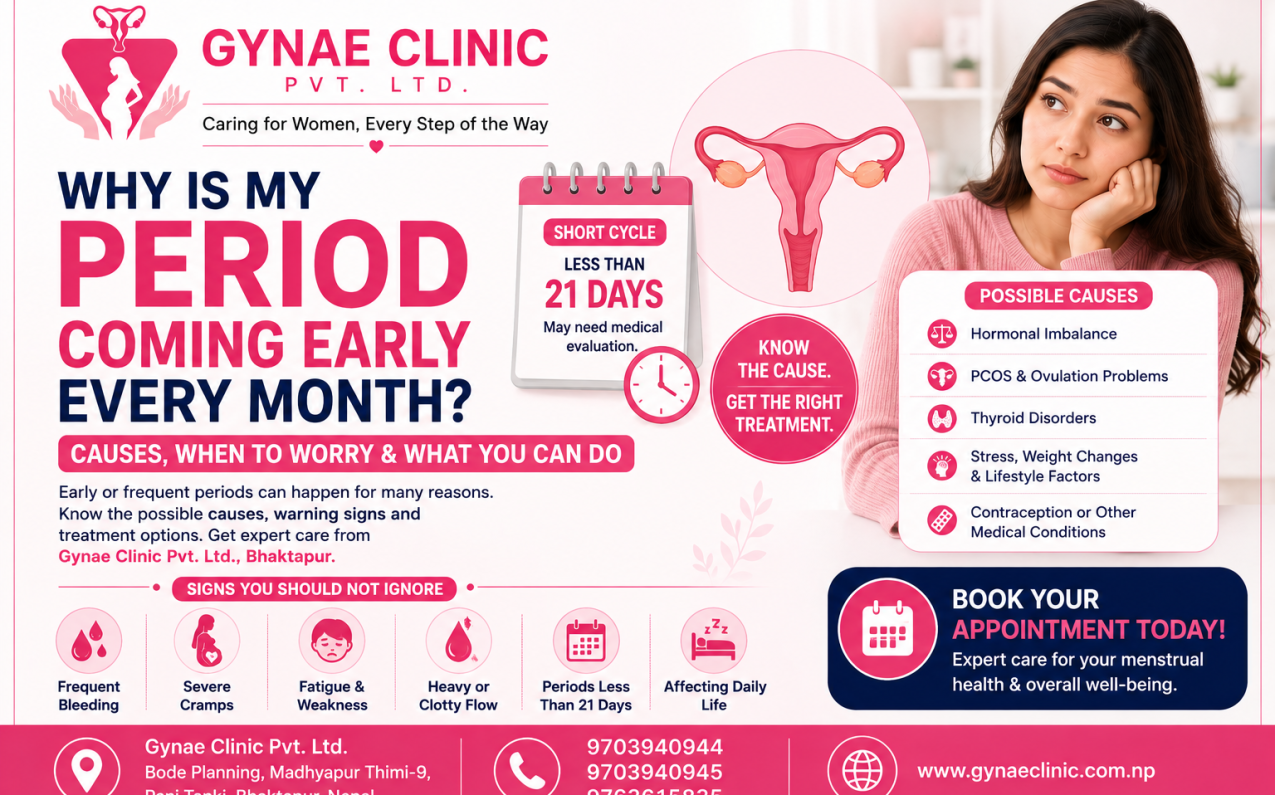
For most adults, a menstrual cycle of approximately 21–35 days can be within the normal range. If the time from the first day of one period to the first day of the next is consistently less than 21 days, the periods are considered unusually frequent and deserve medical evaluation.
The important question is not simply “Why is my period early?” but:
“Why has my menstrual cycle become shorter than usual?”
This complete guide explains the possible causes of frequent or early periods, how doctors investigate them, when treatment may be needed, and where women in Bhaktapur and nearby areas can seek gynecological care.
What Does “Period Coming Early” Actually Mean?
Many women say their period is coming early when they notice bleeding sooner than expected.
But the menstrual cycle should be counted from:
Day 1 = the first day of proper menstrual bleeding
to:
Day 1 of the next menstrual period.
For example:
- Period starts on January 1
- Next period starts on January 29
- Cycle length = 28 days
That is generally within the expected adult range.
But if your periods start:
- January 1
- January 20
- February 8
- February 27
your cycles are around 19–20 days apart.
If this pattern continues, it is worth discussing with a gynecologist.
Is It Normal to Get Your Period Early?
Sometimes, yes.
A menstrual cycle does not have to be exactly 28 days every month. Some women naturally have somewhat shorter or longer cycles.
Occasional variation can happen because of:
- Stress
- Illness
- Changes in sleep
- Weight changes
- Exercise
- Hormonal fluctuations
- Changes in contraception
However, repeated cycles shorter than about 21 days are different from an occasional early period and should be evaluated.
Why Is My Period Coming Early Every Month?
There are several possible explanations.
1. You Naturally Have a Short Menstrual Cycle
Some women naturally have shorter menstrual cycles.
If your cycle has always been around 21–24 days and you have:
- Normal bleeding
- No significant pain
- No bleeding between periods
- No sudden change in your pattern
it may simply be your normal cycle.
However, if your cycle has recently become much shorter, the change deserves attention.
2. Hormonal Changes
Your menstrual cycle is controlled by a complex interaction between the brain, pituitary gland, ovaries and reproductive hormones.
Changes in estrogen, progesterone and other reproductive hormones can affect:
- Ovulation
- The uterine lining
- Timing of menstrual bleeding
- Cycle length
Hormonal changes can therefore make periods appear earlier, later, lighter or heavier.
If your cycle has suddenly changed, your gynecologist may consider whether a hormonal or ovulatory problem is contributing.
3. Stress Can Affect Your Period
Stress can influence the hormonal signals involved in ovulation and menstruation.
Periods may become irregular during periods of:
- Emotional stress
- Poor sleep
- Major lifestyle changes
- Excessive exercise
- Significant dieting
- Sudden weight loss
- Physical illness
Stress does not affect every woman in the same way, and persistent frequent bleeding should not automatically be blamed on stress.
4. Thyroid Problems
The thyroid plays an important role in many body functions, including reproductive health.
Both underactive thyroid (hypothyroidism) and overactive thyroid (hyperthyroidism) can be associated with menstrual changes.
If your periods have suddenly become more frequent or irregular, thyroid function may be considered as part of the evaluation when appropriate.
Women with thyroid-related menstrual problems may also experience symptoms such as:
- Unexplained weight changes
- Fatigue
- Feeling unusually cold or hot
- Hair changes
- Palpitations
- Changes in bowel habits
- Fertility problems
Not everyone with an early period has a thyroid disorder, but recurrent menstrual changes can justify checking for possible hormonal causes.
Internal link: Thyroid and Irregular Periods: Can Thyroid Problems Affect Your Menstrual Cycle?
5. PCOS and Ovulation Problems
PCOS is commonly associated with irregular or infrequent periods, but menstrual patterns can vary considerably between women.
PCOS can interfere with regular ovulation and may cause unpredictable menstrual cycles.
Possible PCOS symptoms include:
- Irregular periods
- Acne
- Excess facial or body hair
- Scalp hair thinning
- Weight or metabolic changes
- Difficulty becoming pregnant
If you have frequent periods together with other hormonal symptoms, your doctor may evaluate whether PCOS or another hormonal condition is involved.
Important: Having an early period alone does not mean you have PCOS.
Internal link: PCOS Symptoms in Women: Signs, Causes & Diagnosis in Bhaktapur
6. Perimenopause
As women approach menopause, menstrual cycles can become less predictable.
During perimenopause, periods may become:
- Earlier
- Later
- Heavier
- Lighter
- Longer
- Shorter
The transition toward menopause commonly occurs during the 40s and 50s, although the timing varies between women.
If you are in this age group and your menstrual pattern has recently changed, a gynecological consultation can help determine whether the changes are part of perimenopause or related to another condition.
7. Hormonal Contraception
Certain contraceptive methods can alter your usual bleeding pattern.
These may include:
- Hormonal pills
- Progestogen-only contraception
- Hormonal injections
- Hormonal intrauterine systems
- Other hormonal contraceptive methods
You may experience:
- Earlier bleeding
- Spotting
- Irregular bleeding
- Lighter periods
- Changes in cycle length
If your bleeding pattern changed after starting, stopping or changing contraception, tell your healthcare provider. Hormonal contraception is a recognized cause of menstrual irregularity.
8. Uterine Fibroids, Polyps or Other Gynecological Conditions
Not every episode of early bleeding is actually a menstrual period.
Bleeding between periods can sometimes be related to conditions affecting the uterus or cervix.
Possible causes include:
- Uterine fibroids
- Endometrial polyps
- Cervical conditions
- Hormonal problems
- Certain infections
- Other gynecological conditions
This is one reason it is important to determine whether the bleeding is truly your menstrual period or abnormal bleeding between periods.
A pelvic examination and, when appropriate, ultrasound can help investigate possible causes.
9. Pregnancy-Related Bleeding
If pregnancy is possible, unexpected bleeding should not automatically be assumed to be a normal period.
Early pregnancy can sometimes involve vaginal bleeding, and pregnancy-related complications can also cause bleeding.
If you have:
- A missed or unusual period
- Positive pregnancy test
- Pelvic pain
- One-sided abdominal pain
- Unusual bleeding
you should seek appropriate medical assessment.
10. Sudden Weight Changes
Significant weight loss or weight gain can affect reproductive hormones and menstrual cycles.
Changes in:
- Diet
- Body weight
- Exercise
- Nutrition
- Sleep
may contribute to menstrual irregularity.
If your periods became unusually frequent after a significant lifestyle or weight change, mention this during your consultation.
11. Excessive Exercise
Very intense physical activity combined with inadequate energy intake can interfere with reproductive hormone function.
Although excessive exercise more commonly causes delayed or absent periods, menstrual patterns can become unpredictable.
If you have recently increased your exercise dramatically and your menstrual cycle has changed, your doctor should know.
12. Sometimes the Bleeding Isn’t a True Period
This is an important point.
A woman may think:
“My period is coming every two weeks.”
But sometimes one episode may be spotting or abnormal uterine bleeding rather than a true menstrual period.
For example:
Day 1: Normal menstrual bleeding
Day 12: Light bleeding/spotting
Day 27: Normal menstrual bleeding
This does not necessarily mean the menstrual cycle is 12 days long.
Correctly identifying the bleeding pattern is an important part of diagnosis.
What Is the Difference Between an Early Period and Bleeding Between Periods?
Early period
The bleeding resembles your normal menstrual period and occurs earlier than expected.
Bleeding between periods
Bleeding occurs outside your expected menstrual period and may be:
- Light spotting
- Pink discharge
- Brown discharge
- Fresh red bleeding
- Bleeding after sex
The causes can be different, so your gynecologist will want to know exactly what the bleeding looks like and when it occurs.
When Should You Worry About Periods Coming Early?
You should consider a gynecological consultation if:
- Your periods repeatedly come less than 21 days apart
- Your normal cycle has suddenly become shorter
- You bleed between periods
- You bleed after sex
- Your periods are becoming increasingly heavy
- You have severe menstrual pain
- You feel unusually tired or weak
- You have pelvic pain
- You have abnormal vaginal discharge
- You are trying to become pregnant
- Your menstrual pattern has changed significantly
Persistent menstrual changes should not simply be ignored.
What Tests May Be Done for Frequent or Early Periods?
There is no single test that explains every case.
Your gynecologist may first ask about:
- Your age
- Previous menstrual cycles
- Cycle length
- Amount of bleeding
- Duration of bleeding
- Pain
- Bleeding between periods
- Pregnancy possibility
- Contraceptive use
- Weight changes
- Stress
- Medications
- Fertility concerns
Depending on your symptoms, your doctor may recommend selected investigations.
Pregnancy Test
If pregnancy is possible, pregnancy testing may be appropriate.
Blood Tests
Depending on your symptoms, blood tests may help investigate:
- Anemia
- Thyroid problems
- Hormonal causes
- Other medical conditions
Pelvic Ultrasound
Ultrasound can help assess the uterus and ovaries and may be useful when abnormal bleeding, pelvic pain or other gynecological concerns are present.
PCOS Evaluation
If you have menstrual irregularity plus symptoms such as acne, excess facial hair, hair thinning or fertility concerns, PCOS may be evaluated.
Not every woman needs every test. The investigation should be individualized.
Can Frequent Periods Cause Anemia?
Yes, particularly when bleeding is heavy or prolonged.
Repeated blood loss can contribute to iron deficiency and anemia.
Possible symptoms include:
- Fatigue
- Weakness
- Dizziness
- Shortness of breath with activity
- Headaches
- Pale skin
- Reduced concentration
If your periods are frequent and heavy, tell your doctor rather than simply accepting it as your normal pattern.
Can Early Periods Affect Fertility?
It depends on the underlying cause.
A naturally shorter but regular menstrual cycle does not necessarily mean that you will have fertility problems.
However, some causes of menstrual irregularity can affect ovulation.
For women trying to conceive, understanding:
- Whether ovulation occurs
- When ovulation occurs
- Whether hormones are balanced
- Whether another gynecological condition is present
can be important.
Irregular menstruation can sometimes make it more difficult to predict the fertile window.
Should I Take Medicine to Delay or Stop My Period?
Do not routinely take hormonal medication on your own simply because your period is arriving early.
The correct treatment depends on the cause.
For example, treatment may be different when frequent bleeding is caused by:
- Hormonal contraception
- Thyroid disease
- Fibroids
- PCOS
- Perimenopause
- Anemia
- Another gynecological condition
The goal should be to identify the cause and choose appropriate treatment—not simply stop the bleeding temporarily.
What Can You Do at Home?
Before your consultation, start tracking your menstrual cycle.
Record:
1. First day of bleeding
2. Last day of bleeding
3. Number of days until the next period
4. How heavy the bleeding is
5. Pain level
6. Spotting between periods
7. Bleeding after sex
8. Medications and contraception
9. Major weight or lifestyle changes
A period-tracking app or simple calendar can make this much easier.
When Is Early Period Bleeding an Emergency?
Seek urgent medical care if you experience:
- Very heavy vaginal bleeding
- Severe abdominal or pelvic pain
- Fainting
- Severe dizziness
- Significant weakness
- Bleeding during a known pregnancy
- Severe pain with possible pregnancy
Do not wait for a routine appointment if bleeding is severe or you feel seriously unwell.
Frequent Periods in Teenagers
Menstrual cycles can be less predictable during the first years after periods begin.
Puberty involves significant hormonal changes, and menstrual patterns may take time to become established.
However, very frequent, heavy, painful or persistent abnormal bleeding should still be discussed with a healthcare professional.
Frequent Periods After Age 40
If your periods suddenly become shorter or unpredictable after age 40, perimenopause may be one possible explanation.
However, other causes—including uterine conditions, hormonal disorders or abnormal bleeding—may also need to be considered.
Do not assume every menstrual change after 40 is simply menopause.
Early Period Every Month: A Simple Checklist
Ask yourself:
Is my cycle actually shorter than 21 days?
Count from the first day of one period to the first day of the next.
Is the bleeding a normal period?
Or could it be spotting between periods?
Has this always happened?
A lifelong short cycle may be different from a newly shortened cycle.
Has anything changed?
Think about:
- Stress
- Sleep
- Weight
- Exercise
- Medication
- Contraception
- Pregnancy possibility
Do I have other symptoms?
Such as:
- Pelvic pain
- Heavy bleeding
- Acne
- Excess facial hair
- Hair loss
- Fatigue
- Weight changes
- Fertility problems
These details can help your gynecologist identify the likely cause.
Where to Get Treatment for Early or Frequent Periods in Bhaktapur
If you are searching online for:
- Early period treatment in Bhaktapur
- Frequent periods treatment in Bhaktapur
- Irregular period treatment in Madhyapur Thimi
- Gynecologist for irregular periods in Bhaktapur
- Female gynecologist near Bode
- Period problem doctor near me
- PCOS and irregular period treatment
- Women’s health clinic in Bhaktapur
Gynae Clinic Pvt. Ltd. is located in Bode Planning, Madhyapur Thimi-9, Pani Tanki, Bhaktapur and provides gynecological consultation and women’s reproductive healthcare.
Nearby areas served
Women searching for gynecological care from surrounding areas may find the clinic convenient if they are located in or around:
- Bode
- Madhyapur Thimi
- Sanothimi
- Gatthaghar
- Kaushaltar
- Lokanthali
- Jadibuti
- Koteshwor
- Radhe Radhe
- Sallaghari
- Suryabinayak
- Jagati
- Bhaktapur
- Madhyapur Thimi-9
- Pani Tanki area
Gynae Clinic’s own published information also identifies surrounding areas including Bhaktapur, Madhyapur Thimi, Bode, Sallaghari, Radhe Radhe, Gatthaghar, Kaushaltar, Lokanthali, Sanothimi, Suryabinayak, Jagati, Jadibuti and Koteshwor among the areas it serves.
Why Choose Gynae Clinic Pvt. Ltd. for Menstrual Problems?
Menstrual problems can have many different causes. A proper consultation helps avoid assuming that every early or irregular period is caused by PCOS or hormonal imbalance.
Gynae Clinic provides women’s gynecological care, including consultation for menstrual concerns, PCOS, fertility, pregnancy and other reproductive-health problems.
Gynae Clinic Pvt. Ltd.
4.8•Gynecologist•ClosedWebsite
•Directions
•976-3615835
Address:
Bode Planning, Madhyapur Thimi-9, Pani Tanki, Bhaktapur, Nepal
Contact:
9703940944
9703940945
9763615835
Website:
www.gynaeclinic.com.np
Working Hours:
7:00 AM – 8:00 PM according to the clinic’s website.
Useful Internal Links
For women who want to learn more about related menstrual and hormonal conditions:
- Irregular Period Treatment in Bhaktapur: Causes, PCOS, Hormonal Problems & When to See a Gynecologist
- PCOS Symptoms in Women: Signs, Causes & Diagnosis in Bhaktapur
- PCOS Symptoms and Treatment in Nepal: Complete Guide for Women
- Gynecologist in Bhaktapur: Complete Women’s Health Guide
- Thyroid and Irregular Periods
Frequently Asked Questions
Why does my period come early every month?
A consistently short menstrual cycle can be your natural pattern, but if periods repeatedly occur less than about 21 days apart, possible causes include hormonal changes, thyroid problems, stress, contraception, perimenopause, ovulation problems or other gynecological conditions.
Is a 20-day menstrual cycle normal?
A 20-day cycle is shorter than the usual adult range of approximately 21–35 days. If it happens repeatedly, it is worth discussing with a gynecologist.
Is it normal to get periods every 2 weeks?
Not usually if the bleeding represents true menstrual periods and this happens repeatedly. Bleeding every two weeks may also represent spotting or abnormal uterine bleeding rather than two true menstrual cycles.
Can PCOS cause periods to come early?
PCOS more commonly causes irregular, infrequent or missed periods, but menstrual patterns can vary. Early periods alone are not enough to diagnose PCOS.
Can thyroid problems cause early periods?
Yes. Thyroid disorders can affect menstrual patterns and may be considered during evaluation of recurrent menstrual changes.
Can stress make my period come early?
Stress can affect the hormonal regulation of menstruation and may contribute to menstrual irregularity.
Should I see a gynecologist if my period comes early every month?
Yes, particularly if your cycles are repeatedly shorter than 21 days, the pattern is new, bleeding is heavy, or you have pain, spotting, fertility problems or other symptoms.
Can frequent periods cause anemia?
Yes. Repeated or heavy blood loss can contribute to iron deficiency and anemia.
Can I become pregnant if my periods come early?
Yes. A short menstrual cycle does not automatically prevent pregnancy. However, the underlying cause of abnormal cycles may affect ovulation and fertility.
What tests are used for frequent periods?
Depending on your symptoms, a gynecologist may consider pregnancy testing, blood tests, thyroid or hormonal evaluation, assessment for anemia and pelvic ultrasound. Not every woman needs every test.
Final Takeaway
If your period is coming early every month, don’t automatically assume it is normal—and don’t automatically assume it is PCOS either.
First, calculate your actual cycle length. If your periods are repeatedly less than 21 days apart, or your normal cycle has suddenly become much shorter, a gynecological evaluation can help identify the reason.
The cause may be something relatively simple such as natural cycle variation or temporary hormonal changes, but it can also be related to thyroid problems, contraception, stress, perimenopause, ovulation problems, uterine conditions or another medical issue.
Finding the cause is more important than simply trying to control the bleeding.
“When your menstrual pattern changes repeatedly, specialized gynecological evaluation can turn an unpredictable cycle into a clear diagnosis and a personalized care plan.”
Medical Disclaimer
This article is intended for general educational purposes and does not replace an individual medical consultation, diagnosis or treatment plan. Persistent, frequent, heavy or unusual vaginal bleeding should be evaluated by a qualified healthcare professional.
Author: Gynae Clinic Pvt. Ltd.


