

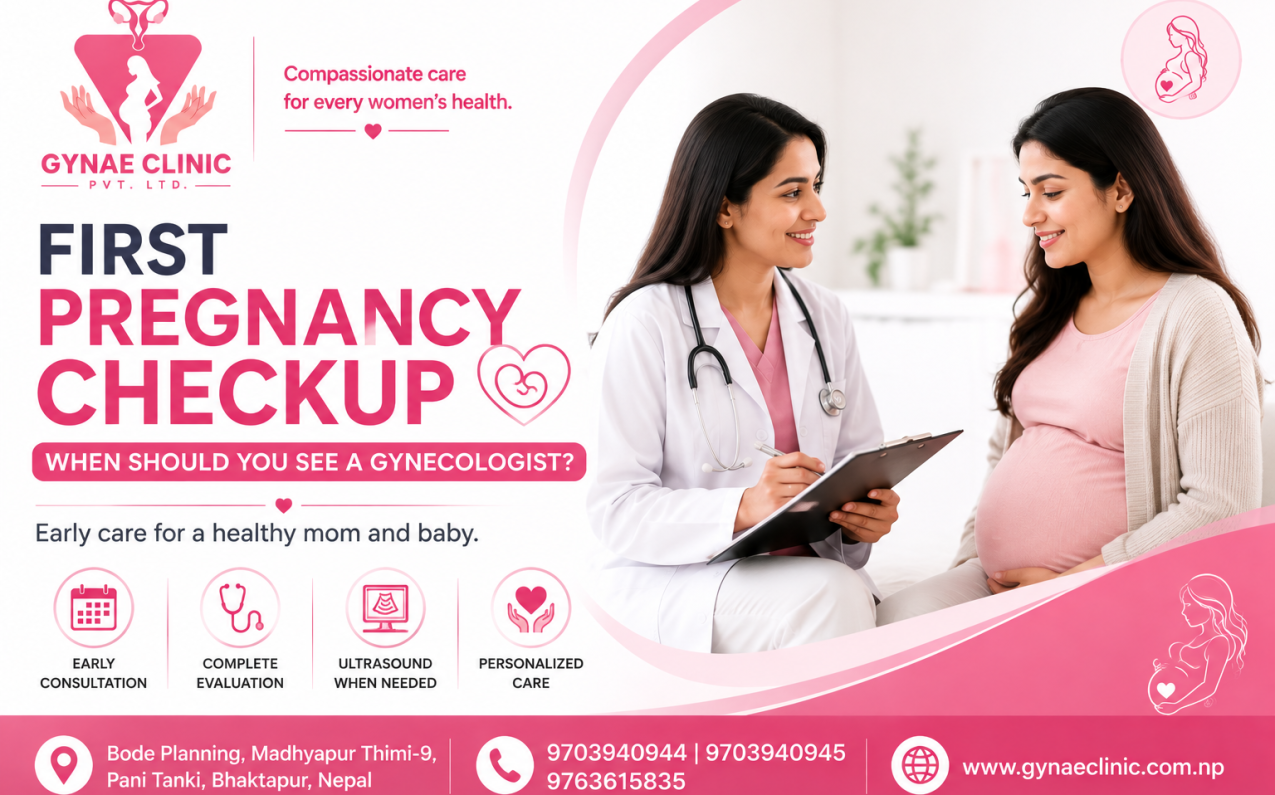
A first pregnancy checkup is an important step after a positive pregnancy test. Early pregnancy care helps establish how far the pregnancy has progressed, review your health and medicines, identify possible risk factors, and plan the right tests and ultrasound at the appropriate time.
If you have just received a positive pregnancy test, you should arrange your pregnancy consultation rather than waiting for symptoms to appear. Antenatal care should ideally begin early; guidance recommends the first formal pregnancy assessment ideally by around 10 weeks where possible.
At Gynae Clinic Pvt. Ltd., pregnancy checkup services include pregnancy monitoring, ultrasound when appropriate, laboratory investigations and nutritional guidance.


7
When Should You Have Your First Pregnancy Checkup?
If your pregnancy test is positive, contact a gynecologist or pregnancy-care provider as soon as reasonably possible.
The exact timing of your first visit depends on your symptoms, medical history, previous pregnancies and how many weeks pregnant you may be.
For an uncomplicated pregnancy, the first formal antenatal assessment is commonly arranged during the early weeks of pregnancy. NHS guidance describes the first booking appointment as usually occurring around 8–12 weeks, while current NICE-based guidance recommends that the first appointment ideally be completed by 10 weeks where possible.
You should not wait until 8–12 weeks if you have concerning symptoms, significant medical conditions, take regular medication, or have a history that may make the pregnancy higher risk.
Why Is the First Pregnancy Checkup Important?
Your first pregnancy consultation establishes the foundation for your pregnancy care.
Your gynecologist may review:
- Your last menstrual period
- Estimated pregnancy duration
- Previous pregnancies
- Previous miscarriage or ectopic pregnancy
- Existing medical conditions
- Current medicines
- Allergies
- Menstrual history
- Pregnancy symptoms
- Vaginal bleeding or abdominal pain
- Family and personal health history
This information helps determine whether your pregnancy appears routine or whether you may need additional monitoring.
Early antenatal care also provides an opportunity to discuss screening, supplements, nutrition, lifestyle and pregnancy warning signs.
What Happens During the First Pregnancy Checkup?
The first appointment is not simply an ultrasound.
Your gynecologist may assess several aspects of your health and pregnancy.
1. Pregnancy Confirmation
If you have already taken a home pregnancy test, your doctor may review the result and determine whether additional testing is appropriate.
Depending on the situation, pregnancy confirmation may involve:
- Urine pregnancy testing
- Beta-hCG blood testing
- Clinical assessment
- Ultrasound when appropriate
A pregnancy test detects human chorionic gonadotropin (hCG), which is produced during pregnancy.
Pregnancy Test in Bhaktapur: Best Time, Types, Accuracy and Confidential Care
2. Pregnancy Dating
Your gynecologist will usually ask about the first day of your last menstrual period.
This helps estimate:
- How many weeks pregnant you may be
- Expected due date
- Appropriate timing of pregnancy investigations
- Appropriate timing of ultrasound
If your periods are irregular or you are unsure of your last period, ultrasound may help establish pregnancy dating when appropriate.
Women with irregular periods or PCOS may have difficulty estimating pregnancy dates from their menstrual cycle alone.
3. Medical and Pregnancy History
Your previous health and pregnancy history can influence pregnancy care.
Tell your gynecologist if you have previously experienced:
- Miscarriage
- Ectopic pregnancy
- Preterm birth
- Pregnancy complications
- Gestational diabetes
- High blood pressure during pregnancy
- Difficult delivery
- Previous pregnancy surgery
Also mention existing conditions such as diabetes, thyroid problems, high blood pressure or other long-term health conditions.
If you take regular medication, discuss it early. Pregnancy can require medication review, but do not stop prescribed medicines on your own.
4. Blood Pressure and Basic Health Assessment
Your first pregnancy assessment may include basic maternal health checks such as:
- Blood pressure
- Weight
- General physical assessment
- Urine testing
Routine antenatal care uses these checks to monitor maternal health and identify potential problems early.
5. Blood and Urine Tests
Your gynecologist may recommend laboratory investigations depending on your medical history and stage of pregnancy.
Possible tests can include:
- Complete blood count
- Blood group and Rh status
- Urine testing
- Infection screening
- Blood sugar testing when indicated
- Other tests based on individual risk factors
Not every woman needs every test at exactly the same time.
The appropriate investigations depend on your pregnancy, medical history and local clinical practice.
6. When Should You Have an Early Pregnancy Ultrasound?
Many women immediately want an ultrasound after a positive pregnancy test.
However, an ultrasound performed too early may not show everything clearly.
The timing depends on:
- Estimated gestational age
- Pregnancy symptoms
- Bleeding
- Abdominal pain
- Previous ectopic pregnancy
- Uncertain dates
- Pregnancy history
A dating ultrasound is commonly performed during the first trimester. NHS guidance describes the dating scan as generally occurring around 8–14 weeks, although earlier ultrasound may be appropriate in specific clinical situations.
Your gynecologist can determine the appropriate timing rather than simply scheduling a scan based on the positive test alone.
What If You Have Pain or Bleeding?
This changes the situation.
You should not wait for a routine first pregnancy appointment if you develop:
- Severe abdominal pain
- One-sided lower abdominal pain
- Heavy vaginal bleeding
- Dizziness
- Fainting
- Shoulder-tip pain
- Severe weakness
- Rapidly worsening symptoms
These can be warning signs of pregnancy complications, including ectopic pregnancy.
If symptoms are severe, seek urgent medical care.


5
Do You Need to See a Gynecologist Immediately After a Positive Test?
For most women without concerning symptoms, this does not necessarily mean you need an emergency visit.
However, you should begin pregnancy care early.
A practical approach is:
Positive pregnancy test → contact your pregnancy-care provider → establish pregnancy dates → review health and medicines → plan appropriate tests and ultrasound.
If you have a long-term medical condition or take regular medication, early medical review is particularly important.
What Should You Bring to Your First Pregnancy Checkup?
Before your appointment, prepare:
Your menstrual information
- First day of your last period
- Usual cycle length
- Whether your periods are regular or irregular
Medical information
- Current medicines
- Vitamins and supplements
- Allergies
- Existing medical conditions
Previous pregnancy information
If applicable:
- Previous pregnancy records
- Ultrasound reports
- Previous miscarriage records
- Previous ectopic pregnancy records
- Previous delivery records
Your questions
Write down anything you are concerned about.
It is completely appropriate to ask your gynecologist about pregnancy symptoms, nutrition, exercise, supplements, medicines, ultrasound and expected pregnancy care.
Should You Start Folic Acid Before the First Appointment?
Yes.
For most women, 400 micrograms of folic acid daily is recommended from before pregnancy through the first 12 weeks. If you did not take folic acid before becoming pregnant, start as soon as you know you are pregnant.
Some women need a higher dose because of specific risk factors, so ask your doctor whether this applies to you.
Do not take multiple pregnancy supplements without checking their ingredients and doses.
What Should You Avoid After a Positive Pregnancy Test?
Once pregnancy is confirmed or strongly suspected:
- Avoid alcohol
- Avoid smoking
- Avoid recreational drugs
- Avoid unnecessary self-medication
- Check medicines and supplements with your healthcare provider
- Avoid supplements containing excessive vitamin A/retinol
If you are already taking prescription medication, do not stop it without medical advice.
First Pregnancy Checkup for Women With Irregular Periods
If your periods are irregular, determining how far along your pregnancy is can be more difficult.
This is particularly relevant for women with:
- PCOS
- Irregular ovulation
- Long menstrual cycles
- Recently stopped hormonal contraception
- Uncertain last menstrual period
A gynecologist can use your menstrual history, pregnancy testing and appropriate ultrasound to help establish the pregnancy timeline.
Early Pregnancy Symptoms | First Signs of Pregnancy in Bhaktapur
First Pregnancy Checkup After IVF or Fertility Treatment
Pregnancy after fertility treatment may require individualized early monitoring.
Tell your gynecologist if pregnancy occurred following:
- IVF
- IUI
- Ovulation-induction treatment
- Fertility medication
- Other assisted reproductive treatment
Your doctor may recommend specific early pregnancy monitoring based on your treatment and medical history.
What If You Have Had a Previous Ectopic Pregnancy?
A previous ectopic pregnancy is important information to tell your gynecologist as soon as pregnancy is confirmed.
Early assessment may be recommended to determine the location of the pregnancy and monitor its development appropriately.
Do not wait for severe symptoms before discussing your history.
What If You Have Had a Previous Miscarriage?
One previous miscarriage does not necessarily mean that your next pregnancy will have complications.
However, tell your gynecologist about your previous pregnancy history.
Your doctor can determine whether additional monitoring or investigations are appropriate.
First Pregnancy Checkup: When Should You See a Gynecologist?
Arrange a routine pregnancy consultation when:
✓ Your pregnancy test is positive
✓ Your period is delayed and pregnancy is possible
✓ You want to begin antenatal care
✓ You need advice about medicines or supplements
✓ You are unsure about your pregnancy dates
Seek prompt medical assessment when:
⚠ You have vaginal bleeding
⚠ You have significant abdominal pain
⚠ Pain is mainly on one side
⚠ You feel dizzy or faint
⚠ You develop shoulder-tip pain
⚠ You have heavy bleeding
First Pregnancy Checkup Timeline
| Pregnancy stage | What may happen |
|---|---|
| Positive pregnancy test | Contact your pregnancy-care provider |
| Early weeks | Review health, medicines and pregnancy history |
| Around 8–12 weeks | Formal booking/antenatal assessment commonly occurs |
| Around 8–14 weeks | Dating ultrasound may be performed |
| Around 11–14 weeks | Certain first-trimester screening may be offered |
| Later pregnancy | Regular antenatal visits and appropriate screening continue |
The exact schedule varies according to your healthcare system, pregnancy and individual risk factors.
First Pregnancy Checkup in Bhaktapur
If you have received a positive pregnancy test and are looking for a first pregnancy checkup in Bhaktapur, Gynae Clinic Pvt. Ltd. provides pregnancy consultation and antenatal care in Bode Planning, Madhyapur Thimi-9, Pani Tanki, Bhaktapur.
Pregnancy-related services include pregnancy monitoring, ultrasound when appropriate, laboratory investigations and nutritional guidance.
Women from Madhyapur Thimi, Bode, Sallaghari, Radhe Radhe, Gatthaghar, Lokanthali, Kaushaltar, Sanothimi, Jadibuti, Koteshwor, Pepsicola, Tinkune, Baneshwor, Suryabinayak, Jagati, Banepa and Dhulikhel can consider pregnancy consultation at the clinic.
Gynae Clinic Pvt. Ltd.
Address: Bode Planning, Madhyapur Thimi-9, Pani Tanki, Bhaktapur, Nepal
Contact:
9703940944
9703940945
9763615835
Website: www.gynaeclinic.com.np
Frequently Asked Questions
When should I see a gynecologist after a positive pregnancy test?
Arrange pregnancy care soon after confirming pregnancy. The exact timing of the first formal appointment depends on your pregnancy dates, symptoms and medical history. Formal antenatal booking is commonly performed around 8–12 weeks, with guidance recommending early assessment ideally by around 10 weeks where possible.
Can I wait until 8 weeks for my first pregnancy checkup?
If you feel well and have no risk factors, your provider may schedule the formal appointment during the early pregnancy period. However, contact your provider sooner if you have pain, bleeding, previous ectopic pregnancy, previous pregnancy complications, a significant medical condition or regular medication.
Do I need an ultrasound immediately after a positive pregnancy test?
Not necessarily. Very early ultrasound may not provide enough information. The appropriate timing depends on gestational age and clinical circumstances.
What tests are done at the first pregnancy checkup?
Depending on your situation, your doctor may recommend blood pressure measurement, urine testing, blood tests, pregnancy assessment and ultrasound when appropriate.
What should I take to my first pregnancy appointment?
Bring your last-period date, previous pregnancy records, current medicines and supplements, medical reports and a list of questions.
Is mild cramping normal after a positive pregnancy test?
Mild cramping can occur in early pregnancy. However, severe or persistent pain, especially one-sided pain with bleeding, dizziness or fainting, requires prompt medical assessment.
What if I have bleeding after a positive pregnancy test?
Contact a healthcare professional for advice. Heavy bleeding or bleeding associated with significant pain, dizziness or fainting requires urgent assessment.
What if I have PCOS and just found out I am pregnant?
Arrange an early pregnancy consultation and tell your gynecologist about your PCOS, medications and menstrual pattern. Irregular cycles can make pregnancy dating more difficult.
Final Takeaway
The best time to start pregnancy care is early.
After a positive pregnancy test, arrange a consultation with a gynecologist, record your last menstrual period, review medicines and supplements, begin appropriate folic acid, and discuss the right timing for investigations and ultrasound.
You do not need to wait for pregnancy symptoms before starting care.
And if you develop severe abdominal pain, one-sided pain, heavy bleeding, dizziness, fainting or shoulder-tip pain, do not wait for a routine appointment—seek prompt medical assessment.
Medical Disclaimer
This article is for general educational purposes and does not replace an individual medical consultation. The timing of pregnancy tests, ultrasound, laboratory investigations and antenatal visits should be individualized according to pregnancy dates, symptoms, medical history and clinical findings. Seek urgent medical care for severe pain, heavy bleeding, fainting, severe dizziness or other concerning symptoms.
Author: Gynae Clinic Pvt. Ltd. Medical Content Team